
Argenica clears final FDA safety hurdle with clean cardiac assay results
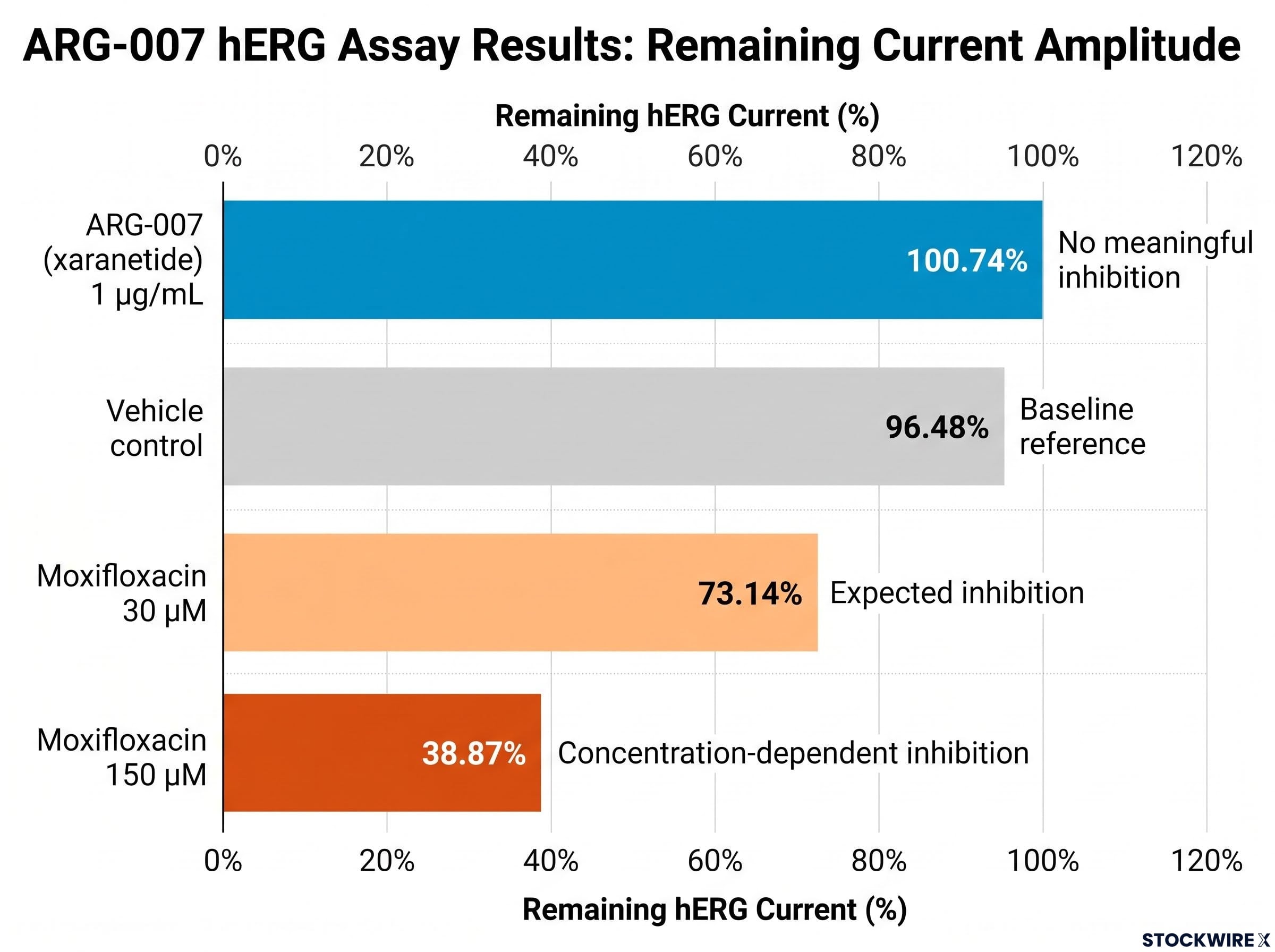
Argenica Therapeutics has completed the third and final FDA-requested assay required to address its clinical hold, with ARG-007 (xaranetide) demonstrating no statistically significant inhibition of the hERG cardiac potassium channel at the highest testable concentration. The GLP-compliant hERG cardiac safety study showed a remaining current amplitude of 100.74 ± 1.44% (mean ± SEM, n=4) at 1 µg/mL, effectively maintaining 100% of baseline cardiac channel activity.
Statistical analysis confirmed the result was not significantly different from vehicle control (P = 0.0524, P > 0.05), which showed a remaining current of 96.48 ± 1.02%. Critically, because ARG-007 (xaranetide) blocked less than 30% of hERG current amplitude, no IC50 (inhibitory concentration) could be calculated — meaning the concentration at which the compound would produce meaningful cardiac channel inhibition is beyond the measurable range of the assay.
All three FDA-requested safety assays are now complete with clean, favourable profiles. Following finalisation of the Phase 2b protocol in the coming weeks, the company is positioned to submit a comprehensive FDA clinical hold response, potentially clearing the path toward IND reinstatement and US clinical trial commencement.
When big ASX news breaks, our subscribers know first
Why hERG cardiac safety testing matters for drug development
The hERG (human Ether-à-go-go Related Gene) potassium channel plays a central role in cardiac electrical activity. Inhibition of this channel by drug compounds has historically been associated with potentially life-threatening cardiac arrhythmias, including sudden cardiac death.
Several approved drugs have been withdrawn from the market due to hERG-related cardiac toxicity. This history has elevated a clean hERG profile to one of the most critical non-clinical safety requirements regulators impose before permitting human clinical trials to proceed.
For investors unfamiliar with preclinical drug development, completing a clean hERG assay represents a material de-risking event for ARG-007’s regulatory pathway. The absence of cardiac liability removes a known failure point that has historically derailed clinical programmes across multiple therapeutic areas.
Technical results demonstrate exceptionally low cardiac liability
The study was conducted by B’SYS GmbH (Switzerland), an internationally accredited safety pharmacology laboratory, using the whole-cell patch-clamp technique on CHO cells stably expressing the hERG channel at near-physiological temperature (35°C–37°C). The methodology aligns fully with FDA ICH S7B guideline requirements.
The 100.74% remaining current amplitude effectively means ARG-007 (xaranetide) does not meaningfully interact with the hERG channel. The company highlighted that because inhibition remained below 30%, the concentration at which ARG-007 would produce meaningful cardiac inhibition is beyond the measurable range of the assay — an exceptionally favourable outcome reflecting very low cardiac liability.
| Compound | Concentration | Remaining hERG Current | Interpretation |
|---|---|---|---|
| ARG-007 (xaranetide) | 1 µg/mL (highest testable) | 100.74 ± 1.44% | No meaningful inhibition |
| Vehicle control | — | 96.48 ± 1.02% | Baseline reference |
| Moxifloxacin (positive control) | 30 µM | 73.14 ± 2.07% | Expected inhibition |
| Moxifloxacin (positive control) | 150 µM | 38.87 ± 2.56% | Concentration-dependent inhibition |
The study’s validity was confirmed by the positive control compound Moxifloxacin, which produced the expected concentration-dependent hERG inhibition consistent with its known cardiac pharmacology. This demonstrated the sensitivity and reliability of the assay system.
All three FDA-requested safety assays now complete
The FDA issued a clinical hold in August 2025 due to insufficient information to assess risks to human subjects under 21 CFR 312.42(b)(2)(i). The agency identified three specific areas requiring additional in vitro data related to safety before the clinical hold could be lifted:
The genotoxicity results for ARG-007 confirmed no evidence of gene mutation or chromosomal aberrations across all test conditions, completing the second of the three FDA-required studies and leaving the hERG assay as the sole remaining requirement before a comprehensive clinical hold response could be assembled.
- TNK assay (previously announced) — Complete with clean profile
- Genotox assay (previously announced) — Complete with clean profile
- hERG cardiac assay (this announcement) — Complete with clean profile
All three assays have demonstrated clean, favourable safety profiles. The FDA specifically identified the absence of a hERG study as a deficiency preventing clinical progression.
Dr Liz Dallimore, Managing Director
“Completing the GLP hERG assay is a significant milestone for Argenica and for ARG-007 (xaranetide). The FDA specifically identified the absence of a hERG study as a deficiency preventing clinical progression, and we have now addressed that requirement with a clean, fully GLP-compliant result showing essentially no cardiac liability at the highest testable concentration. Combined with the previously completed TNK assay and genotox assay, we have now successfully completed all of the FDA requested assays. We are firmly on track to compile our comprehensive response to the FDA and take the next steps toward lifting the clinical hold.”
Pathway to lifting FDA clinical hold and IND reinstatement
The Phase 2b protocol is being finalised in the coming weeks. The updated protocol will reflect the company’s focus on moderate to severe stroke patients.
The Phase 2b trial design is being shaped by a six-member Clinical Advisory Committee that includes Prof Geoffrey Donnan and Prof Jeffrey Saver, two of the most cited figures in stroke neurology, with the committee’s remit focused on endpoint selection, patient selection criteria, and dosing strategy.
Argenica intends to submit a comprehensive response to the FDA addressing all identified requirements. The clinical hold response will include:
- Updated Phase 2b protocol reflecting focus on moderate to severe stroke patients
- Updated investigational brochure reflecting changes to proposed clinical development programme
A successful FDA response would result in lifting the clinical hold and reinstatement of the IND, enabling US clinical trials to commence.
Investment implications for ARG-007’s development pathway
The clean cardiac safety profile represents a material de-risking of the lead asset. ARG-007 (xaranetide) targets acute ischaemic stroke, a large unmet medical need with limited treatment options. Argenica is now positioned for the pivotal Phase 2b clinical trial following IND reinstatement.
The near-term catalyst is clear: FDA clinical hold response submission is expected in the coming weeks following completion of the Phase 2b protocol.
Development timeline summary:
- hERG assay complete with clean cardiac safety profile
- Phase 2b protocol finalisation in coming weeks
- Comprehensive FDA response submission to follow
- Target outcome: IND reinstatement enabling US Phase 2b trial commencement
The completion of all three FDA-requested safety assays removes the final preclinical safety obstacle identified by the regulator. For a clinical-stage biotech, clearing this hurdle represents a defined inflection point in the regulatory pathway, with the focus now shifting to protocol design and formal regulatory engagement rather than fundamental safety data generation.
Want the Next Biotech Breakthrough in Your Inbox?
Join 20,000+ investors getting FREE breaking ASX biotech news delivered within minutes of release, complete with in-depth analysis. Click the “Free Alerts” button at Big News Blast to start receiving alerts the moment market-moving announcements hit the ASX.