

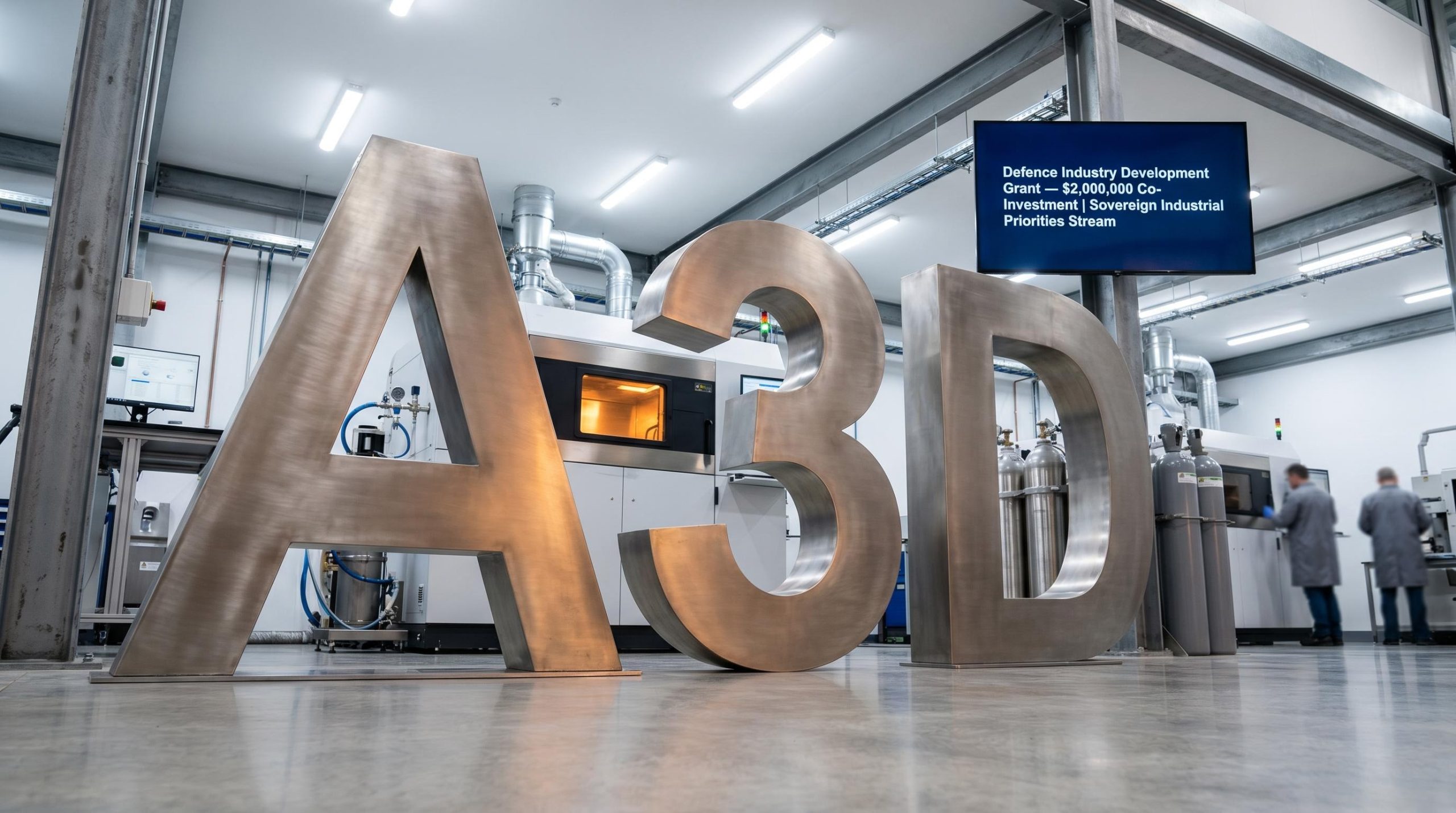
Aurora Labs secures $1 million Defence Industry Development Grant to scale MGT production
Aurora Labs Limited (ASX: A3D), an Australian metal additive manufacturing and advanced propulsion technology company, has been awarded $1,000,000 under the Australian Government’s Defence Industry Development Grant (DIDG) program, within the Sovereign Industrial Priorities Stream. Aurora will match the grant dollar-for-dollar, bringing the total co-investment to $2,000,000, directed at procuring and commissioning a large-format Commercial Off-The-Shelf (COTS) industrial metal 3D printer at the company’s Canning Vale, Western Australia facility.
The government’s selection of Aurora as a priority sovereign industrial manufacturer signals a meaningful step forward in the company’s transition from R&D-stage business to high-rate defence supplier.
When big ASX news breaks, our subscribers know first
What the Defence Industry Development Grant means for investors
Aurora’s hybrid manufacturing model explained
The DIDG program is an Australian Government initiative that co-invests with eligible small and medium-sized enterprises (SMEs) to build sovereign defence manufacturing capability, with a focus on autonomous systems, guided weapons, and propulsion technologies. For Aurora, the grant directly funds the next phase of a deliberate strategic shift in how the company structures its manufacturing operations.
Management has finalised a hybrid manufacturing model that separates two distinct functions:
- High-risk R&D and IP generation continues exclusively on Aurora’s proprietary Laser Powder Bed Fusion (LPBF) machines, preserving technical flexibility, rapid prototyping capability, and protection of core intellectual property.
- Commercial scale production transitions to COTS industrial printers, enabling Aurora to expand fleet capacity, print multiple components across different materials simultaneously, and access robust global vendor support networks.
This split matters because it allows Aurora to protect the IP that underpins its competitive position while removing the bottlenecks that proprietary machine constraints would otherwise impose on volume manufacturing. The COTS infrastructure also supports the advanced process monitoring and quality assurance workflows required for defence-grade component certification, positioning Aurora to move from low-rate initial production into higher-volume, repeatable manufacturing.
The attritable defence markets Aurora is targeting
“Attritable” refers to low-cost, expendable platforms designed to be deployed at scale in asymmetric warfare scenarios, where the economic calculus favours quantity and rapid replaceability over individual unit cost. Demand for reliable, domestically sourced propulsion systems for these platforms is growing across allied defence programs.
Aurora’s Micro Gas Turbine (MGT) propulsion systems are engineered for integration across four primary attritable platform types:
- Low-cost one-way effectors and precision strike systems
- Loitering munitions requiring rapid throttle response and high power-to-weight ratios
- Counter-Unmanned Aerial Systems (C-UAS) interceptors
- High-speed target drones used for advanced air-defence training
Each of these segments represents a high-demand, high-growth area of defence procurement, with domestic supply requirements becoming increasingly urgent given ongoing supply chain vulnerabilities.
Managing Director, Rebekah Letheby
“Securing the $1.0 million Defence Industry Development Grant represents a definitive operational milestone for Aurora Labs. This co-investment accelerates our transition from an R&D pioneer into a high-rate, sovereign manufacturer of advanced defense propulsion technologies. By adopting a hybrid manufacturing model keeping our high-risk IP creation on our own advanced printers while scaling production via robust, commercial off-the-shelf platforms we gain unmatched market agility. We can print multi-material, high-tolerance components concurrently, ensuring we can rapidly meet the scale and delivery constraints of global partners like MBDA and QinetiQ while answering Australia’s sovereign call for domestic guided weapon and autonomous systems supply.”
Sovereign validation and the investment case
Tier-1 defence engagement confirms commercial traction
Government selection under the Sovereign Industrial Priorities Stream represents independent, third-party validation of Aurora’s technology at a national level. The program is competitive and directed at SMEs that can demonstrably contribute to Australia’s sovereign defence industrial base, making Aurora’s inclusion a meaningful endorsement.
Beyond the grant itself, the company’s active engagement with named Tier-1 defence primes and partners, including MBDA, the Australian Department of Defence, and SPS, reinforces the commercial relevance of Aurora’s MGT systems within operational defence programs.
Aurora’s expanded manufacturing capability directly addresses two core Sovereign Defence Industrial Priorities:
- Development and Integration of Autonomous Systems: Providing reliable, high-speed domestic propulsion units for next-generation unmanned aerial vehicles (UAVs) and robotic systems.
- Domestic Manufacture of Guided Weapons, Explosive Ordnance and Munitions: Delivering scalable, ITAR-free onshore production of advanced components for precision-guided weapons and loitering systems, reducing reliance on international supply chains.
| Element | Detail | Aurora Contribution | Total |
|---|---|---|---|
| Grant program | DIDG — Sovereign Industrial Priorities Stream | $1,000,000 matched | $2,000,000 |
| Use of funds | Large-format COTS metal 3D printer, Canning Vale WA | Co-investment | Combined procurement |
| Defence alignment | Autonomous systems + guided weapons/munitions | Sovereign manufacturer status | Priority selection |
| Key partners | MBDA, Dept of Defence, SPS | MGT propulsion integration | Active engagement |
What comes next for Aurora Labs
The immediate pathway involves procurement and commissioning of the COTS printer at the Canning Vale facility. According to the announcement, this equipment is described as “critical to establishing the manufacturing flexibility and volume capacity required to fulfil expected commercial demand” for Aurora’s MGT units.
Once operational, the printer is expected to support the transition from low-rate initial production into higher-volume, repeatable manufacturing workflows capable of meeting the delivery constraints of global defence partners. Forward-looking timelines beyond the commissioning phase have not been disclosed in the announcement.
Aurora’s broader positioning as a domestic, ITAR-free propulsion supplier across the full production lifecycle remains the strategic thesis underpinning the grant award. With sovereign manufacturing recognition now formalised, the company’s next phase centres on converting that validation into contracted production volumes.
Don’t Miss the Next Defence Sector Breakout
Get FREE breaking ASX news delivered to your inbox within minutes of release, complete with in-depth analysis already done for you. Join 20,000+ investors who never miss a market-moving announcement. Click the “Free Alerts” button at Big News Blast to stay ahead of the next defence and manufacturing story before the market moves.