
Percheron’s HMBD-002 data lands at ASCO, pointing to VISTA’s role in TNBC treatment resistance
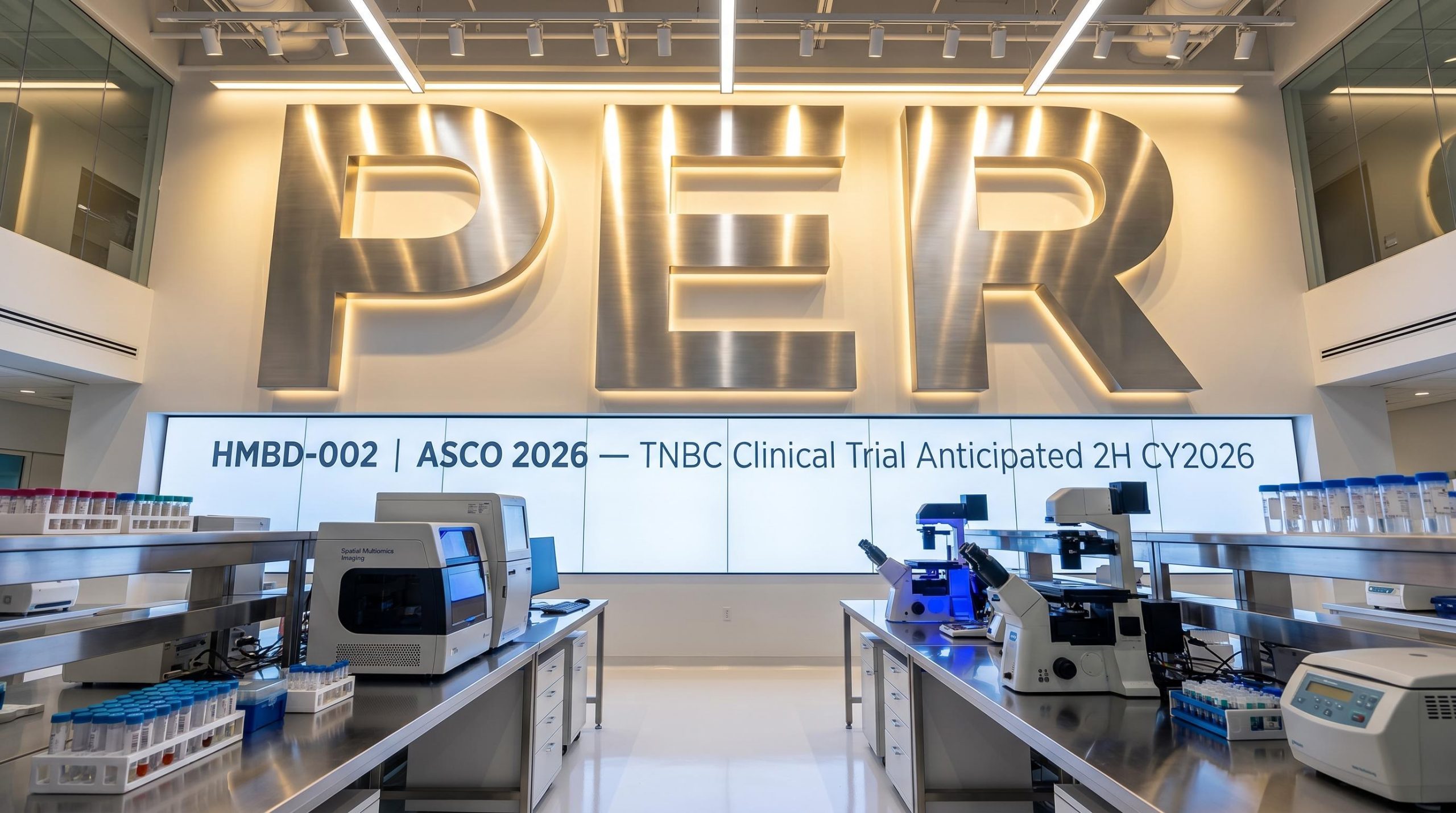
The American Society for Clinical Oncology (ASCO) Annual Meeting is widely regarded as the foremost annual gathering for practising oncologists and clinical researchers, attracting up to 50,000 attendees from over 100 countries. With more than 7,500 abstracts submitted in 2025 and only a minority selected for presentation, acceptance itself signals scientific merit. Against that backdrop, Percheron Therapeutics (ASX: PER) presented a poster at the 2026 ASCO Annual Meeting in Chicago on 2 June 2026, sharing new preclinical data from a collaboration with QIMR Berghofer that examines VISTA’s role in triple-negative breast cancer (TNBC). The company anticipates commencing a new HMBD-002 clinical trial in 2H CY2026.
When big ASX news breaks, our subscribers know first
What the QIMR Berghofer data shows
The research was led by Professor Sudha Rao, a leading immunotherapy expert at QIMR Berghofer Medical Research Institute in Brisbane. Using advanced spatial multiomics techniques across multiple patient datasets, the team characterised VISTA expression patterns within the tumour microenvironment. Key findings include:
- Spatial multiomics techniques were applied across multiple datasets, including data from 83 patients previously treated with Tecentriq® (atezolizumab), a PD-1/PD-L1 inhibitor
- VISTA is upregulated in patients who become resistant to chemotherapy, suggesting it may form part of a potential resistance mechanism to treatment
- VISTA expression increases after PD-1/PD-L1 inhibition, implying VISTA may drive resistance to existing immunotherapy
- VISTA co-expression with TIM3, LAG3, CTLA4, and TIGIT indicates severe T-cell dysfunction and immune suppression in TNBC
- VISTA is enriched in exhausted T-cell niches, metastasis-initiating tumour cells, and circulating tumour cells post-chemo-immunotherapy
Authors’ Conclusion
“…support VISTA as a promising therapeutic target in TNBC.”
CEO Dr James Garner on what this means for HMBD-002
This ASCO presentation marks the first exhaustive attempt to elucidate VISTA’s role specifically in TNBC, building on prior signals observed in other cancer types. Percheron CEO Dr James Garner commented:
Dr James Garner, CEO, Percheron Therapeutics
“Despite huge progress in the treatment of breast cancer over recent decades, there continues to be significant unmet medical need in the disease, and TNBC remains especially challenging. This work indicates that VISTA, the molecular target of Percheron’s HMBD-002, may play an important role in treatment resistance. We have previously seen indications of this in other cancer types, but the current project is the first attempt to elucidate its role in TNBC so exhaustively.”
Why TNBC represents one of oncology’s most significant unmet needs
Triple-negative breast cancer is defined by what it lacks: oestrogen receptors, progesterone receptors, and the HER2 protein. This absence means that many of the most effective targeted therapies used in other breast cancer subtypes, such as hormone therapies and HER2-directed treatments, simply do not work against TNBC.
The condition accounts for approximately 15% of all newly diagnosed breast cancer patients, yet it carries a disproportionately poor prognosis. In the metastatic setting, the median overall survival is approximately 23 months, and durable responses are infrequent.
Immunotherapy drugs targeting the PD-1/PD-L1 pathway, such as Keytruda® (pembrolizumab), are approved for TNBC. However, their efficacy is generally considered suboptimal, and a substantial proportion of patients develop resistance over time. This has generated significant scientific interest in identifying additional immune checkpoints that could augment or replace existing immunotherapy.
VISTA (V-domain Ig suppressor of T-cell activation) represents a next-generation immune checkpoint with distinct biology from PD-1/PD-L1. It is enriched in tumour-infiltrating immune cells in TNBC and, as the QIMR Berghofer data demonstrates, its expression increases precisely when existing therapies begin to fail. That pattern makes VISTA a scientifically motivated target for addressing treatment resistance in a disease where alternatives are limited.
What comes next for Percheron and HMBD-002
Peer-reviewed publication and clinical trial catalyst
HMBD-002 has already completed a Phase I clinical trial in advanced cancer patients, demonstrating it to be generally safe and well-tolerated. The TNBC data presented at ASCO is intended to serve as a scientific foundation for the next clinical phase. Upcoming steps include:
- The QIMR Berghofer team expects to compile a manuscript for submission to a peer-reviewed scientific journal, incorporating additional preclinical data
- Percheron anticipates commencing a new clinical trial of HMBD-002 in 2H CY2026
- The company plans to discuss the ASCO findings and consider their implications for future clinical trial directions
HMBD-002 at a glance
| Feature | Detail |
|---|---|
| Drug type | Monoclonal antibody (non-depleting recombinant IgG4) |
| Target | VISTA immune checkpoint |
| Binding affinity | Picomolar affinity, high specificity |
| Clinical stage | Phase I complete (advanced cancer); new trial anticipated 2H CY2026 |
| TNBC data source | QIMR Berghofer collaboration; presented at ASCO 2026 |
Don’t Miss the Next Healthcare Breakthrough on ASX
Big News Blast delivers FREE breaking ASX healthcare news straight to your inbox within minutes of release, complete with in-depth analysis. Join 20,000+ subscribers already ahead of the market and click the “Free Alerts” button to get the next market-moving announcement the moment it lands.