

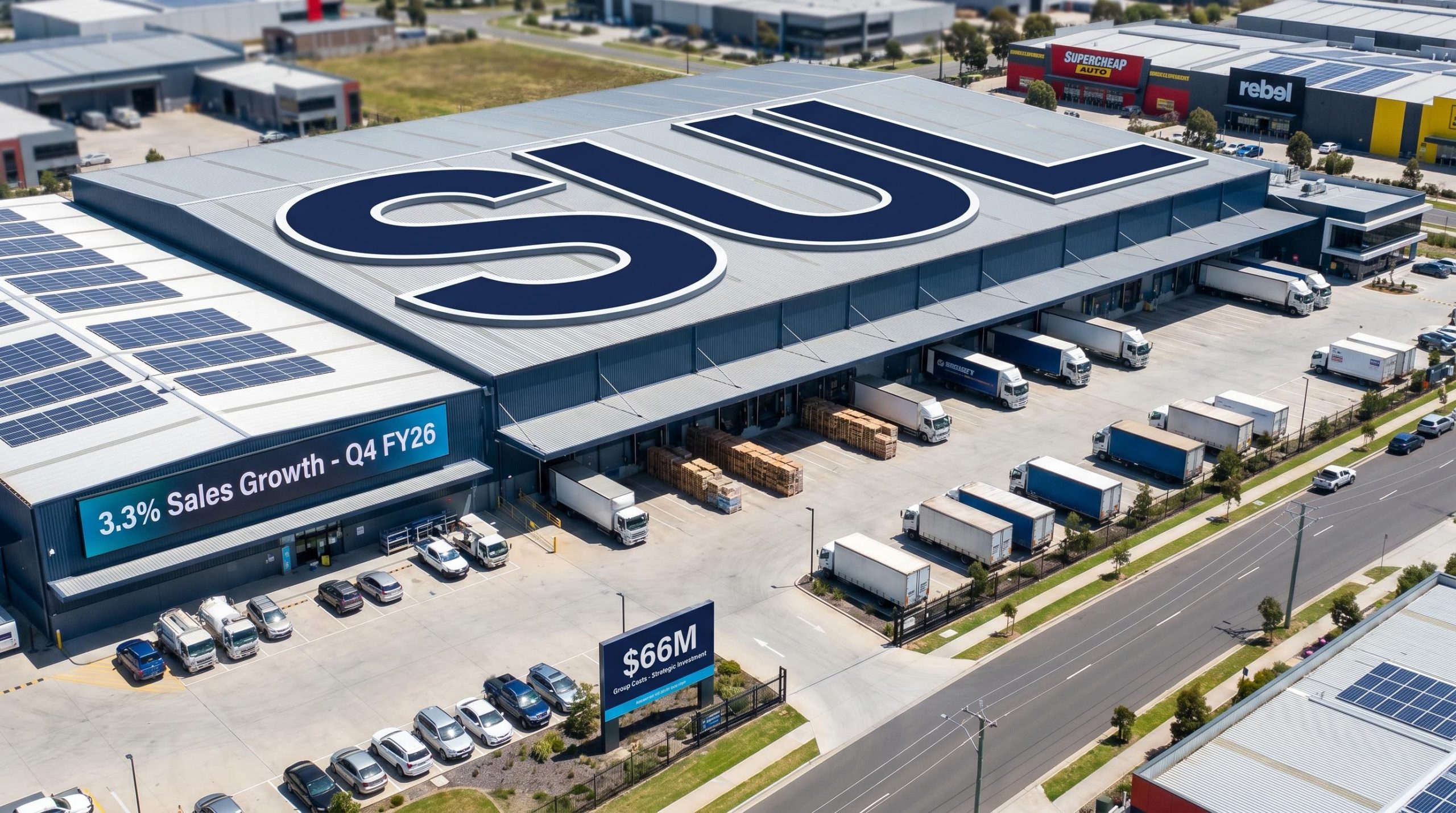
Super Retail Group delivers steady sales growth despite consumer headwinds
Super Retail Group has reported 3.3% Group total sales growth for the first 44 weeks of FY26, maintaining positive momentum despite significant macroeconomic pressures weighing on discretionary spending. The retailer’s H2 like-for-like sales grew 0.4% through weeks 27 to 44, with trading conditions notably affected by the onset of the Middle East conflict, elevated fuel prices, rising interest rates, and concerns around fuel availability.
The Easter trading period proved particularly challenging for consumer sentiment. Group gross margin H2 to date sits modestly below the prior comparable period, reflecting the broader pressures on discretionary retail categories.
Brand performance breakdown
Individual brand performance varied across the portfolio, with Macpac delivering the standout result at 8.9% total sales growth year to date. Both Supercheap Auto and rebel posted solid growth despite category headwinds, while BCF was most impacted by fuel constraints, recording the only negative result at -0.3% total sales for weeks 1 to 44.
| Brand | H2 LFL Sales % | H2 Total Sales % | YTD Total Sales % |
|---|---|---|---|
| Supercheap Auto | 1.6 | 3.0 | 4.3 |
| rebel | 1.4 | 2.8 | 4.0 |
| BCF | (3.3) | (1.2) | (0.3) |
| Macpac | 2.5 | 2.9 | 8.9 |
When big ASX news breaks, our subscribers know first
What is like-for-like sales growth?
Like-for-like sales measures revenue growth from stores that have been open for at least 12 months. This metric excludes new store openings to isolate underlying trading performance at established locations.
Investors monitor LFL growth closely as it strips out the effects of network expansion, providing a clearer view of organic demand trends and customer engagement at mature stores. A positive LFL result indicates the business is growing sales within its existing footprint rather than relying solely on new locations to drive top-line growth.
Category insights reveal shifting consumer priorities
Brand-level performance reflected distinct category dynamics across the portfolio:
Supercheap Auto:
- Discretionary categories such as power tools moderated through March and April
- Fuel-related and DIY categories (maintenance, braking, trailer components) saw increased demand
- The brand gained market share in the Auto category over the March quarter
rebel:
- Gained market share despite operating in a sports category that recorded declining sales
- Men’s wear, recovery gear, football, and licensed fan gear performed well
- Fitness tech contributed positively, supported by recent promotional activity
- Demand for higher-value sporting equipment remained subdued
- Performance footwear growth moderated amid increased competitive intensity
BCF:
- Most impacted by elevated fuel prices and fuel supply constraints, particularly in regional areas
- Reduced customer participation in outdoor activities over the Easter and school holiday period
- An unfavourable calendar arising from the separation of Easter and Anzac Day compounded the impact
Macpac:
- Strong year-to-date momentum similarly affected by reduced outdoor activity in March and April
- The business focused on managing inventory and ranging ahead of peak winter trade in Q4
Strategic inventory investment ahead of price increases
The Group invested approximately $30 million in additional working capital during H2, leveraging its strong balance sheet position to make a strategic investment in inventory security. This capital was targeted at securing inventory ahead of pending price increases, most notably within the Supercheap Auto business.
The Group’s brands are also focusing on distributing sufficient supply to regional areas in advance of any potential impact on supply chain operations from elevated fuel prices or rationing. This forward positioning aims to protect both margins and product availability as inflationary pressures continue.
Pre-emptive inventory builds of this nature allow the Group to capture demand while competitors may face supply disruptions, providing a competitive advantage in constrained market conditions.
Group costs outlook revised for FY26
Total Group and Unallocated costs for FY26 are now expected to reach $66 million, up from the previously guided $60 million. The increase includes the early commencement of projects previously targeted for FY27, reflecting deliberate acceleration rather than cost overruns.
Two major projects are driving duplicated costs in the second half:
- Transition to the Group’s new Victorian distribution centre
- Implementation of a new HR Core & Payroll system
Both projects are proceeding as planned in H2 FY26. The $6 million cost increase reflects strategic investment in infrastructure that is expected to deliver operational efficiencies once fully implemented, potentially bringing forward medium-term benefits.
Investment outlook
The trading update positions Super Retail Group within a challenging near-term environment characterised by elevated fuel prices, rising interest rates, and softening consumer sentiment across discretionary retail categories. However, the Group demonstrated resilience through market share gains at both Supercheap Auto and rebel, alongside strategic inventory investment that protects margins and availability.
The $30 million working capital deployment underscores management’s willingness to leverage balance sheet strength to navigate inflationary pressures. Infrastructure projects remain on track, positioning the business for long-term efficiency improvements despite the $66 million FY26 cost base.
Q4 performance will be closely watched, particularly Macpac’s winter season execution and BCF’s recovery from fuel-driven headwinds. The Group’s ability to sustain market share gains while managing gross margin pressure will determine whether the 3.3% year-to-date sales growth can accelerate into FY27.
Stay Ahead on Consumer Retail News
Join 20,000+ investors receiving FREE ASX retail alerts delivered to your inbox within minutes of release, complete with in-depth analysis. Click the “Free Alerts” button at Big News Blast to get breaking consumer sector news and expert coverage the moment market-moving announcements drop.