
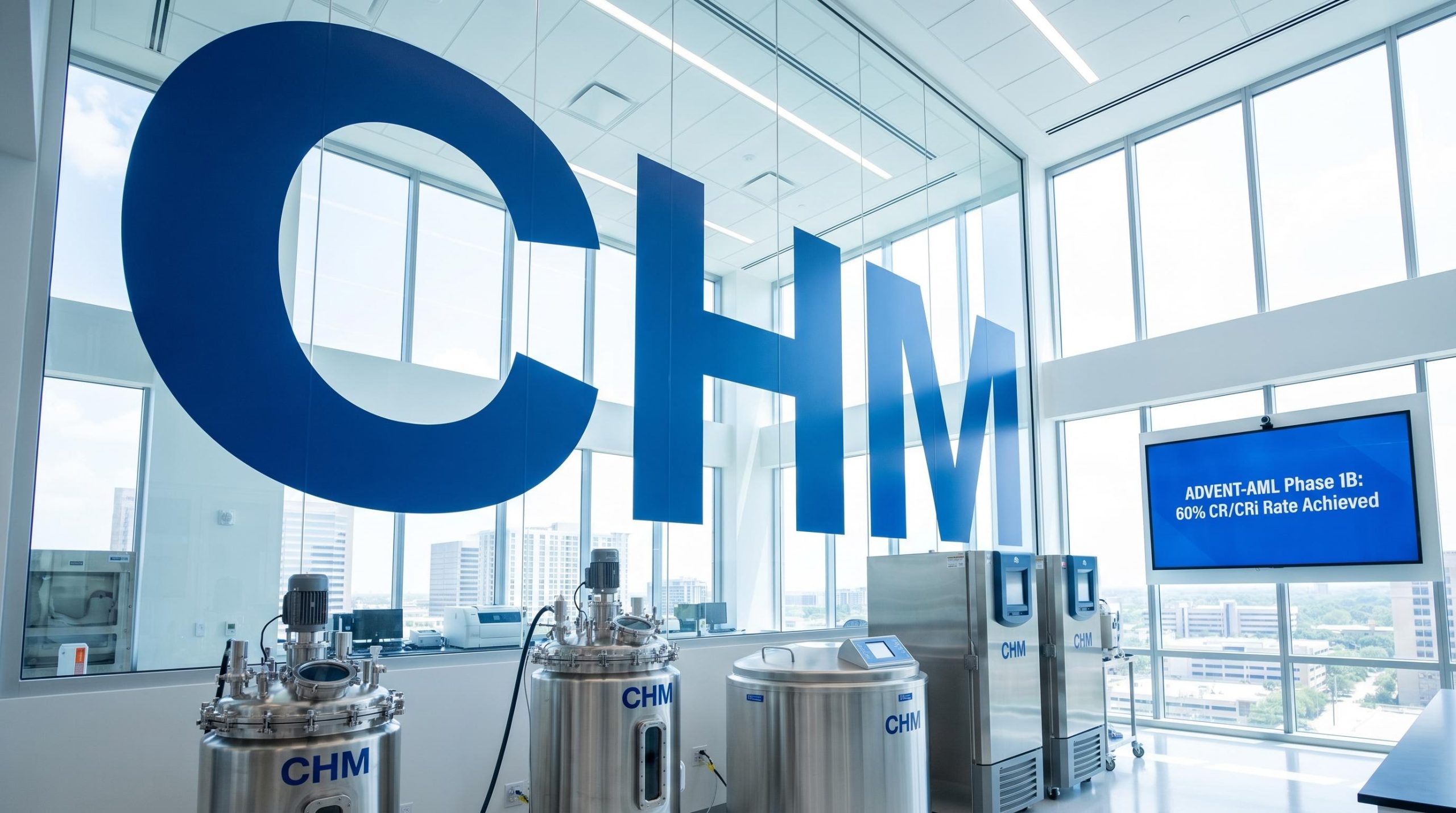
Chimeric reports 60% complete response rate in frontline AML cell therapy trial
Chimeric Therapeutics has reported a 60% complete response rate in its ADVENT-AML Phase 1B trial, marking significant progress in frontline acute myeloid leukaemia treatment. The investigator-initiated study, conducted at MD Anderson Cancer Center, has enrolled 25 patients receiving CHM CORE-NK cell therapy in combination with standard of care agents azacitidine and venetoclax. This response rate represents a substantial improvement over the 20-30% response rate typically achieved with current standard of care alone in high-risk patients.
The safety profile remained favourable throughout the trial, with no unexpected findings reported in this high-risk patient population. The combination therapy was well tolerated, supporting the potential for CHM CORE-NK to enhance existing treatment regimens.
| Metric | Detail |
|---|---|
| Trial | ADVENT-AML (NCT05834244) |
| Phase | 1B |
| Patients enrolled | 25 |
| CR/CRi rate | 60% |
| Standard of care benchmark | 20-30% |
The 60% response rate represents a meaningful improvement over standard of care benchmarks, positioning CHM CORE-NK as a potentially differentiated treatment option in a high-unmet-need indication. This performance advantage becomes particularly relevant given the limited therapeutic options available to high-risk frontline patients who cannot tolerate intensive treatment regimens.
When big ASX news breaks, our subscribers know first
What is acute myeloid leukaemia and why do high-risk patients need new options?
Acute myeloid leukaemia is an aggressive blood cancer characterised by the rapid growth of abnormal white blood cells that accumulate in the bone marrow and interfere with normal blood cell production. High-risk patients who are newly diagnosed but ineligible for intensive chemotherapy or allogeneic stem cell transplantation face particularly limited treatment options. Current standard of care for these patients typically achieves only 20-30% response rates.
Clinical responses in AML trials are measured using two key endpoints. Complete Response (CR) indicates no detectable leukaemia with fully recovered blood counts, whilst Complete Response with incomplete count recovery (CRi) indicates no detectable leukaemia but platelet counts remain below 100,000 per microlitre or neutrophil counts remain below 1,000 per microlitre. Both CR and CRi are recognised as clinically meaningful outcomes that can extend survival and improve quality of life.
Understanding the patient population and response definitions helps investors assess the clinical value of the reported outcomes. Frontline cell therapy trials matter because they address a critical unmet need: providing treatment options for newly diagnosed patients who lack access to standard intensive regimens.
World’s first frontline cell therapy trial advances toward completion
ADVENT-AML represents the first clinical trial evaluating CHM CORE-NK in the frontline AML setting. The study is enrolling up to 3 more subjects to complete this cohort, bringing the trial closer to full enrollment. The investigator-initiated trial structure positions MD Anderson as the executing partner, with Principal Investigator Abhishek Maiti MD, Assistant Professor in the Department of Leukemia, leading the study.
Translational data evaluating persistence and cytokine profiles are currently being evaluated. These additional analyses will provide insight into the mechanism of action and durability of response, informing future development decisions for the CHM CORE-NK platform.
Dr Rebecca McQualter, Chief Executive Officer
“As pioneers in cell therapy, these results are a step forward to change the standard of care for high risk AML patients. This is uncharted territory as the world’s first frontline cell therapy trial, and we would like to thank to our partners MD Anderson for their efforts in executing on this study.”
First-mover positioning in frontline cell therapy for AML creates potential differentiation in a crowded oncology development landscape. Nearing enrollment completion signals trial progression toward data readout, with translational analyses expected to provide additional mechanistic insights.
Off-the-shelf manufacturing supports scalability
The CHM CORE-NK cells used in ADVENT-AML were manufactured and cryopreserved for off-the-shelf accessibility at the Cellular Therapy Integrated Services Laboratory at Case Western Reserve University, where the CORE-NK technology was developed. This manufacturing approach contrasts with autologous therapies requiring patient-specific cell collection, genetic modification, and expansion.
Off-the-shelf accessibility addresses key commercialisation barriers including cost structure, logistics complexity, and treatment timing. Patients can receive therapy without the 3-6 week manufacturing delay typical of autologous CAR T products, potentially improving outcomes in aggressive diseases where treatment delays impact efficacy.
Chimeric’s diversified clinical pipeline
Chimeric’s clinical portfolio extends beyond CORE-NK, with 4 clinical stage programmes spanning autologous CAR T and allogeneic NK platforms. This diversification provides multiple value inflection points across distinct mechanisms and indications.
The company’s active clinical programmes include:
-
CHM CORE-NK: Allogeneic NK platform with multiple Phase 1B trials underway investigating combination regimens in blood cancers and solid tumours, supported by published Phase 1A data demonstrating safety and efficacy signals
-
CHM CDH17: First-in-class autologous CAR T therapy targeting CDH17, currently in Phase 1/2 trial for gastrointestinal and neuroendocrine tumours, invented at the University of Pennsylvania and initiated in 2024
The CHM CDH17 programme is supported by preclinical evidence published in Nature Cancer in March 2022, demonstrating complete tumour eradication across 7 cancer types in mouse models. The CORE-NK platform similarly benefits from published Phase 1A data validating safety and preliminary efficacy in both haematological malignancies and solid tumours.
Multiple clinical readouts across distinct mechanisms and indications provide portfolio diversification and multiple value inflection points. This approach mitigates development risk whilst maintaining exposure to both established (CAR T) and emerging (allogeneic NK) cell therapy modalities.
Want the Next Biotech Breakthrough in Your Inbox?
Join 20,000+ investors receiving FREE breaking ASX news within minutes of release, complete with in-depth analysis. Click the “Free Alerts” button at StockWire X to get market-moving healthcare announcements delivered straight to your inbox the moment they break.