

Neuren declares first-ever dividend as DAYBUE royalties climb 29%
Neuren Pharmaceuticals has declared its first-ever fully franked interim dividend of 15 cents per share for H1 2026, marking a strategic shift for the clinical-stage biotech. The maiden payout is anchored to surging royalty income from DAYBUE (trofinetide), which rose 29% to US$23.3 million compared with H1 2025.
The company reported net profit after tax of A$4.9 million and closed the half with A$287 million in cash and short-term investments. The interim dividend will be paid on 7 October 2026.
The move places Neuren in an enviable position: fully funding its NNZ-2591 pipeline while simultaneously returning capital to shareholders through a recurring franked dividend.
When big ASX news breaks, our subscribers know first
A maiden dividend anchored to royalty income
Neuren’s new dividend policy targets a semi-annual payout ratio between 70% and 100% of the after-tax amount of royalty income less corporate and administrative costs, a figure the company terms the “Available Pool”. The Board declared an interim dividend for H1 2026 of 15 cents per share, representing 90% of the H1 2026 Available Pool of A$21.1 million.
The company intends to frank dividends to the maximum extent possible, subject to available credits.
Jon Pilcher, CEO & Managing Director
“Neuren’s substantial income from trofinetide means that we are in the enviable position of being able to fund all development programs for NNZ-2591 aiming for significant capital appreciation, as well as optimise total shareholder return through ongoing fully franked dividends.”
| Metric | H1 2026 Actual | Full Year 2026 Estimate |
|---|---|---|
| Royalty income (US$m) | 23.3 | 52.6 – 56.2 |
| Royalty income (A$m) | 33.2 | 75.1 – 80.3 |
| Corporate & admin costs (A$m) | (3.0) | (6.6) |
| Available Pool (A$m) | 21.1 | 48.0 – 51.6 |
| Payout ratio | 90% | — |
| Dividend per share (A$) | 0.15 | — |
Key dates for the interim dividend are as follows:
- Ex-dividend date: 15 September 2026
- Record date: 16 September 2026
- Payment date: 7 October 2026

DAYBUE net sales climb 25% with STIX driving adoption
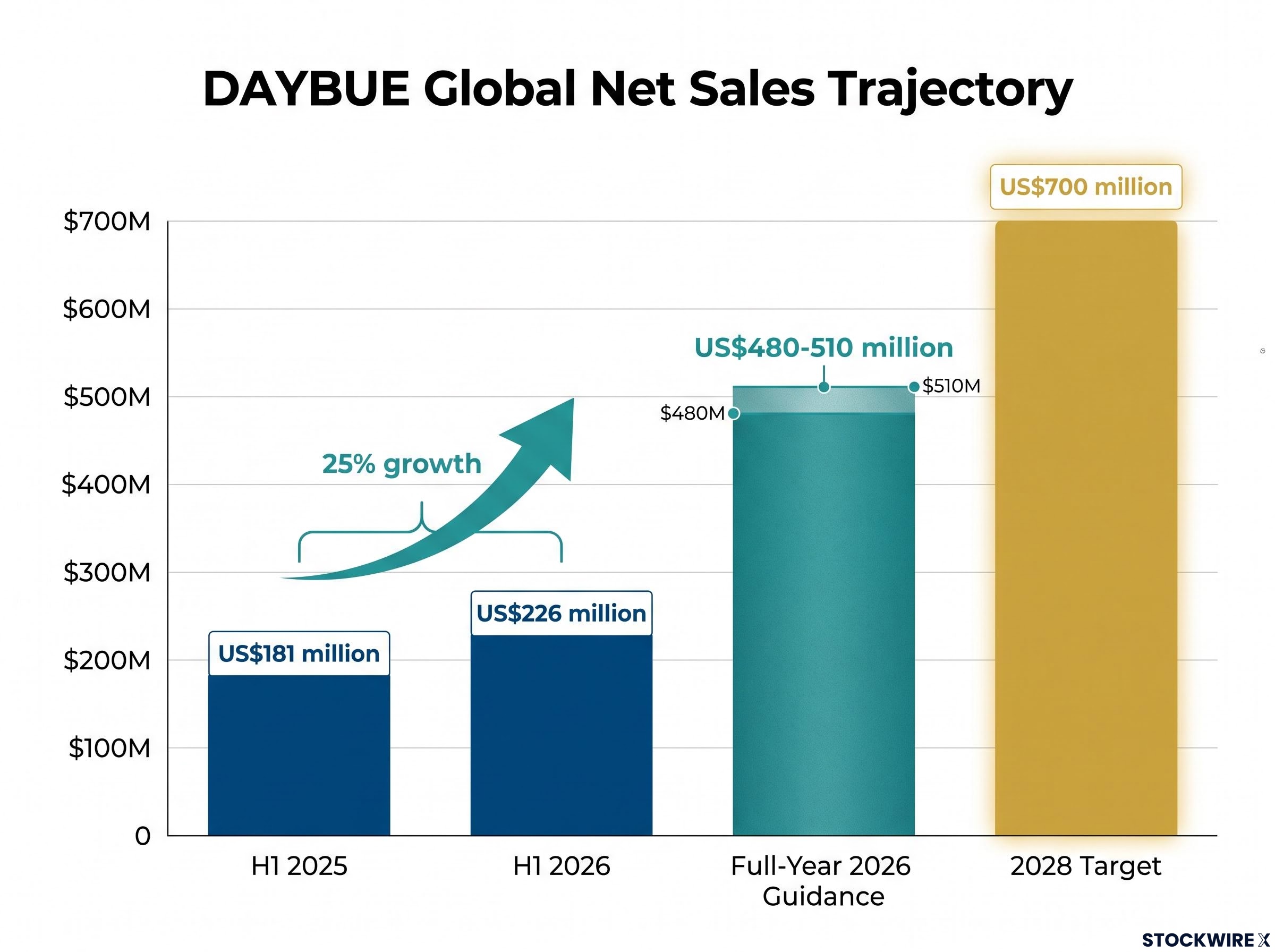
Acadia Pharmaceuticals, Neuren’s exclusive global licensee for DAYBUE (trofinetide), reported global net sales for H1 2026 of US$226 million, up 25% from US$181 million in H1 2025. Growth was driven by continued momentum in the US and named patient programs in other territories.
The DAYBUE STIX powder formulation became broadly available across the US in Q2 2026. By 30 June 2026, 40% of all US DAYBUE patients were receiving STIX, with approximately 45% of Q2 STIX demand coming from new or returning patients.
Acadia recently increased full-year 2026 global net sales guidance to US$480–510 million and reaffirmed its target global net sales in 2028 of US$700 million. Neuren’s anticipated royalties for full-year 2026 accordingly increased to US$53–56 million.
On the regulatory front, the European Commission granted marketing authorisation for DAYBU (trofinetide) for the treatment of neurobehavioral symptoms of Rett syndrome in adults and pediatric patients aged five years and older across all 27 EU member states, as well as Iceland, Liechtenstein and Norway, making it the first and only approved treatment for Rett syndrome in the European Union. Commercial launch by Acadia in Germany is anticipated in early Q4 2026.
EU marketing authorisation for DAYBU followed the CHMP’s positive opinion adopted on 29 June 2026, reversing an initial negative vote from early 2025 and triggering the pathway to a US$35 million first-sale payment under the Acadia licence agreement.
In Japan, topline results of Acadia’s ongoing trofinetide trial remain on track for the September to November 2026 timeframe, with a regulatory submission anticipated in 2027.
Outstanding milestone potential under the licence agreement includes:
- North America: US$50 million milestone once net sales in North America exceed US$500 million in a calendar year.
- Europe: US$35 million on first commercial sale; up to US$170 million in sales milestones; tiered royalties from mid-teens to low-20s % of Europe net sales.
- Japan: US$15 million on first commercial sale; up to US$110 million in sales milestones; tiered royalties from mid-teens to low-20s % of Japan net sales.
What DAYBUE and NNZ-2591 mean for investors
Neuren develops therapies for rare neurological disorders, including Rett syndrome, Phelan-McDermid syndrome and Pitt Hopkins syndrome. Its treatments target the role of Insulin-like growth factor 1 (IGF-1) in the brain, using orally administered analogs of naturally occurring peptides.
The company licenses DAYBUE globally to Acadia and earns royalties on net sales.
Neuren currently holds Rare Pediatric Disease designations for NNZ-2591 in PMS, PTHS and Angelman syndrome. A Rare Pediatric Disease designation may qualify the developer for a Priority Review Voucher upon FDA approval of a drug for that designated rare pediatric disease.
Neuren supported a study recently published in the Autism Research journal estimated the prevalence of Phelan-McDermid syndrome at 1 in 7,300 people, significantly higher than previous estimates and reinforcing the scale of the unmet need.
NNZ-2591 pipeline builds momentum across multiple programs
The Koala Phase 3 study in Phelan-McDermid syndrome (PMS), the first Phase 3 trial ever conducted in the condition, continues to scale. Since 1 January 2026, the number of trial sites in the US and Canada activated for enrolment has grown from 2 to 15, with 8 sites activated for the open-label extension study. The families of more than 100 potential participants have been referred to active sites or await activation of closer sites.
The Koala Phase 3 trial in Phelan-McDermid syndrome launched as the world’s first Phase 3 study ever conducted in the condition, with NNZ-2591 carrying FDA Fast Track designation and Orphan Drug status in both the US and EU, and zero competing therapies in development.
For Pitt Hopkins syndrome, a Type B End of Phase 2 face-to-face meeting with the FDA has been confirmed for late October 2026 to agree the path forward for NNZ-2591. The Pitt Hopkins Research Foundation will host an Externally-Led Patient-Focused Drug Development meeting with the FDA on 13 November 2026.
Neuren’s hypoxic ischemic encephalopathy (HIE) program has seen its IND submission timeline shift. The application is now expected in H1 2027, rather than Q4 2026, pending an additional juvenile animal safety study requested by the FDA.
The Priority Review Voucher (PRV) program offers further potential upside. US Congress reauthorised the program to 30 September 2029, and a voucher was recently sold for US$215 million in July 2026. Neuren would retain 100% ownership and proceeds of any voucher it earns.
Development remains fully funded. Total costs for the PMS program are expected to fall within the previously guided range of US$80–90 million, while R&D investment rose to A$27.4 million in H1 2026.
A self-funded pipeline plus shareholder returns
Neuren’s growing royalty income now serves a dual purpose: funding all NNZ-2591 development while underpinning recurring franked dividends. The balance sheet remains strong, with A$287 million in cash and short-term investments and modest corporate costs of A$3.0 million fully offset by A$5.6 million in interest income.
Near-term catalysts include the anticipated German launch in early Q4 2026, Japan topline results between September and November 2026, the FDA Pitt Hopkins meeting in late October 2026, and a second-half dividend to follow.
The result is a dual value proposition: potential capital appreciation from the NNZ-2591 pipeline alongside income from a maiden dividend program anchored to established royalty cash flow.
Don’t Miss the Next ASX Healthcare Dividend Story
Big News Blast delivers FREE breaking ASX healthcare news directly to your inbox within minutes of release, complete with in-depth analysis. Join 20,000+ subscribers already getting the edge on market-moving announcements the moment they drop. Click the “Free Alerts” button at Big News Blast to stay ahead before the market has a chance to react.