
UniCredit’s 8.72% Generali Stake Defies Orcel’s Denials
38 mins ago


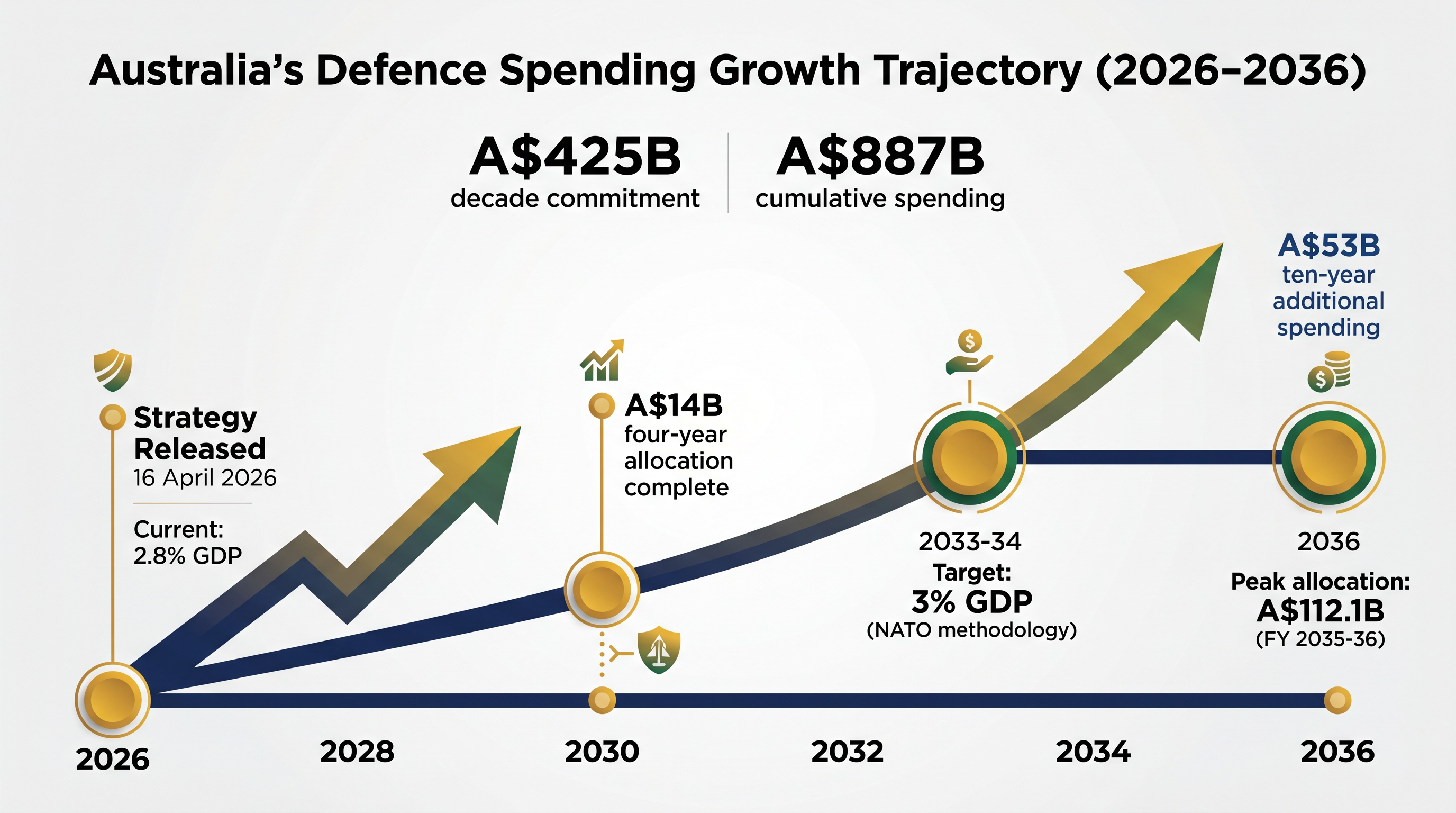
Australia has committed A$425 billion to defence over the next decade, the largest military spending programme in the nation’s history. The 2026 National Defence Strategy and Integrated Investment Program, released on 16 April 2026, sets defence spending on a trajectory to reach 3% of GDP by 2033-34, calculated using NATO methodology. Cumulative spending over the decade will total A$887 billion. The strategy arrives as analysts debate whether the pace matches the deteriorating regional security environment the government cites as justification.
This explainer breaks down where the money goes, what capabilities Australia intends to acquire, why the government considers this necessary, and what experts say about whether the investment will prove adequate.
The decade-long commitment represents A$425 billion in additional defence investment from 2026 through 2036. Cumulative spending over the period reaches A$887 billion when baseline allocations are included. The government has structured the increase in two tranches: A$14 billion over four years (2026-2030) and A$53 billion over ten years.
Defence spending currently sits at 2.8% of GDP. The strategy targets 3% by 2033-34, a figure that includes pension costs under NATO accounting standards. The trajectory implies an average annual growth rate of 7.6% across the decade. By the final year of the programme, FY 2035-36, the single-year allocation reaches A$112.1 billion.
Defence Industry Minister Pat Conroy has framed the 3% target as aligning Australia with NATO spending benchmarks, positioning the increase as part of burden-sharing expectations among Western allies. The federal budget scheduled for next month will detail the A$14 billion four-year allocation, providing the first concrete spending breakdown since the strategy’s release.
Key budget milestones include:
The A$425 billion divides across six domains, with maritime capabilities receiving the largest share. The allocation percentages reveal strategic priorities shaped by Australia’s geography and the Indo-Pacific security environment.
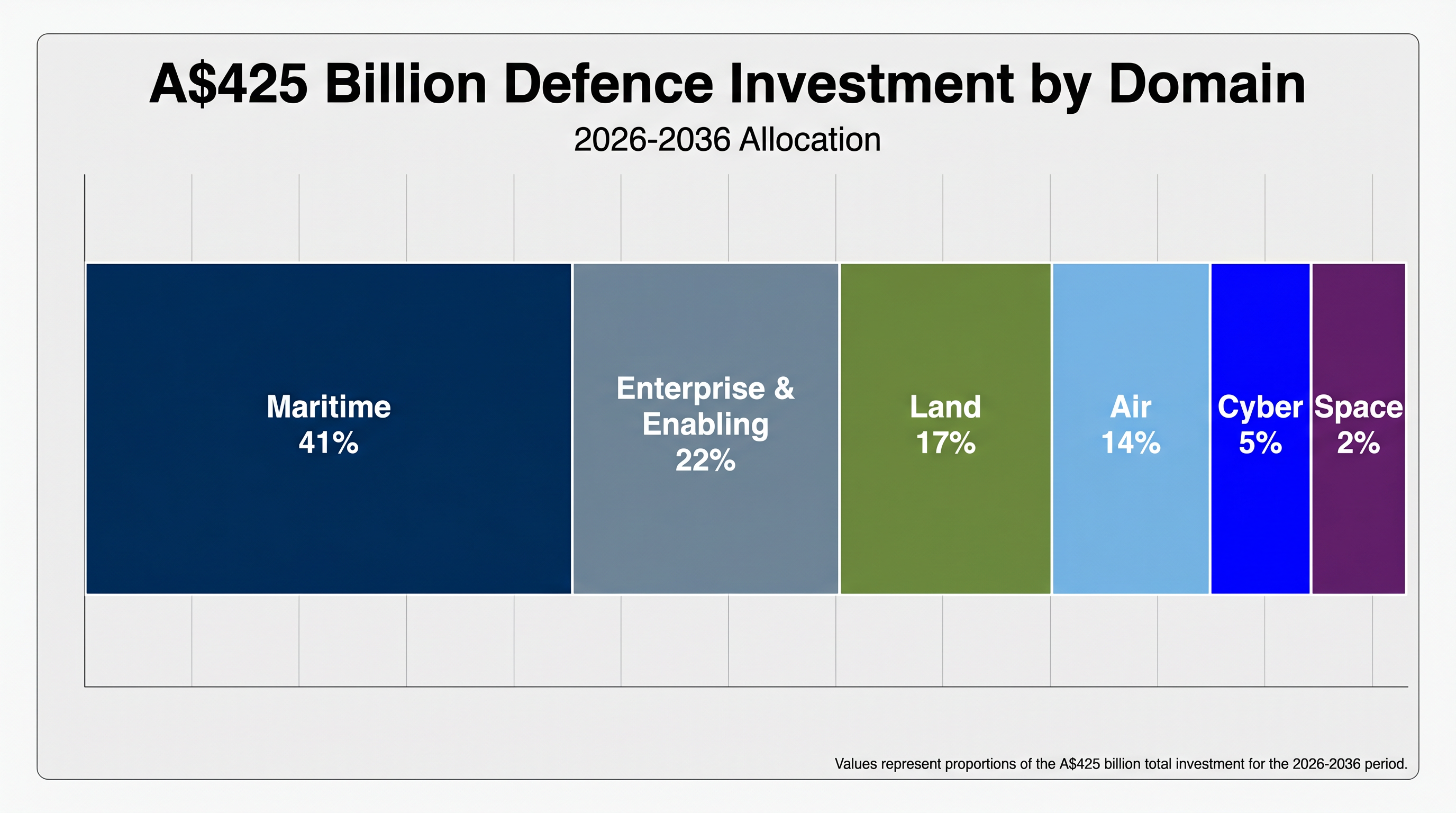
Maritime receives 41% of total funds, reflecting the submarine programme’s scale and surface fleet modernisation. Enterprise and enabling infrastructure, including IT systems and support networks, accounts for 22%. Land capabilities receive 17%, air systems 14%, cyber 5%, and space 2%.
The maritime emphasis aligns with AUKUS commitments and undersea warfare priorities. Enterprise and enabling investments support the infrastructure required to sustain advanced platforms. Cyber and space allocations, though smaller in percentage terms, represent growing domains where Australia seeks sovereign capability.
| Domain | Allocation (%) | Description |
|---|---|---|
| Maritime | 41% | Nuclear submarines, surface vessels, undersea warfare systems |
| Enterprise & Enabling | 22% | Infrastructure, IT systems, logistics support networks |
| Land | 17% | Ground forces equipment, armoured vehicles, artillery |
| Air | 14% | Fighter aircraft, transport planes, air defence systems |
| Cyber | 5% | Offensive and defensive cyber capabilities, network security |
| Space | 2% | Satellite systems, space domain awareness, communications |
The distribution reflects judgements about where Australia faces the greatest capability gaps and where investment delivers strategic effect. Maritime dominance signals that undersea and surface warfare remain the primary focus for the decade ahead.
The abstract allocations translate into specific platforms and systems. Three capability domains, maritime, strike and air defence, and unmanned systems, account for the bulk of programme-level investment.
The nuclear-powered attack submarine programme represents the single largest defence investment in Australian history. The government has committed up to A$96 billion for submarine acquisition under AUKUS. This figure covers infrastructure, workforce development, and platform costs, though contract details remain under negotiation.
Surface fleet modernisation includes eleven Mogami-class frigates planned for acquisition from Japan, plus six Hunter-class frigates under construction domestically. The Mogami-class selection addresses the capability gap between current vessels and the Hunter-class timeline. The government has also committed to acquiring six large optionally crewed surface vessels, each equipped with up to 32 missile cells, designed to operate with reduced crew or autonomously.
Austal’s $4 billion Landing Craft Heavy contract, awarded in February 2026 for construction of eight vessels through 2038, represents one of the first major industrial commitments delivered under the expanded defence investment framework, demonstrating how surface fleet priorities translate into binding shipyard work.
Western Australia shipyards will receive A$12 billion to support AUKUS submarine maintenance and infrastructure. This investment builds sovereign industrial capacity to sustain nuclear-powered platforms without reliance on foreign facilities.
Integrated air and missile defence receives A$21-30 billion over the decade. The range reflects ongoing assessments of system requirements and supplier negotiations. A medium-range air defence system is scheduled to commence acquisition in 2026, though the supplier remains unconfirmed.
The F-35A fleet will receive armament upgrades, including Long Range Anti-Ship Missiles (LRASM) and Joint Strike Missiles (JSM). These weapons extend strike range and improve maritime targeting capability. Super Hornet and Growler aircraft will undergo life extensions to keep them operational through 2040, bridging the gap until sixth-generation platforms become available.
Unmanned aircraft investment totals up to A$5 billion, including the MQ-28A Ghost Bat programme. The Ghost Bat, developed domestically by Boeing Australia, is designed to operate alongside manned fighters as a loyal wingman platform. Mick Ryan of the Lowy Institute has characterised the drone investment as a “modest boost” continuing capabilities outlined in the 2024 strategy rather than introducing new directions.
Transport aircraft priorities include acquiring twenty C-130J-30 Hercules to replace ageing airlift capacity. The C-27J Spartan fleet will be retired, consolidating transport operations on the larger Hercules platform.
Major programmes ranked by investment scale:
These programmes remain largely at planning stage. No major contracts, construction milestones, or delivery announcements have been reported since the strategy’s release four days ago.
The government justifies the investment increase by citing a “deteriorating strategic environment” and “complex and threatening” global conditions. The language frames the spending as response to long-term trajectory rather than acute crisis.
Defence Minister Richard Marles has stated that no effective regional balance of power exists without continued American presence, positioning Australian capability development as complementary to alliance frameworks rather than substitution for US power projection. The strategy emphasises self-reliance, building sovereign industrial capacity and reducing dependence on foreign supply chains for critical systems.
Richard Gray, an analyst at the Australian Strategic Policy Institute, has assessed that Australia cannot substitute for US capabilities in the Indo-Pacific. The spending programme instead aims to ensure Australia can sustain its own defence and contribute meaningfully to allied operations without becoming a strategic liability.
“There is no effective regional balance of power without the United States continuing to play the role that it has. Our entire strategy is premised on the continued presence of the United States in our region.”
Richard Marles, Defence Minister
The strategic rationale rests on three cited concerns:
No specific incidents in the Taiwan Strait, South China Sea, or broader Indo-Pacific have been cited as immediate triggers for the spending increase. The rationale appears grounded in assessment of strategic trajectory over the next decade rather than response to current flashpoints.
For readers wanting to understand how regional security incidents affecting supply chains translate into measurable economic disruption, our dedicated guide to the April 2026 Strait of Hormuz naval incident walks through the immediate currency market reactions, oil price movements, and what the episode reveals about vulnerability of Indo-Pacific trade routes to single-point-of-failure choke points.
Malcolm Davis of the Australian Strategic Policy Institute has assessed the strategy as moving in a sound direction, praising its focus on power projection, resilience, and industrial capacity. Davis has expressed concern, however, about timeline adequacy. In his assessment, the preparation window has compressed from ten years to “perhaps one or two years” given the pace of regional strategic deterioration.
Mick Ryan of the Lowy Institute has characterised the spending increases as “relatively modest” given the security challenges Australia faces. Ryan describes the 2026 strategy as “a continuation of 2024 with modest drone and missile boosts” rather than a fundamental strategic recalibration.
“The problem is the timeline. When we did the Defence Strategic Review two years ago, we thought we had maybe ten years to get ready. Now it looks like we might have one or two years.”
Malcolm Davis, Australian Strategic Policy Institute
Contrasting expert positions include:
The expert disagreement centres on adequacy and pace rather than strategic direction. Both assessments accept the government’s threat characterisation while questioning whether the investment schedule matches the timeline of potential conflict.
The strategy was released on 16 April 2026. As of 20 April, no implementation progress, contract awards, or construction milestones have been announced. The commitment exists on paper; delivery depends on industrial capacity, workforce availability, and programme execution.
The government has announced creation of a Defence Delivery Agency designed to accelerate programme timelines and improve execution. No operational details or progress updates for this agency have been provided since the strategy’s release.
The Integrated Investment Program projects creation of “tens of thousands of jobs” from defence investment. Workforce development, supply chain resilience, and sovereign industrial capacity building are cited as programme objectives. Specific mechanisms, timelines, and stakeholder commitments remain undetailed in public commentary.
Key outstanding questions include:
The federal budget next month will provide the first detailed allocation breakdown for the A$14 billion four-year spending increase. Contract awards, stakeholder responses, and implementation milestones in coming months will determine whether the ambitious blueprint translates into delivered capability.
The A$425 billion commitment marks a generational shift in Australian defence posture, lifting spending to 3% of GDP and prioritising maritime capabilities, integrated air defence, and sovereign industrial capacity. The strategy responds to what the government characterises as a deteriorating strategic environment, though expert views diverge on whether the pace and scale prove adequate.
Whether the investment delivers operational capability depends on execution speed, industrial capacity realisation, and whether regional security conditions deteriorate faster than current planning assumes. The federal budget next month will detail near-term allocation. Implementation milestones, contract awards, and stakeholder responses over the next year will reveal whether this blueprint becomes reality or remains constrained by workforce shortages, supply chain limitations, and programme delays that have historically challenged major defence acquisitions.
Australia has committed A$425 billion in additional defence investment from 2026 through 2036, with cumulative decade spending reaching A$887 billion when baseline allocations are included.
Australia is targeting defence spending of 3% of GDP by 2033-34, calculated using NATO methodology, up from the current level of 2.8% of GDP.
The largest programme is the nuclear-powered attack submarine acquisition under AUKUS, costing up to A$96 billion, followed by integrated air and missile defence at A$21-30 billion and surface fleet modernisation including eleven Mogami-class and six Hunter-class frigates.
Maritime capabilities receive the largest share at 41%, followed by enterprise and enabling infrastructure at 22%, land at 17%, air at 14%, cyber at 5%, and space at 2%.
Expert opinion is divided on adequacy: Malcolm Davis of ASPI praised the strategic direction but warned the preparation window may have shrunk to one or two years, while Mick Ryan of the Lowy Institute described the increases as relatively modest given the scale of security challenges.



