
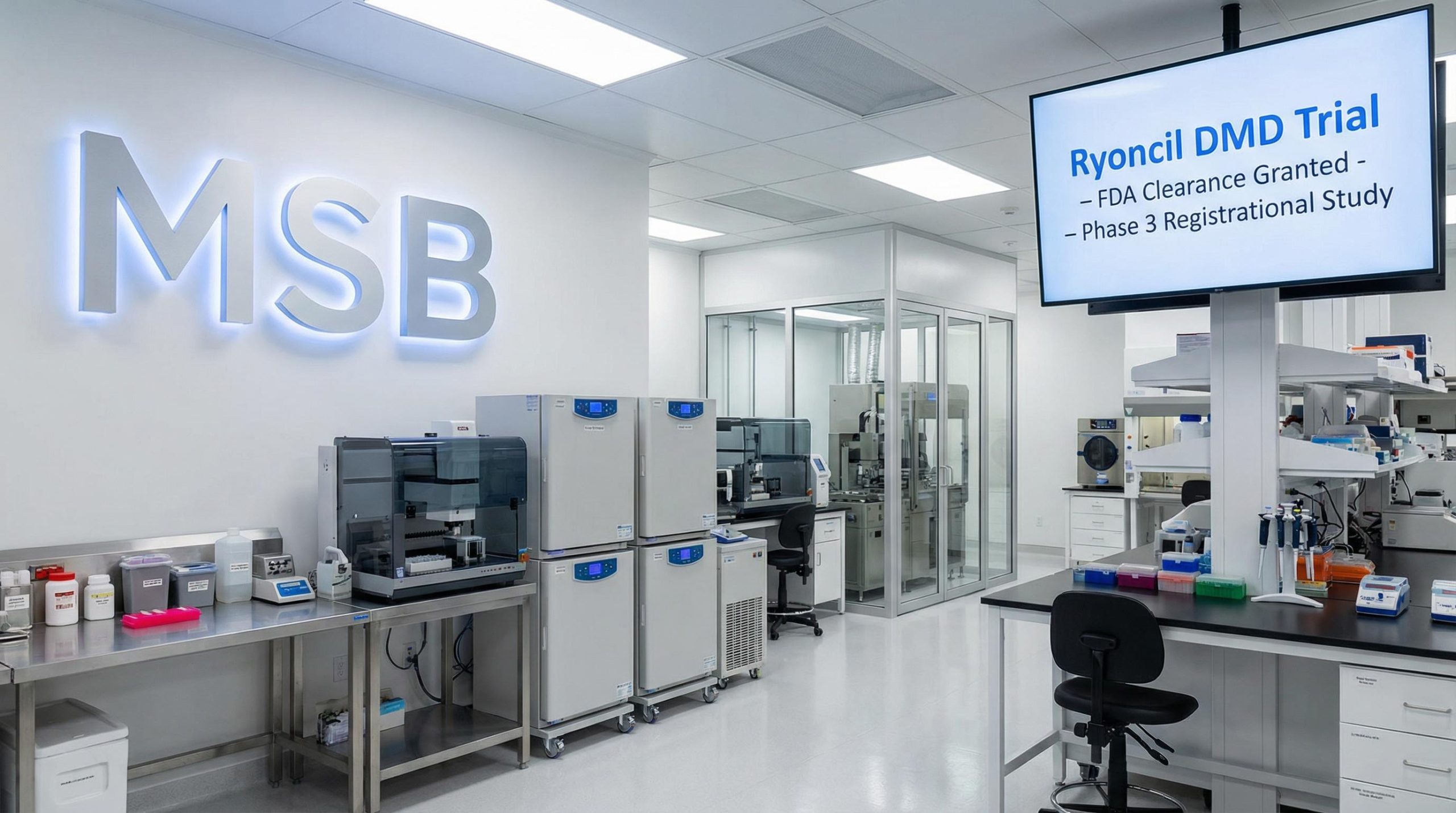
Mesoblast Limited (ASX: MSB) has received FDA clearance to advance its approved cell therapy Ryoncil directly into a registrational trial for Duchenne muscular dystrophy, bypassing earlier-phase studies. The Investigational New Drug (IND) clearance positions the company to potentially expand Ryoncil’s market beyond its current pediatric steroid-refractory acute graft-versus-host disease indication into a disease affecting approximately 15,000 children in the United States.
Mesoblast receives FDA clearance to advance Ryoncil into registrational trial for Duchenne muscular dystrophy
The FDA’s decision to grant direct-to-registrational pathway status reflects confidence in Ryoncil’s existing safety profile and preclinical efficacy data in DMD animal models. Ryoncil is the first mesenchymal stromal cell (MSC) product approved by the FDA and the only approved therapy for children under age 12 with steroid-refractory acute graft-versus-host disease (SR-aGvHD). This established safety record in pediatric populations, combined with FDA-validated manufacturing processes, supports the accelerated development pathway.
The regulatory milestone eliminates the need for Phase I and Phase II studies, potentially reducing development costs and accelerating time to market. For investors, this represents a more efficient capital deployment compared to traditional drug development timelines, whilst leveraging Mesoblast’s existing manufacturing infrastructure and clinical experience with the product.
Mesoblast is partnering with Parent Project Muscular Dystrophy (PPMD), a leading patient advocacy organisation founded in 1994, to support patient identification and trial recruitment. This collaboration addresses a common challenge in rare disease development, where patient identification and enrolment can significantly impact trial timelines.
When big ASX news breaks, our subscribers know first
What is Duchenne muscular dystrophy?
Duchenne muscular dystrophy is an X-linked genetic disorder characterised by progressive muscle degeneration affecting skeletal, respiratory, and cardiac muscles. The disease primarily impacts boys and is caused by the absence of functional dystrophin, a structural protein essential for muscle cell integrity.
Patients experience progressive muscle deterioration leading to loss of ambulation, respiratory failure, and cardiomyopathy. Death typically occurs by the third decade of life. Current treatment approaches include gene therapies designed to replace or increase dystrophin protein levels, and corticosteroids to manage inflammation.
Whilst gene therapies represent significant therapeutic advances, they do not constitute a complete cure. Chronic inflammation of skeletal and cardiac muscle remains a major driver of progressive weakness and functional decline. Corticosteroid therapy has improved survival outcomes but demonstrates plateauing effects over time, and prolonged use carries serious adverse events.
Ryoncil’s therapeutic rationale targets the inflammatory component of DMD pathology. The therapy’s anti-inflammatory mechanism aims to reduce the damaging inflammatory cascade, preserve muscle function, and slow disease progression. This positions Ryoncil as a complementary approach to gene therapies rather than a competing treatment, potentially supporting combination therapy strategies and differentiated market positioning.
Trial design targets validated FDA endpoint
The registrational trial will randomise 76 patients aged 5 to 9 years to receive either Ryoncil or placebo on top of standard of care. Treatment consists of 7 infusions at a dose of 2 x 10⁶ cells/kg administered over 9 months.
| Parameter | Detail |
|---|---|
| Patients | 76 randomised |
| Age range | 5-9 years |
| Dosing | 7 infusions over 9 months |
| Dose level | 2 x 10⁶ cells/kg |
| Primary endpoint | Time-to-stand at 9 months |
The primary endpoint, time-to-stand at 9 months, is a validated FDA endpoint for approval purposes. This regulatory validation provides clarity on the approval pathway and reduces uncertainty around acceptable clinical outcomes for regulatory review.
Time-to-stand measures the time required for a patient to rise from a supine position to standing, a functional assessment that reflects muscle strength and disease progression in DMD. The metric has established precedent in DMD clinical development and regulatory submissions.
Ryoncil’s mechanism targets inflammation cascade
Ryoncil’s therapeutic approach leverages the product’s anti-inflammatory properties to address the inflammatory component of DMD pathology. The mechanism operates through multiple pathways:
- Ryoncil releases anti-inflammatory factors into the surrounding tissue
- These factors modulate multiple arms of the immune system
- The modulation reduces damaging inflammatory processes in muscle tissue
- The intervention aims to preserve muscle function whilst tissue remains viable
Preclinical efficacy data in DMD animal models demonstrated sufficient activity to support the IND clearance and direct-to-registrational pathway. The approach targets disease intervention at a stage where muscle preservation may still be achievable, potentially altering disease trajectory.
Leadership and clinical perspectives
Dr Aravindhan Veerapandiyan, Director of the Comprehensive Neuromuscular Program at Arkansas Children’s Hospital and Principal Investigator of the study, provided context on the trial’s significance:
Dr Aravindhan Veerapandiyan, Principal Investigator
“This study represents an important step forward in potentially addressing the inflammatory component of DMD, a major driver of disease progression. By leveraging the anti-inflammatory effects of Ryoncil, we aim to intervene at a stage where muscle tissue may still be preserved, potentially altering the trajectory of the disease.”
Silviu Itescu, Chief Executive of Mesoblast, emphasised the regulatory pathway and existing safety foundation:
Silviu Itescu, Chief Executive
“We are very pleased to have received clearance to proceed directly to a registrational study for DMD based on our preclinical data in DMD animal models and our extensive safety data in children with SR-aGvHD. Our experience with Ryoncil suggests that we may have a unique approach to help with this devastating disease in children.”
The next major ASX story will hit our subscribers first
Strategic positioning and commercial outlook
The DMD trial expands Ryoncil’s addressable market beyond its current SR-aGvHD indication. Mesoblast is developing the therapy for additional inflammatory conditions including SR-aGvHD in adults and biologic-resistant inflammatory bowel disease, whilst advancing rexlemestrocel-L, a related therapy, for heart failure and chronic low back pain.
The company’s platform approach allows it to leverage existing manufacturing capabilities, safety data, and regulatory experience across multiple indications. This improves development economics compared to single-indication programmes and supports portfolio diversification.
Key strategic assets include:
- Ryoncil approved for pediatric SR-aGvHD (first FDA-approved MSC therapy)
- Ryoncil in development for adult SR-aGvHD and biologic-resistant inflammatory bowel disease
- Rexlemestrocel-L in development for heart failure and chronic low back pain
- Over 1,000 granted patents or applications globally
Mesoblast holds commercial partnerships in Japan, Europe and China, providing established distribution channels and regional expertise for potential future product launches. The company’s intellectual property portfolio extends through at least 2044 in all major markets, providing commercial protection for its technology platform and product candidates.
The proprietary manufacturing processes yield industrial-scale, cryopreserved, off-the-shelf cellular medicines with defined pharmaceutical release criteria, supporting global scalability and consistent product quality.
Get Breakthrough Biotech News Before the Market Reacts
Join 20,000+ investors receiving FREE real-time ASX alerts within minutes of release, complete with expert analysis. Click the “Free Alerts” button at Big News Blast to ensure you never miss another regulatory breakthrough or clinical trial update the moment it breaks.