
Racura Oncology Partners with Top US University to Unlock How Its Drug Silences MYC
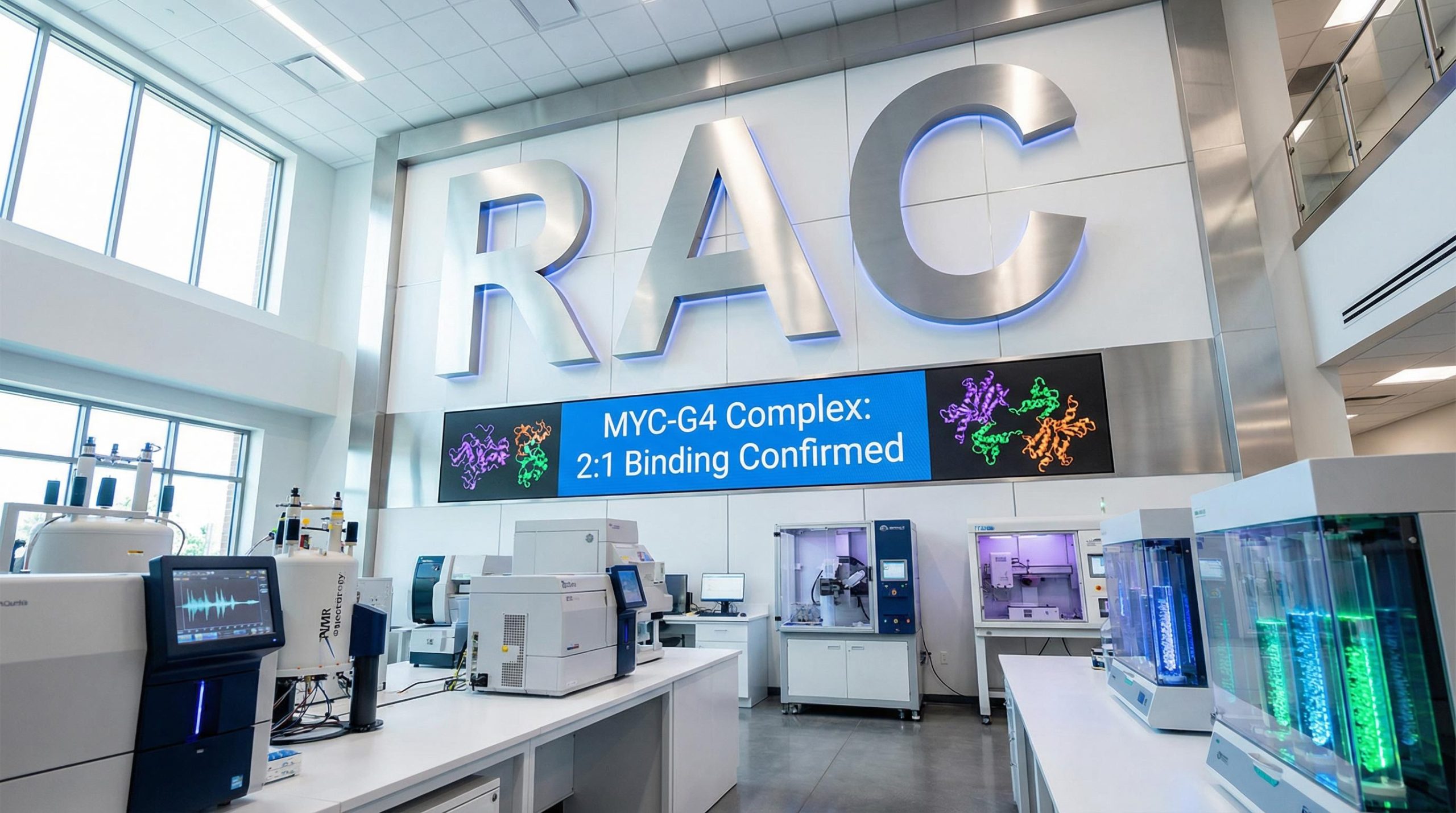
Racura Oncology partners with Purdue University to unlock MYC-silencing secrets
Racura Oncology (ASX: RAC) has commenced a research collaboration with Purdue University to study how (E,E)-bisantrene binds to G-quadruplex DNA structures to silence MYC transcription in cancer. The Racura Oncology Purdue University partnership provides the biotech firm with access to high-resolution nuclear magnetic resonance (NMR) and X-ray expertise at a world-class US institution.
Professor Danzhou Yang, who leads the collaboration, is a global leader in G-quadruplex structural biology. Her team published the first X-ray crystal structure of the MYC-G4/nucleolin complex in the prestigious journal Science in 2025. Results from the research program are expected to emerge over the next 24 months, with publication anticipated in a high-impact international journal.
Professor Danzhou Yang, Purdue University
“I’m truly excited to partner with Racura on this important project and on the promising anticancer drug (E,E)-bisantrene. By uncovering structural and mechanistic insights into how (E,E)-bisantrene engages the MYC G-quadruplex to regulate MYC expression, my team and I hope to generate high-impact findings that will advance both the scientific understanding and therapeutic development of this compelling anticancer agent.”
The collaboration aims to generate robust mechanism of action data for (E,E)-bisantrene’s anticancer activity. Independent academic validation strengthens the scientific credibility of Racura’s approach, with data to be shared with potential pharmaceutical partners to support business development efforts.
When big ASX news breaks, our subscribers know first
What is G-quadruplex DNA and why does MYC matter?
G-quadruplex (G4) DNA is a specialised DNA structure found in gene promoter regions. It acts as a regulatory element that controls gene transcription, determining whether specific genes are switched on or off in cells.
MYC is an oncogene that regulates cancer cell growth and proliferation. The gene is overactive in up to 70% of cancers, making it a highly attractive therapeutic target. Despite its importance, MYC has proven very difficult to target directly with small-molecule drugs.
The MYC gene contains a G4 structure in its promoter region. Stabilising this DNA structure can repress MYC gene transcription and MYC oncogenic signalling, producing a pharmacological effect equivalent to inhibiting the MYC protein itself. This G4-targeting approach represents a scientifically validated alternative pathway to address an otherwise “undruggable” target.
How (E,E)-bisantrene silences MYC transcription:
- A G4 structure exists naturally in the MYC gene promoter region
- (E,E)-bisantrene binds to and stabilises this G4 structure
- Stabilisation of the G4 represses MYC gene transcription, effectively silencing the oncogene
The ability of (E,E)-bisantrene to bind MYC-G4 positions Racura within an emerging therapeutic field focused on G-quadruplex-targeting cancer treatments. Recent discoveries by Racura have enabled composition of matter intellectual property filings that provide for 20 years of patent protection over (E,E)-bisantrene.
Research program scope and scientific objectives
The Purdue University collaboration will investigate four distinct research areas using complementary techniques to characterise how (E,E)-bisantrene interacts with MYC-G4 at the molecular level.
The program emphasises high-resolution structural studies to fully map the binding interaction. Understanding how MYC-G4 binding affects regulatory proteins that influence MYC transcription forms a core objective, alongside determining precisely how these molecular interactions silence MYC gene transcription.
Research focus areas:
- Molecular level binding studies using complementary techniques
- Effect on regulatory proteins influencing MYC transcription
- How molecular interactions silence MYC gene transcription
- High-resolution structural characterisation of binding
The comprehensive data set generated through this research will strengthen Racura’s intellectual property positioning. For investors, robust mechanism of action data de-risks the scientific narrative ahead of partnering discussions with pharmaceutical companies.
Early data confirms direct binding
Early research at Purdue University has already confirmed that (E,E)-bisantrene binds directly to MYC-G4. 1H NMR titration experiments have demonstrated the formation of a stable 2:1 (E,E)-bisantrene:MYC-G4 complex, providing initial validation of the binding mechanism.
Professor Michael Kelso, Vice President of Research, Racura Oncology
“Racura is thrilled to be working with Prof Yang and her team of experts in the structural biology and biochemistry of MYC-G4 at Purdue. Together we will generate a rich data set that expands our knowledge of (E,E)-bisantrene’s anticancer mechanism of action via MYC silencing.”
The next major ASX story will hit our subscribers first
Strategic implications for Racura’s pipeline and partnering efforts
The research collaboration supports Racura’s broader MYC-focused oncology initiatives across multiple development programs. Robust mechanism of action data strengthens the scientific case for (E,E)-bisantrene across multiple indications, providing independent verification for potential pharmaceutical partners.
Racura is advancing its proprietary formulation RC220 in a Phase 3 clinical program for acute myeloid leukaemia. The company is also conducting Phase 1a/b studies in mutant epidermal growth factor receptor non-small cell lung cancer (EGFRm NSCLC) and a Phase 1a/b combination program with the anthracycline doxorubicin, where the company aims to deliver both cardioprotection and enhanced anticancer activity for solid tumour patients.
| Indication | Development Stage | Approach |
|---|---|---|
| Acute myeloid leukaemia | Phase 3 | RC220 monotherapy |
| EGFRm NSCLC | Phase 1a/b | RC220 |
| Solid tumours | Phase 1a/b | RC220 + doxorubicin combination |
Independent academic validation from a prestigious US institution enhances credibility with potential partners and acquirers. Data generated through the Purdue collaboration will be shared with potential pharmaceutical partners, providing third-party verification of studies undertaken by Racura scientists. The company has stated it is actively exploring partnerships, licence agreements, or commercial merger and acquisition opportunities to accelerate patient access to RC220.
Want the Next Biotech Breakthrough in Your Inbox?
Join 20,000+ investors receiving FREE breaking ASX healthcare news within minutes of release, complete with expert analysis. Get real-time alerts on clinical trials, partnerships, and regulatory developments the moment they’re announced. Click the “Free Alerts” button at Big News Blast to start receiving market-moving biotech news before the broader market reacts.