
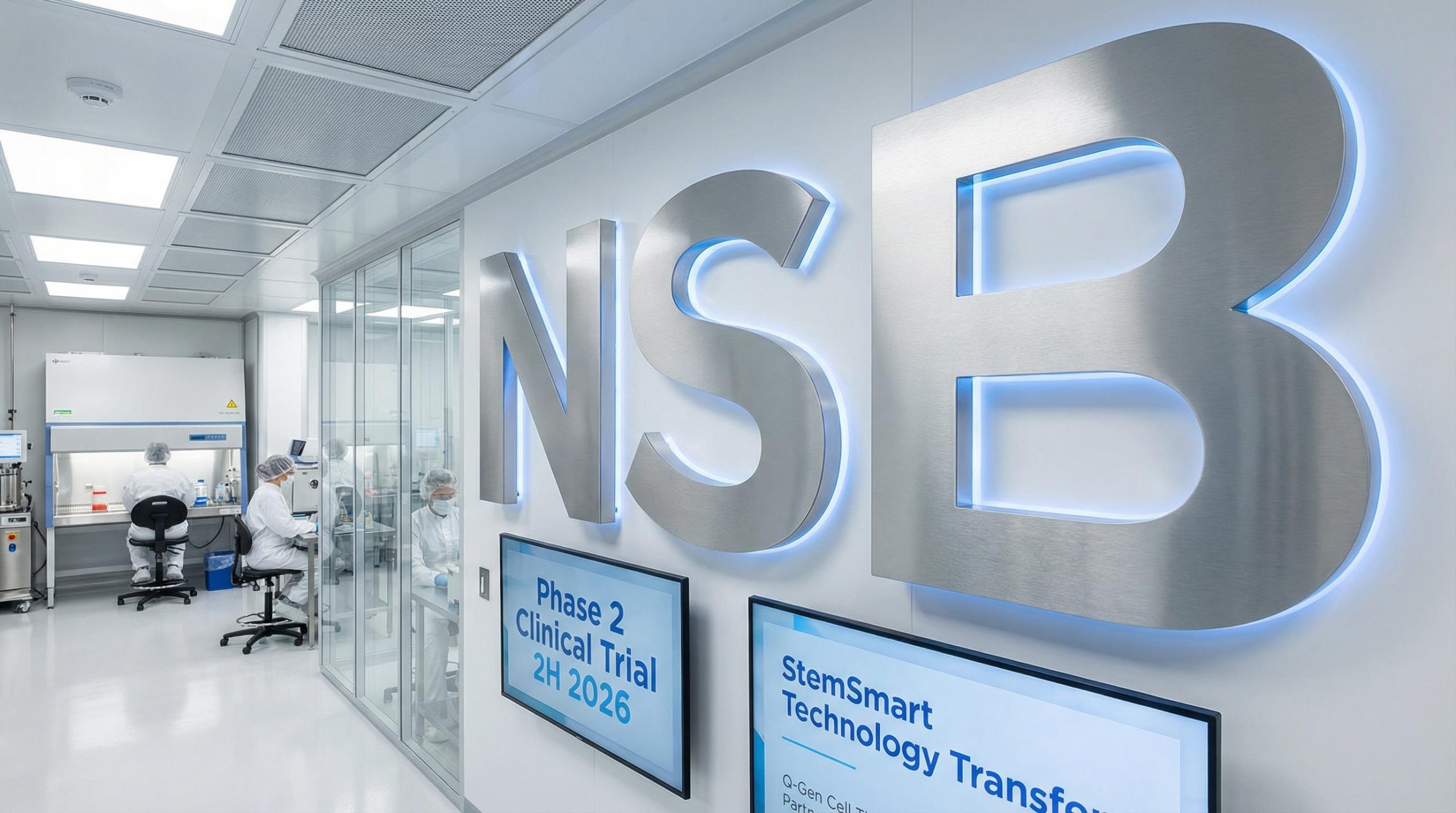
NeuroScientific Biopharmaceuticals (ASX: NSB) has initiated the first technology transfer manufacturing run for its patented StemSmart mesenchymal stem cell therapy at Q-Gen Cell Therapeutics in Brisbane. The commencement represents a major milestone in transferring the manufacturing process to clinical scale, enabling supply for Phase 2 trials targeted to begin in 2H 2026.
NeuroScientific begins critical StemSmart manufacturing transfer at Q-Gen facility
The technology transfer to Q-Gen Cell Therapeutics marks a critical step in establishing clinical-scale manufacturing capability for StemSmart. Q-Gen, located within QIMR Berghofer in Brisbane, operates one of Australia’s largest cell therapy manufacturing facilities, with 13 cleanrooms dedicated to cell manufacturing and quality control.
The facility holds a TGA licence for cell therapy manufacture and brings more than 25 years of industry experience to the partnership. This positions Q-Gen to meet the scale and regulatory requirements necessary for late-stage clinical trials and potential commercialisation.
The full technology transfer programme remains on schedule for completion in 2H 2026, subject to successful validation and TGA audit. Upon completion, Q-Gen’s manufacturing licence is expected to be expanded to include the StemSmart process, enabling supply of clinical-scale product for Phase 2 studies and beyond.
Nathan Smith, Chief Executive Officer
“The initiation of the first tech transfer run at Q-Gen is an important step in securing our supply chain for our commercialisation goals. Our partnership with Q-Gen is critical in ensuring patients receive high-quality StemSmart products that meet global regulatory standards.”
When big ASX news breaks, our subscribers know first
What is technology transfer in cell therapy manufacturing?
Technology transfer refers to the process of moving a proprietary manufacturing method from development-scale operations to a larger contract manufacturer capable of producing consistent, high-quality product at volumes required for clinical trials. For cell therapies like StemSmart, this process is particularly complex due to the biological nature of the product and stringent regulatory requirements.
Successful technology transfer validates that the manufacturing process can be replicated reliably at commercial scale whilst maintaining the product’s quality, safety, and efficacy characteristics. This step is essential before advancing to larger clinical trials, where consistent supply and batch-to-batch reproducibility become critical.
NeuroScientific has structured the StemSmart technology transfer programme across six stages:
- Process mapping and facility assessment
- Documentation and SOP transfer
- Analytical method qualification
- GMP engineering and demonstration runs
- Product comparability assessment
- Regulatory audit and TGA licence expansion
Each stage builds upon the previous one, with formal validation required before progressing. The structured approach reduces risk by identifying and resolving potential issues early in the transfer process.
GMP demonstration runs represent the validation gateway
The technology transfer has now entered stage four, the GMP engineering and demonstration runs phase. This represents the critical validation phase of the transfer, requiring the manufacture of consecutive compliant batches that meet predefined release and potency specifications.
Demonstration runs must prove that Q-Gen can consistently replicate the StemSmart manufacturing process under Good Manufacturing Practice (GMP) conditions. Only after successful completion of these runs can the programme advance to formal comparability review and TGA inspection.
This phase serves as the primary quality gate before regulatory submission, confirming that the transferred process produces material equivalent to that used in earlier clinical studies.
Dr Marian Sturm, Chief Scientific Officer
“I am excited by the commencement of the first tech transfer manufacturing run at Q-Gen. It represents a significant milestone and is the culmination of an extensive amount of work by both Q-Gen and NSB.”
Phase 2 Crohn’s disease trial preparations advance in parallel
Whilst manufacturing scale-up progresses, NeuroScientific continues Phase 2 clinical trial start-up activities in parallel. The company is targeting trial initiation in 2H 2026, focusing on fistulising Crohn’s disease, a severe and treatment-resistant form of the condition.
The dual-track approach positions the company to begin patient enrolment once manufacturing validation is complete and regulatory approvals are secured. Recent favourable outcomes from the Special Access Scheme programme targeting fistulising Crohn’s disease support the progression toward formal Phase 2 evaluation.
The global Crohn’s disease market represents substantial commercial opportunity, projected to reach approximately US$13.8 billion by 2026. Despite multiple available biologic and small-molecule therapies, a substantial proportion of patients either fail to respond, lose response over time, or experience significant adverse effects.
Addressing unmet need in refractory Crohn’s disease
Patients with refractory or fistulising disease remain particularly difficult to treat, representing a meaningful unmet clinical need. Current therapeutic options demonstrate limited efficacy or durability in this population, creating opportunity for novel therapies with differentiated mechanisms of action.
StemSmart is designed to modulate pathological immune responses and reduce inflammation through mesenchymal stem cell activity. The platform approach extends beyond Crohn’s disease, with potential applicability across other immune-mediated inflammatory conditions including organ transplant rejection, lung inflammatory disease, and graft-versus-host disease.
This multi-indication potential provides strategic optionality for NeuroScientific’s development pipeline, though near-term focus remains on advancing the Crohn’s disease programme.
Key milestones and investment timeline
The convergence of manufacturing and clinical activities in 2H 2026 creates a concentrated period of potential value catalysts for NeuroScientific. Successful execution across both workstreams would establish critical infrastructure for commercialisation whilst generating clinical data to support efficacy claims.
| Milestone | Target Timing | Significance |
|---|---|---|
| Technology transfer completion | 2H 2026 | Enables clinical-scale supply |
| TGA audit and licence expansion | 2H 2026 | Regulatory manufacturing clearance |
| Phase 2 trial initiation | 2H 2026 | Clinical efficacy evaluation begins |
Each milestone represents a distinct validation point. Technology transfer completion confirms manufacturing scalability, TGA audit establishes regulatory compliance, and Phase 2 initiation begins the formal efficacy evaluation required for registration.
The parallel advancement of manufacturing and clinical activities demonstrates efficient capital deployment by compressing the timeline to potential value inflection. Investors should monitor progress updates across both workstreams as 2H 2026 approaches.
Want the Next Biotech Breakthrough in Your Inbox?
Join 20,000+ investors getting FREE breaking ASX healthcare and biotech news delivered within minutes of release, complete with in-depth analysis. Click the “Free Alerts” button at Big News Blast to start receiving market-moving alerts the moment announcements hit the ASX.