
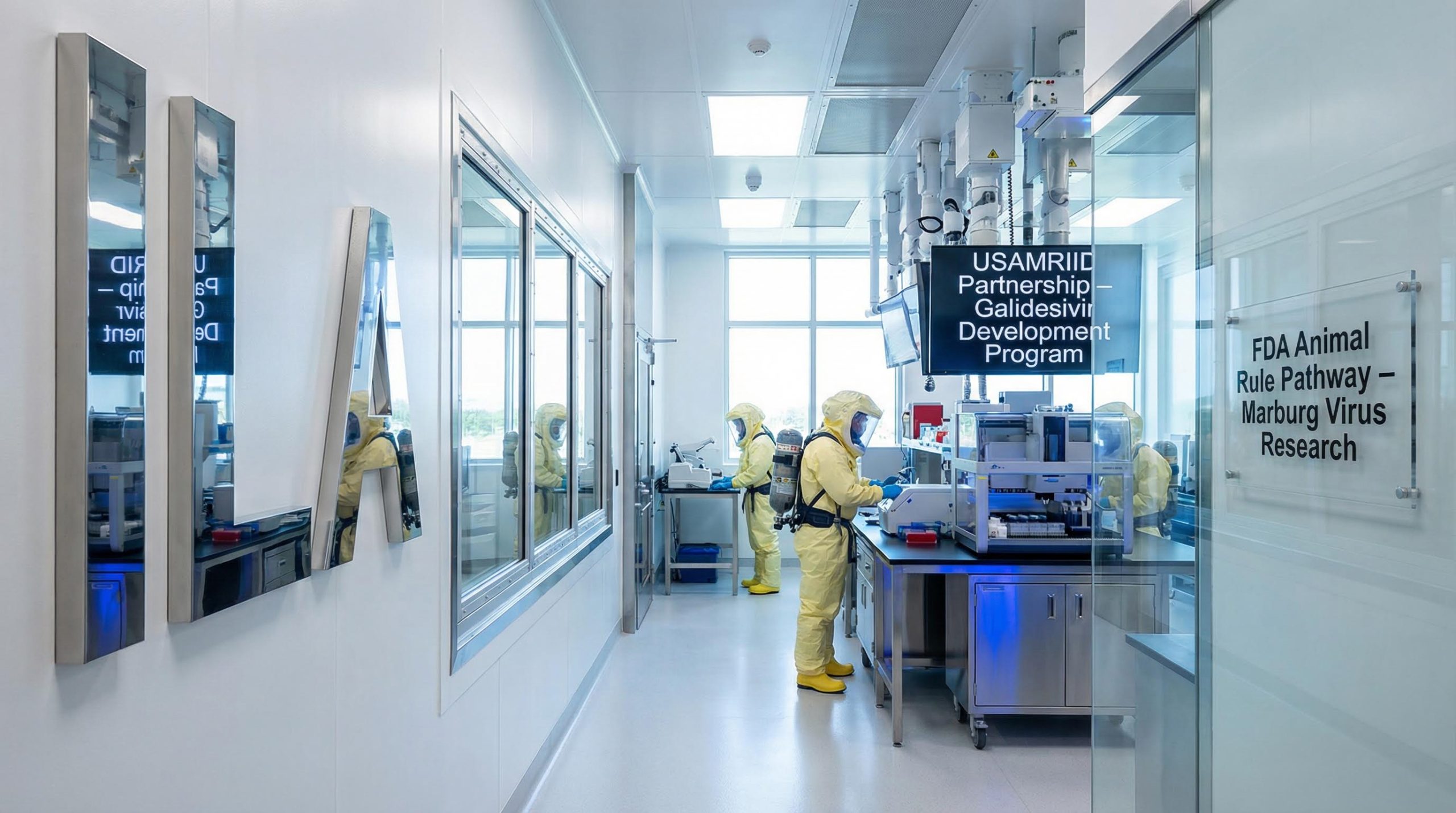
Island Pharmaceuticals (ASX: ILA) has entered into a Cooperative Research and Development Agreement (CRADA) with the US Army Medical Research Institute of Infectious Diseases (USAMRIID) and The Geneva Foundation to advance its antiviral candidate Galidesivir toward FDA approval for Marburg Virus Disease treatment. The Island Pharmaceuticals Galidesivir CRADA Agreement positions the company within the highest levels of the US biodefence ecosystem, providing access to specialised containment facilities and regulatory expertise required to complete Animal Rule development studies over a three-year term with expansion optionality.
The three-party collaboration brings together USAMRIID, the Department of War’s only Biosafety Level 4 laboratory capable of safely studying highly hazardous viruses, and Geneva Foundation, which manages approximately US$383 million in annual research funding across 49 universities, 95 industry partners, and 39 Department of War installations. This institutional validation significantly reduces execution risk for the non-human primate studies necessary for Galidesivir’s progression toward new drug application (NDA) approval under the FDA’s Animal Efficacy Rule pathway.
What is the FDA Animal Rule and why does it matter?
The FDA Animal Rule provides a regulatory pathway for drug approval when human efficacy studies are neither ethical nor feasible. This framework applies specifically to treatments targeting diseases where exposing healthy volunteers or patients to lethal pathogens cannot be justified on ethical grounds. For therapies like Galidesivir, which aims to treat Marburg Virus Disease with case fatality rates exceeding 80% in some outbreaks, conducting traditional Phase III trials would require deliberately exposing participants to a deadly pathogen with no established treatment.
Under the Animal Rule, developers must demonstrate efficacy in at least two well-characterised animal models that reasonably predict human response, alongside established safety data from human clinical trials. The regulatory framework requires that the disease or condition be studied in animals at an advanced stage that models human disease progression. This pathway represents the only viable route to approval for medical countermeasures against high-consequence pathogens where natural outbreak frequency and ethics preclude conventional human efficacy trials.
Understanding this regulatory mechanism is essential for evaluating Island Pharmaceuticals’ development timeline. The Animal Rule pathway removes the dependency on unpredictable outbreak timing while maintaining rigorous scientific standards, though it requires access to highly specialised Biosafety Level 4 facilities capable of conducting non-human primate studies with containment-level pathogens.
When big ASX news breaks, our subscribers know first
USAMRIID’s pivotal role in Galidesivir’s development history
Established in 1969, USAMRIID has provided leading edge medical capabilities to deter and defend against current and emerging biological threat agents for over 50 years. The Institute maintains the only Biosafety Level 4 laboratory within the Department of War equipped to safely study highly hazardous viruses requiring maximum containment, conducting research that leads to vaccines, drugs, diagnostics, and training programmes benefiting both military personnel and civilians.
USAMRIID has been instrumental in Galidesivir’s historical development, supporting preclinical through to non-human primate studies that demonstrated potent antiviral activity against both Ebola and Marburg viruses. Previous studies conducted at the Institute highlighted exceptional survival rates in Marburg and Ebola infected non-human primates following Galidesivir administration, establishing a foundation of efficacy data that directly informs the current collaboration.
Dr David Foster, CEO and Managing Director
“Galidesivir has a long-standing history with USAMRIID, including successful non-human primate studies in Ebola and Marburg. This agreement builds on that foundation and directly supports the data generation required for potential approval in Marburg.”
The existing relationship and proven efficacy data significantly de-risk the upcoming non-human primate studies required for NDA submission. Access to USAMRIID’s specialised BSL-4 infrastructure represents a substantial barrier to entry that Island has now secured through formal collaboration, positioning the company to execute Animal Rule studies without dependency on third-party contract research organisations lacking appropriate containment capabilities.
Geneva Foundation as a government programme accelerator
The Geneva Foundation, established in 1993, operates as a leading US-based non-profit organisation advancing military medical research that protects force health and national security. Geneva partners with the Department of War, federal agencies, academia, and industry to accelerate development of critical medical countermeasures and operational solutions for high-consequence health threats.
Geneva’s credentials and capabilities include:
- US$383 million in annual research funding under management
- Active collaborations with 49 universities and academic medical centres
- Partnerships with 95 industry partners
- Programme support across 39 Department of War installations
- Deep expertise in government-sponsored biodefence programmes
- Regulatory navigation and compliant programme execution experience
Geneva’s involvement provides Island Pharmaceuticals with regulatory navigation expertise and government programme management experience essential for successful biodefence product development. The organisation’s established credibility within the Department of War research ecosystem positions Galidesivir within a network of high-priority medical countermeasure programmes aligned with national security objectives.
Strategic pathway toward Marburg Virus Disease approval
Under the Island Pharmaceuticals Galidesivir CRADA Agreement, the three parties will collaborate to design and conduct non-human primate studies required to progress Galidesivir toward new drug application approval for use in Marburg Virus Disease under the FDA’s Animal Efficacy Rule. The agreement establishes a three-year term with optionality to expand the collaboration as needed to continue accelerating development of Galidesivir for MVD treatment.
The collaboration framework provides several strategic advantages:
- Access to world-leading BSL-4 facilities: USAMRIID’s unique containment infrastructure enables execution of studies impossible to conduct at standard research facilities.
- Regulatory pathway expertise from Geneva: Established experience navigating government-sponsored biodefence programmes and FDA Animal Rule requirements.
- Historical efficacy data foundation: Existing non-human primate study results from USAMRIID demonstrating exceptional survival rates in Marburg and Ebola models.
- Alignment with US biodefence procurement priorities: Formal collaboration positions Galidesivir within established government medical countermeasure programmes.
Government alignment creates a potential procurement pathway post-approval, with the Department of War and Strategic National Stockpile representing significant acquisition channels for approved biodefence therapeutics. The three-year timeline provides visibility on development milestones, while expansion optionality suggests scope for deeper collaboration if initial studies demonstrate compelling efficacy signals.
CEO Dr David Foster noted that the collaboration “further aligns Island with US Government biodefence priorities could operate as both a clinical and commercial accelerator as we advance toward Animal Rule approval.”
What comes next for Island Pharmaceuticals
The formal CRADA establishes the operational framework for near-term development activities, with Island, USAMRIID, and Geneva collaborating on study design and execution protocols for the non-human primate studies required for NDA submission. These studies will generate the pivotal efficacy data necessary to satisfy FDA Animal Rule requirements, building on historical data demonstrating Galidesivir’s activity in Marburg-infected animal models.
Beyond Marburg Virus Disease, Galidesivir has demonstrated broad-spectrum activity across more than 20 RNA viruses, including Ebola, Marburg, MERS, Zika, and Yellow fever. This multi-pathogen activity profile suggests that successful Marburg approval could serve as a platform for expanded indications, potentially accelerating development timelines for additional high-priority threats where similar Animal Rule pathways apply.
Island continues executing a dual development strategy, advancing both ISLA-101 for dengue fever prevention and treatment, and Galidesivir for biodefence applications. The parallel approach diversifies development risk while targeting distinct market opportunities within the antiviral therapeutic space. The biodefence alignment achieved through the USAMRIID and Geneva collaboration positions Island for potential government procurement opportunities that extend beyond traditional pharmaceutical commercialisation models.
The Marburg development programme now benefits from institutional validation at the highest levels of US biodefence research infrastructure. This positioning may influence both development execution risk and commercial trajectory as the company progresses toward regulatory submission milestones over the agreement’s three-year term.
Want the Next Biotech Breakthrough in Your Inbox?
Join 20,000+ investors receiving FREE breaking ASX Healthcare and Biotech news within minutes of release, complete with expert analysis. Click the “Free Alerts” button at Big News Blast to get market-moving announcements delivered straight to your inbox the moment they drop.