
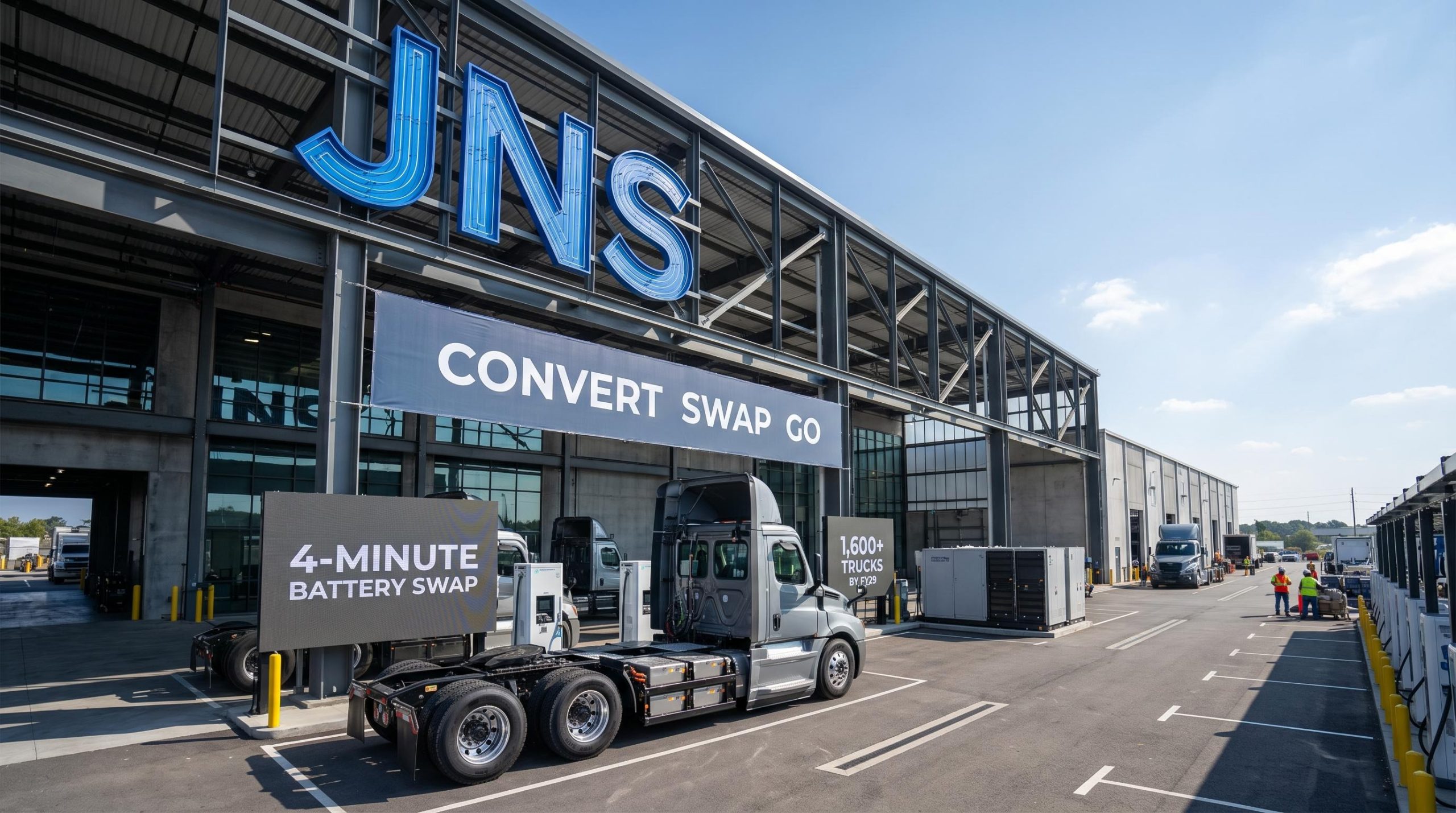
Janus Electric outlines ambitious path to 1,600+ electric trucks
In its April 2026 investor presentation, Janus Electric (ASX: JNS) outlined a three-horizon growth framework targeting transformation from 28 trucks currently on the road to 1,600+ by FY29. The strategic roadmap, presented under new CEO Ben Hutt (appointed January 2026) and CFO Ton van Hoof (March 2026), projects revenue scaling from approximately A$105-115M in FY27 to ~A$660M by Horizon 3.
Management detailed the company’s “convert, swap, go” value proposition, positioning diesel-to-electric retrofits paired with four-minute battery swaps as the solution to heavy transport’s electrification challenge. The presentation emphasised operational proof points including 650,000+ kilometres electrified, 3,600+ battery swaps completed, and 11 Charge & Change Stations operational. With conversion costs of A$175,000 compared to A$500,000-900,000 for new electric trucks, the company argues it has cracked the capital barrier preventing fleet electrification at scale.
When big ASX news breaks, our subscribers know first
How battery swap technology solves heavy transport’s electrification problem
The presentation positioned heavy transport as the hardest sector to decarbonise, with capital constraints forming the primary adoption barrier. New Class 8 electric trucks command price tags of A$500,000-900,000, compared to A$150,000-175,000 for Janus conversion kits. This cost differential enables fleet operators to electrify existing assets rather than undertaking wholesale fleet replacement.
The Janus solution centres on three integrated components: diesel-to-electric retrofit via the Janus Conversion Module (JCM540 with 540kWh capacity), Battery-as-a-Service eliminating operator ownership risk, and a software platform providing fleet intelligence and predictive maintenance. The company’s swap infrastructure delivers four-minute battery changes, contrasting with three-to-four-hour plug-in charging that removes trucks from revenue-generating service. Management claims this operational model supports 99%+ uptime SLAs and 30%+ lower total cost per kilometre versus diesel.
The platform operates on an OEM-agnostic basis, compatible with Mack, Kenworth, Western Star, and Volvo trucks. The JCM540 system provides 350-450km range for single-trailer configurations, targeted at port-based closed loops and high-density freight corridors where battery swap infrastructure density justifies deployment economics.
- Conversion – Retrofit existing diesel trucks with modular electric powertrain
- Battery Swap – Four-minute changeovers via Charge & Change Station network
- Software – Fleet management SaaS generating recurring revenue per asset
Three horizons targeting A$660 million revenue
Management structured its growth framework across three distinct execution phases, each with defined objectives and exit conditions.
Horizon 1 (FY26-27) targets building commercial demand and deploying initial infrastructure. The company aims to place 50-75 trucks on the road by December 2026, establish a 500+ truck pipeline, and deploy Gen 2 battery systems. Production capacity must reach 50 kits per month, with positive gross margin achieved and funding secured to support infrastructure rollout. Revenue target for FY27 stands at A$105-115M, comprising 172 conversions/kits, 205 battery pairs, and 185 charging stations.
Horizon 2 (FY27-28) focuses on establishing physical operations in 3+ countries, reaching 650+ trucks on the road, and structuring the AssetCo/OpCo model. The company plans to introduce bus conversions and seed FleetCo, targeting approximately A$305M revenue. This phase transitions the business model toward capital-light recurring revenue, with infrastructure partners funding battery and charging assets while Janus captures management fees, energy margins, and SaaS revenue.
Horizon 3 (FY29+) envisions scaling to 1,600+ trucks globally under an own/operate/rent/lease model, targeting ~A$660M revenue. At this scale, the company projects ~86% of revenue from transport operations (conversions, kits, leases) and ~14% from energy infrastructure (Battery-as-a-Service, grid services, electricity arbitrage).
| Horizon | Period | Trucks on Road | Revenue Target | Key Milestones |
|---|---|---|---|---|
| H1 | FY26-27 | 50-75 (Dec 2026), 200 (FY27 exit) | A$105-115M | 50 kits/month production, positive gross margin, Gen 2 deployed |
| H2 | FY27-28 | 650+ | ~A$305M | 3+ countries operational, AssetCo structured, FleetCo seeded |
| H3 | FY29+ | 1,600+ | ~A$660M | Global fleet ownership, infrastructure buildout complete |
The AssetCo/OpCo structure reduces Janus’s balance sheet burden by partnering with infrastructure capital providers who own trucks, batteries, and charging hardware. These partners target 10-12%+ infrastructure IRR while Janus earns recurring revenue from management fees, energy margins, and software subscriptions. Management indicated discussions with infrastructure partners are in progress.
Total capital requirements across the three horizons are projected at A$138-187M: A$8-12M for H1 (equity raise ~A$3-5M plus debt), A$30-50M for H2 (asset finance, debt, and JV structures), and A$100-125M for H3 (asset-backed and project finance).
Commercial pipeline exceeds $1 billion
The presentation outlined a geographically diversified pipeline spanning Australia, USA, Canada, and Africa. In Australia, the company has secured 50+ confirmed orders and is booking build slots. The USA Ability Tri-modal trial involves 8+ trucks, with California’s US$90,000-120,000 per-truck incentive driving adoption economics. The EVC dealer network represents an active pipeline of 20+ units targeting Q1-Q2 FY27 delivery.
Canada has signed a consortium deal for 25+ trucks, subject to regulatory approvals, with a pathway to 100 additional trucks by 2028. Africa represents 10+ units in progress under a consortium structure. Management noted 500+ inbound dealer enquiries from USA, UK, Japan, and Malaysia, indicating global interest.
The global addressable market comprises approximately 8 million heavy diesel trucks across target geographies, with current electrification penetration below 1% in most markets. The company positions itself to capture share in a A$1.2 trillion replacement market by offering conversion at A$175,000 versus A$500,000-900,000 for new trucks.
Competitive positioning in an uncontested space
Management positioned Janus as occupying a unique market segment: the only global operator offering diesel-to-electric retrofit combined with battery swap, charging infrastructure, and SaaS for Class 6-8 trucks outside China. The presentation contrasted Janus against adjacent competitors operating in different segments.
CATL/Aulton operates the world’s largest battery swap network with approximately 300 swap stations in China by end-2025, but focuses exclusively on new trucks rather than retrofits. Ample provides battery swap for light commercial vehicles (sedans and vans) but lacks Class 8 heavy truck capability. Revoy offers trailer-mounted range extenders that supplement diesel engines rather than replace them. Lightning eMotors, a Class 3-6 electrification specialist, filed for bankruptcy in 2024, validating the execution challenge in this market.
Pure One (ASX: P1E) competes in the new battery-swappable truck segment, designing vehicles to Australian Design Rules using CATL batteries manufactured in China. Management noted this positions Pure One in the new-truck market rather than the retrofit segment Janus targets.
The presentation identified four structural moats:
- Ecosystem network effects – Operators integrating with swap infrastructure create platform density that attracts additional fleet conversions
- Technology patents – Proprietary conversion system and battery swap platform works across OEM platforms
- First-mover position – No direct global competitor currently operates retrofit+swap+charging+SaaS at scale outside China
- Unit economics advantage – A$175,000 conversion versus A$500,000-900,000 new truck purchase, with 30%+ lower cost per kilometre for operators
Revenue model combines hardware and recurring streams
The presentation detailed a dual revenue structure combining upfront hardware sales with recurring infrastructure and software revenue. Hardware components include truck conversions (A$175,000), conversion kits (A$150,000), Charge & Change Stations (A$225,000), and side batteries (A$330,000).
Recurring revenue flows from Battery-as-a-Service (commercially sensitive pricing), energy pass-through margins, potential grid services and carbon credits, SaaS fleet management platform, energy optimisation, predictive maintenance, and carbon reporting. Management emphasised the 20+ year asset lifecycle generating recurring revenue from each deployed truck.
For FY27, the revenue building blocks comprise 172 conversions/kits, 205 battery pairs, 185 charge stations, and 200 fleet on road by year-end, targeting total revenue of A$105-115M. This scales to ~A$305M in Horizon 2 with 650+ trucks operational, and ~A$660M in Horizon 3 with 1,600+ trucks and approximately 1,200 battery units generating energy infrastructure revenue.
The presentation highlighted the FleetCo/LeaseCo model as enabling zero-capex electrification for operators. Under this structure, a dedicated Janus entity acquires existing diesel trucks, converts them to electric, and leases them back to operators. This generates lease income (30-35% of truck value annually), energy revenue from Battery-as-a-Service (~A$45,000 per truck per year), and SaaS subscription revenue (~A$12,000-24,000 per truck per year).
What investors should watch
The presentation established clear accountability metrics for tracking execution progress. Near-term milestones for Horizon 1 include achieving 50 kits per month production capacity by 31 December 2026, deploying Gen 2 battery systems by 30 June, and reaching positive gross margin. Management must convert the 500+ truck pipeline into confirmed orders and secure A$8-12M funding (equity ~A$3-5M plus debt) to support infrastructure deployment.
Pipeline conversion represents the critical commercial metric, particularly movement from the 500+ inbound enquiries to contracted orders across Australia, USA, Canada, and Africa. The company’s ability to activate its dealer network and scale regional sales teams will determine pipeline velocity.
Ben Hutt, CEO and Managing Director
“We exist to make electric heavy transport the default choice — for every operator, on every route, in every market. Through conversion, not replacement. Through infrastructure, not just vehicles. Through data, not just hardware.”
The company’s shareholding structure comprises approximately 13% held by founders and management (including Founder Lex Forsyth and a pending executive incentive plan subject to shareholder approval), ~25% by significant shareholders (board and early high-net-worth supporters), and ~52% public float. At A$0.15 per share and 118 million shares on issue, market capitalisation stands at A$17.7M.
Operational metrics investors should monitor include fleet uptime performance against the 99%+ SLA guarantee, kit production cycle time (target ≤2 days per kit), battery swap completion rates, and station utilisation across the 11 operational Charge & Change Stations. The progression from 28 trucks currently electrified to 50-75 by December 2026 forms the foundational test of Horizon 1 execution.
Stay Ahead on Electric Vehicle Infrastructure News
Join 20,000+ investors receiving FREE breaking ASX news and in-depth analysis delivered within minutes of release. Click the “Free Alerts” button at StockWire X to get real-time alerts on transport technology companies the moment market-moving announcements hit the ASX.