


Harvest signs strategic MOU to explore Nodestream™ integration in Ukrainian defence systems
Harvest Technology Group (ASX: HTG) has entered a non-binding Memorandum of Strategic Partnership with Ukrainian technology and research organisation Public Union “Technopark Flight City 4.0” (“Technopark”), announced on 23 July 2026.
The MOU sets out the parties’ intention to explore the adaptation, integration, testing and potential deployment of the company’s ultra-low-bandwidth Nodestream™ platform across unmanned aerial systems (UAS), ground robotic platforms (including counter-mine and demining platforms) and AI-enabled systems.
Critically, the arrangement is non-binding, imposes no financial obligations on the company, and effects no transfer of technology. No revenue, committed deployment, or signed commercial contract flows from this document.
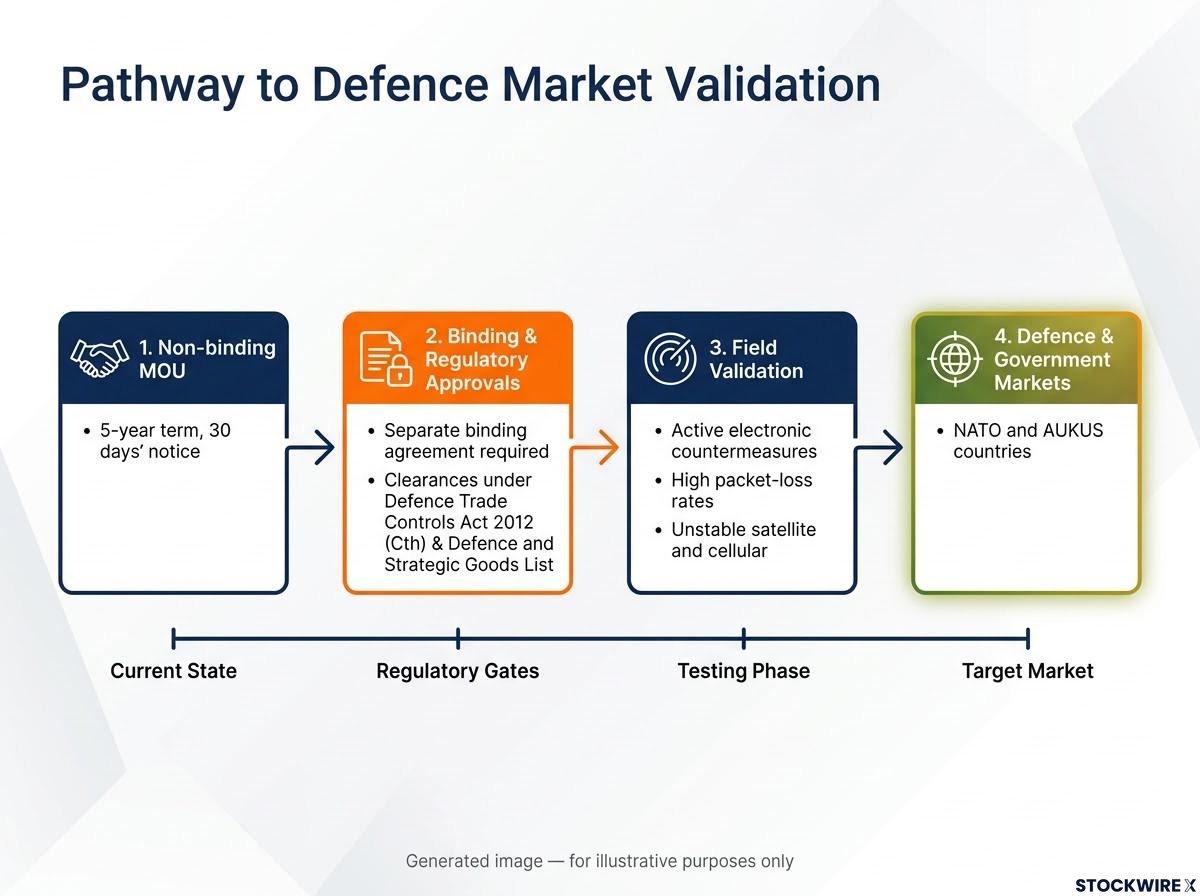
The strategic angle centres on validation. Any performance data obtained under the MOU may support the future marketing of Nodestream™ to defence and government customers in NATO and AUKUS countries. The platform is designed to operate from as little as 8 kbit/s of bandwidth. The MOU carries a 5-year term and may be terminated by either party on 30 days’ notice.
When big ASX news breaks, our subscribers know first
What the partnership is exploring
Subject to a future binding agreement and the required approvals, the parties have identified three areas of potential research and development:
-
Hardware integration — integration of Nodestream™ physical modules (NANO and INTEGRATED form factors) into the onboard systems of unmanned aerial and ground robotic platforms, including demining platforms.
-
Software and AI integration — combining Nodestream™ video, audio and telemetry compression with Technopark’s AI developments to enable transmission of critical recognition data over bandwidth-constrained channels.
-
System and command-and-control integration — implementation of Nodestream™ applications (for Linux and Windows) into ground control stations and coordination centres to support remote operation of robotic platforms over long distances.
The MOU also contemplates field validation of Nodestream™ under demanding conditions, including active electronic countermeasures, high packet-loss rates, and unstable satellite and cellular communications. Any resulting testing reports and expert conclusions may be used by the company to demonstrate the reliability of its systems to defence and government customers in NATO and AUKUS countries.
The field-testing contemplated under the MOU would complement the independent US defence validation Harvest secured earlier in 2026, when a Washington D.C. advisory firm confirmed Nodestream’s alignment with funded Department of Defence programmes in bandwidth-constrained and contested environments.
What Nodestream™ actually does
Nodestream™ is the company’s network-optimised remote-operations platform. It enables secure, resilient, real-time transmission of video, voice, telemetry and data for situational awareness and remote control across mission-critical environments.
Nodestream™ is designed to operate efficiently from 8 kbit/s over any available network, including congested, contested or degraded satellite and cellular links.
This capability is relevant in an electronic-warfare (EW) context. Nodestream™ is available in multiple configurations and form factors, from compact embedded modules to software applications for Linux and Windows. At its most advanced end, it is configured for defence and government security use cases where performance, survivability and reliability are paramount.
For investors, the significance lies in the addressable market. An EW-resilient, ultra-low-bandwidth platform addresses a defence communications need that is drawing increasing international attention.
Why this matters for investors
The MOU signals growing international interest in Nodestream’s defence applications and opens a potential pathway toward NATO and AUKUS defence markets. That said, the arrangement remains exploratory. It commits neither party to proceed and generates no financial return at this stage.
CEO Commentary — Veronica Bainton, Chief Executive Officer
“This memorandum reflects the growing international interest in Nodestream’s ability to deliver resilient communications where bandwidth is scarce and conditions are contested. It is an early, non-binding step, and any future work will be undertaken strictly in line with our export-control obligations — but it opens a pathway to validate our technology in some of the most demanding operational environments in the world.”
The table below separates the confirmed position of the MOU from its potential significance for shareholders.
| Element | MOU Position | Investor Takeaway |
|---|---|---|
| Financial obligation | None | No cost or capital commitment |
| Technology transfer | None | No IP or source code transferred |
| Binding status | Non-binding | Contingent on future binding agreement |
| Market opportunity | NATO/AUKUS defence & government | Validation could support future marketing |
Conditions and next steps
Any future adaptation, integration, testing, deployment or transfer of the company’s technology is conditional on two requirements:
-
The negotiation and execution of a separate, binding agreement.
-
Harvest first obtaining all approvals, permits and licences required under Australian export-control and sanctions laws, including the Defence Trade Controls Act 2012 (Cth) and the Defence and Strategic Goods List, together with applicable customs requirements.
The company has stated there is no certainty that these conditions will be satisfied, that the MOU will progress to a binding agreement, or that it will generate revenue. The arrangement carries a 5-year term and may be terminated by either party on 30 days’ notice.
For shareholders, the MOU represents an early-stage, low-commitment step that could open a validation pathway into contested defence communications markets. Its ultimate value depends on subsequent binding agreements and regulatory clearances that have not yet been secured.
Harvest’s European defence representation now includes Dr Oleksandra Molloy, appointed as European Defence Strategic Advisor with established networks across defence organisations in Australia, Europe, North America, and Ukraine, positioning the company to convert exploratory arrangements like this MOU into procurement conversations.
Get ASX Defence Tech News Before the Market Moves
Big News Blast delivers FREE breaking ASX announcements straight to your inbox within minutes of release, complete with in-depth analysis already done for you. Over 20,000+ subscribers rely on it to stay ahead on defence tech and across every non-resource ASX sector. Click the “Free Alerts” button at StockWire X to start receiving alerts today.