
BWP caps off a reset year with 4.5% FFO growth and $257m valuation uplift
In its August 2026 investor presentation, BWP Group outlined a financial year framed as a “reset year”, one that strengthened income security while building a platform for long-term income and capital growth. The Bunnings-anchored property trust reported funds from operations (FFO) of $140.9m, up 4.5% on the prior corresponding period.
The presentation was delivered by Managing Director Mark Scatena, Chief Financial Officer David Hawkins and Head of Property Andrew Ross. Management structured FY26 around four pillars: management internalisation, the Bunnings lease reset, a balance sheet reset, and an increased contribution from large format retail (LFR).
Alongside earnings growth, the trust recorded profit after revaluations of $408.4m (up 53.8%), a distribution per security (DPS) of 19.41 cents (up 4.1%), and net tangible assets (NTA) of $4.11 per security (up 3.3%). The portfolio valuation rose $257.0m, or 6.9%.
For investors, the combination stands out. FY26 delivered income growth, capital growth and a de-risked balance sheet simultaneously, a rare outcome across the current REIT landscape.
| Metric | FY26 | pcp (FY25) | Change |
|---|---|---|---|
| Funds from operations (FFO) | $140.9m | $134.8m | ↑ 4.5% |
| Profit (after revaluations) | $408.4m | $265.6m | ↑ 53.8% |
| Distribution per security | 19.41 cents | 18.65 cents | ↑ 4.1% |
| Net tangible assets | $4.11 | $3.98 | ↑ 3.3% |
| Portfolio valuation uplift | $257.0m | — | ↑ 6.9% |
When big ASX news breaks, our subscribers know first
A year of reset: internalisation, lease security and a stronger balance sheet
Management presented FY26 as a deliberate reset built on three foundations, each intended to lower the cost base, secure income tenure and strengthen the balance sheet.
-
Internalisation — Management internalisation was implemented in August 2025, driving the management expense ratio down to 0.34% from 0.66% in FY25, through a collaborative transition with Wesfarmers.
-
Lease reset and extension — 62 Bunnings leases were reset and extended, lifting the weighted average lease expiry (WALE) to 7.3 years, from 4.5 years at the prior period.
-
Balance sheet reset — A $228m fully underwritten entitlement offer was completed in May 2026, alongside a $300m 5-year bond issued in October 2025 at a 4.55% coupon. Moody’s upgraded its rating to A3/stable, revised upward from A3/negative.
These measures reduced gearing to 18.5%, from 21.6% at June 2025, while the weighted average cost of debt sat at 4.6% for the year. Notably, Wesfarmers took up its full entitlement in the equity raising, representing a commitment of approximately $53m.
The BWP equity raising terms required retail securityholders to decide whether to participate or accept permanent dilution, with the 1-for-12 non-renounceable structure closing in May 2026 and Wesfarmers anchoring the raise with its full $53 million entitlement.
The company described the reset period as designed to improve recurrent income, secure the Bunnings covenant, lower the cost structure, improve alignment with securityholders and reset the balance sheet to enable a platform for growth.
For investors, the equation is straightforward: a lower cost base, longer income tenure and a de-geared balance sheet together provide a platform for accretive growth.
What is a large format retail REIT?
BWP Group is an ASX-listed property trust anchored by Bunnings Warehouse assets, increasingly diversifying into large format retail (LFR) centres, the destination-style retail parks that house national brands such as home, sporting and lifestyle retailers.
Understanding a few property trust terms helps frame the results:
-
FFO (funds from operations): the cash-based earnings measure REITs use to reflect underlying operating performance.
-
WALE (weighted average lease expiry): the average time remaining on tenant leases. A longer WALE generally means more secure income.
-
Cap rate: the yield used to value a property. A lower or compressing cap rate typically signals higher valuations.
-
NTA (net tangible assets): the underlying asset value per security.
-
Gearing: the ratio of debt to total tangible assets, an indicator of balance sheet risk.
Why does this matter? Income security depends heavily on tenant quality and lease length. Wesfarmers and national retailers together account for approximately 96% of income. Capital growth, meanwhile, comes from valuation uplift and development activity.
Operational execution: LFR leasing spreads surge to 23.6%
Operational performance underpinned the income growth. The trust reported like-for-like rental growth of 3.0%, supported by a balanced lease structure and an increasing contribution from the LFR portfolio.
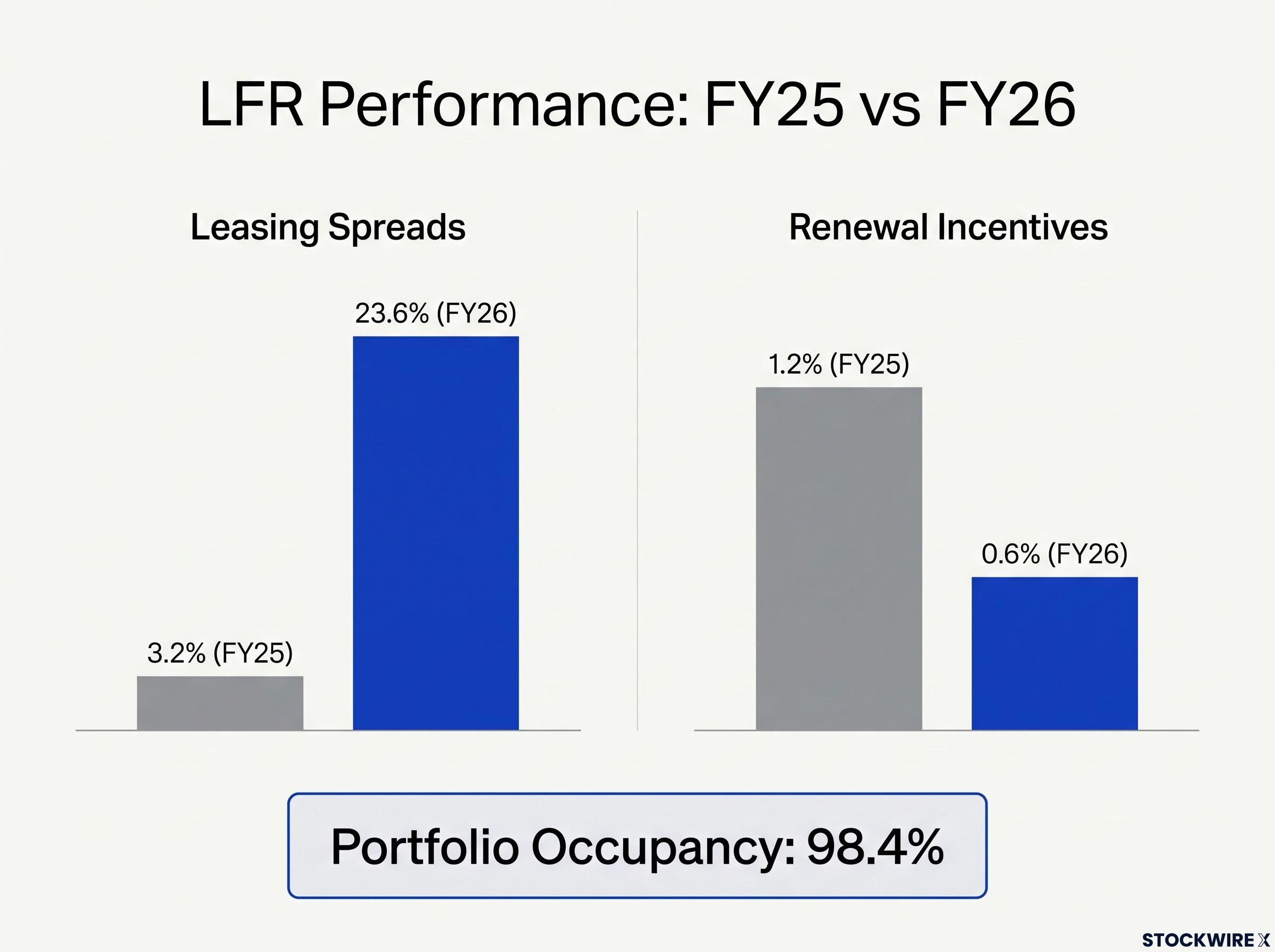
The standout figure was LFR leasing spreads of 23.6% across 14 tenancies, well above the 3.2% recorded in FY25. LFR renewal incentives fell to just 0.6%, down from 1.2%, while portfolio occupancy sat at 98.4% (with non-development assets fully occupied at 100%).
FY26 LFR market rent reviews were resolved at an average increase of 9.3%, and national tenant income represented 96.3% of the total.
Two LFR acquisitions supported the growth pathway:
-
HomeCentre Morayfield (QLD): acquired November 2025 for $48.0m (plus costs) at a 5.75% cap rate, spanning 12,086 sqm and 100% leased.
-
Sunbury Lifestyle Centre (VIC): acquired August 2026 for $25.2m (plus costs) at a 6.00% cap rate, spanning 5,554 sqm and 100% leased.
LFR is now emerging as the growth engine, delivering reversion well above the Bunnings-anchored core.
Capital recycling and a $120m development pipeline
Management detailed active capital recycling, with three divestments completed above book value during the period:
-
Chadstone (VIC): $86.0m, a 15.2% realised internal rate of return (IRR)
-
Morley (WA): $19.5m, a 10.2% IRR
-
Port Kennedy (WA): $14.3m, a 5.8% IRR
Cumulative gross proceeds on sale came in 18.6% above pre-divestment valuations.
The Chadstone Homeplus divestment, completed at $86.025 million and settled in June 2026, illustrated the mechanics of BWP’s recycling discipline: a Bunnings lease extension to July 2030 was used to lift the asset’s marketability before sale to Centuria Capital Group at a 1.1% premium to book value.
Looking forward, the presentation outlined approximately $120m of committed future capital expenditure across repurposing, expansions and portfolio upgrades.
| Project | Future use | Est. yield on spend | Completion |
|---|---|---|---|
| Fountain Gate (VIC) | LFR conversion | ~15% | September 2026 |
| Noarlunga (SA) | LFR conversion | ~12% | December 2026 |
| Broadmeadows (VIC) | Expansion on surplus land | ~10% | March 2027 |
| Midland (WA) | No change to use | ~7.5% | September 2026 |
The repurposing of ex-Bunnings sites into LFR centres is creating substantial value. Fountain Gate, for example, was revalued from $30.5m to $81.0m across the second half.
FY27 outlook: distribution guidance lifted to 20.00 cents
Management provided forward guidance for FY27, setting distribution guidance at 20.00 cents per security, representing approximately 3.0% growth on FY26. This reflects an expected payout ratio of approximately 104% of FFO, within the trust’s target range of 90 to 110%.
FY27 capital expenditure guidance was set at $55m to $65m, dependent on construction phasing. Guidance remains subject to no major disruption to the Australian economy or material change in market conditions.
Management noted that FY27 FFO is expected to be improved by like-for-like rental growth, leasing spreads, contributions from repurposing activities and acquisitions, and reduced interest expense following the May 2026 equity raising. This improvement is expected to be moderated by reduced income from recent property divestments.
The strategic priorities outlined for FY27 include:
-
Seeking positive LFR leasing spread outcomes
-
Completing the Fountain Gate, Noarlunga, Midland and Broadmeadows repurposing projects
-
Progressing Bunnings expansions at Pakenham and Maitland
-
Pursuing complementary acquisitions to the portfolio
Taken together, the guidance signals management’s confidence that the FY26 reset year converts into sustained income growth over the periods ahead.
Don’t Miss the Next REIT Opportunity on the ASX
Big News Blast delivers FREE breaking ASX property and REIT news directly to your inbox within minutes of release, complete with in-depth analysis. Join 20,000+ investors already staying ahead of the market. Click the “Free Alerts” button at StockWire X to start receiving alerts the moment news breaks.