
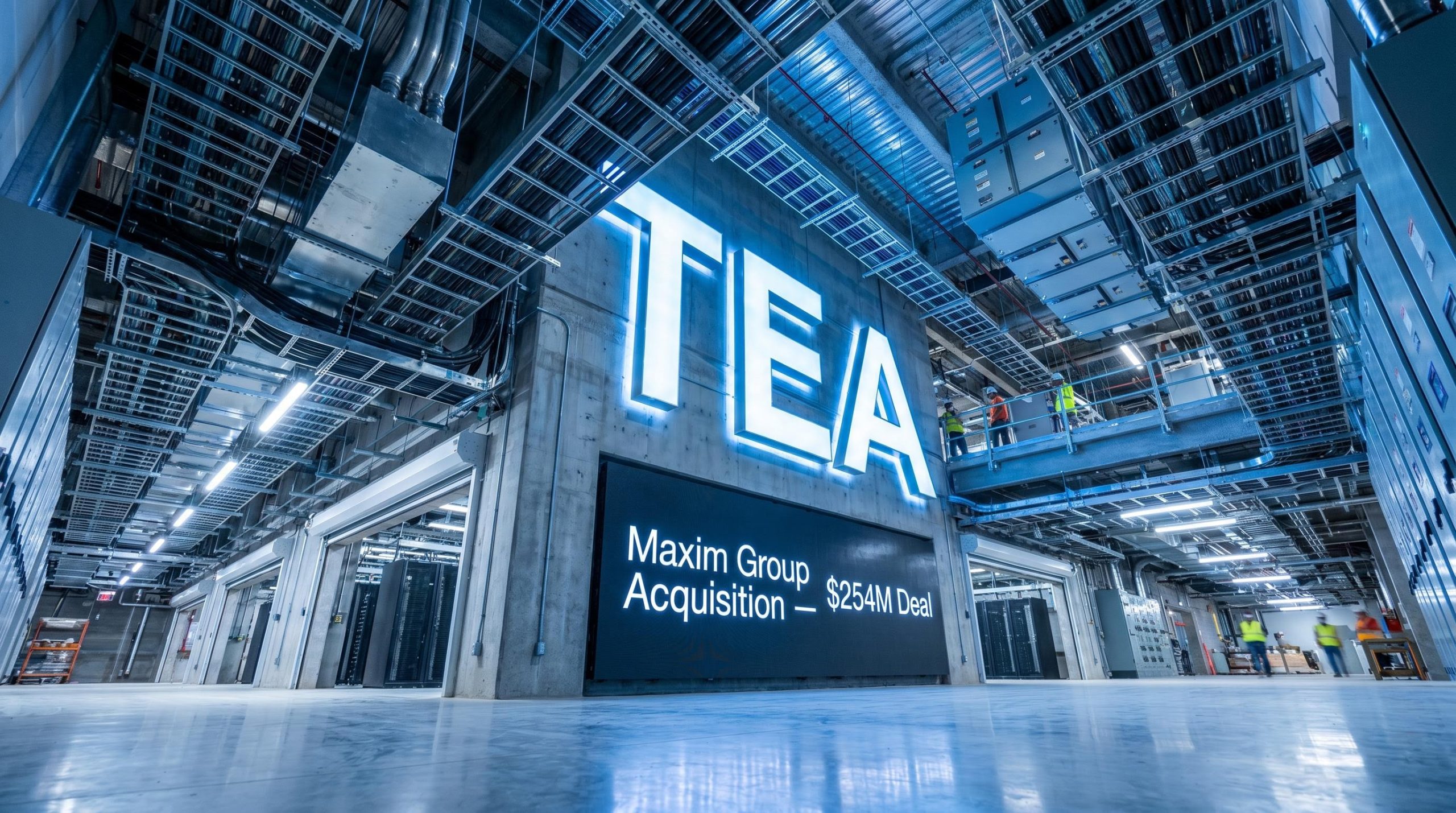
Tasmea acquires Maxim Group in a ~$254 million deal, targeting Victoria’s data centre and energy storage boom
In its June 2026 investor presentation, Tasmea Limited (ASX: TEA) outlined the acquisition of Maxim Group, a specialist Victorian electrical contractor, for total consideration of up to approximately A$254 million. The deal comprises A$184 million upfront at settlement plus an earn-out of up to A$70 million across FY27–FY29, with the Sale and Purchase Agreement (SPA) executed on 1 June 2026 and settlement targeted on or around 1 July 2026, subject to Australian Competition and Consumer Commission (ACCC) approval.
The acquisition is forecast to be immediately EPS accretive, with management presenting a pro forma ~31% EPS accretion for FY26e (excluding synergies), lifting forecast pro forma EPS from 29.8 cents per share (cps) to 39.1 cps. Tasmea’s existing FY26 guidance remains intact, with underlying EBIT of $117 million and underlying NPAT of $72.5 million reconfirmed.
When big ASX news breaks, our subscribers know first
Who is Maxim Group?
Maxim Group is a Victoria-headquartered, owner-led specialist electrical contractor with more than 30 years of operating history. Its current workforce stands at approximately 900 people, anchored by a core of around 600 full-time electricians supported by roughly 70 apprentices.
The business operates across three structural end-markets: Data Centres, Major Government Infrastructure, and Renewable Energy including Battery Energy Storage Systems (BESS). Competitive differentiation is significant. Maxim holds entrenched relationships with one of Victoria’s largest data centre operators, maintains one of the largest rail-inducted workforces in the state (more than 200 VEDN-accredited personnel), and has an internalised high-voltage (HV) capability backed by more than 30 specialist accredited staff. The business currently has 14 active Data Centre and Industrial projects and 15 active Infrastructure and Renewable Energy projects.
Financially, Maxim is tracking to an FY26e underlying EBIT of approximately $47.1 million, with Maintainable EBIT of approximately $50 million per annum, achieved against a revenue growth rate of approximately 70% CAGR from FY24A to FY26e.
A business built for Victoria’s structural growth markets
- 30+ years operating, headquartered in Victoria
- ~600 full-time employees; ~70 apprentices; ~900 current workforce
- 450+ projects delivered; approximately 30 currently active
- $1.3 billion+ identified pipeline
- Full FY27 revenue visibility; approximately 85% FY28 revenue visibility
- More than 90% long-term, high-recurring revenue customers; half of the top 20 customer relationships exceed 10 years tenure
Why data centres, BESS and infrastructure? Understanding Victoria’s structural growth opportunity
The three sectors in which Maxim operates are not cyclical in nature — they reflect multi-year structural shifts in how Australia builds, stores, and distributes power and compute capacity.
Victorian data centre operating capacity is forecast to grow at a 22% CAGR from CY25 to CY30, expanding from 0.4GW in 2025 to a projected 1.1GW by 2030 (DC Byte, Australian Data Centre Forecast Report, April 2026). At the national level, McKinsey forecasts Australian data centre demand growing from approximately 1.5GW in 2025 to 3.9GW by 2030, representing a CAGR of more than 21%. A supply shortfall of approximately 200MW is already apparent at 2026 estimates, with forecast supply of ~1.7GW falling short of demand of ~1.9GW. Announced Australian data centre capital expenditure to 2030 exceeds A$65 billion, with Microsoft committing approximately A$25 billion and Amazon/AWS approximately A$20 billion.
Electrical infrastructure is a particularly well-positioned subsector within this buildout. According to AFR/Chanticleer (19 May 2026), electrical infrastructure accounts for approximately one-third of the total construction cost of an individual data centre. Specialist electricians with accredited HV capability sit at the centre of nearly every major project.
On the BESS side, the AEMO Draft 2026 Integrated System Plan (ISP) forecasts NEM utility-scale storage capacity to grow from 3GW in FY25 to 27GW in FY30, representing a 58% CAGR. Australia’s AEMO connections pipeline currently holds approximately 26GW of utility-scale battery projects at various development stages. Delivering the HV infrastructure required (33kV–132kV) demands scarce, accredited specialists — precisely the capability Maxim has built.
The Victorian government infrastructure pipeline adds a third demand layer, with approximately $10 billion+ in committed projects creating sustained workload.
| City / Market | 2025 (GW) | 2026F (GW) | 2027F (GW) | 2028F (GW) | 2029F (GW) | 2030F (GW) |
|---|---|---|---|---|---|---|
| Sydney | 0.8 | 1.0 | 1.2 | 1.5 | 1.7 | 2.0 |
| Melbourne | 0.4 | 0.5 | 0.6 | 0.7 | 0.9 | 1.1 |
| National | 1.4 | 1.7 | 1.9 | 2.3 | 2.7 | 3.2 |
Source: DC Byte / Data Centres Australia, Australian Data Centre Forecast Report Issue 1, April 2026 (data as at 31 March 2026)
Transaction structure and what it means for TEA shareholders
How the deal is funded
The A$184 million upfront consideration is funded through two sources:
- ~A$112 million cash, drawn from Tasmea’s existing cash reserves and debt facility (gross acquisition debt pre-consolidation of the Maxim Group Balance Sheet)
- A$72 million in Tasmea scrip, comprising 12 million new TEA shares issued to vendors at $6.00 per share, with a Floor Price Guarantee of $6.00 to 30 June 2027, conditional on non-disposal
The earn-out structure comprises three cash payments of up to approximately A$23.33 million each, payable on 30 September 2027, 2028, and 2029, contingent on Maxim achieving a Maintainable EBIT of at least A$50 million in each of FY27, FY28, and FY29. For every $1 of EBIT below A$50 million, the earn-out reduces by $2, with an EBIT floor of A$38.3 million equating to nil earn-out. A cumulative catch-up provision applies if Maxim achieves cumulative EBIT of A$150 million over the three-year earn-out period.
Post-deal, forecast net debt to pro-forma FY26e EBITDA is approximately 0.8x, remaining within Tasmea’s target leverage range.
The financial uplift for TEA shareholders
| Metric | TEA pre-Maxim | Pro forma post-Maxim |
|---|---|---|
| EBIT | $128m | $175m |
| NPAT | $78m | $107m |
| EPS | 29.8 cps | 39.1 cps |
| Net leverage | <0.5x | ~0.8x |
Maxim contributes 27% of pro forma FY26e EBIT and 27% of pro forma NPAT. Following completion, Tasmea’s Electrical segment becomes one of the largest electrical contractors on the ASX, with Electrical EBIT forecast at approximately $100 million.
Tasmea Presentation — June 2026
“Maxim positions Tasmea as the leading specialist electrical platform exposed to high growth Data Centre, Infrastructure, BESS and Renewables sectors.”
Management retained and incentivised — the owner-operator model in action
The Maxim Group brand will be retained, and the founding owners and senior executives are remaining with the business under minimum three-year employment contracts. The retained leadership team includes the Managing Director (30+ years with Maxim), the Estimating Director (26+ years), the Infrastructure Director (9+ years), and the Operations Manager.
Vendor and management alignment is structured across three layers. First, the A$72 million in TEA scrip (12 million shares at $6.00 per share) issued to vendors creates direct equity alignment with Tasmea shareholders. Second, the earn-out of up to A$70 million tied to the A$50 million Maintainable EBIT hurdle ensures performance-based incentivisation over the FY27–FY29 period. Third, key executives will join Tasmea’s Long-Term Incentive (LTI) programme following the earn-out period.
On synergies, the presentation outlined cross-sell opportunities across Tasmea’s Electrical, Mechanical, Civil, and Water and Fluid service streams into Maxim’s client base. Tasmea Corporate Services (covering finance, legal, commercial, recruitment, HR, IR, taxation, and safety) will support Maxim’s growth, while the WorkPac labour engine provides workforce scale. Cost synergies are anticipated on procurement (cable, switchboards, plant) and insurance at the group level. Maxim’s core clients have national operating footprints, with NSW, WA, and SA identified as cross-sell growth markets for Tasmea’s specialist subsidiaries.
A landmark deal that repositions TEA for the next decade of infrastructure growth
The acquisition of Maxim Group represents a material step in Tasmea’s programmatic acquisition strategy. The deal is immediately EPS accretive at approximately 31%, underpinned by high-quality earnings with more than 90% recurring revenue customers, full FY27 revenue visibility, approximately 85% FY28 visibility, and conservative post-deal leverage of approximately 0.8x.
Maxim is the latest addition to Tasmea’s multi-subsidiary electrical platform, which now encompasses eight electrical businesses, including Tasman Power (18 years), ICE Engineering and Construction (25 years), Future Engineering and Communication (21+ years), and Maxim Group (30 years), among others. The combined Electrical segment is positioned across Mining, Electrification, Energy, Data Centres, and Infrastructure, with structural tailwinds in each market.
Settlement is targeted on or around 1 July 2026, subject to satisfaction of customary conditions precedent, including ACCC approval under Australia’s new mandatory merger control regime.
Don’t Miss the Next ASX Industrials Breakout
Big News Blast delivers FREE breaking ASX news straight to your inbox within minutes of release, complete with in-depth analysis already done for you. Join 20,000+ investors staying ahead on deals, earnings, and sector moves the moment they hit the market. Click the “Free Alerts” button to start receiving alerts today.