


Freelancer posts A$574.6m in group GMV as Escrow and Loadshift offset a softer half
In its H1 FY26 investor update, released on 28 July 2026, Freelancer Limited (ASX: FLN | OTCQX: FRLCY) reported group gross marketplace value (GMV) of A$574.6m, up 30.9%, as strong growth in Escrow.com and Loadshift offset lower activity in the core Freelancer marketplace.
Management presented a mixed but constructive half. Group revenue fell 12.1% in Australian dollars to A$23.9m, yet was broadly flat in US dollars, declining just 2.6% to US$16.8m. With USD representing 72.4% of group revenue, currency movements were a key distortion behind the headline figures.
The group ended the period near breakeven, recording an operating loss of A$0.3m. For investors, the AUD headline understates the underlying USD performance, an important nuance when assessing the true trajectory of the business.
When big ASX news breaks, our subscribers know first
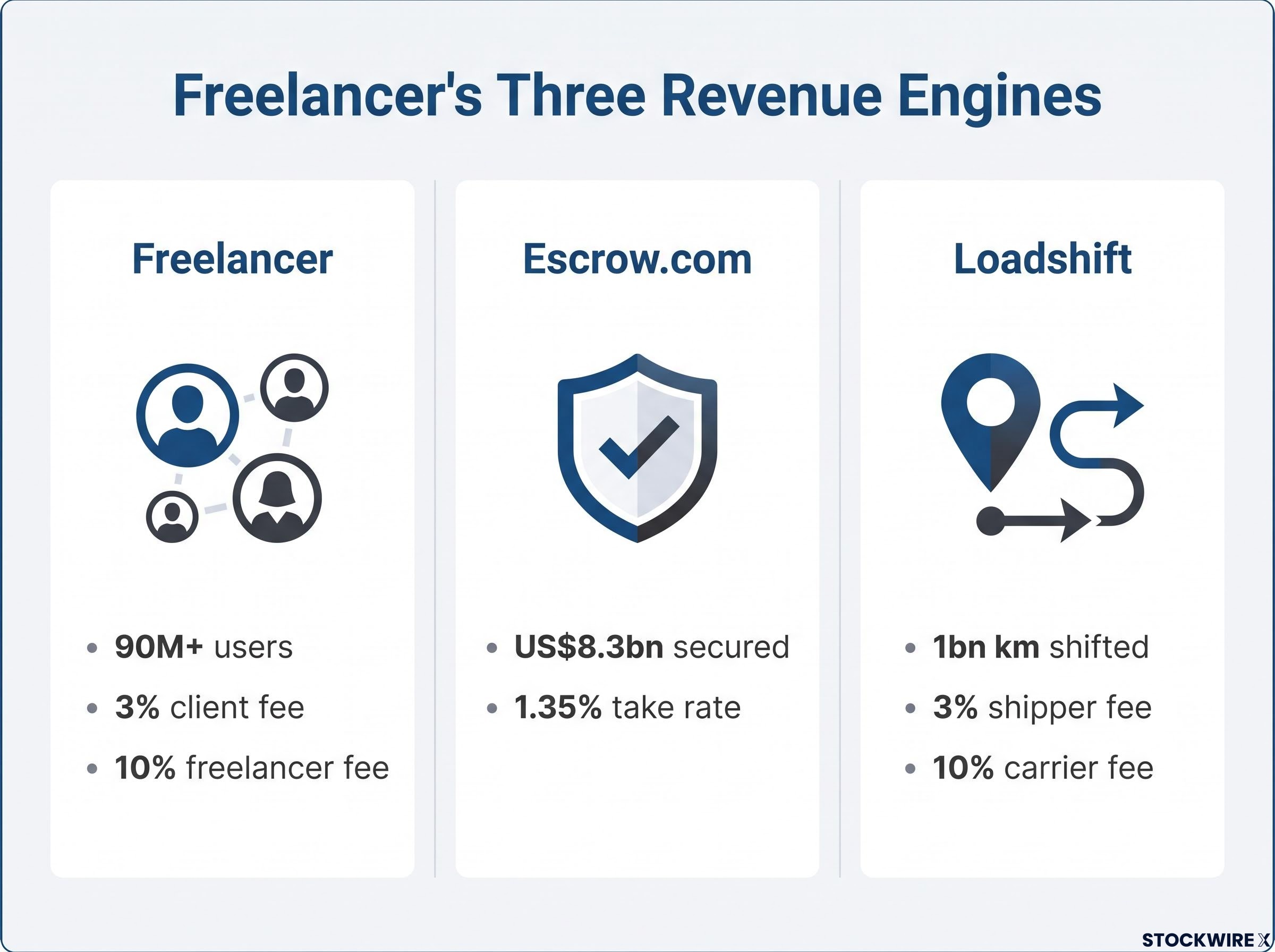
Three platforms, one engine: how Freelancer generates revenue
Freelancer operates three asset-light marketplaces, each monetising a different form of critical business infrastructure through transaction-based take rates. The model matters because diversified, transaction-driven revenue can cushion weakness in any single segment.
-
Freelancer: described as the world’s largest cloud workforce with 90M+ users; charges a 3% client fee plus a 10% freelancer fee on each job.
-
Escrow.com: described as the #1 global online escrow company, with over US$8.3bn secured to date; average take rate of 1.35% per secure transaction.
-
Loadshift: described as Australia’s largest freight marketplace, with over 1bn km shifted; charges a 3% shipper fee plus a 10% carrier fee.
Together, the three platforms monetise trust, talent and transport at transaction speed, giving the group multiple revenue streams that scale independently.
Segment performance — Escrow and Loadshift scale as Freelancer manages headwinds
Escrow and Loadshift both delivered growth over the half, while the Freelancer marketplace worked through a series of operational headwinds. The segment split is set out below.
| Segment | Metric | H1 FY26 (A$m) | Growth (AUD) | Growth (CC/USD) |
|---|---|---|---|---|
| Escrow | GMV | 517.6 | ↑ 39.0% | ↑ 54.6% |
| Escrow | Revenue | 7.0 | ↑ 15.1% | ↑ 27.7% |
| Loadshift | GMV | 14.6 | ↑ 9.6% | — |
| Loadshift | Revenue | 1.8 | ↑ 12.2% | — |
| Freelancer | GMV | 42.4 | ↓ 20.3% | ↓ 11.7% |
| Freelancer | Revenue | 14.9 | ↓ 23.2% | ↓ 15.0% |
Escrow.com scaling with operating leverage
Escrow.com continued to scale, with domain-name transactions remaining a core growth driver. Domain names rose 56%, IPv4 addresses 70%, and wholesale electronics surged 1,688%, a vertical the company forecasts to become its #2 category.
Gross margin expanded to 92.9%, up 2.7 percentage points, in what management described as the seventh consecutive year of profitability. The take rate eased to 1.35% from 1.63%, reflecting a mix shift towards higher-value transactions that carry lower take rates.
Loadshift sets records and prepares to go global
Loadshift delivered all-time record revenue and GMV, reaching A$14.6m in GMV over the half. The company launched a PSTN-to-in-app voice bridge intended to reduce off-platform activity, and is progressing plans to expand beyond Australia into other jurisdictions.
Freelancer — three headwinds being remediated
Management presented the Freelancer weakness as operational and being actively remediated rather than structural. Three specific headwinds were identified:
-
A surge in AI scraper traffic, up 1,300% year-on-year, caused stability issues and SEO de-indexation. Stability has since been rectified, with traffic reported above pre-de-indexation levels.
-
Enhanced security and two-factor authentication (2FA) controls reduced fraud but churned some returning customers. Integrity controls were optimised in Q2 FY26.
-
A failed payment gateway migration in Q1 FY26 revealed long-standing acceptance issues at some providers. Remediation is underway, with volume progressively migrated away from underperforming gateways.
What is online escrow — and why Escrow.com is the growth engine to watch
Online escrow is a payment method that holds a buyer’s funds securely until both parties are satisfied a transaction is complete. It exists to make high-value transactions safe where the buyer and seller may not know or trust each other.
The process follows a simple flow. The buyer and seller agree terms, the buyer pays Escrow.com, the seller delivers the goods or service, the buyer inspects what was received, and only then does Escrow.com release funds to the seller.
This matters because everyday digital payments handle low-value transactions well, but struggle above a few thousand dollars. Escrow unlocks the larger-value half of trade across verticals such as:
-
Domain names
-
IPv4 addresses
-
Wholesale electronics
-
Cars, boats and aircraft
-
Business mergers and acquisitions
Escrow.com operates in a structurally underserved segment of large-value payments, positioning it as the clearest scaling story within the group.
H1 FY26 financials — cost discipline holds the line near breakeven
Group profitability was impacted by the softer Freelancer performance, though cost discipline and margin expansion supported the underlying result. The summary is set out below.
| Metric (A$m) | H1 FY26 | H1 FY25 | Change |
|---|---|---|---|
| Revenue | 23.9 | 27.2 | ↓ 12.1% |
| Gross Profit | 20.9 | 23.2 | ↓ 10.4% |
| Gross margin | 87.4% | 85.3% | +2.1 ppt |
| Operating expenses | 19.8 | 19.4 | +1.8% |
| EBITDA | 1.1 | 3.8 | ↓ 70.2% |
| Operating (loss)/profit | (0.3) | 1.8 | — |
| Net (loss)/profit after tax | (2.1) | 1.9 | — |
Several nuances underpin the result:
-
Gross margin improved to 87.4% despite lower revenue, helped by the relatively fixed cost base supporting Escrow volumes.
-
Employee and hosting costs were reduced through active cost management, operating efficiencies and supplier negotiations.
-
The net loss of A$2.1m was primarily driven by a A$2.4m non-cash impairment of non-core digital assets (Warrior Forum, acquired in 2014). The carrying values of the core Freelancer, Escrow.com and Loadshift businesses remained supported.
-
An FX gain of A$0.9m arose mainly from translating foreign-denominated liabilities back to AUD.
The statutory loss is therefore heavily influenced by a non-cash impairment, with underlying operations sitting near breakeven while margins expand.
Cash position and balance sheet
Cash and cash equivalents stood at A$17.9m at 30 June 2026, down from A$22.9m at the start of the half. Positive operating cash flow before working capital was offset by lease payments, working-capital movements and the acquisition of non-controlling interests.
-
Opening (31 Dec 2025): A$22.9m
-
Operating cash flow (before working capital): +A$0.7m
-
Working capital movements: −A$1.2m
-
Lease liabilities: −A$2.8m
-
Capex: −A$0.1m
-
FX revaluation: −A$0.8m
-
Loadshift NCI acquisition: −A$0.8m
-
Closing (30 Jun 2026): A$17.9m
Management outlined capital priorities of maintaining strong treasury discipline to manage user obligations, reaching consistent positive free cash flow, and achieving an outsized return on invested capital. The drawdown was largely structural, driven by leases, and strategic, driven by the NCI acquisition.
H2 FY26 outlook — executing to reignite Freelancer growth
For the second half, management set out priorities across three areas, framed around returning Freelancer to growth while continuing to scale Escrow and Loadshift.
The company’s stated focus is that execution and cost discipline will drive operating leverage, supported by new financial and product leadership and demonstrable AI-driven productivity gains.
The stated priorities were grouped as follows:
-
Return Freelancer to growth: deliver product stability under new leadership, improve payment acceptance and conversion, rebuild organic traffic, and drive repeat and higher-value use.
-
Scale Escrow & Loadshift: expand Escrow verticals including wholesale electronics and import/export, improve Loadshift monetisation and enterprise workflows, and progress selective geographic expansion.
-
Improve operating leverage: implement identified cost savings, demonstrate AI-driven productivity (AI handles 100% of tier-1 support and around 11% end-to-end, with up to a 40% uplift in engineering releases), and allocate capital selectively.
The recovery thesis rests on Freelancer remediation landing while Escrow and Loadshift continue to compound.
The investment case in brief
Freelancer’s H1 FY26 update presents three asset-light platforms, two compounding strongly and one in active remediation. Margins expanded across the group, with gross margin lifting to 87.4%, even as revenue softened in reported terms.
The statutory loss was shaped largely by a non-cash impairment of a non-core asset, leaving underlying operations near breakeven on a disciplined cost base. Whether the recovery thesis plays out depends on the Freelancer remediation taking hold while Escrow.com and Loadshift keep scaling into H2 FY26.
Don’t Miss the Next ASX Tech Turnaround
Big News Blast delivers FREE breaking ASX tech and digital sector news directly to your inbox within minutes of release, complete with in-depth analysis already done for you. Join 20,000+ active subscribers who stay ahead of the market the moment announcements drop. Click the “Free Alerts” button to start receiving alerts today.