

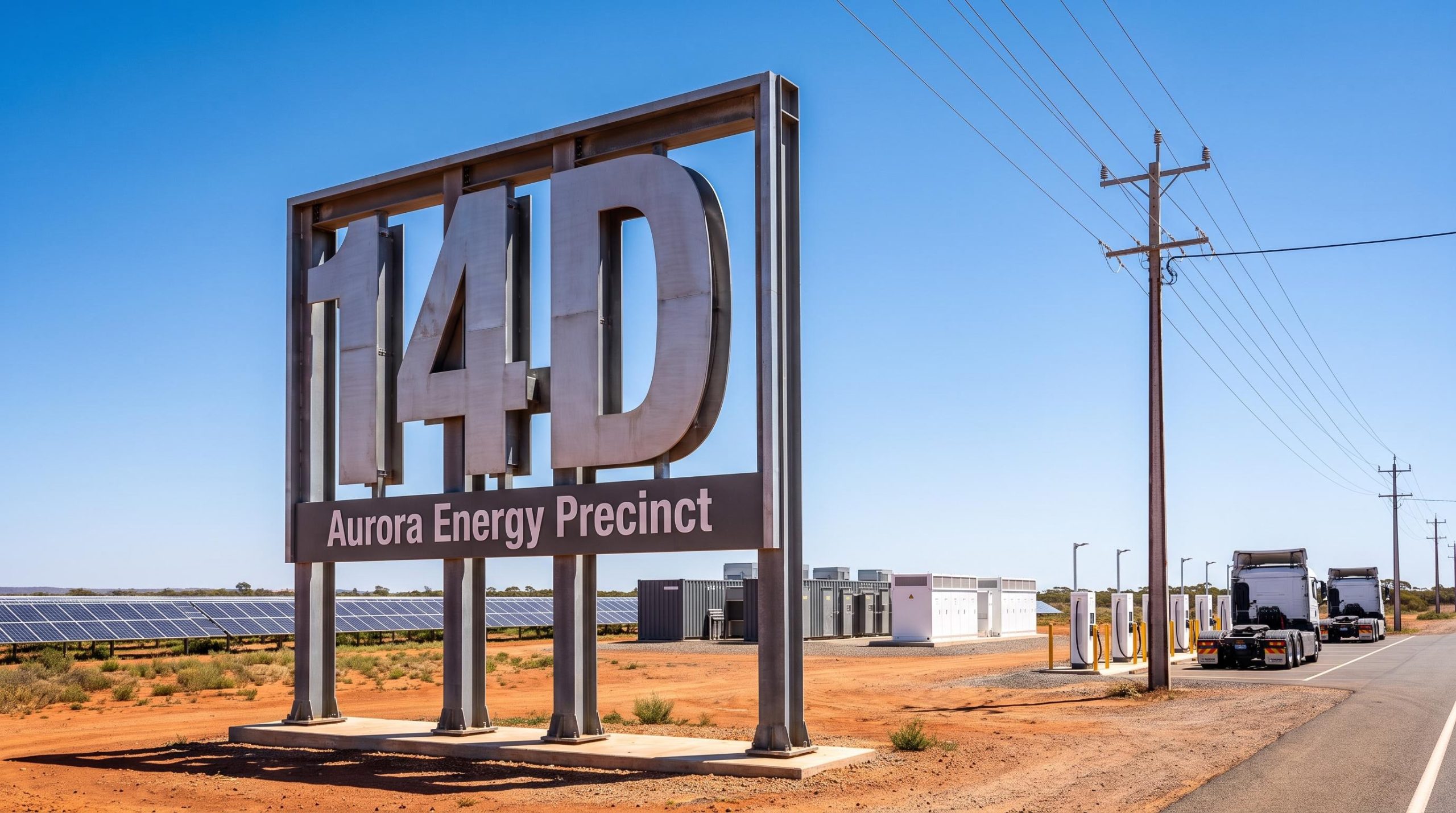
14D fast-tracks early revenue with EV charging and modular data centre plans at Aurora
1414 Degrees (ASX:14D) is advancing a 33kV distribution connection pathway at its Aurora Energy Precinct to enable a faster, lower-capital route to commercialisation ahead of the full 275kV transmission build-out.
The Company has identified two early uses for this pathway: EV charging infrastructure for heavy transport and power supply for modular data centres. Together, these applications could open a potential early revenue pathway without waiting for the larger transmission-connected development to reach full scale.
When big ASX news breaks, our subscribers know first
Two boundaries, two pathways to commercialisation
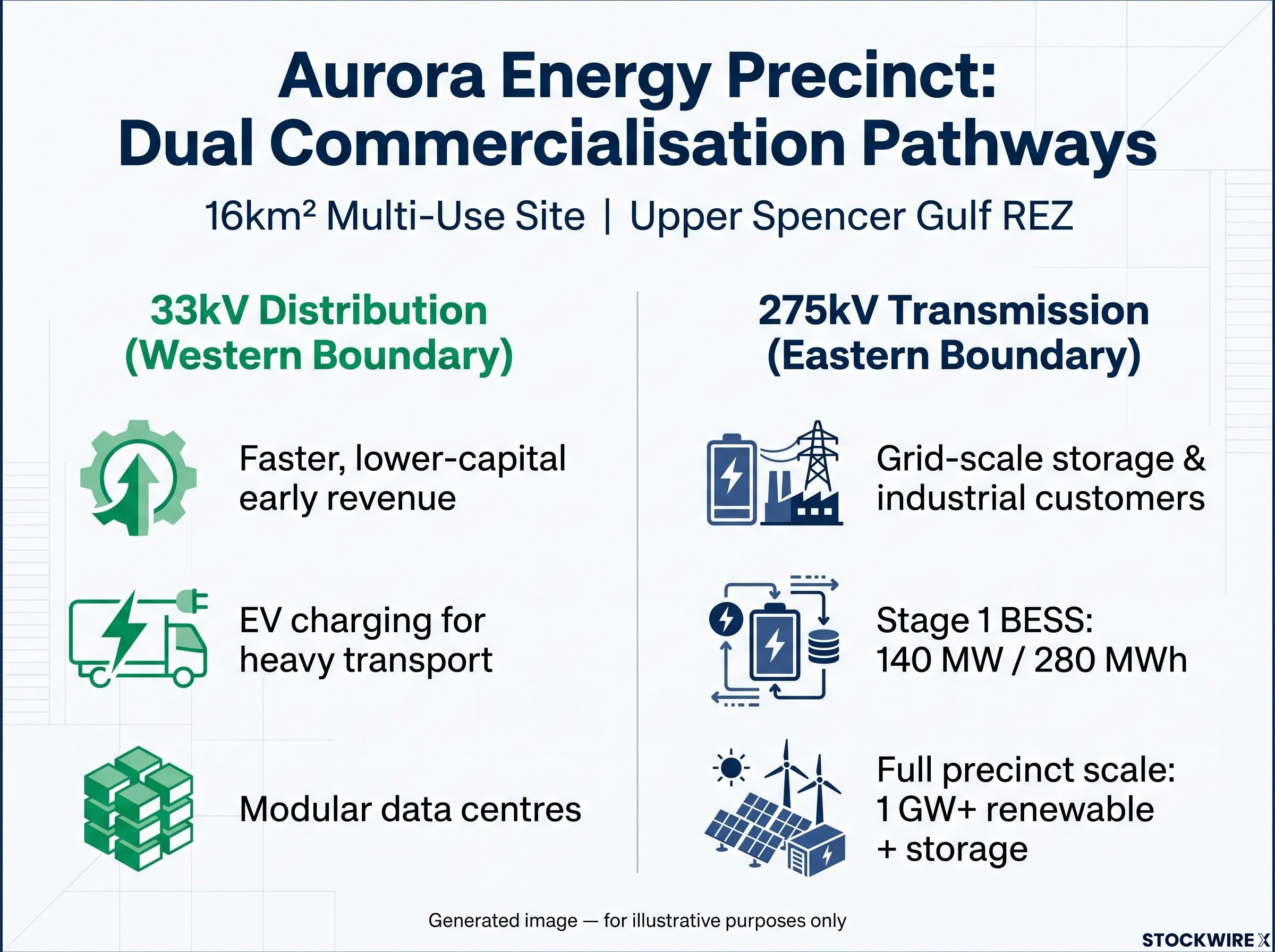
Aurora’s development plan to date has centred on its 275kV transmission connection along the eastern boundary, which is being progressed to support grid-scale battery storage, renewable generation and industrial-scale customers. The Company has now identified that its 33kV distribution infrastructure on the western boundary offers a complementary, lower-capital route that could bring parts of the precinct into commercial use earlier.
Importantly, this approach complements rather than replaces the broader transmission-connected vision. The 33kV pathway offers several potential advantages:
-
Reduced upfront capital requirements
-
A quicker path to connection and revenue
-
Shortened development timelines
By pursuing both boundaries in parallel, 1414 Degrees aims to stage development in a way that could unlock earlier commercial activity while continuing to progress the larger-scale grid-connected opportunities.
Powering the freight electrification wave
The first identified use for the 33kV pathway is EV charging infrastructure for heavy transport fleets operating the Stuart Highway corridor, including traffic linked to Olympic Dam. This corridor runs approximately 2,700 kilometres from Darwin in the Northern Territory to Port Augusta in South Australia, serving as a critical artery for heavy transport, mining logistics and national supply chains.
Such charging infrastructure could be co-located with Aurora’s renewable generation from photovoltaic and battery energy storage systems. The broader freight electrification trend is supported by notable market tailwinds:
-
Global electric truck sales more than doubled in 2025, surpassing 400,000 units and accounting for 9% of all new truck sales worldwide, up from around 2% in 2024 (International Energy Agency)
-
A federal A$70 million Clean Energy Finance Corporation (CEFC) financing package to accelerate deployment of Australian-made Volvo electric trucks, alongside support for charging infrastructure
According to the Company, the Aurora Energy Precinct is positioned to benefit from this growing trend and aligns with government EV policy, potentially becoming an important enabler of fleet transition for mining, logistics and industrial operators.
Riding the AI-driven data centre demand surge
The second identified use is power supply for modular data centres, an emerging category of smaller, quickly deployable (often prefabricated) infrastructure suited to distribution-scale connections. 1414 Degrees is negotiating power and land packages with a modular data centre proponent that could underpin development of Aurora’s approved behind-the-meter photovoltaic generation and battery systems.
The Company notes that the advantage of modular data centres lies in faster deployment, scalability and efficiency, not lower power consumption. Overall electricity demand is driven by the IT equipment, especially AI GPUs, rather than the building method.
Why data centre demand matters for Aurora
Data centres require continuous, high-quality electricity 24 hours a day to power computing equipment and prevent overheating. Artificial intelligence, cloud computing and digital services are driving a structural, long-term surge in electricity demand.
The scale of this trend is reflected in industry forecasts:
-
Global data centre power consumption is expected to more than double from approximately 415 TWh today to 945 TWh by 2030 (International Energy Agency)
-
Major AI infrastructure companies, including Anthropic, have publicly indicated requirements for 500 MW-plus sites in Australia
Aurora’s grid access, proximity to fibre infrastructure and development-ready land make it suited to this fast-growing, energy-intensive customer segment.
Aurora’s infrastructure edge and integrated energy model
Aurora’s existing infrastructure, including transmission, distribution, telecommunications and water access, provides a strong foundation for a range of commercial energy developments. The integration of photovoltaic generation, battery energy storage and distribution infrastructure is expected to support a scalable energy model that can be expanded in line with customer requirements.
The Company has estimated that a fully developed Aurora Energy Precinct with the 275kV transmission connection could supply 1 GW or more of renewable power with energy storage. In parallel, commercial negotiations are progressing with BHP under the Hill-to-Hill (H2H) term sheet, and with ElectraNet for the substation and Transmission Connection Agreement.
The 140 MW Aurora BESS approvals from AEMO and ElectraNet cleared the critical technical grid connection requirements for Stage 1, removing a key uncertainty for commercial counterparties evaluating power supply agreements at the precinct.
| Infrastructure / Asset | Detail | Investor Relevance |
|---|---|---|
| 33kV distribution | Western boundary | Faster, lower-capital early revenue |
| 275kV transmission | Being progressed | Grid-scale storage, industrial customers |
| Stage 1 BESS | 140 MW / 280 MWh | Near-term revenue opportunity |
| Full precinct scale | 1 GW+ renewable + storage | Long-term commercial upside |
| Landholding | 16km², Upper Spencer Gulf REZ | Development-ready multi-use site |
What management is saying
Dr Kevin Moriarty, Executive Chairman
“Aurora is more than a grid scale battery project. The presence of distribution power infrastructure alongside transmission lines creates opportunities to stage development and pursue commercial projects that can be delivered more quickly and at lower capital cost. The emergence of heavy vehicle electrification and modular data centres presents new opportunities to leverage Aurora’s location, infrastructure and renewable energy potential, while continuing to progress larger-scale developments across the precinct.”
The road ahead for 14D
Next steps centre on progressing negotiations for potential power and land packages, alongside the ongoing BHP H2H term sheet and the ElectraNet substation and Transmission Connection Agreement discussions. These commercial pathways remain subject to negotiation.
In parallel, 1414 Degrees continues to advance the commercialisation of its Aerospace & Aviation Division, which is progressing its SiNTL™ battery technology into the drone, UAV and space satellite sectors.
For investors, the announcement reinforces a dual-track thesis: near-term infrastructure revenue potential through the 33kV pathway, paired with the scalable long-term upside of a fully developed, transmission-connected energy platform.
Don’t Miss the Next ASX Energy and Tech Breakout
Big News Blast delivers FREE breaking ASX announcements straight to your inbox within minutes of release, complete with in-depth analysis already done for you. Join 20,000+ subscribers staying ahead of the market across tech, energy, and industrials sectors. Click the “Free Alerts” button at StockWire X to start receiving alerts today.