
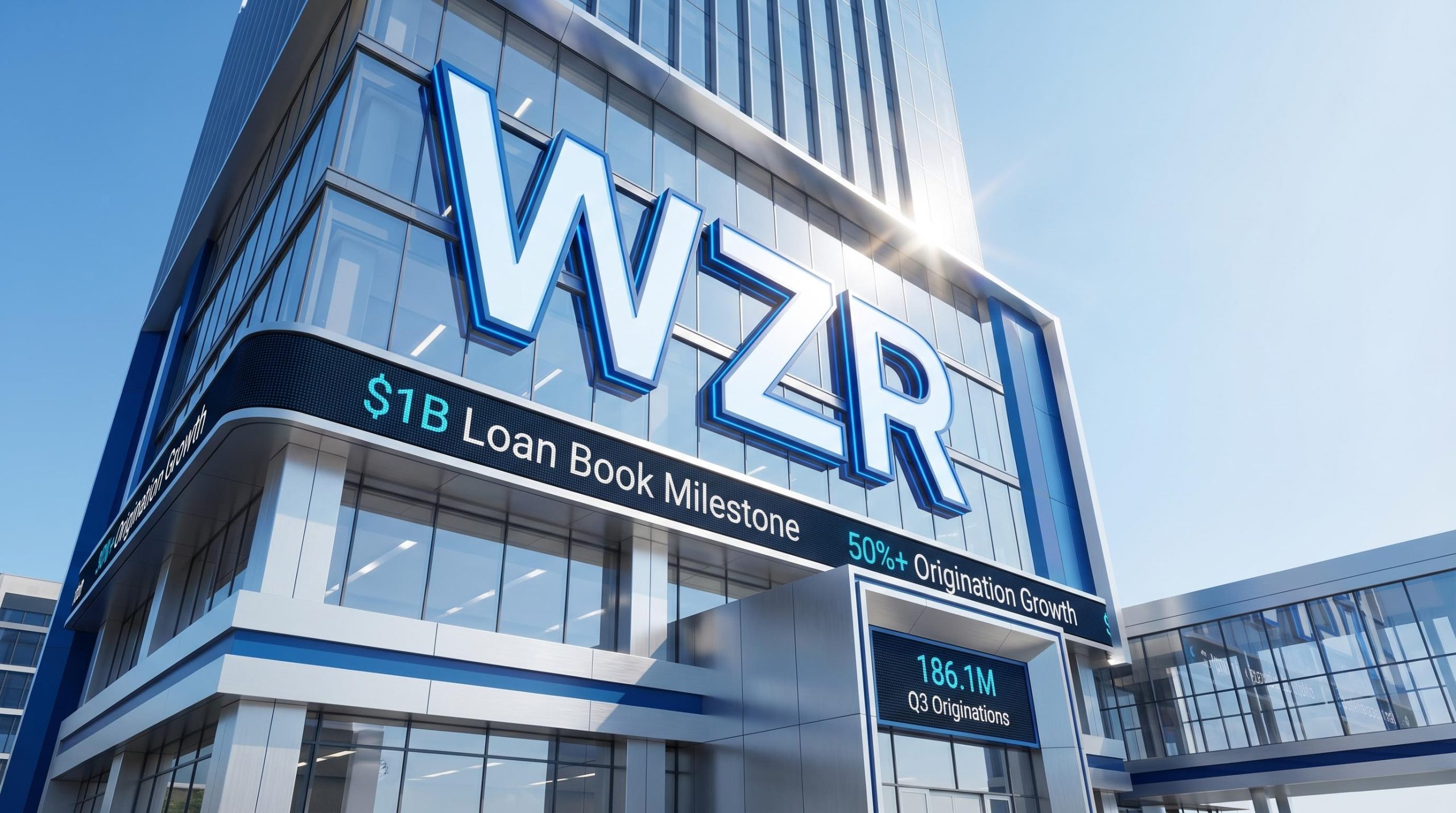
Wisr crosses $1 billion loan book milestone as originations hit record
Wisr Limited (ASX: WZR) delivered a Q3 FY26 update that saw its loan book cross the $1 billion milestone, with the loan book closing at $1,003.4M. This represented 29% year-on-year growth from $777.2M in March 2025 and 8% quarter-on-quarter growth from $928.5M in December 2025.
Record quarterly loan originations of $186.1M underpinned the result, up 68% on $111.0M in Q3 FY25 and 13% on $164.2M in Q2 FY26. Revenue increased 22% year-on-year to $27.4M in Q3 FY26, supported by the expanding loan book.
Reflecting strong year-to-date performance, Wisr upgraded its FY26 guidance for loan origination growth to 50%+ (from 40%+ previously). Management also reaffirmed its guidance to achieve Cash NPAT profitability in H2 FY26, alongside continued revenue growth and disciplined cost-to-income performance.
For investors, the $1 billion loan book is a scale marker that supports the company’s growth thesis, while the guidance upgrade indicates management confidence in the current trajectory.
When big ASX news breaks, our subscribers know first
Personal and secured vehicle loans both accelerating
Wisr’s origination growth in Q3 FY26 was broad-based across personal and secured vehicle loans, with both categories contributing to the $186.1M in quarterly originations.
Personal loans remained the larger contributor by volume, but secured vehicle loans grew more rapidly and are gaining share within the portfolio.
| Segment | Q3 FY26 | Q3 FY25 | YoY growth |
|---|---|---|---|
| Personal loans | $107.6M | $73.8M | 46% |
| Secured vehicle loans | $78.5M | $37.2M | 111% |
| Total originations | $186.1M | $111.0M | 68% |
Secured vehicle loans were the faster-growing segment, more than doubling year-on-year with 111% growth, compared with 46% for personal loans. This mix shift increases Wisr’s exposure to asset-backed lending, which is typically lower risk than unsecured consumer credit.
From an investment perspective, the diversification into secured vehicle lending reduces concentration risk in unsecured personal loans, while also supporting higher aggregate growth rates across the loan book.
What is a loan book and why does $1 billion matter?
A loan book is the total value of loans outstanding that are owed to a lender at a specific point in time. It represents the stock of credit exposure the lender has on its balance sheet, rather than the new lending written in a given period.
Originations, by contrast, measure the flow of new loans written during a quarter or year. Strong quarterly originations add to the loan book, subject to repayments and any write-offs.
For lenders such as Wisr, a larger loan book generally generates more interest income, which can improve operating leverage as fixed costs are spread over a bigger revenue base. As the book scales, the potential for profitability typically increases, provided credit performance remains stable or improves.
Crossing the $1 billion threshold is both a psychological and operational milestone for a fintech lender. It signals that the platform has reached meaningful scale in Australian consumer lending, which can support better access to funding markets, improved credibility with institutional partners, and more stable earnings profiles over time.
For investors in (ASX: WZR), the $1,003.4M loan book highlights that Wisr is now operating at a size where unit economics and funding efficiency become more visible, with the potential for further margin and profitability improvements if growth and credit quality are maintained.
Credit quality improving despite rapid growth
Wisr’s Q3 FY26 update indicated that credit quality metrics improved year-on-year despite the rapid expansion of both originations and the loan book. This outcome is significant for a fintech lender pursuing aggressive growth.
The company reported lower arrears and net losses compared with the prior year, while also modestly improving the average credit profile of its borrowers.
Key credit metrics reported for Q3 FY26 were:
-
90+ day arrears decreased 34 bps year-on-year to 1.14%, down from 1.48% in March 2025, and remained broadly stable versus 1.13% in December 2025.
-
Net losses declined 55 bps year-on-year to 1.44%, compared with 1.99% in Q3 FY25. Management noted that net losses increased 29 bps compared with 1.15% in Q2 FY26, attributing this to seasonality, with Q3 typically a seasonal high and Q2 a seasonal low.
-
The weighted average Equifax credit score of the loan book increased to 808, compared with 800 in March 2025, and remained stable versus 807 in December 2025.
For investors, the combination of strong origination growth with improving or stable arrears and loss metrics is a critical validation of Wisr’s underwriting approach. It indicates that growth is not being driven by materially looser credit standards, which is a common concern in high-growth lending models.
Yield compression a deliberate trade-off
Wisr reported that its quarterly portfolio yield in Q3 FY26 was 10.99%, a modest decline from 11.25% in Q3 FY25 and 11.08% in Q2 FY26.
Management attributed this to a continued shift toward higher credit quality borrowers and a greater proportion of secured vehicle loans in the mix, which typically carry lower interest rates but lower risk profiles.
This change in portfolio composition flowed through to Net Interest Margin (NIM), which decreased 37 bps year-on-year to 5.23% in Q3 FY26, from 5.60% in Q3 FY25, and was 7 bps lower than 5.30% in Q2 FY26.
Wisr also increased front book pricing for new originations during the quarter to offset higher funding costs that were described as geopolitics driven. The benefit of this repricing is expected to emerge gradually in portfolio yield and NIM over time as new loans replace older cohorts.
From an investor standpoint, this indicates that yield compression is a deliberate trade-off in favour of lower risk and better credit outcomes. When paired with declining net losses and improved arrears, lower yields can still support attractive risk-adjusted returns, especially if repricing actions partially restore margins.
Cash position and funding runway
Wisr’s Q3 FY26 disclosure also outlined its cash and warehouse funding position, which are important for assessing its capacity to support continued origination growth.
Key capital and funding metrics included:
-
Unrestricted cash of $14.8M, compared with $16.3M at December 2025.
-
Total warehouse facility commitments of $767M across three facilities, unchanged from December 2025, with $47.5M of undrawn capacity at 31 March 2026.
-
In April 2026, Wisr secured a temporary $120M increase in warehouse limits to provide additional flexibility ahead of its next Asset Backed Securities (ABS) transaction.
The warehouse limit increase suggests active preparation for ongoing origination growth and potential securitisation activity. For equity investors, this additional funding headroom is aligned with the upgraded 50%+ origination growth guidance and provides visibility on the company’s ability to fund incremental loan volumes without immediate equity capital requirements being indicated in this update.
Technology investments driving efficiency
Wisr continued to invest in technology and automation initiatives during Q3 FY26, targeting both customer experience and operational efficiency across the lending lifecycle.
Several key initiatives were highlighted in the quarter:
-
Automated income verification that checks income against payroll and superannuation data, designed to enable faster approvals and more accurate assessment of borrower capacity.
-
AI-verified settlements, where account details are cross-checked against source documents before funding, aimed at reducing processing errors and fraud risk.
-
AI collections assistant that provides real-time compliance prompts and automated call summaries, supporting collections staff to focus more on customer outcomes and less on manual administration.
Wisr also received external recognition through the WeMoney 2026 “Best Mobile Experience” award, which it has now achieved for the third consecutive year for app experience across lenders.
For investors, these automation and AI-driven initiatives suggest the potential for scale without proportional increases in headcount or operating expenses. Over time, this can contribute to improved cost-to-income ratios and support the company’s profitability ambitions.
CEO Goodwin on path to profitability
Wisr’s Chief Executive Officer, Andrew Goodwin, framed the Q3 FY26 results as a key step in the company’s growth and profitability pathway, linking the loan book milestone, revenue growth, and upgraded guidance.
Andrew Goodwin, Chief Executive Officer
“Q3FY26 marked a significant milestone for Wisr, with our loan book growing 29% to over $1 Billion, and revenue increasing 22% to $27.4M… Given strong year-to-date momentum, we are pleased to upgrade the FY26 origination growth guidance to 50%+, while remaining on track to deliver Cash NPAT profitability in H2FY26.”
The reaffirmation of Cash NPAT profitability in H2 FY26 is particularly relevant for investors, as it provides a defined timeframe for the transition from scale-building to earnings delivery. Combined with the upgraded origination growth guidance, management commentary indicates confidence that current momentum can be sustained while still achieving the profitability target.
Closing outlook for investors
Wisr’s Q3 FY26 update combined a scale achievement, with the loan book passing $1,003.4M, and an upgraded growth outlook, with FY26 origination guidance lifted to 50%+. These developments were supported by record quarterly originations of $186.1M and 22% revenue growth to $27.4M.
Importantly for a high-growth lender, credit quality metrics such as 90+ day arrears and net losses improved year-on-year, even as the portfolio expanded. While yields and NIM compressed modestly, this reflected a strategic shift toward higher quality and more secured lending, with repricing actions already in progress.
With Cash NPAT profitability still targeted for H2 FY26, Wisr’s latest quarter suggests that scale, growth, and credit discipline are currently aligned, which will be key variables for investors monitoring the company’s path from expansion to sustainable earnings.
Don’t Miss the Next Fintech Breakout
Join 20,000+ investors getting FREE breaking ASX news delivered to your inbox within minutes of release, complete with in-depth analysis. Click the “Free Alerts” button at StockWire X to receive real-time coverage the moment market-moving announcements hit the ASX.