
Telstra delivered earnings growth across FY26 and rewarded shareholders with a higher dividend alongside a fresh on-market share buy-back of up to $1 billion in FY27. Telstra Group reported the full-year result for the year ended 30 June 2026, with CEO Vicki Brady anchoring the performance to the company’s Connected Future 30 strategy.
Underlying EBITDAaL rose 4% to $8.3 billion, while reported EBITDAaL grew 3% to $8.2 billion. Reported net profit after tax (NPAT) increased 2.7% to $2.4 billion, and the total dividend lifted 10.5% on a cash basis to 21 cents per share.
Growth in earnings paired with increased capital returns points to balance sheet strength and management confidence heading into FY27.
FY26 results at a glance
The full-year scorecard shows momentum across both reported and underlying measures. The distinction matters: underlying figures exclude one-off guidance adjustments to give a cleaner read on operating performance.
Telstra’s H1 FY26 result showed Cash EBIT surging 14%, a pace that outran the full-year guidance range of 5-10% due to capex timing, with second-half spending expected to normalise as network investment ramped up.
| Metric | Reported | Growth | Underlying | Growth |
|---|---|---|---|---|
| EBITDAaL | $8.2b | +3% | $8.3b | +4% |
| NPAT | $2.4b | +2.7% | — | Up |
| EPS | 19.9c | +5.3% | Cash EPS 25.5c | +14% |
| ROIC | 8.0% | — | 9% | +0.5pp |
| Cash EBIT | $4.7b | +1.7% | — | — |
Operational customer metrics reinforced the financial result:
-
Mobile users grew by 270,000+ (1.9%)
-
Average revenue per user (ARPU) growth was delivered across all categories, brands and segments
-
Strategic NPS lifted to +20 and Episode NPS to +49, the highest year-end results since the company began measuring Net Promoter Score (NPS)
Vicki Brady, CEO, Telstra
“FY26 was a strong year as we continued to deliver for customers and shareholders.”
When big ASX news breaks, our subscribers know first
Progress on Connected Future 30
FY26 laid foundations across the strategy’s core layers: Customer Engagement, Network as a Product, and Digital Infrastructure. On customer engagement, management focussed on making interactions easier, more personal and more valuable.
Under the Network as a Product layer, the company reported the following FY26 network build achievements:
-
Upgraded nearly 1,200 mobile sites with 5G Advanced capability
-
Built more than 150 new mobile sites
-
Upgraded more than 1,800 network sites with back-up power
-
Invested in Satellite Messaging and Select Satellite Applications
Aura Network gaining momentum
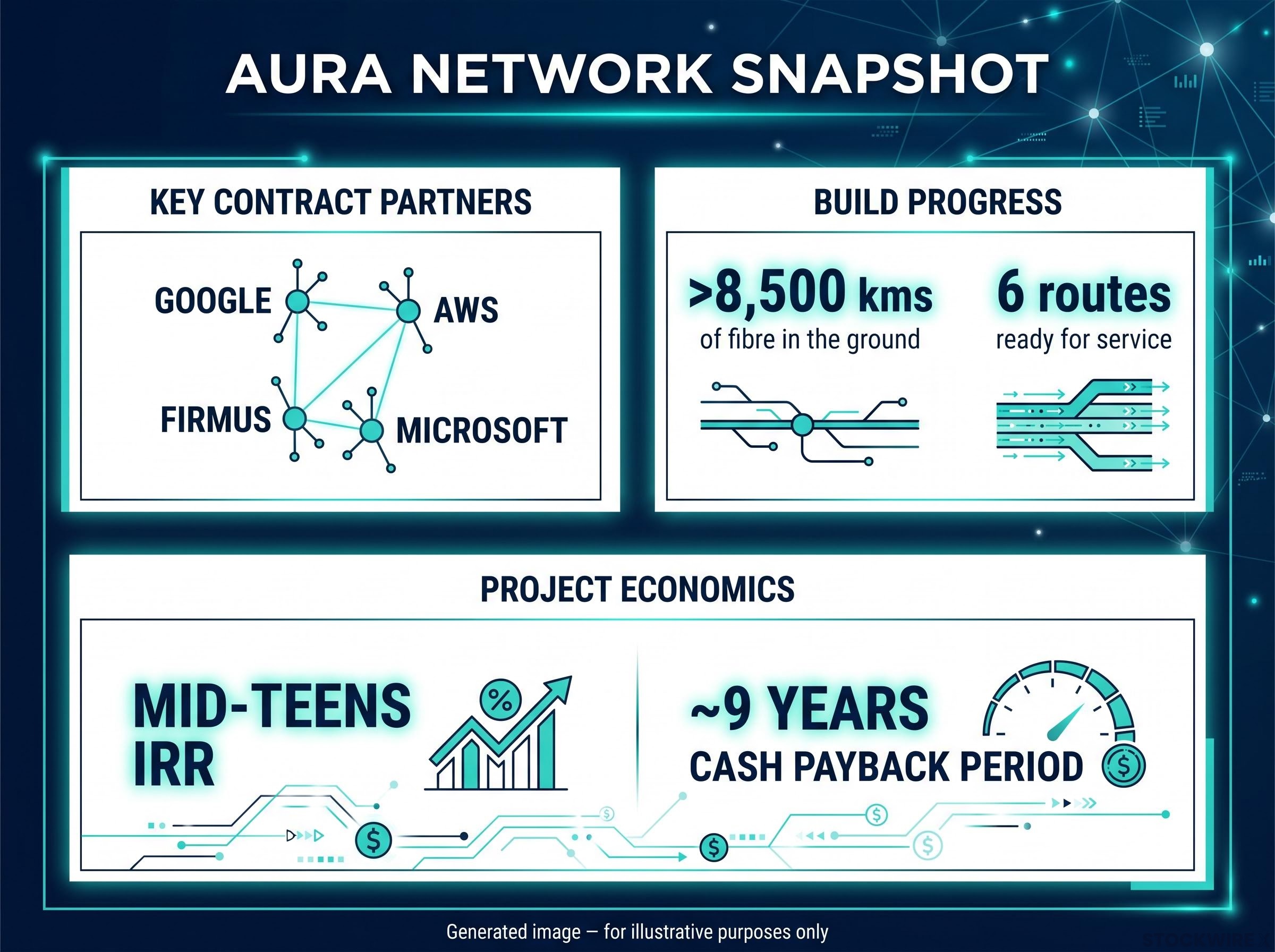
Digital infrastructure was positioned as the growth engine in the AI era. The company signed long-term contracts across its Aura Network, subsea cable and long-haul fibre assets, including Google, AWS, Firmus and Microsoft, with Microsoft serving as the foundational partner on the Aura Network.
The build is over halfway complete, with more than 8,500 kms of fibre in the ground and six routes ready for service. Management noted the Aura Network sales pipeline had increased significantly over the last six months, strengthening confidence in the project’s returns.
Telstra expects a mid-teens IRR and a cash payback period of around nine years. The company now expects total strategic investment, including Viasat, to be around $1.8 billion across FY23 to FY28, up from a previous estimate of around $1.6 billion, reflecting a combination of inflationary pressures and project-specific factors.
What is an on-market share buy-back?
Telstra completed its $1.25 billion buy-back in June 2026 and has announced a further buy-back of up to $1 billion in FY27. Per the company, this shifts its capital structure toward more debt and less equity, lowers the cost of capital, and runs alongside increased capex rather than instead of it.
Dividend and capital returns
The Board resolved to reward shareholders with a growing, cash-backed dividend. Key details of the FY26 distribution include:
-
Final dividend of 10.5 cents per share
-
Total FY26 dividend of 21 cents per share (interim 10.5c plus final 10.5c)
-
A 10.5% increase on the prior year on a cash basis (FY25 was 19c fully franked)
-
Final dividend 90.5% franked, comprising 9.5c franked and 1c unfranked
The dividend is consistent with the company’s Capital Management Framework and its aim to deliver a sustainable and growing distribution supported by strong cash earnings. This aligns with the Connected Future 30 ambition to deliver mid-single-digit growth in cash earnings.
FY27 guidance and outlook
Management set out its forward guidance while flagging continued discipline on cost and capital allocation. The company noted it would remain focussed on network resilience and growth, including taking the lessons from its outage in July.
| Metric | FY26 Actual | FY27 Guidance |
|---|---|---|
| Underlying EBITDAaL | $8.34b | $8.5b to $8.8b |
| BAU capex | $3.36b | $3.35b to $3.65b |
| Cash EBIT | $4.66b | $4.75b to $4.95b |
| Strategic investment | $0.46b | $0.2b to $0.3b |
BAU capex guidance reflects a lift in network investment intended to support the company’s leadership and ongoing growth. Management framed the FY27 outlook around delivering on Connected Future 30 targets covering cash earnings growth, underlying ROIC and operating leverage.
Looking further ahead, Telstra positioned itself as a sovereign digital infrastructure provider in the AI era. The company emphasised its role in laying foundations for the next few decades of economic growth, prosperity and resilience, with sovereign capability and assets working in the national interest as AI and global investment in digital infrastructure accelerate.
Stay Ahead on Telco and Digital Infrastructure News
Get FREE breaking ASX news delivered to your inbox within minutes of release, complete with in-depth analysis already done for you. Join 20,000+ investors who never miss a market-moving announcement. Click the “Free Alerts” button at StockWire X to start receiving alerts the moment news breaks.