
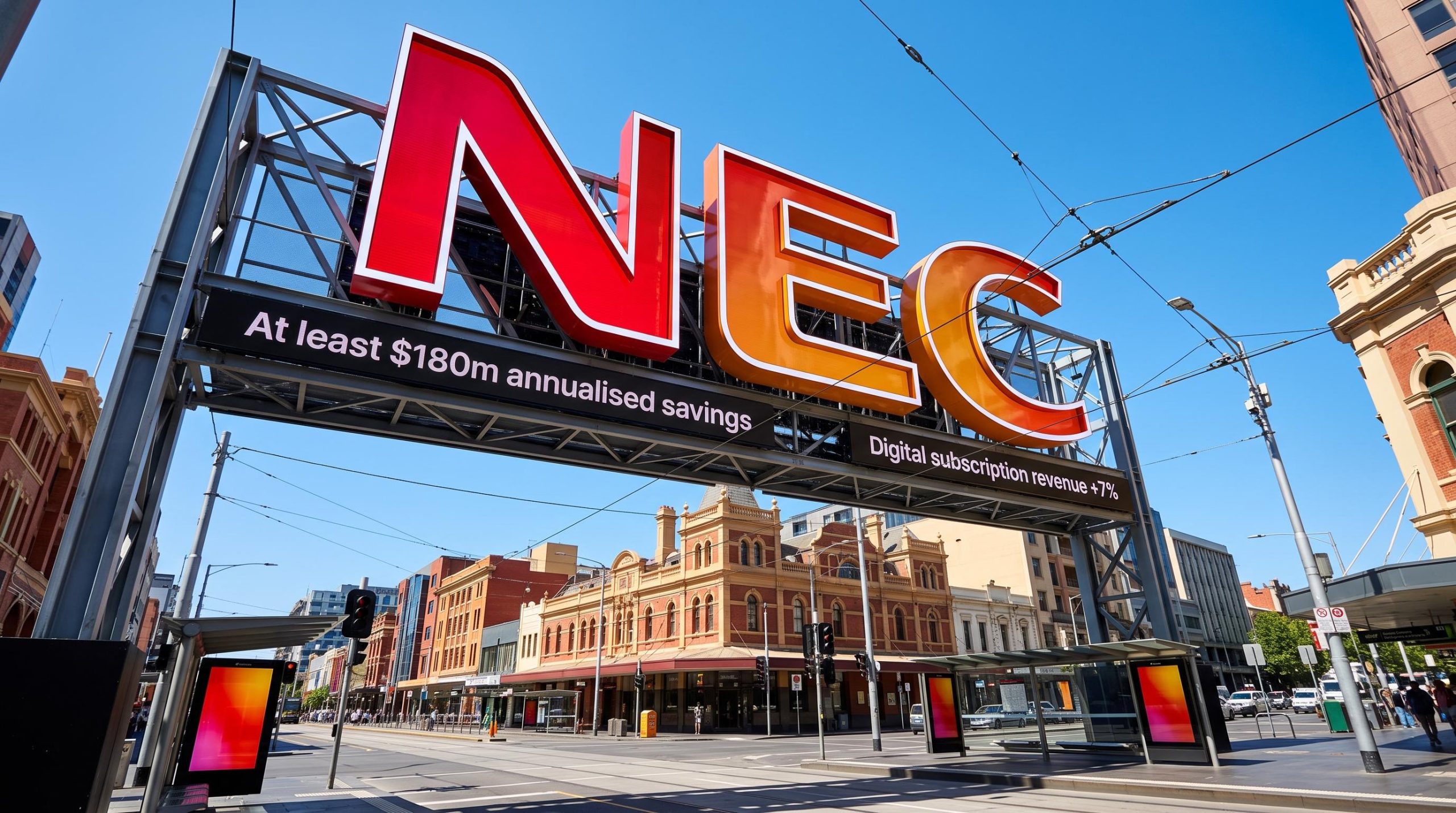
Nine outlines FY27 growth path and lifts cost savings target to at least $180m
In its 6 November 2026 AGM trading update and presentation, Nine Entertainment (ASX: NEC) outlined that it continues to expect another year of revenue and EBITDA growth in FY27 on FY26 (pro forma basis). EBITDA growth is expected to be weighted to the second half.
Management also highlighted that Nine now expects to exceed its previous 3 year estimate of $160m in annualised savings to the end of FY27, by around $20m, to at least $180m. The growth outlook is premised on a comparable level of Publishing licensing revenue in FY27 as FY26.
The presentation detailed a portfolio shift. The growth businesses (Stan, 9Now, Outdoor and Digital Publishing) are expected to deliver more than 60% of revenue and around 70% of EBITDA in FY27. In the Chair’s words, a larger share of earnings now comes from businesses that are growing, rather than from free-to-air television alone.
When big ASX news breaks, our subscribers know first
Q1 FY27 trading update by division
Publishing and the News Bargaining Incentive
Nine Publishing recorded digital subscription revenue growth of 7% in Q1 FY27 on Q1 FY26.
The News Bargaining legislation has been passed. With no direct qualifying deals currently in place, Nine intends to accrue an amount of the expected News Bargaining Incentive during FY27, subject to further clarity from the Government. The first cash payments under the scheme will not be received until H1 FY28.
Outdoor, Stan and Total TV
Management outlined momentum in Outdoor, supported by new sites and contracts in Australia and New Zealand. Stan EBITDA growth is expected in FY27, driven primarily by Stan Sport and the second season of its Premier League rights.
Total TV revenue for Q1 FY27 was down 6% on Q1 FY26 (pro forma). A later start to The Block and the impacts of the FIFA World Cup and Commonwealth Games on other networks accounted for part of the result.
| Division | Update | Metric |
|---|---|---|
| Publishing | Q1 FY27 digital subscription revenue growth on Q1 FY26 | 7% |
| Outdoor | H1 FY27 media revenue growth expected on H1 FY26 (pro forma) | Mid teens (%) |
| Outdoor | FY27 EBITDA growth expected, over and above the c$9m of expected cost synergies | Double-digit (%) |
| Stan | EBITDA growth expected in FY27 | n/a |
| Total TV | Q1 FY27 revenue on Q1 FY26 (pro forma) | -6% |
| Total TV | Q2 FY27 revenue expected on Q2 FY26 (pro forma) | Low single digit (%) decline |
| Total TV | FY27 costs expected, before the benefit of FY26 cost write-offs | Low single digit (%) decline |
What the FY26 results base looks like
The FY26 figures below are before Specific Items, as presented in the AGM presentation. Continuing business excludes Domain, Radio and Pedestrian Group, includes NBN and Darwin as affiliates, and includes 3 months of QMS.
| Basis | Revenue | EBITDA | EBITDA margin |
|---|---|---|---|
| Continuing Business | $2.2B (+3% on pcp) | $379M (+17%) | 17.3% (+2.0 pts) |
| Pro forma | $2.4B (+1% on pcp) | $516M (+6%) | 21.4% (+1.0 pts) |
NPATA was $147M (+11%) and EPSA was 9.3 cps (+11%). Net debt was $658M at 1.7x leverage.
Divisional highlights for FY26 included:
- Outdoor (pro forma): revenue +15%, EBITDA +18%.
- Mastheads: revenue +3%, EBITDA +4%, with digital subscription revenue up 15%.
- Streaming & Broadcast: revenue -1%, EBITDA +1%, Stan EBITDA +34%, and Total TV costs down 8%.
Dividends comprised 7.5c ordinary (3.0c final), unfranked, plus a 49c fully franked special dividend paid in September 2025.
For readers wanting the complete August picture, our full explainer on Nine’s FY26 results covers the Total TV carrying-value adjustment, the Stan subscriber base and the advertising tier launching from August 2026.
Three growth pillars and the investment case
Digital publishing, Outdoor and Streaming
Management set out three growth pillars:
- Digital publishing: management says digital revenue growth is outpacing print declines and the business is past the inflexion point. The Australian Financial Review has a 5 year EBITDA CAGR of 18%, an EBITDA margin of almost 50%, accounted for more than half of Publishing EBITDA in FY26, and has 75% of revenue from digital. Nine has also signed AI licensing deals, including with Microsoft Copilot and a number of Australian corporates.
- Outdoor: average lease expiry is about 8 years, maintenance capex is c$10m and cost synergies are c$20m. FY27 cash leases are expected to track almost $20m lower than AASB 16 depreciation and interest.
- Streaming: Stan’s profit has doubled over the past 5 years since the launch of Sport, and Premier League rights have been extended to 2034. Nine and Seven have also formed a joint venture in the BVOD (broadcaster video on demand) market.
Management’s view on valuation
Chair Peter Tonagh acknowledged the significant decline in the share price in recent months. He noted that largest shareholder Birketu has purchased more Nine shares on market during the year.
Peter Tonagh, Chair
“On that basis, we believe the company to be undervalued at the current share price.”
The statement followed his comment that the current trading update remains consistent with the August results presentation. Chief Executive Officer Matthew Stanton took a similar line.
Matthew Stanton, Chief Executive Officer
“…where we believe the market is over-looking the opportunities for Nine, given the current share price.”
How AI licensing and copyright shape Nine’s content value
AI content licensing is an arrangement in which a technology company pays to use a publisher’s content, for example to ground its own Large Language Models (the systems behind AI chatbots). The News Bargaining Incentive is legislation intended to have tech platforms pay for the value of news journalism.
Mr Tonagh said the Board’s principle is that anyone who trains or powers an AI system on Australian journalism, sport or entertainment should pay for it and attribute it. He said Nine is licensing its content to platforms and models, including Microsoft Copilot and a number of Australian corporates.
Mr Stanton said the model under consideration for AI and copyright is “deeply flawed”. In the presentation, Nine listed the News Bargaining Incentive and AI licensing as a growing annuity stream. The Chair described licensing as a new revenue stream built on assets Nine already owns.
AGM vote results
All seven resolutions at the 6 November 2026 meeting were put to a vote, with the following results for each:
- Remuneration Report (advisory only): 65.49% for, 34.40% against.
- 2026 performance rights to the CEO: 73.41% for.
- 2027 performance rights to the CEO: 74.57% for.
- Mandy Pattinson re-election: 84.24% for.
- Chris Halios-Lewis election: 99.63% for.
- Leigh Terry election: 99.22% for.
- Financial assistance (QMS): 99.54% for.
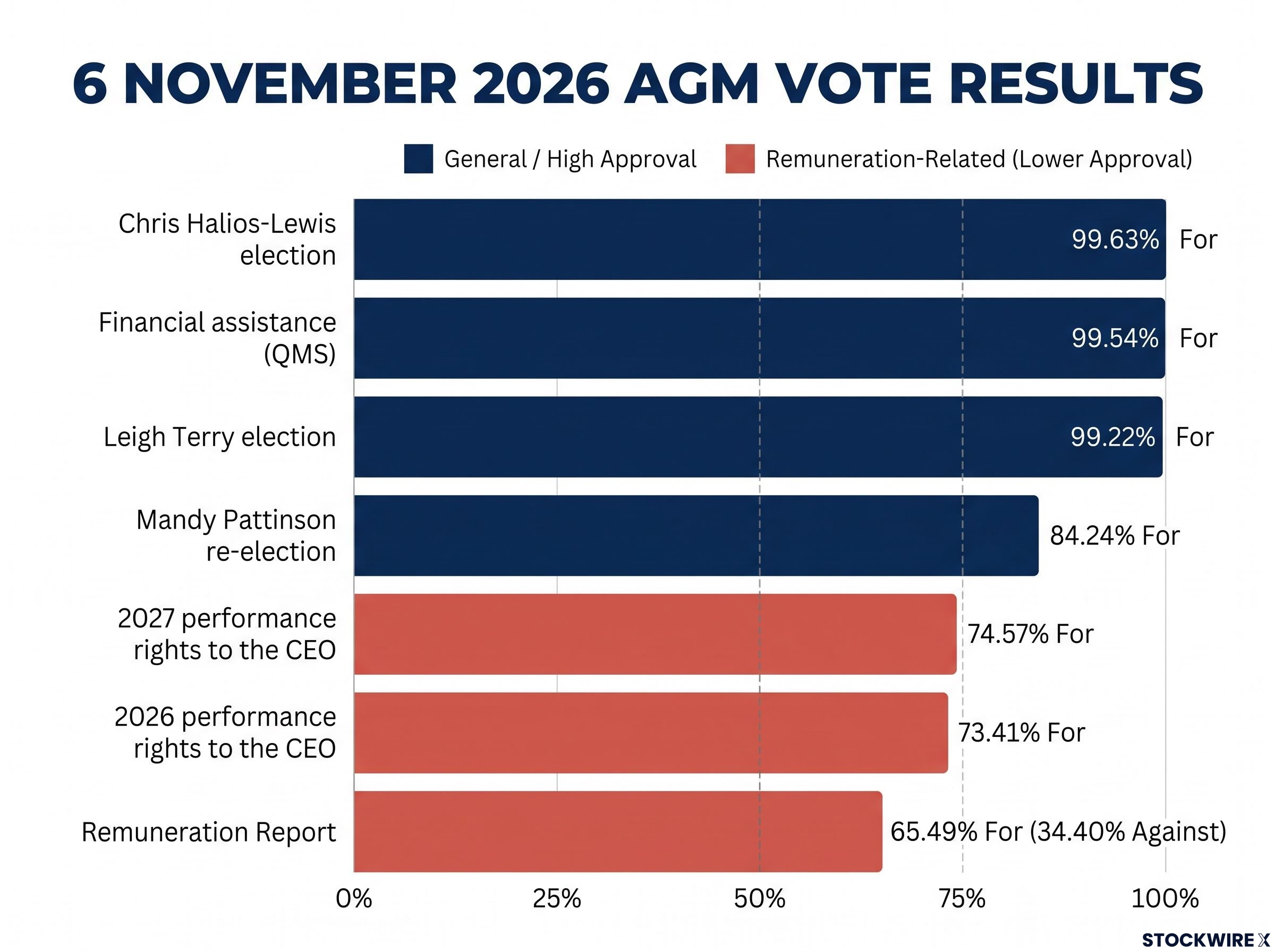
Mr Tonagh addressed remuneration directly, saying proxy votes showed a number of shareholders did not support the Remuneration Report or the issue of performance rights to the CEO. He said the Board has increased disclosure of incentive components and will keep engaging in the year ahead.
What happens next for Nine
Management’s stated expectations include:
- Q2 FY27 Total TV revenue: management currently expects a low single digit (%) decline on Q2 FY26 (pro forma).
- H1 FY27 Outdoor media revenue: growth in the mid teens (%) expected on H1 FY26 (pro forma).
- News Bargaining Incentive: accrual during FY27, subject to further clarity from the Government, with first cash payments not until H1 FY28.
- FY27 EBITDA growth: expected to be weighted to the second half.
- Annualised savings: at least $180m to the end of FY27.
- Premier League rights: the cost to Nine will increase from FY29, which management expects to be covered by removal of the subscription discount for legacy Optus subscribers, incremental ARPU growth and other cost-saving initiatives.
The Premier League rights extension adds six seasons to the existing deal, with fees scaling at roughly 3% a year across the term.
Don’t Miss the Next Media Mover on the ASX
Join 20,000+ investors getting FREE breaking ASX news within minutes of release, complete with in-depth analysis and the full announcement. Stay ahead of the market on media, tech, healthcare and more. Click the “Free Alerts” button at Big News Blast to receive alerts the moment market-moving news breaks.