

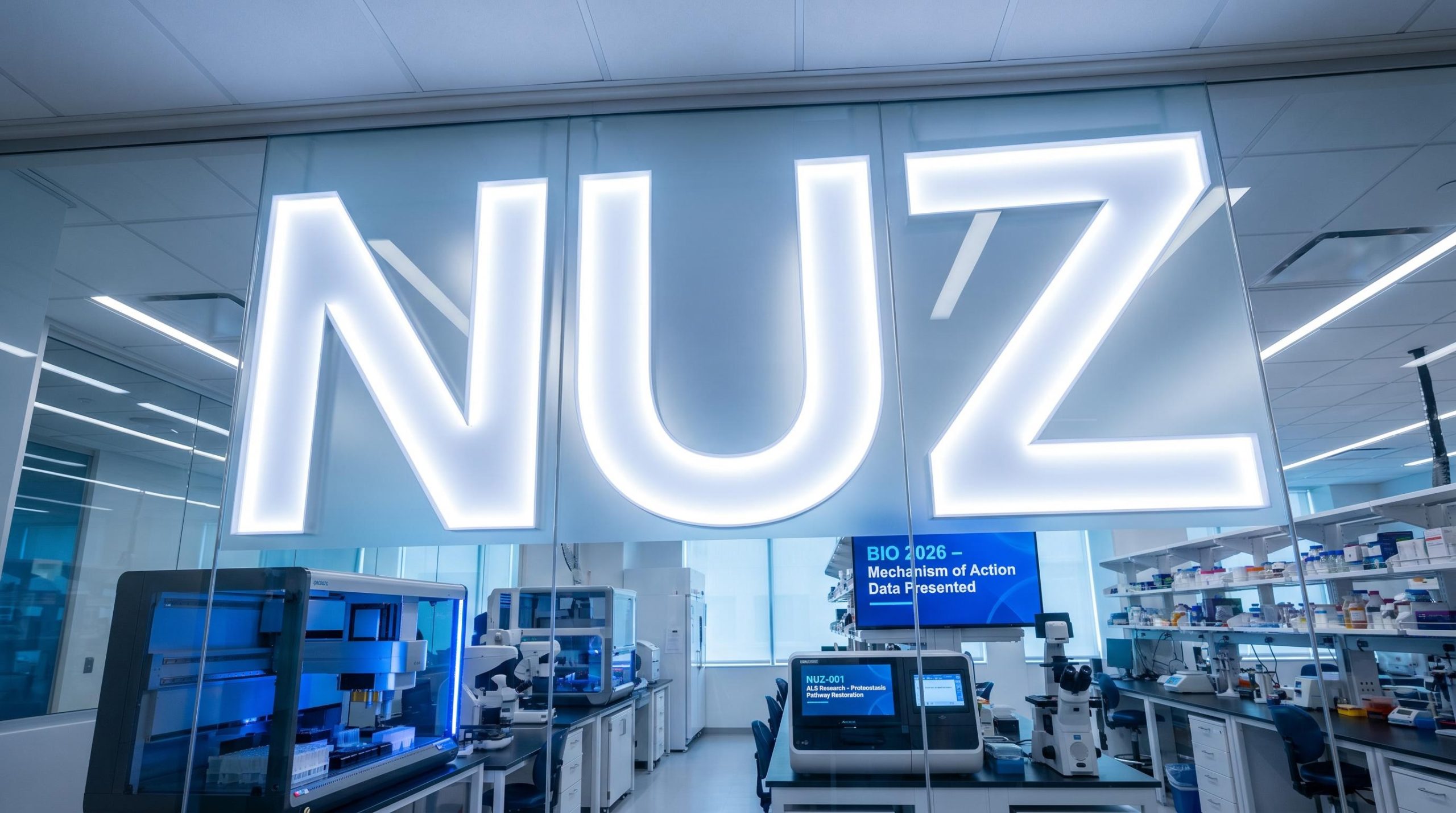
Neurizon presents new NUZ-001 mechanism data at BIO 2026
Neurizon Therapeutics has presented new preclinical mechanism-of-action data for NUZ-001 at the BIO International Convention 2026, expanding the scientific evidence base for its lead ALS candidate. The presentation, delivered on 23 June 2026 by Dr Martin Engel, Head of Scientific and Commercial Partnerships, strengthens the mechanistic profile of NUZ-001 as a multi-pathway modulator targeting protein homeostasis and neuronal stress-response biology, directly relevant to ALS pathology.
The data were presented at BIO 2026, one of the world’s leading biotechnology and lifescience partnering forums. Participation provides Neurizon with a platform to share scientific and clinical progress, including findings that continue to strengthen the mechanistic and translational profile of NUZ-001 in ALS and other neurodegenerative diseases.
Late-stage clinical programmes with expanding preclinical mechanistic evidence are better positioned for regulatory and commercial discussions. This presentation at a major partnering forum signals ongoing scientific validation as the company progresses its Phase 2/3 HEALEY ALS Platform Trial.
When big ASX news breaks, our subscribers know first
Three key findings from the new preclinical data
The presentation includes three new findings that represent distinct scientific advances, demonstrating NUZ-001’s activity across multiple validated neuronal dysfunction models:
-
STMN2-related findings in motor neurons: NUZ-001 prevents the decline of STMN2, an axonal maintenance and regeneration factor disrupted when TDP-43 function is impaired. Preservation of STMN2 is increasingly recognised as a meaningful marker of neuronal resilience in ALS, as TDP-43 pathology is a central feature of the majority of ALS cases.
-
Human neurosphere proteostasis data: In stress-exposed human neurosphere models, NUZ-001 restored expression of multiple regulators associated with protein homeostasis, including markers linked to mitochondrial and lysosomal function, autophagy, mitophagy, and cellular clearance systems. These findings extend earlier cellular observations by demonstrating coordinated restorative activity in a more complex 3D human neural model.
-
Zebrafish proteostasis-regulatory expression data: In zebrafish larval stress models, NUZ-001 treatment restored expression patterns across a panel of proteostasis-regulatory candidates. These in vivo data demonstrate that NUZ-001’s biological activity is not restricted to in vitro systems and may reflect a reproducible stress-adaptive mechanism across model types.
Consistency of NUZ-001 activity across 2D, 3D, and in vivo models is a critical translational validation step. Drugs that show reproducible mechanism across multiple model types carry lower development risk.
Why TDP-43 pathology matters in ALS
TDP-43 is a protein that normally functions in RNA processing and gene regulation within neurons. In ALS, TDP-43 forms toxic aggregates and loses its normal function, driving motor neuron degeneration. 97% of ALS cases involve TDP-43 aggregates, making it the core disease driver NUZ-001 is designed to address.
Current ALS therapies target downstream neuronal stress and extend life expectancy by only 2 to 6 months. These treatments address the consequences of motor neuron dysfunction rather than the underlying cause. In contrast, NUZ-001 targets the upstream cause—TDP-43 aggregation and proteostasis failure—representing a differentiated therapeutic approach.
A therapy that addresses the root cause of motor neuron degeneration rather than downstream symptoms could offer a step-change in patient outcomes and commercial differentiation. By restoring the cellular systems that govern protein quality control, NUZ-001 aims to halt or slow disease progression at its source.
How NUZ-001 works — restoring cellular protein clearance
NUZ-001 enhances both autophagy and proteasomal clearance pathways, helping cells clear toxic protein aggregates. Autophagy is the process by which cells degrade and recycle damaged proteins and organelles, while the proteasome is a cellular machinery that breaks down misfolded proteins. In ALS, both systems are impaired, leading to accumulation of toxic protein aggregates.
The compound reduces p62 and LC3 markers in human iPSC-derived neurons, established indicators of autophagy activity. NUZ-001 also increases S20 proteasomal activity, demonstrating engagement of both major cellular clearance pathways.
Earlier preclinical work established the mechanistic foundation for these findings, with dual autophagy and proteasomal activation demonstrated in human iPSC-derived neurons at statistically significant levels, including activity from the NUZ-001 sulfone metabolite that suggests the clearance effect may persist following clinical administration.
Zebrafish model data show in vivo biological activity, BDNF restoration, and protection from pathological stress phenotypes. The new BIO 2026 data extend these findings by showing a broader pattern of restoration across proteins and pathways involved in maintaining neuronal protein quality control under stress.
Pathways engaged by NUZ-001:
- Autophagy (p62, LC3 markers)
- Proteasome (S20 activity)
- TDP-43 aggregation prevention
- STMN2 preservation
Multi-pathway engagement increases the likelihood of clinical benefit and supports potential platform applications beyond ALS. The consistency of NUZ-001’s activity across multiple complementary models strengthens confidence that the programme is targeting biologically relevant pathways implicated in disease progression.
Management commentary
Sergio Duchini, Interim Executive Chair
“These findings provide important additional validation of the biological activity of NUZ-001 and further strengthen the mechanistic framework supporting its ongoing clinical development. What is particularly encouraging is the consistency of the signal across multiple independent model systems, spanning cellular 2D and 3D human neural models and in vivo settings. Together, these data continue to build confidence that NUZ-001 is engaging pathways directly relevant to ALS biology, including TDP-43 dysfunction, proteostasis and neuronal resilience. As our Phase 2/3 HEALEY ALS Platform Trial progresses, we believe these findings further support NUZ-001’s potential as a differentiated therapeutic approach for ALS.”
Phase 2/3 HEALEY ALS Platform Trial progress
The new mechanistic findings support the ongoing Phase 2/3 HEALEY ALS Platform Trial in the United States. The trial is dosing now across 78 activated sites in the U.S., with topline data readout expected early Q3 2027.
| Metric | Status |
|---|---|
| Activated sites | 78 |
| Participants dosed | 164 |
| Enrolment target | 240 |
| Expected topline readout | Early Q3 2027 |
Data as of 16 June 2026.
NUZ-001 was independently selected for the HEALEY trial, considered the world’s leading platform trial for ALS. Inclusion provides third-party validation of clinical potential. Topline readout in approximately 12 months represents the next major catalyst for the programme.
Early clinical signals from Phase 1 and Open Label Extension
The Phase 1 and Open Label Extension studies in Australia, funded by FightMND, provided key efficacy signals supporting the HEALEY trial selection:
- ALSFRS-R: 31% slower decline compared to PRO-ACT matched controls
- SVC (Slow Vital Capacity): 43% slower decline compared to PRO-ACT matched controls
- Survival: 71% reduction in risk of death (hazard ratio 0.29, 95% CI: 0.131-0.644, p=0.0024)
Stable neurofilament (NfL) and p75 biomarker concentrations suggest reduced disease pathology progression. NUZ-001 appeared generally safe and well tolerated, with no study discontinuations over 3+ years.
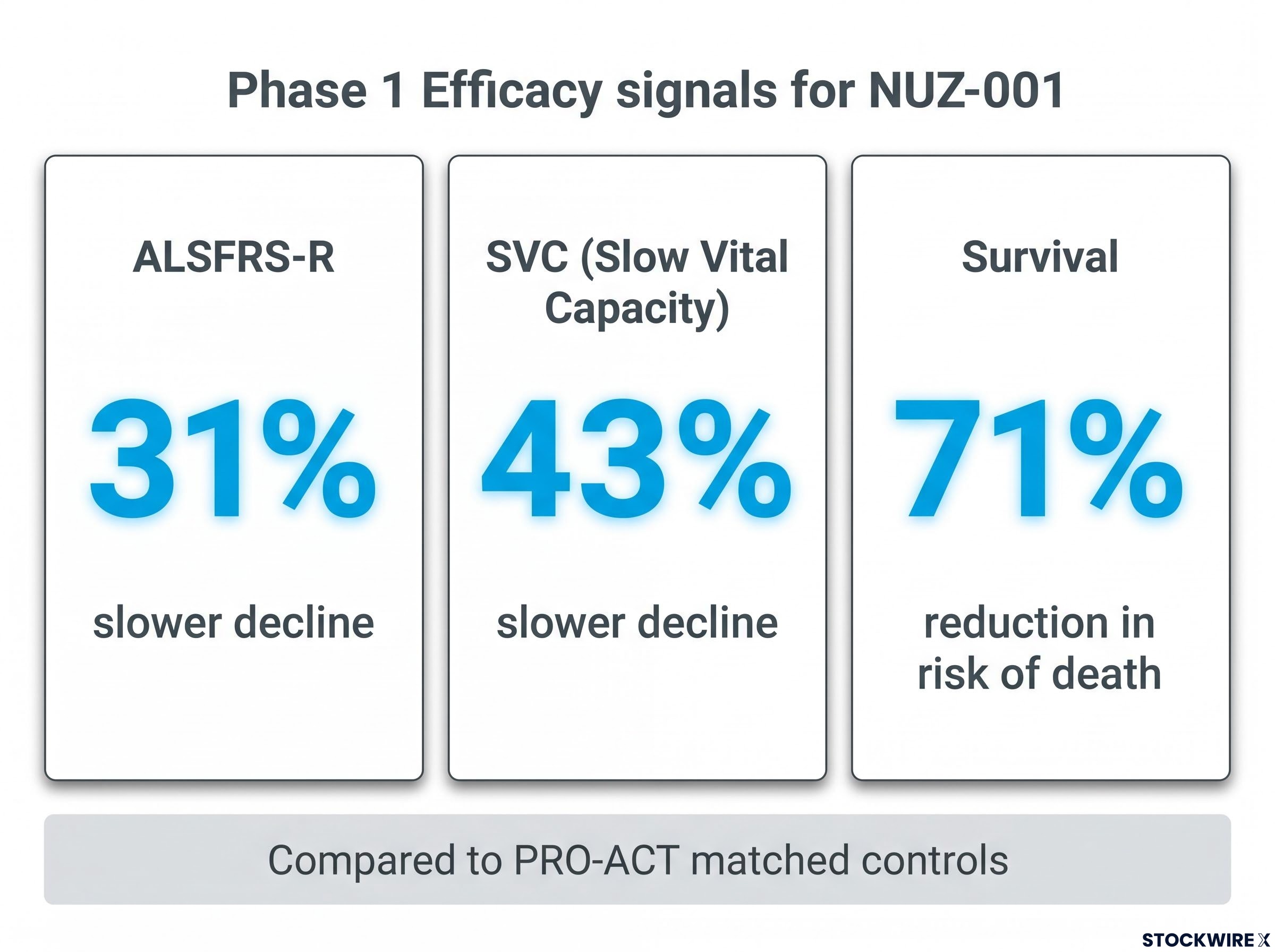
Phase 1 data provided the foundation for HEALEY selection. The survival and functional decline signals, while from a small cohort (n=12), are directionally encouraging ahead of the larger registrational trial.
Regulatory and commercial positioning
Neurizon has established a strong regulatory and commercial foundation for NUZ-001:
- Orphan Drug Designation granted by FDA (U.S.) and EMA (Europe)
- U.S. and Australian patent protection to 2041; EU and Japan pending
- GMP manufacturing and supply chain established
- Oral tablet formulation with oral liquid formulation Phase 1 PK study planned for Q3 2026
- Active regulatory engagement with FDA, EMA, and PMDA (Japan)
For investors exploring the regulatory and development rationale behind the formulation programme, our full explainer on the NUZ-001 oral liquid formulation study covers the Bellberry HREC approval, the 32-volunteer pharmacokinetic study design, and why addressing dysphagia is a meaningful clinical consideration as ALS progresses.
Orphan designation provides regulatory incentives and market exclusivity benefits. Established manufacturing reduces execution risk ahead of potential approval.
Platform potential beyond ALS
NUZ-001’s mechanism—rebalancing proteostasis—has potential applicability across multiple neurodegenerative proteinopathies where protein aggregation drives disease. The following proteins and associated diseases represent areas where NUZ-001 may have relevance:
- TDP-43: ALS, Alzheimer’s, Parkinson’s, FTD, CTE
- α-Synuclein: Alzheimer’s, Parkinson’s
- mHTT: Huntington’s Disease
- Tau: Alzheimer’s, Parkinson’s, FTD, CTE, PSP
- Amyloid beta: Alzheimer’s, Parkinson’s
Preclinical data show NUZ-001 enhances proteasomal activity following α-synuclein treatment and attenuates apoptosis in a Huntington’s zebrafish model. Platform potential significantly expands the addressable market beyond ALS. Success in ALS could provide proof-of-concept for broader neurodegenerative applications, enhancing long-term value.
Investment outlook
NUZ-001 targets TDP-43 pathology present in 97% of ALS cases, a differentiated approach compared to current symptomatic therapies. The Phase 2/3 HEALEY trial is dosing, with topline readout expected early Q3 2027. Encouraging Phase 1 signals across function, survival, and biomarkers provide clinical validation.
The company holds a strong regulatory position with Orphan Drug Designation in the U.S. and Europe, alongside patent protection extending to 2041 in the U.S. Platform potential across multiple neurodegenerative diseases offers long-term optionality beyond the lead ALS indication.
The BIO 2026 presentation provides partnering and investor visibility at a leading global biotechnology forum. The combination of late-stage clinical development, expanding mechanistic evidence, and platform potential positions Neurizon as a clinical-stage biotech with multiple near-term catalysts and longer-term strategic value.
Want the Next Biotech Breakthrough in Your Inbox?
Join 20,000+ investors getting FREE breaking ASX news delivered within minutes of release, complete with in-depth analysis. Click the “Free Alerts” button at Big News Blast to start receiving real-time alerts the moment market-moving announcements hit the ASX.