

Noxopharm’s Sofra oligonucleotides show “clear promise” in next-generation mRNA vaccine data
Independent data generated by global biopharma company CSL, using novel oligonucleotides from Noxopharm’s (ASX:NOX) Sofra™ platform, was presented at the ISRV Options for the Control of Influenza XIII Conference in Washington DC.
The scientific poster reported that the oligonucleotides “show clear promise” in reducing vaccine-related inflammation markers in self-amplifying mRNA (sa-mRNA) vaccines, a next-generation vaccine technology attracting worldwide interest and investment.
For investors, the significance lies in the source of the data. This is independent, third-party validation from a major biopharma company, strengthening the commercial and partnering case for the Sofra platform beyond Noxopharm’s own internal research.
When big ASX news breaks, our subscribers know first
The data: reducing sa-mRNA vaccine reactogenicity
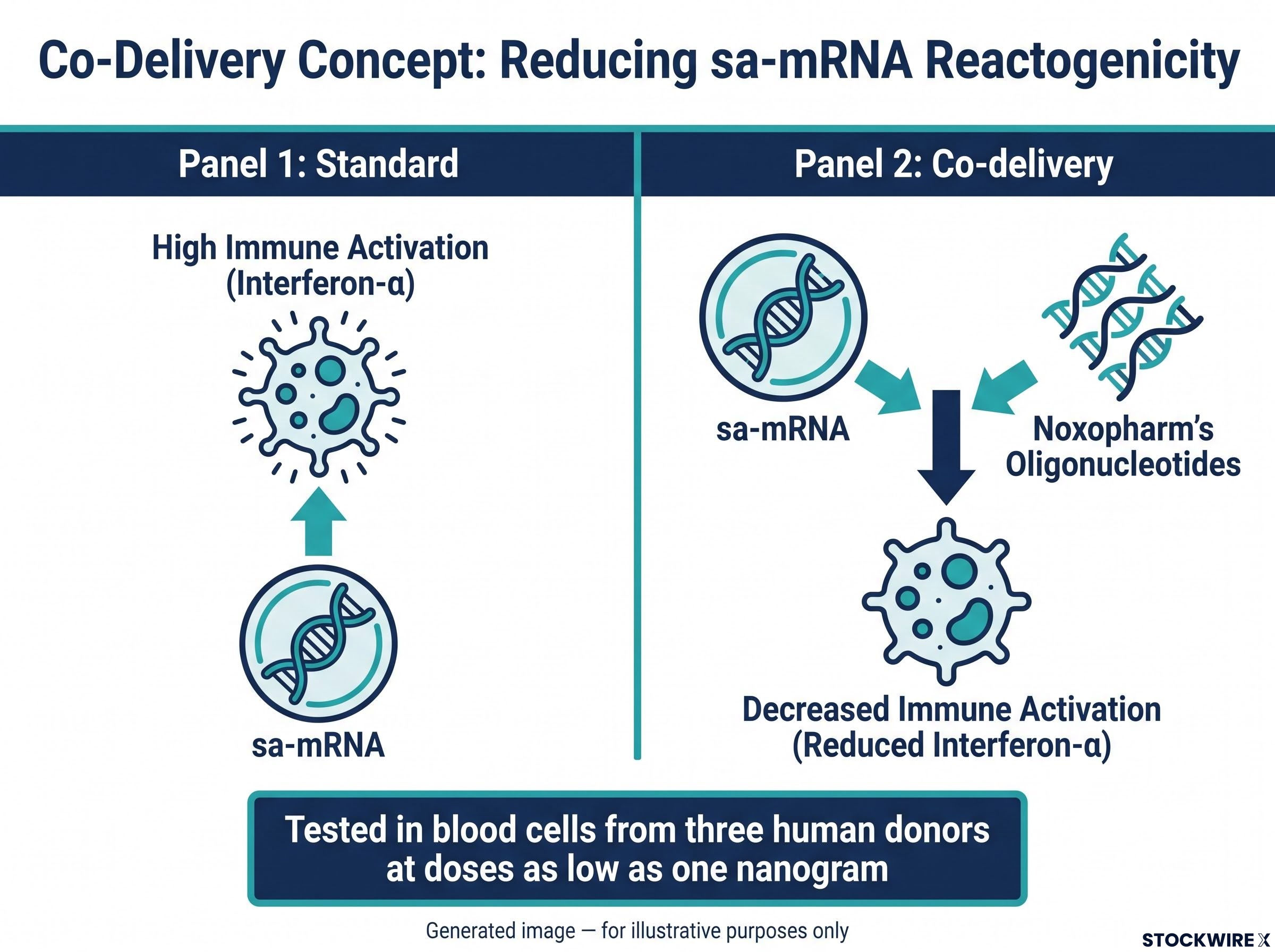
The research explored how Noxopharm’s anti-inflammatory oligonucleotides could be co-delivered with sa-mRNAs to decrease the immune activation that potentially contributes to post-vaccination adverse reactions in investigational influenza sa-mRNA vaccines.
Reactogenicity is a central challenge for the technology. While sa-mRNA offers greater dose efficiency and more durable immunity than conventional mRNA, the reactogenicity profile of both platforms is comparable. Noxopharm’s oligonucleotides are intended to target that gap and improve vaccine tolerability.
The poster graph (Figure 1) showed that production of highly inflammatory interferon-α by the sa-mRNA vaccine was greatly reduced by Noxopharm’s oligonucleotide. The effect was observed even at doses as low as one nanogram, tested in blood cells from three human donors following sa-mRNA H1N1 LNP transfection.
Several technical points help frame the finding:
-
Self-amplifying mRNA (sa-mRNA) is a next-generation form of mRNA vaccine designed to replicate itself once inside cells, allowing smaller doses and potentially more durable immunity.
-
Reactogenicity refers to the expected physical reactions to a vaccine, such as inflammation or soreness, that affect how well patients tolerate it.
-
Co-delivery involves administering Noxopharm’s oligonucleotides alongside the vaccine’s sa-mRNA, aiming to dial down the excess immune activation linked to adverse reactions.

Why the conference and CSL involvement matter
The presentation took place at the Options for the Control of Influenza XIII Conference in Washington DC, described as the largest global scientific meeting focused on influenza prevention, control and treatment.
The event brings together international experts in virology, clinical care, public health and vaccine research. Speakers at this year’s meeting included representatives from leading global institutions such as:
-
Johns Hopkins University
-
Princeton University
-
Massachusetts Institute of Technology
-
World Health Organization
-
US Centers for Disease Control and Prevention
Presenting alongside institutions of this calibre raises the Sofra platform’s profile with the researchers, public health bodies and potential commercial partners who shape the vaccine field.
Dr Olivier Laczka, CEO of Noxopharm
“This presentation and these independent results further demonstrate the versatility of our technology. It is appealing to other companies because it can be used in conjunction with their own approaches to both new vaccine and new drug development. In light of Moderna and Merck’s recent positive results from their cancer mRNA vaccine/Keytruda trial, and the potential for the mRNA vaccine market to grow rapidly, our approach could play a key role in the field.”
Understanding the Sofra platform
The Sofra™ platform is based on the use of synthetic nucleic acids, known as oligonucleotides, to mimic natural regulators of the body’s defence system. In simple terms, these are lab-made genetic fragments designed to communicate with the immune system.
This approach enables selective and modular tuning of immune sensors, reducing or stimulating their associated biological responses. That versatility matters to investors because the same underlying technology can dial immune responses either up or down, giving it multiple potential applications across diseases and as an enhancer of RNA-based therapies.
The scientific basis for this mechanism received top-tier independent endorsement through a Nature Immunology publication earlier in 2026, with globally recognised TLR8 expert Professor Arthur Krieg among those validating the underlying anti-inflammatory science.
Sofra is focused on inflammatory and autoimmune diseases such as rheumatoid arthritis, lupus and diabetes, as well as immuno-oncology for cancer treatment. The company’s lead clinical asset, SOF-SKN™, is a topical therapy initially being developed for cutaneous lupus erythematosus, with Phase I completed and further clinical development progressing.
Patient-derived lupus efficacy data released in April 2026 gave that focus empirical weight, with SOF-16 reducing inflammatory markers by more than 90% in blood samples from systemic lupus erythematosus patients and near-completely eliminating TLR7-driven signals in rheumatoid arthritis synovial fluid.
The table below presents the addressable market context cited by Noxopharm. These figures reflect total market size and are not an indication of revenue captured by the company.
| Focus Area | Application | Market Size (2023/24) | Projected Market | Source Note |
|---|---|---|---|---|
| Inflammatory & autoimmune disease | Rheumatoid arthritis, lupus, diabetes | US$163.2B (2024) | US$219.6B by 2035 | Global autoimmune disease therapeutics market |
| Immuno-oncology | Cancer treatment | US$43B (2023) | US$284B by 2033 | Worldwide immuno-oncology market |
What this means for investors and what comes next
Independent validation from a major biopharma such as CSL helps de-risk the platform’s commercial narrative and supports a partnering-led strategy. Third-party data carries weight that internal results alone may not, particularly when engaging potential collaborators.
It is important to keep the framing measured. The poster reported “clear promise” rather than proven efficacy, and the data represents early-stage findings rather than a clinical or commercial milestone.
Looking ahead, Dr Laczka indicated the company intends to continue pursuing external partnerships wherever they make strategic sense.
Dr Olivier Laczka, CEO of Noxopharm
“We will continue to pursue and develop external partnerships wherever they make strategic sense for us, and are confident that our Sofra platform will keep generating more interest in the future.”
The versatility of the technology, its ability to tune immune responses up or down across vaccines, autoimmune conditions and oncology, remains central to the investment case. Whether that translates into formal partnership agreements will be the key measure for investors monitoring the platform’s progress.
Don’t Miss the Next Healthcare Breakthrough
Big News Blast delivers FREE breaking ASX healthcare news directly to your inbox within minutes of release, complete with in-depth analysis already done for you. Join 20,000+ investors who never miss a market-moving moment. Click the “Free Alerts” button to start receiving alerts the moment ASX announcements drop.