
Travelan Phase 2 results published in Nature’s Scientific Reports
Immuron Limited (ASX: IMC; NASDAQ: IMRN) announced on 13 October 2026 that data from its Phase 2 clinical trial of once-daily oral Travelan® has been published in the Nature journal, Scientific Reports. The publication covers Travelan’s potential role in preventing Travellers’ Diarrhoea.
The article is titled “A phase 2, randomized, placebo-controlled study to evaluate once-daily oral Travelan for the prevention of Travellers’ Diarrhoea.” It describes clinical data previously announced to the ASX on 7 March 2024, so the results themselves are not new.
The study was partially funded by the U.S. Department of Defense (MTEC Award 21010.13). It reported that Travelan® was safe and well tolerated, with a statistically significant 50% reduction in ETEC challenge-related adverse events versus placebo (P=0.0001).
Peer-reviewed publication places the clinical data before an independent scientific audience.
Although the study did not meet its primary efficacy endpoints, efficacy results consistently trended in favour of Travelan® across multiple clinically meaningful endpoints, supporting the potential protective benefit of the once-daily formulation against ETEC-associated disease.
When big ASX news breaks, our subscribers know first
Key findings: efficacy trends and safety profile
Travelan® was safe and well tolerated in the study. The study did not, however, meet its primary efficacy endpoints.
A lower than anticipated placebo attack rate (33% versus 70%) materially reduced statistical power. Despite this limitation, results consistently trended in favour of Travelan® across multiple clinically meaningful endpoints.
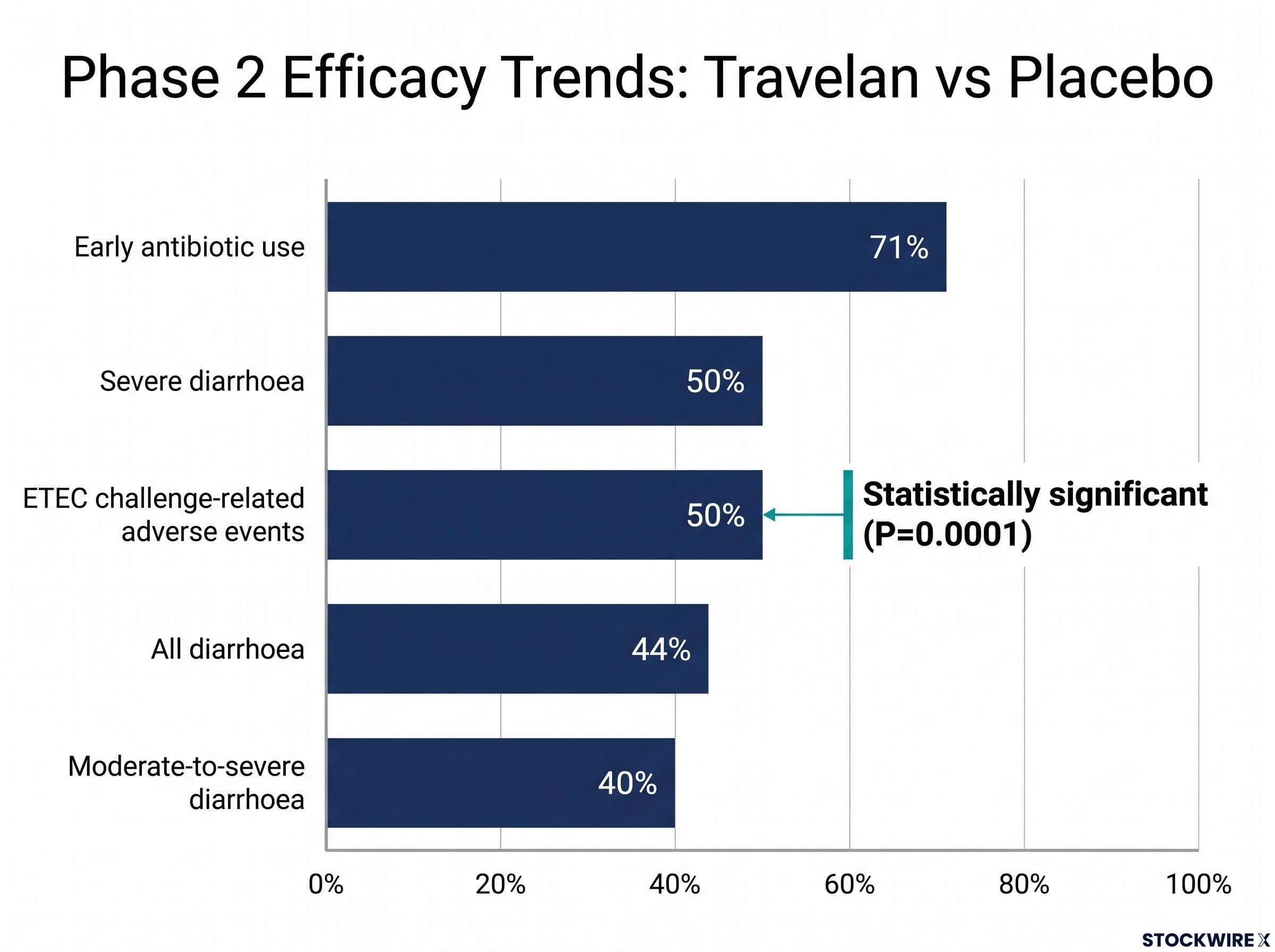
The reported reductions versus placebo were as follows:
| Endpoint | Reduction versus placebo |
|---|---|
| ETEC challenge-related adverse events | 50% (P=0.0001) |
| Moderate-to-severe diarrhoea | 40% |
| Severe diarrhoea | 50% |
| All diarrhoea | 44% |
| Early antibiotic use | 71% |
Only the ETEC challenge-related adverse events result was described in the announcement as statistically significant.
Secondary biomarker and immunity data included:
- Travelan recipients showed attenuated mucosal inflammation four days post-challenge, with lower fecal myeloperoxidase (p=0.04) and calprotectin (p=0.06) than placebo.
- More than 80% of subjects in both arms seroconverted (IgG/IgA anti-ETEC) by day 15 to 29, indicating Travelan did not impair natural adaptive immunity to the challenge strain.
How Travelan works and why travellers’ diarrhoea matters
Travelan® is an orally administered passive immunotherapy. It is a highly purified tabletized preparation of hyper immune bovine antibodies and other factors.
Taken with meals, the antibodies bind to diarrhoea-causing bacteria and prevent colonisation and the pathology associated with travellers’ diarrhoea. In simple terms:
- The antibodies are taken with meals.
- They bind to diarrhoea-causing bacteria.
- This prevents colonisation and the associated pathology.
ETEC refers to enterotoxigenic Escherichia coli, a type of bacteria. The announcement states that diarrhoea is the leading infectious disease threat to the overall health and preparedness of deployed US armed forces, with diarrheagenic E. coli, Campylobacter spp. and Shigella spp. among the most commonly reported etiologies (causes).
Travelan® is positioned as a non-antibiotic option, which is relevant to both travellers and military deployment settings.
Travelan FY26 sales growth reached AUD$7.7 million, up 6% on the prior year, with four consecutive quarters of year-on-year gains showing the OTC product generating revenue independently of the clinical program.
Next-generation formulation and what comes next
Immuron is advancing Travelan® as a next-generation, non-antibiotic oral immunoprophylactic for the prevention of bacterial diarrhoeal disease. The program aims to deliver a military-ready, once-daily formulation capable of providing broad-spectrum protection against key pathogens responsible for travellers’ diarrhoea and military deployment related gastrointestinal infections.
The company has developed a next-generation, delayed-release capsule formulation optimised for once-daily dosing, which enables delivery of a substantially higher payload. It may be investigated in larger, adequately powered clinical studies as recommended by the investigators. The announcement does not confirm any such trial, nor does it disclose a timeline or funding.
Microbiome work and defence collaborations
A further manuscript describing Travelan’s effects on the gut microbiome is currently in preparation. Study data showed that Travelan recipients had lower relative abundance of E. coli, enrichment of beneficial bacteria, and greater microbiome richness and diversity compared with placebo.
Separately, the Naval Medical Research Command and the Walter Reed Army Institute of Research, in collaboration with Immuron, are progressing the development of novel vaccines targeting Campylobacter jejuni and Shigella sonnei.
Current dosing recommendation
Immuron continues to recommend a dose of 1-2 Travelan tablets, three times daily. This is based on clinical efficacy observed in previous studies using this regimen, with protection rates of 58.3% (p=0.02), 76.7% (p=0.007) and 90.9% (p=0.0005) (Otto et al., 2011). These figures come from earlier studies, not the Phase 2 trial.
For investors, the announcement combines peer-reviewed publication of US Government-supported clinical data with a program that includes defence-related collaborations.
Beyond Travelan, Immuron has signed an exclusive PROIBS US distribution agreement with Calmino group AB, covering a European-certified medical device with more than a decade of sales on the Swedish pharmacy market.
Want to Explore Immuron’s Travelan Programme Further?
Immuron’s once-daily oral Travelan® has now had its Phase 2 data peer-reviewed in Nature’s Scientific Reports, showing a statistically significant 50% reduction in ETEC challenge-related adverse events. With a next-generation formulation in development and defence collaborations underway, the programme targets a non-antibiotic approach to Travellers’ Diarrhoea.
Investors seeking the latest updates on the pipeline, clinical data and commercial performance can visit the Immuron investor centre for full company information. Explore the announcements and presentations to assess the opportunity ahead.