

Entropy Neurodynamics completes first cohort dosing in Phase 2 BED trial
Entropy Neurodynamics (ASX: ENP) has completed dosing for all six participants in Cohort 1 of its Phase 2 clinical study evaluating TRP-8803 in patients with Binge Eating Disorder. Each participant received two administrations of the IV-infused psilocin treatment 14 days apart, in conjunction with supportive therapy. All participants achieved a controlled and reproducible psychedelic response, supporting the company’s thesis that IV delivery offers advantages over oral psychedelic therapies.
The study, conducted in collaboration with Swinburne University, targets enrolment of 12 patients across two cohorts of six participants each. Topline efficacy results from Cohort 1 are expected in July 2026, representing a near-term data catalyst for the clinical-stage biotechnology company.
When big ASX news breaks, our subscribers know first
Why IV-infused psilocin may solve oral psychedelic therapy’s biggest problems
TRP-8803 is IV-infused psilocin, the active metabolite of psilocybin. The delivery method addresses key challenges that have limited the commercial viability of oral psychedelic therapies in clinical settings.
Oral psilocybin faces three operational hurdles: unpredictable onset times, variable treatment intensity across patients, and long treatment durations. These factors complicate treatment scheduling, require extensive clinical oversight, and increase the cost per patient session.
IV delivery is designed to address each of these constraints. The intravenous route enables rapid onset, predictable pharmacokinetics, and precise control over treatment intensity and duration. Importantly, the effects can be rapidly reversed if needed. These characteristics could enable shorter treatment sessions, potentially making psychedelic-assisted therapy scalable in real-world clinical settings where treatment efficiency drives commercial viability.
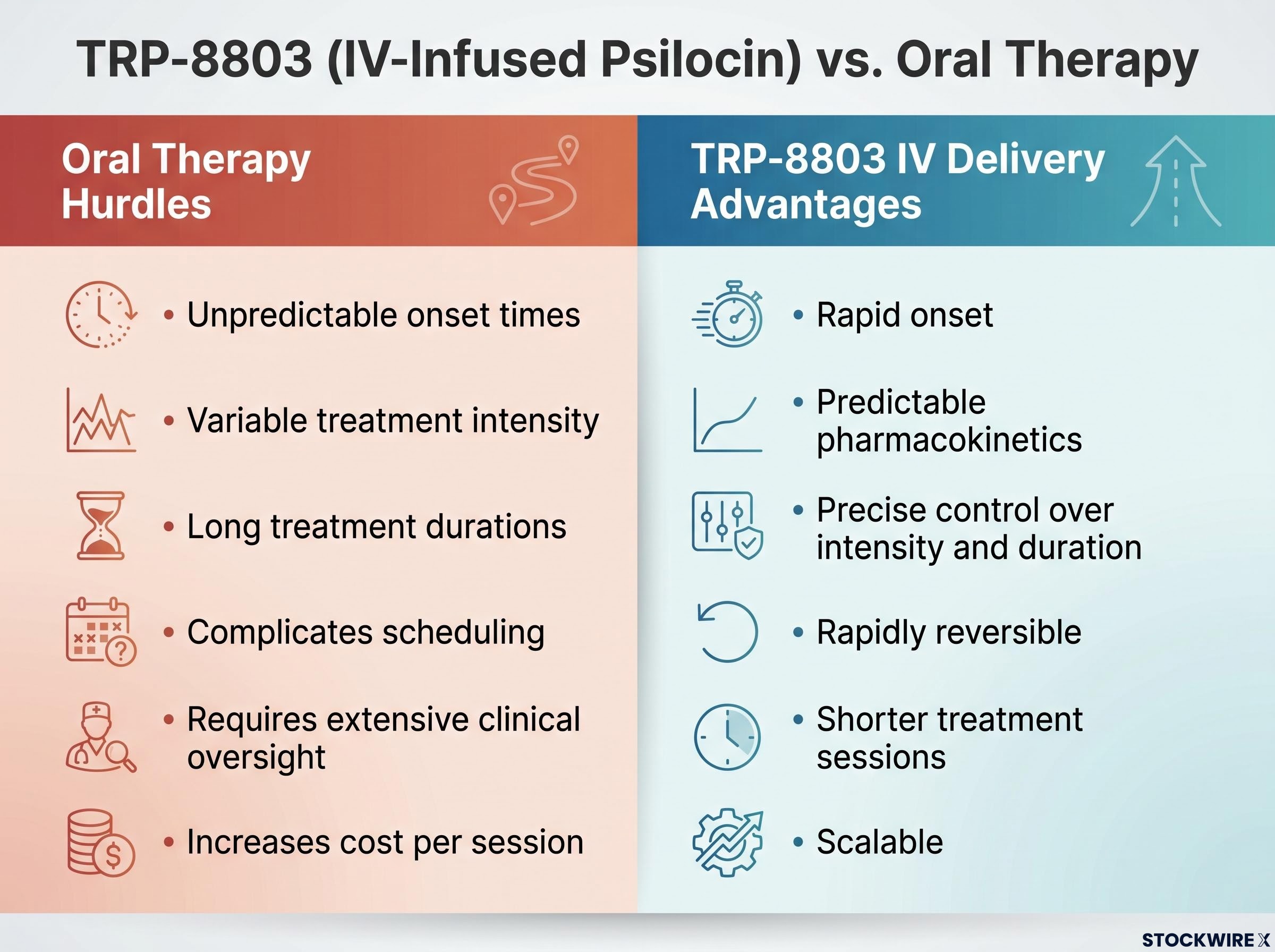
The company’s observations from Cohort 1 support this differentiation. All participants achieved controlled, reproducible responses at high intensity—outcomes that suggest the IV platform may deliver the predictability required for broader clinical adoption.
Cohort 2 recruitment nearly complete ahead of safety review
Recruitment for Cohort 2 has progressed in parallel with Cohort 1 dosing. Five of the six required participants have been enrolled, with the sixth in final interview stage.
Before Cohort 2 dosing commences, a Data Safety and Monitoring Board will review Cohort 1 safety data. This assessment is expected to be completed in the coming weeks. The dosing regimen for Cohort 2 will be informed by Cohort 1 outcomes, allowing the company to optimise treatment parameters based on observed responses.
The near-complete enrolment of Cohort 2 minimises timeline gaps between the DSMB review and the commencement of the next dosing phase. This operational momentum reduces execution risk and supports continuous trial progression through the second half of 2026.
Key trial milestones and upcoming catalysts
| Milestone | Status | Expected Timing |
|---|---|---|
| Cohort 1 dosing | Complete | — |
| DSMB safety review | Pending | Coming weeks |
| Topline Cohort 1 efficacy | Pending | July 2026 |
| Cohort 2 enrolment | 5 of 6 enrolled | Ongoing |
| Cohort 2 dosing | Pending | Post-DSMB clearance |
The trial’s phased structure provides multiple newsflow events over the coming months. The DSMB review, expected within weeks, will determine whether Cohort 2 proceeds under the current protocol or with adjusted dosing parameters. Topline efficacy data from Cohort 1 in July 2026 will be the first formal readout of clinical outcomes. Cohort 2 data will subsequently inform the broader TRP-8803 development pathway, including dose optimisation and potential expansion into additional indications.
CEO confident in positive clinical outcomes for BED patients
Jason Carroll, CEO
“Given that all patients achieved a controlled and reproducible response to treatment and all at with a high intensity, we are very confident that topline will highlight positive clinical outcomes for BED patients.”
Management’s confidence stems from direct observation of Cohort 1 responses. Chief Executive Officer Jason Carroll noted that the consistency observed across all participants supports the differentiated profile of TRP-8803. “Delivering a predictable and controllable psychedelic experience is an important step towards developing a therapy that can be integrated into real-world clinical settings, where treatment efficiency, reproducibility and scalability will be key drivers of commercial success,” he stated.
Early post-treatment assessments from the first enrolled patient had already shown clinically meaningful reductions in binge eating severity, anxiety, and depression before the cohort completed full dosing, providing an early signal that aligned with the consistent psychedelic responses observed across all six participants.
Carroll added that the company is well positioned to maintain momentum following the DSMB assessment, with the upcoming Cohort 1 data expected to inform optimisation of the second dosing cohort and provide insights into the future development pathway for TRP-8803.
What is Binge Eating Disorder and why does it need new treatments?
Binge Eating Disorder is a serious eating disorder characterised by recurrent episodes of consuming large quantities of food accompanied by a sense of loss of control. The condition represents an unmet medical need, with limited effective treatment options and high relapse rates among existing therapies.
Emerging clinical evidence suggests psychedelics may address underlying psychological drivers of the disorder, offering a mechanism of action distinct from conventional treatments. This rationale has prompted several biotechnology companies to explore psychedelic-assisted therapy for eating disorders, with varying delivery methods and protocols under investigation.
The addressable patient population is substantial. If TRP-8803 demonstrates efficacy in this indication, the company would be positioned to pursue a commercial opportunity in a space with few approved pharmacological interventions.
What the Cohort 1 data means for Entropy’s clinical platform
Completion of Cohort 1 dosing validates the viability of the TRP-8803 platform in clinical practice. The controlled, reproducible responses observed across all participants suggest the IV delivery system functions as intended under real-world clinical conditions, not just in controlled laboratory settings.
This builds on prior Phase 2a trials conducted by Entropy using oral psilocybin across multiple indications, including Binge Eating Disorder, Irritable Bowel Syndrome, and Fibromyalgia. Those trials demonstrated clinical benefits of psychedelic therapy and provided insights that informed the development of TRP-8803. The IV-infused formulation represents the next evolution of the company’s psychedelic therapy approach, aiming to address the operational constraints identified in oral delivery trials.
The IV psilocin platform has also demonstrated a 75% response rate in treatment-resistant IBS patients across prior Phase 2a work, a result researchers from Massachusetts General Hospital and Columbia University described as the strongest clinical signal ever recorded in IBS drug development, extending the technology’s potential well beyond the BED indication.
The Cohort 1 data will inform optimisation of Cohort 2 and guide decisions on dosing regimens, treatment protocols, and future development priorities. Successful execution across multiple indications and delivery methods builds platform value beyond any single trial, positioning Entropy to leverage the TRP-8803 technology across a broader therapeutic pipeline.
Could IV-Infused Psilocin Redefine Psychedelic-Assisted Therapy for Binge Eating Disorder?
Entropy Neurodynamics has completed dosing for all six participants in Cohort 1 of its Phase 2 trial, with topline efficacy results expected in July 2026. The controlled, reproducible psychedelic responses observed across all participants suggest TRP-8803’s IV delivery platform may address the operational challenges that have limited oral psychedelic therapies.
To explore how Entropy’s IV psilocin technology could transform treatment efficiency and scalability in real-world clinical settings, visit the Entropy Neurodynamics investor centre. Discover the full development pathway for TRP-8803 and assess the company’s broader psychedelic therapy platform across multiple indications.