
dorsaVi Brings On-Sensor Intelligence to Wearables for First Time via Firmware
Key Takeaways
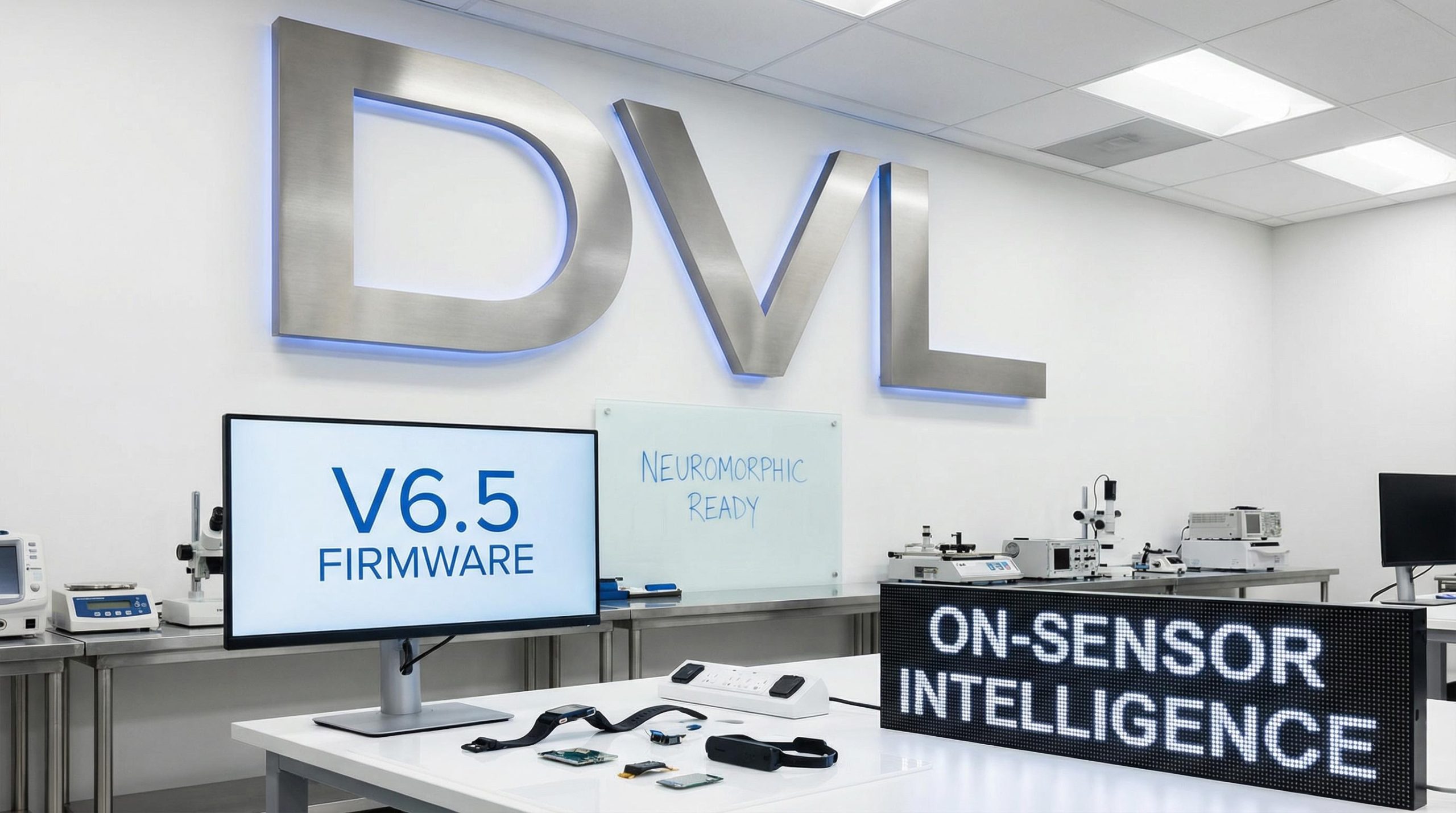
dorsaVi Limited (ASX: DVL) has commenced development of Sensor V6.5, introducing dorsaVi on-sensor intelligence development to its FDA and TGA-cleared wearable platform for the first time — delivering real-time analytics directly within the sensor via firmware upgrade to existing clients including Select Medical's 100+ US sites.
- dorsaVi has commenced development of Sensor V6.5, marking the first time on-sensor intelligence has been introduced into its FDA and TGA-cleared wearable sensor platform.
- The upgrade is delivered via firmware to existing hardware, meaning current clients — including Select Medical (100+ US physical therapy sites), Dr. Patel's elite sport program, and the SEROMA European clinical study — benefit without requiring hardware replacement.
- V6.5 establishes a neuromorphic-ready architecture and firmware foundation for Ultra-Edge Platform 1.0, which targets compute-in-memory efficiency exceeding 20 TOPS/W at the 22-nm node through the ITRI collaboration.
- The on-sensor processing architecture aligns with emerging EU AI Act and autonomous medical device regulatory requirements, potentially strengthening dorsaVi's competitive position in the European clinical and robotics markets.
- dorsaVi is exploring compatibility of its V6.5 platform as the movement intelligence layer within collaborative robot (cobot) systems, representing a potential new commercial avenue under active investigation.
dorsaVi Limited (ASX: DVL) has commenced development of Sensor V6.5, a firmware upgrade introducing on-sensor intelligence to its FDA and TGA-cleared wearable sensor platform for the first time. The upgrade enables analytics and signal interpretation to occur directly within the sensor, reducing latency and improving responsiveness for real-time clinical, workplace, and sporting applications. Critically, V6.5 is delivered via firmware to existing hardware, meaning current clients—including Select Medical (100+ US physical therapy sites), Dr. Patel’s elite sport program, and the SEROMA European clinical study—benefit without hardware replacement.
What is on-sensor intelligence?
On-sensor intelligence refers to analytics and signal interpretation occurring directly within the wearable sensor rather than being transmitted to external devices or cloud platforms for processing. The current Sensor V6.0 platform captures high-fidelity movement data at the sensor level, but analytics and intelligence are primarily derived on edge devices or through cloud-based processing. V6.5 shifts this model by enabling selected analytics to occur within the sensor itself, reducing the latency inherent in transmitting raw data to an edge device or cloud platform.
This matters because client requirements are evolving toward real-time analytics, distributed clinical trials with reduced cloud dependency, and continuous monitoring. By processing data at the point of capture, V6.5 addresses growing demand for immediate insight without the delays associated with cloud-based workflows.
Four foundational enhancements in V6.5
The V6.5 firmware upgrade introduces four key capabilities:
- On-sensor processing — selected analytics and signal interpretation now occur directly within the wearable sensor hardware
- Enhanced embedded processing capability — expanded computational headroom enables more sophisticated real-time signal analysis at the sensor level
- Neuromorphic-ready architecture — firmware framework designed to support integration of dorsaVi’s neuromorphic IP within the sensor processing environment, a first for the Company’s platform
- Foundation for Ultra-Edge Platform 1.0 — establishes firmware and processing groundwork for next-generation sensor hardware where sensing, processing, and decision-making increasingly occur within the device itself
When big ASX news breaks, our subscribers know first
Sensor evolution roadmap: from V6.0 to Ultra-Edge Platform 1.0
V6.5 represents a deliberate stepping stone on a clearly defined technology pathway. The current V6.0 architecture relies on edge devices and cloud platforms for intelligence. V6.5 introduces on-sensor processing and establishes neuromorphic-ready architecture. Ultra-Edge Platform 1.0, the target hardware generation, aims to achieve primarily on-sensor processing with native RRAM embedded memory and neuromorphic compute.
The January 2026 ITRI collaboration targets compute-in-memory efficiency exceeding 20 TOPS/W at the 22-nm node. When integrated into a future sensor hardware generation, this capability will enable Ultra-Edge Platform 1.0. V6.5 ensures that when that hardware arrives, the firmware and processing architecture are already in place to support it.
| Capability | Sensor V6.0 (Current) | Sensor V6.5 (In Development) | Ultra-Edge Platform 1.0 (Roadmap) |
|---|---|---|---|
| Processing location | Edge device / cloud | Sensor + edge device | Primarily on-sensor |
| Latency | Transmission + cloud processing delay | Reduced (selected analytics on-sensor) | Near real-time (sub-millisecond on-device) |
| Neuromorphic capability | None | Neuromorphic-ready architecture | Native neuromorphic compute |
| RRAM integration | None | Firmware foundation established | Native RRAM embedded memory and compute-in-memory |
| Power profile | Standard wearable | Improved (reduced data transmission overhead) | Ultra-low power (always-on operation) |
| Cloud dependency | High | Reduced | Minimal (edge-first architecture) |
| Delivery mechanism | Hardware | Firmware upgrade to existing hardware | New hardware generation |
This stepping-stone approach is deliberate. Rather than waiting for full RRAM integration before delivering enhanced capability, dorsaVi is advancing the intelligence of its current platform now, generating commercial value in the near term while building toward a transformative hardware architecture for the medium term.
Existing clients positioned as direct beneficiaries
Because V6.5 is delivered as a firmware upgrade, dorsaVi’s current commercial client base is positioned to benefit from enhanced on-sensor intelligence without hardware replacement.
Select Medical: US physical therapy network
The Select Medical Physical Therapy network operates across more than 1,900 sites in the United States, with more than 100 sites currently using dorsaVi’s technology. V6.5’s on-sensor processing capability reduces the latency between movement capture and clinical insight, improving the responsiveness of real-time biofeedback during patient assessments and enabling more seamless clinical workflows across the network.
Dr. Patel program: elite sport and military applications
The Dr. Patel commercial project is focused on delivering live, in-game biomechanical metrics for elite athletes. V6.5’s on-sensor intelligence is directly aligned with this requirement, reducing the latency between movement event and metric delivery. The neuromorphic-ready architecture established in V6.5 will ultimately enable sub-millisecond, reflex-speed injury detection as the platform matures toward Ultra-Edge Platform 1.0.
SEROMA: European clinical research
The SEROMA study for Axial Spondyloarthritis spans six European clinical sites, backed by the ASAS research community and three global pharma groups. On-sensor processing reduces the cloud dependency that creates standardisation and data sovereignty challenges across multi-site, multi-geography trials. V6.5 moves dorsaVi closer to a sensor that generates validated, regulatory-ready metrics at the point of assessment, with no cloud infrastructure required.
Regulatory alignment and European robotics opportunity
Europe is establishing comprehensive regulatory frameworks governing AI and autonomous systems, including the EU AI Act and emerging standards for autonomous medical devices and robotic systems. A central requirement across these frameworks is that AI inference occurs in a validated, auditable, and increasingly on-device manner. Cloud-dependent systems, where data is transmitted and processed remotely, face growing regulatory scrutiny in safety-critical, medical, and industrial contexts.
V6.5’s neuromorphic-ready, on-sensor processing architecture is directly aligned with this regulatory direction. By moving computation progressively closer to the sensor itself, reducing cloud dependency, and enabling validated metrics to be generated at the point of measurement, dorsaVi is building a sensor platform whose architecture mirrors what European regulators are increasingly requiring.
dorsaVi’s existing European presence through the SEROMA clinical study across six sites, with backing from the ASAS research community and three global pharma groups, provides an established foothold in the European clinical network at precisely the moment these regulatory frameworks are taking shape. The biomechanical data generated by dorsaVi’s sensors (spinal mobility vectors, lower-limb joint angles, movement signatures under load) are the precise data categories that European humanoid and rehabilitation robotics developers require to train, validate, and certify their locomotion systems under emerging EU standards.
Collaborative robot compatibility under exploration
Collaborative robots (cobots) are interactive, flexible, and safety-focused systems allowing for safer interaction with and around humans, in contrast to traditional robots focused on fast, powerful, and often fenced-off movements. dorsaVi is exploring the potential for its V6.5 sensor platform to serve as the movement intelligence layer within cobot systems.
A cobot built on dorsaVi’s V6.5 sensor architecture would be differentiated by sensing and interpreting human movement in real time, on-device, at clinical grade, rather than relying on external cameras, GPS, or generic IMUs. The requirements of a cobot’s movement sensing and response system align directly with V6.5’s capability profile: on-sensor processing for low-latency response, neuromorphic-ready architecture for adaptive, event-driven inference, and clinically validated movement metrics for safe and precise human interaction.
This is a strategic direction the Company is exploring, not a committed product roadmap. Management believes the architectural alignment between V6.5 and cobot system requirements is sufficiently compelling to warrant active investigation.
CEO Mat Regan on the significance of V6.5
Mat Regan, Group CEO
“V6.5 represents a significant step for dorsaVi—it is the first time on-sensor intelligence has been introduced into our wearable sensor platform, and it signals clearly that Intelligence at the Ultra Edge is no longer a future concept. It is beginning to be deployed within our existing hardware, for our existing clients.
The firmware-based upgrade approach is also strategically important. Our Select Medical network, Dr. Patel program and SEROMA clinical study do not need to wait for new hardware to begin benefiting from on-sensor intelligence. This provides a meaningful commercial advantage.
As our RRAM and neuromorphic capabilities mature through our ITRI collaboration and are integrated into Ultra-Edge Platform 1.0, the firmware and processing foundations we are establishing today will already be in place. We are sequencing this deliberately—delivering near-term client value while building toward longer-term platform transformation.”
The next major ASX story will hit our subscribers first
What comes next for dorsaVi’s sensor platform
V6.5 development is underway, with firmware foundations being established for future RRAM and neuromorphic integration as those capabilities mature through the ITRI/NTU 22-nm program. The firmware and architectural foundations established in V6.5 are specifically designed to accommodate progressive integration of dorsaVi’s RRAM and neuromorphic IP.
Ultra-Edge Platform 1.0 represents the target hardware generation, where sensing, processing, and decision-making increasingly occur within the wearable device itself. When that hardware generation arrives, the firmware and processing architecture established in V6.5 will already be in place to support it, providing a clear execution pathway from near-term firmware delivery to medium-term hardware transformation.
Want the Next Healthcare Breakout in Your Inbox?
Join 20,000+ investors receiving FREE breaking ASX healthcare news delivered within minutes of release, complete with in-depth analysis. Click the “Free Alerts” button at Big News Blast to start getting market-moving announcements and expert coverage the moment news breaks.