

CLINUVEL sets the vitiligo benchmark ahead of December 2026 CUV105 results
On 30 July 2026, CLINUVEL Pharmaceuticals (ASX: CUV | Nasdaq: CUVL | Börse Frankfurt: UR9) released a commercial update establishing objective, peer-reviewed clinical benchmarks in the emerging vitiligo market.
The review directly addresses frequent questions from analysts and the medical community on what to expect from trials of SCENESSE® (afamelanotide) combined with adjunct narrowband ultraviolet B (NB-UVB) phototherapy. It arrives ahead of a key catalyst: topline results from the completing late-stage CUV105 study are anticipated December 2026, while the pivotal CUV107 study is anticipated to start November 2026.
The opportunity centres on a clear gap. Extensive vitiligo, defined as ≥10% of total body surface affected by depigmentation, currently lacks an effective therapy.
When big ASX news breaks, our subscribers know first
Understanding vitiligo and why repigmentation matters to investors
Vitiligo causes the loss of skin pigment, known as depigmentation. When 10% or more of the total body surface is affected, the condition is classified as extensive vitiligo, a segment where treatment options remain limited.
Clinicians measure treatment success using the Vitiligo Area Scoring Index (VASI), a standardised scoring system for tracking repigmentation.
The Vitiligo Visual Algorithm, a proprietary AI assessment tool developed entirely in-house, is being deployed alongside CUV105 and is planned for integration into the CUV107 protocol, targeting the limitations of traditional VASI scoring, which carries a reported 50% error rate.
Understanding VASI scores
F-VASI measures facial repigmentation, while T-VASI measures total body repigmentation. A result such as F-VASI75 means a patient achieved 75% or more repigmentation over the treatment window.
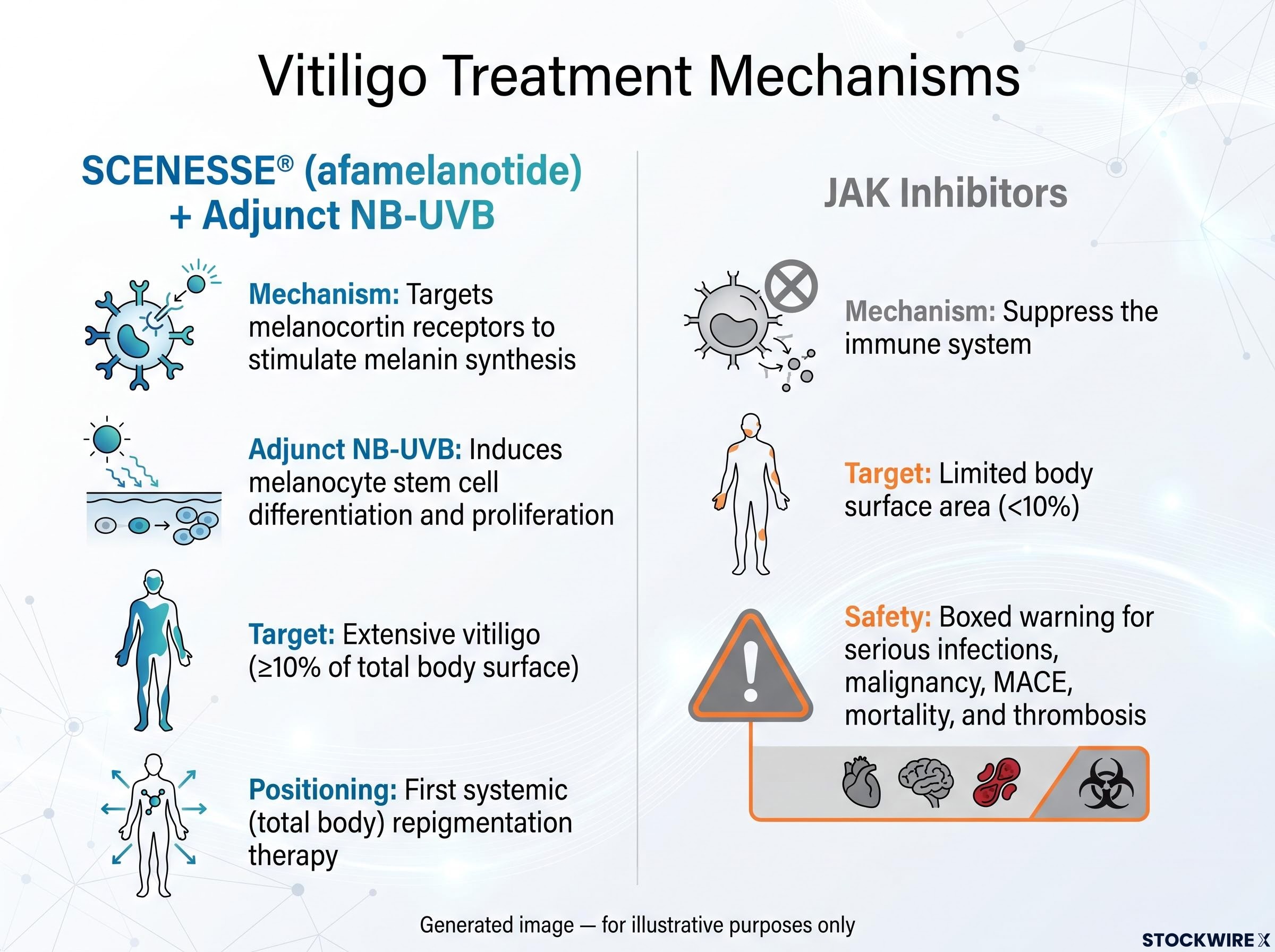
Two competing mechanisms are being developed for vitiligo. Janus kinase (JAK) inhibitors work by suppressing the immune system. Afamelanotide, the peptide in SCENESSE®, targets melanocortin receptors to stimulate melanin synthesis, working alongside adjunct NB-UVB, which induces melanocyte stem cell differentiation and proliferation to activate repigmentation.
The mechanism difference matters for investors. SCENESSE® is being developed as the first systemic (total body) repigmentation therapy for vitiligo, positioning it towards the extensive-vitiligo patients that JAK inhibitors, focused on limited body surface areas, currently underserve.
The clinical benchmarks — how current therapies perform
The peer-reviewed data indicates that while current and emerging therapies deliver meaningful results in limited body surface involvement (<10%), a significant unmet need persists in extensive vitiligo.
Standard of care — narrowband UVB (NB-UVB) phototherapy
NB-UVB remains the preferred first-line, most widely used whole-body phototherapy for extensive vitiligo. It requires frequent brief exposure to specific light wavelengths and has been reported to provide limited efficacy over long-term use.
-
Dosing: two to three times per week, wavelengths of 308–311nm, generally for 12–18 months.
-
2025 study (n=176): 45% achieved clinically significant repigmentation, highest on the face and neck at 53%. Among responders, 95% maintained response for six or more months, and 59% retained repigmentation for more than 72 months.
-
Second study (n=32): 42.2% achieved at least 50% repigmentation of limbs and 37.5% of total body.
-
Meta-analysis (1,428 patients, 35 studies): a marked response was found in 19% after six months and 36% after 12 months.
-
Best response was associated with longer treatment duration (>18 months) and higher cumulative radiation dose (>356 J/cm²).
JAK inhibitors — topical and systemic performance
Ruxolitinib 1.5% cream is the first pharmaceutical product approved in vitiligo, applied twice daily for vitiligo affecting less than 10% of body surface area. A range of oral JAK inhibitors are also in development, with three late-stage programmes reporting larger trial results.
| Therapy | Type | Key Endpoint | Result | Placebo / Comparator |
|---|---|---|---|---|
| Ruxolitinib (Phase II, n=157) | Topical | F-VASI50 at wk 24 | 45% (1.5% twice daily) / 50% (once daily) | 3% vehicle |
| Ruxolitinib (Phase III, TRuE-V1/V2, n=674) | Topical | F-VASI75 at wk 52 | 50.3% continuous users | 28.2% crossover |
| Upadacitinib (Phase III, n=614) | Systemic (oral) | T-VASI50 / F-VASI75 at wk 48 | T-VASI50 19.4% / 21.5%; F-VASI75 25.2% / 23.4% | T-VASI50 5.9%; F-VASI75 5.9–6.9% |
| Povorcitinib (Phase III, n=917) | Systemic (oral) | F-VASI75 at 52 wks | 18.9% | 3.1–6.8% placebo |
| Ritlecitinib (Phase III, Tranquillo) | Systemic (oral) | F-VASI75 at wk 52 | Ongoing — no topline yet | — |
A key safety consideration differentiates this class:
- Ruxolitinib, along with other JAK inhibitor drugs, carries a boxed warning regarding serious infections, malignancy, major adverse cardiovascular events (MACE), mortality, and thrombosis. Careful patient selection and risk–benefit assessment are required, particularly in individuals with increased infection risk, immunosuppression, a history of malignancy, cardiovascular risk factors, or prior thromboembolic disease.
Where SCENESSE® fits — the afamelanotide opportunity
Against these benchmarks, CLINUVEL is positioning SCENESSE® plus adjunct NB-UVB towards the underserved extensive-vitiligo segment, where the systemic approach targets whole-body repigmentation rather than limited surface areas.
Early clinical data from the CUV105 study have shown visible and lasting repigmentation. In 12 case reports using SCENESSE® implant injections and adjunct NB-UVB (up to 40 NB-UVB sessions), physicians observed progressive repigmentation of facial and body regions, with skin tone returning towards baseline over time.
CUV105 case studies presented at AAD 2026 showed repigmentation after 20 weeks of afamelanotide combined with NB-UVB, with pigmentation maintained post-withdrawal for up to six months in Fitzpatrick IV-VI skin types, a durability profile that contrasts sharply with JAK inhibitor relapse rates upon cessation.
Prior studies CUV102 and CUV103 demonstrated that SCENESSE® combined with NB-UVB significantly improves repigmentation compared to NB-UVB as a monotherapy. Importantly, a pilot study confirmed that SCENESSE® as a monotherapy is unable to provoke repigmentation, illustrating the need for adjunctive NB-UVB.
Dr Dennis Wright, Chief Scientific Officer
“The medical community understands that NB-UVB as monotherapy provides irregular repigmentation in about 40% to 50% of the patients after 12 months of administration. On analyses, the response to the first JAK inhibitor as a cream to treat facial vitiligo was approximately 45% after 24 weeks, and for a systemic JAK3 inhibitor treating full body vitiligo response ranges from 15.7% to 19.1%. These numbers provide a good reference for the evaluation of afamelanotide and adjunct NB-UVB in the future.
“These data show that while JAK inhibitors offer meaningful repigmentation in patients with limited body surface area involvement (<10%), there remains a significant unmet need for patients with more extensive vitiligo. The CUV105 topline results in December 2026 will be a welcome moment to evaluate afamelanotide in the treatment challenge posed by extensive vitiligo."
Commercial preparation and the road ahead
CLINUVEL has outlined a series of commercial and clinical milestones as it builds towards the North American vitiligo market:
-
The first late-stage study of SCENESSE® in vitiligo (CUV105) is completing, with topline results anticipated December 2026 (per ASX announcement 28 July 2026).
-
The pivotal CUV107 study is anticipated to start November 2026.
-
The supply chain has been reinforced for expansion.
-
North American infrastructure has been scaled up.
-
More than 100 potential new Specialty Centers were engaged at the 2026 American Academy of Dermatology meeting.
These checkpoints give investors clear near-term catalysts, with the December 2026 CUV105 topline standing out as the key value-inflection event. As the first systemic repigmentation therapy in development, SCENESSE® is being positioned to address the extensive-vitiligo gap left open by current and emerging therapies.
Don’t Miss the Next Healthcare Breakthrough Before December’s Catalyst
Big News Blast delivers FREE breaking ASX healthcare news directly to your inbox within minutes of release, complete with in-depth analysis already done. Join 20,000+ investors staying ahead of market-moving announcements. Click the “Free Alerts” button at Big News Blast to ensure the next major healthcare update lands in your inbox the moment it breaks.