
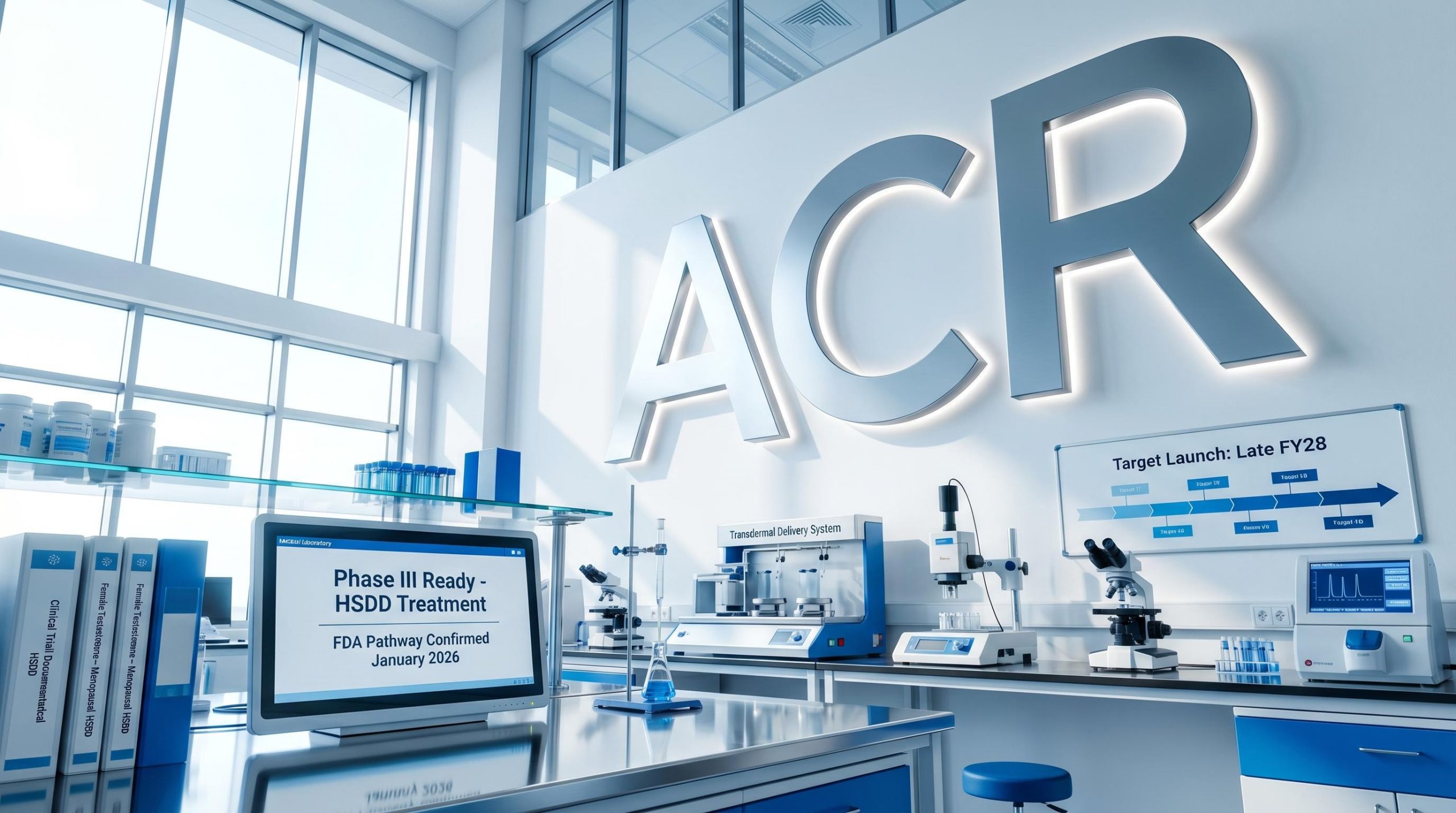
Acrux pivots strategy to Female Testosterone for underserved HSDD market
In its April 2026 Strategic Update, Acrux Limited (ASX: ACR) outlined a strategic pivot from purely pursuing Topical Generics to advancing its Female Testosterone product for the treatment of Hypoactive Sexual Desire Dysfunction (HSDD). The presentation detailed how positive FDA engagement on the company’s completed Phase I and Phase II clinical trials has clarified a viable pathway to Phase III, positioning Acrux to address a significant unmet clinical need in women’s health. Management highlighted that the company’s existing Topical Generics revenue base underpins and funds the Female Testosterone development programme, differentiating Acrux from purely clinical-stage developers reliant on capital raises.
The company reported that Phase I and Phase II trials demonstrated a strong efficacy and safety profile, with no material adverse events recorded. Management outlined target market entry of late FY28 to early FY29, with a co-development partnering milestone targeted for mid CY26. The strategic shift follows a comprehensive business review conducted by CEO John Warmbrunn and the executive team, which assessed the performance of existing commercialised products, development pipeline potential, regulatory environment changes in Hormone Replacement Therapy, and Acrux’s capacity to leverage 25 years of transdermal delivery expertise.
John Warmbrunn, CEO and Managing Director
“Female Testosterone is a great opportunity that Acrux is incredibly well positioned to exploit. The core revenue we are generating from our Topical Generics portfolio underpins and supports our capacity to bring this product to market. With a huge unmet need for women with Hypoactive Sexual Desire Dysfunction (HSDD), Acrux is looking forward to making a significant contribution to women’s health globally.”
The presentation positioned Acrux as uniquely placed to exploit global demand for Female Testosterone products, supported by significant intellectual property in testosterone formulations, regulatory engagement history, and proven transdermal spray application technology. Management emphasised that the company’s 505(b)(2) regulatory pathway provides exclusivity advantages, whilst existing manufacturing know-how from commercialised products Lenzetto and Evamist reduces execution risk.
When big ASX news breaks, our subscribers know first
What is HSDD and why is it a significant market opportunity?
Hypoactive Sexual Desire Dysfunction refers to persistently low or absent sexual desire in women that causes personal distress. The condition most commonly presents as reduced libido or diminished response to sexual stimulation, but can extend to broader quality-of-life impacts. Symptoms identified in the presentation include:
- Low self-esteem
- Reduced energy levels
- Depression and anxiety
- Interpersonal conflict
HSDD affects approximately 10% of all adult women, with the presentation highlighting that roughly 4.9 million menopausal women in the US alone suffer from the condition. Despite this prevalence, no FDA-approved Female Testosterone product exists for HSDD in the United States. The presentation noted that approximately 2 million women currently use off-label testosterone treatments, underscoring both the unmet clinical need and existing patient demand for approved therapeutic options.
The clinical evidence base supporting testosterone therapy for HSDD is substantial. The presentation referenced 36 randomised clinical trials demonstrating efficacy in postmenopausal women, with approximately 52% of patients reporting improved sexual function 6-8 weeks after treatment initiation. Anecdotal benefits cited included improved mood, energy, and cognitive function. Professor Susan R Davis AO, Head of the Monash Women’s Health Research Programme and author of the 2019 Global Consensus Position Statement on the Use of Testosterone Therapy for Women, was quoted in the presentation endorsing the evidence base and highlighting Acrux’s Metered Dose Transdermal System (MDTS) as offering advantages as a “patchless patch” with strong pharmacokinetic absorption evidence.
The combination of high prevalence, demonstrated clinical efficacy across dozens of trials, and the absence of FDA-approved treatment options creates a first-mover opportunity for a Phase III-ready developer. Acrux’s existing regulatory engagement and completed Phase I/II trials position the company to potentially enter this market ahead of competitors.
US market potential and global opportunity
Management presented detailed market sizing estimates for the US HSDD opportunity. The company estimates the US menopausal market (ages 45-65 years) could deliver commercial value of approximately US$2.88 billion per annum. Across all age demographics, the total addressable US market was estimated at US$6.6 billion. The presentation outlined these estimates by age category:
| Age Category | Market Value (US$Bn) |
|---|---|
| 18-44 years | 1.44 |
| 45-65 years | 2.88 |
| >65 years | 2.24 |
| Total | 6.6 |
The market sizing assumptions detailed in the presentation include: HSDD prevalence rates of 12.3% for women aged 45-65 years, 8.9% for 18-44 years, and 7.4% for over 65 years; annual treatment cost of US$300 per month; 40% patient response rate; 75% willingness to discuss with a doctor; and 82% of those women initiating discussion with a healthcare provider. No rebates were factored into the estimates.
Globally, the presentation highlighted that by 2030, approximately 130,000 women will enter menopause each day, with an estimated 120 million women worldwide expected to have HSDD by 2030. Management noted that Female Testosterone is gaining significant mainstream awareness, referencing coverage in publications including The Times, The Sydney Morning Herald, The Australian, and The New York Times Magazine. The presentation also outlined potential expansion beyond HSDD in postmenopausal women to include surgically postmenopausal women, women with premature menopause, and post-chemotherapy/radiotherapy indications as part of lifecycle management strategy.
Acrux’s competitive advantages and FDA pathway
The April 2026 Strategic Update emphasised Acrux’s Phase III readiness, supported by completed Phase I and Phase II clinical trials demonstrating strong efficacy and safety profiles with no material adverse events recorded. Management outlined a series of recent regulatory milestones that have clarified the pathway forward:
- October 2025: Acrux submitted a Pre-IND (Investigational New Drug) package to the FDA
- November 2025: US Department of Health & Human Services removed FDA Black Box warnings from female hormone replacement therapy products
- January 2026: FDA clarified Acrux’s registration pathway
The removal of Black Box warnings in November 2025 represented a significant shift in the regulatory landscape for hormone replacement therapies. The presentation noted that in the early 2000s, the Women’s Health Initiative found overall risks exceeded benefits from certain hormone products (not including testosterone), creating a misconception that persisted for two decades. Management highlighted that in July 2025, the unmet clinical need of HSDD in postmenopausal women was a key focus of the FDA Expert Panel on Menopause and Hormone Replacement Therapy for Women, signalling regulatory receptiveness to new treatment options.
Acrux’s proprietary technology platform centres on its Metered Dose Transdermal System, a spray applied to the abdomen that utilises the same delivery mechanism as the company’s existing commercialised products Lenzetto and Evamist. The presentation detailed three core technological components:
- MDTS or MD-Lotion Applicator: Enables simple, accurate, and flexible dosing applied to the abdomen
- ACROSS Enhancers: Allow drugs to pass through skin more rapidly
- Patchless Patch Reservoir: Forms an invisible reservoir within the skin
Management emphasised that utilising the same delivery technology as Lenzetto and Evamist ensures high scalability once in market. The product is positioned for once-daily administration, applied to the abdomen to reduce the risk of incidental contact and transfer on other parts of the body. The presentation noted that Acrux will pursue the 505(b)(2) regulatory pathway, which provides exclusivity advantages. Lifecycle management considerations outlined include development of a new improved MDTS applicator with patent protection and potential combination therapies with patent protection.
The January 2026 FDA pathway clarification de-risks the regulatory journey compared to typical early-stage clinical developers. The combination of completed Phase I/II data, existing manufacturing expertise from commercialised hormone products, and regulatory engagement history positions Acrux to potentially achieve early mover advantage in a market with no currently approved competitor offering female-appropriate dosing.
Co-development strategy and partner leverage
The presentation outlined Acrux’s commercialisation approach, which centres on securing a co-development partner with specific capabilities. Management identified four core partner requirements:
- Clinical trial expertise
- Sales force access
- Hormone product experience
- Market education and advocacy capabilities
The company stated it has “significant, long-term existing relationships with potential co-developers,” leveraging distribution and product agreements already in place with potential partners. The co-development partnering milestone is targeted for mid CY26, representing the next material catalyst for investors to monitor.
Management explained the strategic rationale for this approach: de-risking the clinical trial process, expediting market entry, and leveraging partner infrastructure for both Phase III execution and commercial launch. The presentation noted that Acrux will work proactively with its co-development partner to finalise Phase III trial design and manufacturing protocols. This strategy contrasts with a solely in-house development model, recognising that partner capabilities in conducting large-scale clinical trials and establishing market access can accelerate the pathway to commercialisation whilst reducing capital intensity.
Development roadmap and key milestones to FY28 launch
Management presented a detailed milestone timeline extending from mid CY26 through to late FY28/early FY29 product launch. The roadmap provides visibility on value-creating catalysts over the next 2-3 years, with multiple near-term and medium-term milestones identified to ensure strong investor engagement.
| Milestone | Target Timing |
|---|---|
| Co-development Partnering | Mid CY26 |
| CRO Contract | Early FY27 |
| Manufacturing | Early FY27 to launch |
| Phase III Trials | Early FY27 to submissions |
| Dossier to US FDA | Early FY28 |
| Submission and Product Launch | Late FY28 to Early FY29 |
The timeline positions co-development partnering as the immediate catalyst, targeted for within months of the April 2026 presentation. Following partnering, the company outlined progression through CRO (Contract Research Organisation) contracting in early FY27, with manufacturing scale-up running concurrently through to launch. Phase III trials would commence in early FY27, running through to dossier submission in early FY28. Final FDA submission and product launch are targeted for late FY28 to early FY29.
Management’s regional regulatory strategy extends beyond the US. The presentation noted that Acrux will define regulatory and clinical strategies for the US and rest of world through consulting with regional authorities including the TGA (Therapeutic Goods Administration) and EMA (European Medicines Agency). Market entry would be staged based on regional regulatory requirements, with recent 2025 approvals in the UK, Australia, New Zealand, and South Africa of products treating HSDD in postmenopausal women indicating potential regulatory pathways in those jurisdictions.
Existing revenue base supports development funding
The presentation emphasised Acrux’s differentiation from typical clinical-stage biotechnology companies: an existing portfolio of FDA-registered Topical Generics generates revenue to subsidise group R&D activities. Commercialised products generating income include:
- Nitroglycerin 0.4% ointment (launched end of Q2 FY25)
- Dapsone 5.0% gel
- Dapsone 7.5% gel
- Evamist royalties (ongoing)
Management reported that quarterly revenues from product licensing are growing, driven by the Nitroglycerin launch. With Q4 FY26 revenues yet to be reported, FY26 Product Licensing Income was described as on track to more than double the prior year. The presentation also noted that proceeds from divestment of Prilocaine 2.5% and Lidocaine 2.5% cream were received in 1H FY26, providing additional capital to support the Female Testosterone programme.
This revenue-generating base provides Acrux with a degree of self-funding capacity for the Female Testosterone development, reducing reliance on capital markets compared to pure-play clinical developers. Management stated that the company will continue to review its asset portfolio to ensure optimal product mix for delivering shareholder value, indicating potential for further divestments or partnership arrangements to support the strategic focus on Female Testosterone.
Investment case summary
The presentation synthesised six core pillars underpinning the investment proposition for Acrux following the strategic pivot:
- Phase III ready asset: Trials completed with strong efficacy and safety profile; FDA pathway clarified in January 2026
- Significant, fast-growing market: Approximately US$2.88 billion US menopausal opportunity; 120 million global HSDD sufferers by 2030
- Early mover advantage: No FDA-approved competitor; first-to-market opportunity with approved formulation
- Co-development pathway: Existing partner relationships provide accelerated route to market
- Revenue-generating generics portfolio: Product licensing income supports R&D, reducing capital dependency
- Proprietary IP and expertise: 25 years of transdermal delivery know-how; 505(b)(2) exclusivity pathway; proven history commercialising hormone products
Management positioned the company as moving beyond a pure generics play to a high-value, innovative transdermal IP developer addressing significant unmet clinical need. The combination of completed Phase I/II trials, FDA regulatory clarity obtained in January 2026, existing manufacturing infrastructure, and revenue generation from commercialised products differentiates Acrux’s risk profile from typical early-stage clinical developers.
The immediate catalyst for investors to monitor is co-development partnering, targeted for mid CY26. Securing a global partner with clinical trial expertise, hormone product experience, and established sales force access would de-risk the Phase III pathway and provide validation of the commercial opportunity. Subsequent milestones through FY27 and FY28 offer regular re-rating catalysts as the programme progresses towards market entry in late FY28 to early FY29.
Want to Track Acrux’s Journey to Market Entry in FY28?
With co-development partnering targeted for mid-2026 and Phase III trials set to commence early FY27, Acrux’s Female Testosterone programme represents a clear catalyst pathway through to commercial launch. The company’s quarterly revenue updates and partnership announcements will provide critical milestones for monitoring development progress.
Stay ahead of key announcements by visiting the Acrux investor centre for real-time regulatory updates, partnership news, and clinical trial developments. With first-mover advantage in a US$2.88 billion US menopausal market, tracking Acrux’s execution against its published roadmap could prove essential for informed investment decisions.