
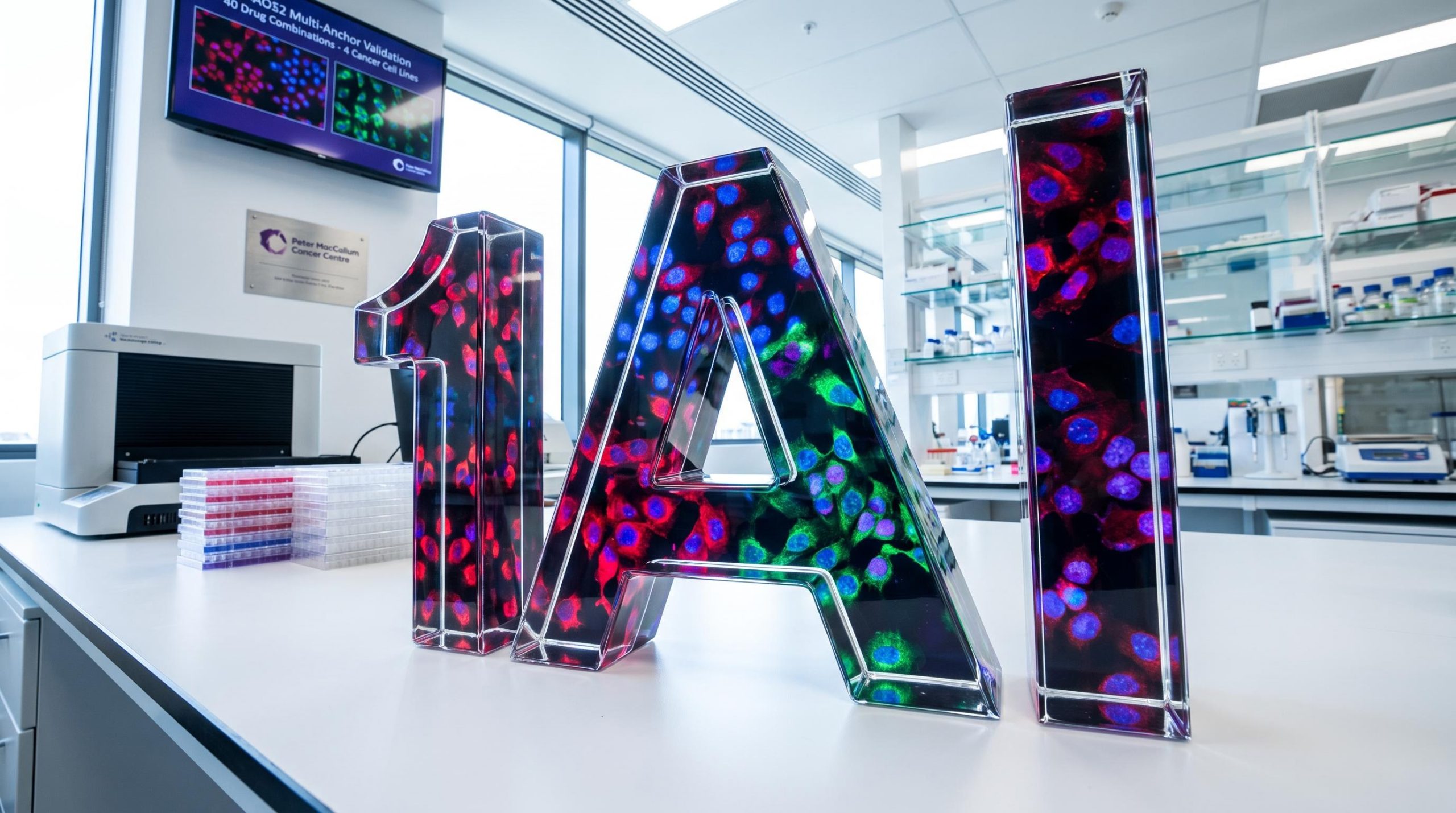
Third Peter Mac drug synergy program gets underway
Algorae Pharmaceuticals (ASX: 1AI) has entered into an agreement with the Victorian Centre for Functional Genomics (VCFG) at Peter MacCallum Cancer Centre for a third program to independently validate predictions from its AlgoraeOS v2 (AOS2) multi-anchor program. The work extends the company’s AI drug discovery collaboration with the cancer centre.
The program will screen 40 high-priority drug combination candidates for synergy across four cancer cell lines: glioblastoma, non-small cell lung cancer, colorectal cancer and bladder cancer. The project is expected to be completed within six months.
For investors, the agreement adds a further round of external testing of the platform’s predictions, following two earlier programs at the same centre.
Dr James McKenna, Chief Scientific Officer
“This study builds on the foundations established through our previous two collaborations with the VCFG team at the Peter MacCallum Cancer Centre… allowing us to assess the real-world generalisability of the platform across multiple anchor drugs. Importantly, the study also provides a further demonstration of how AOS can help bridge the gap between in silico prediction and biological validation.”
When big ASX news breaks, our subscribers know first
From 9 million predictions to 40 candidates
How the multi-anchor program narrowed the field
The multi-anchor program, announced on 18 May 2026, evaluated 18 anchor drugs in combination with thousands of approved and investigational compounds across a panel of human cell lines. The anchors were selected to span a diverse range of therapeutic areas and mechanisms of action.
The multi-anchor program expanded AlgoraeOS v2 from a single anchor drug to 18, producing the prediction set from which the current 40 candidates were drawn.
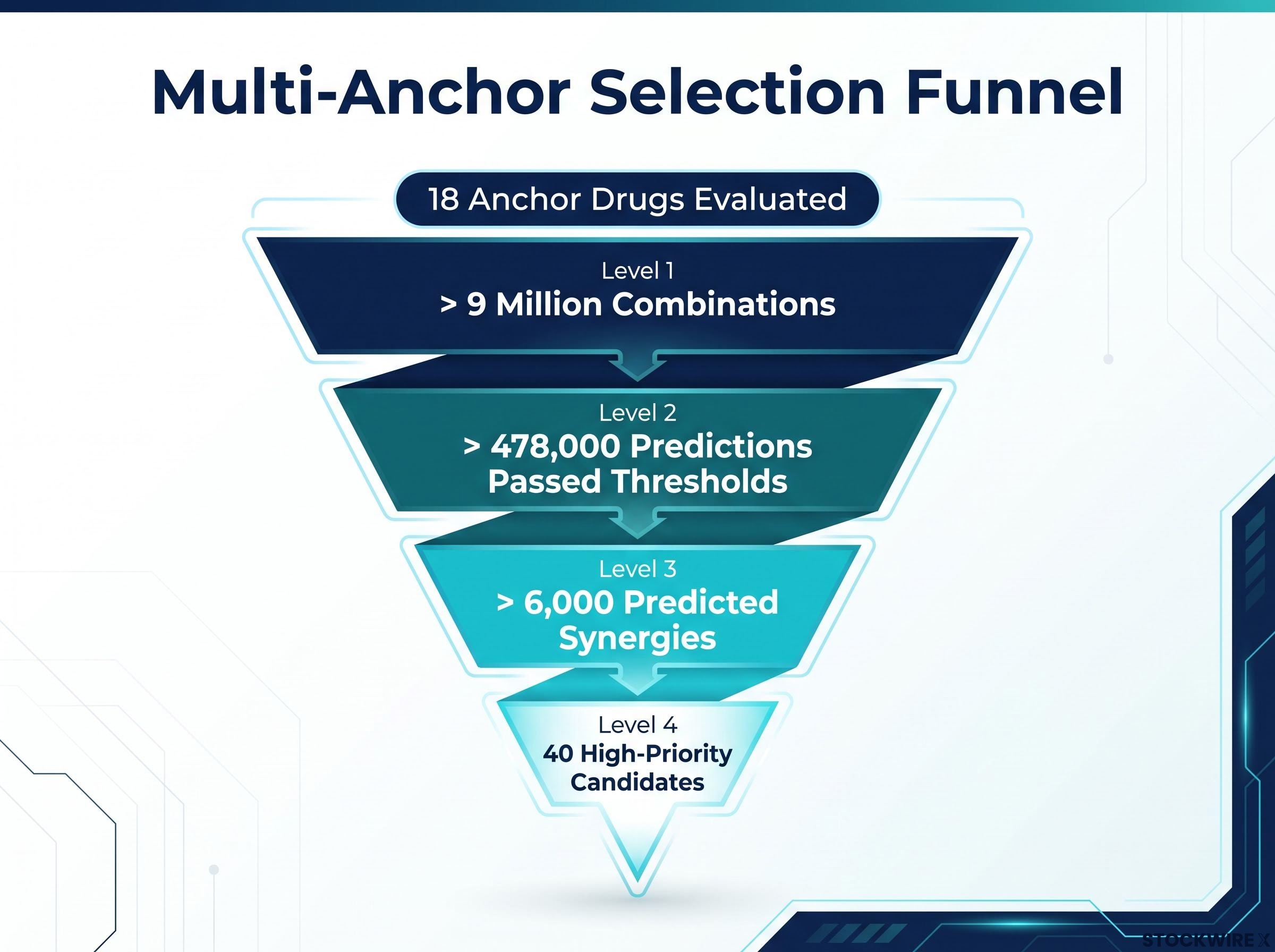
The selection funnel ran as follows:
- Over 9 million potential drug–drug–cell line combinations were evaluated.
- More than 478,000 individual synergy predictions passed preliminary synergy and uncertainty thresholds.
- Over 6,000 drug combinations demonstrated predicted synergy across multiple cell lines, which the company said indicates greater biological robustness.
- 40 candidates were selected after analysis of commercial and intellectual property considerations.
The 40 combinations use only a subset of the 18 anchors, so not all anchor drugs are progressing. Each prediction in the dataset included four synergy metrics (ZIP, Bliss, HSA and Loewe) alongside confidence-weighted measures of predictive uncertainty.
What is drug synergy screening?
Drug synergy occurs when two drugs used together produce a stronger effect than would be expected from each drug alone. Drug synergy screening tests many combinations in the laboratory to find those that work better together.
In silico predictions are generated by computer models rather than lab experiments. They need laboratory validation because a prediction only becomes credible preclinical data once it is tested in real biological systems.
Funding support and validation process
$49,109 voucher
The program is supported by a competitive voucher of $49,109 awarded to the company under the Phenomics Australia – Therapeutic Innovation Australia Pipeline Accelerator 2025-26 Round 2 scheme. It supports experimental work in partnership with the VCFG.
The scheme attracted 28 applications, of which 13 were selected for funding. The award reduces the total cost to the company of accessing these services.
Screening workflow
VCFG will perform the screening at Peter Mac using its high-throughput microscopy platform. The process will include:
- Cell growth optimisation for the high-throughput platform.
- Single-agent dose-response curves across four cancer cell lines.
- Synergy screens using selected dose ranges.
Data analysis will be completed within three weeks of the synergy screen, with the full dataset expected within six months. Key decision points will be integrated into the study to ensure data quality and optimise further testing.
The table below places the program alongside the earlier Peter Mac validation work.
| Program | Platform | Announcement date |
|---|---|---|
| First program | AlgoraeOS v1 (AOS1) | 5 December 2025 |
| Second program | AOS2 | 3 July 2026 |
| Third program | AOS2 multi-anchor | 16 October 2026 (this announcement) |
Building the Peter Mac pipeline and what comes next
Investment significance
The work builds on the independent preclinical validation of AOS1 at Peter Mac and of AOS2. Promising candidates from the current program and the previous two programs will inform the company’s ongoing discussions with Peter Mac.
Earlier Peter Mac work found that AOS2 identified synergistic combinations at about 2.5 times the rate of its predecessor, which is the validation record this third program now seeks to extend across multiple anchor drugs.
Priority candidates from the initial two programs have been shortlisted. Discussions are under way to advance their development through a combination of in vitro assays and in vivo animal models. The announcement does not state that any further work has been agreed or funded.
The announcement does not disclose financial results or revenue data, and the screens are preclinical, with no efficacy outcomes reported yet.
Dual-business context
In parallel with its AI drug discovery activities, the company’s commercial pharmaceutical business continues to advance, with additional products and agreements progressing through the pipeline. No figures are disclosed.
Peter Mac currently treats more than 47,000 patients every year, and the VCFG was established over 16 years ago. Algorae will continue to update shareholders as key commercial and scientific milestones are achieved.
Ready to Follow Algorae’s Third Peter Mac Validation Program?
Algorae Pharmaceuticals is putting 40 AI-predicted drug combinations to the test across four cancer cell lines, extending its independent validation work with the Victorian Centre for Functional Genomics. The program is supported by a $49,109 competitive voucher and is expected to deliver a full dataset within six months.
To explore the company’s AI drug discovery platform and commercial pharmaceutical pipeline, visit the Algorae Pharmaceuticals website. Find out how AlgoraeOS v2 is working to bridge the gap between in silico prediction and biological validation.