The biggest nuclear deal of the week does not involve a single new reactor. When Google and Constellation Energy announced their partnership on 6 October 2026, the new capacity came entirely from upgrading plants that are already running. Constellation plans to invest about $4.3 billion to add 890 MW across existing units, with a separate supply deal lifting the headline total to roughly 3.59 GW.
That detail matters for anyone weighing hyperscalers’ nuclear stocks. Meta, Amazon, Google and Microsoft are all signing 20-year nuclear commitments. The equities tied to those deals fall into two very different groups: incumbent operators with working reactors, and small modular reactor (SMR) developers whose designs are not yet built.
Constellation shares reportedly jumped about 12% on the announcement. The market is clearly paying attention, but it is not always separating the near-term cash from the long-dated promise.
Here is how to sort hyperscaler-linked nuclear names into incumbents and early-stage bets, plus a four-part test you can apply to any SMR stock before buying.
Where hyperscaler nuclear money is actually going
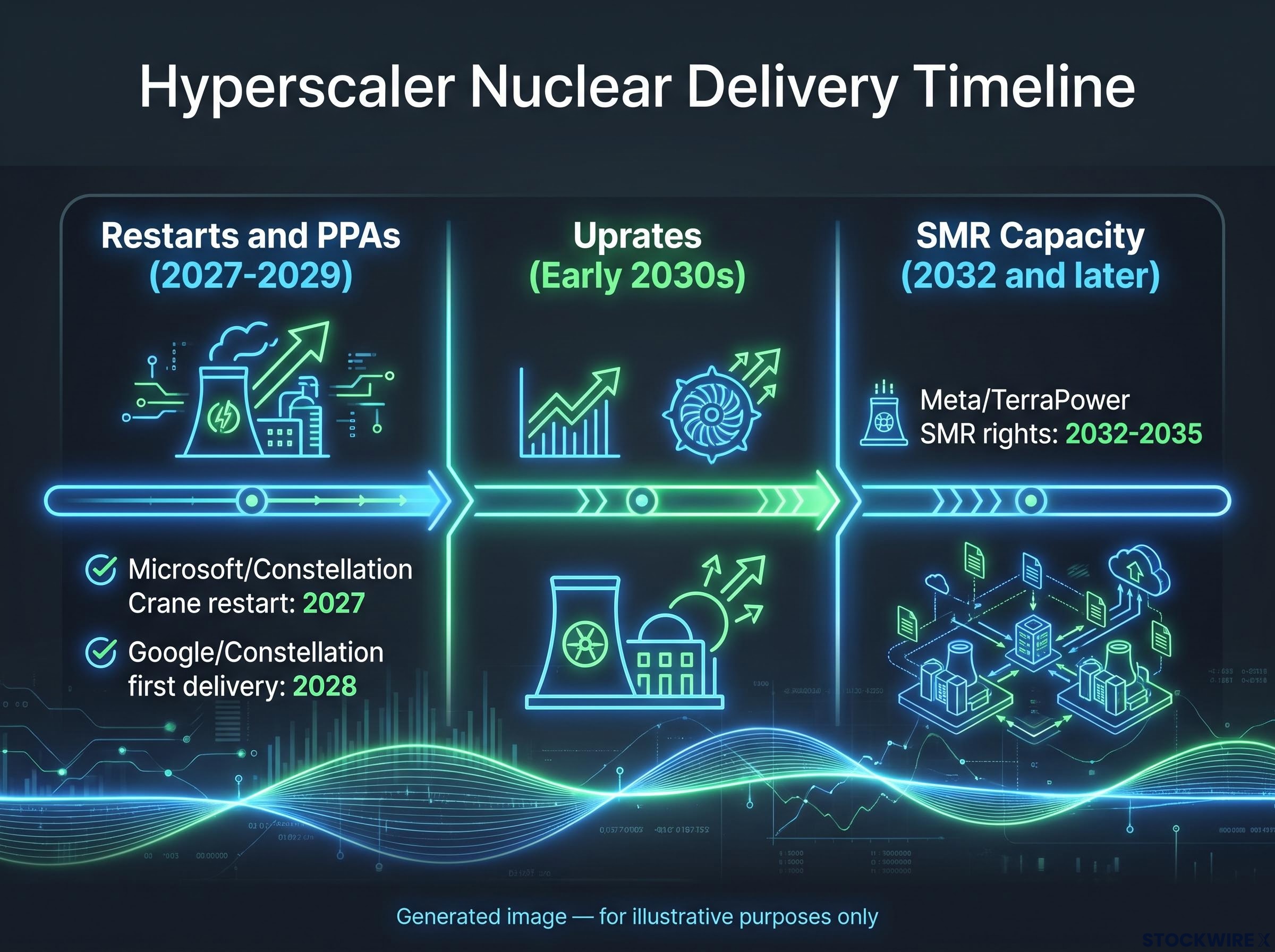
Sort the deals by when electricity actually flows, rather than by buyer, and a clear pattern emerges. Restarts and power purchase agreements (PPAs) on operating plants deliver from 2027-2029. Uprates arrive in the early 2030s, and SMR capacity sits at 2032 and later. A PPA is a long-term contract in which a buyer agrees to purchase electricity from a specific generator at set terms. An uprate is an upgrade that raises the output of an existing reactor.
The scale of these commitments reflects how quickly AI power demand is outrunning grid supply, which is why hyperscalers are willing to lock in 20-year nuclear contracts rather than wait on intermittent capacity.
| Hyperscaler | Counterparty | Capacity | Asset type | Target timing |
|---|---|---|---|---|
| Microsoft | Constellation (Crane) | 835 MW | Restart | 2027 |
| Meta | Constellation (Clinton) | 1,121 MW | Existing plant, virtual PPA | From June 2027 |
| Meta | Vistra | ~2,609 MW | Existing plants plus uprates | Late 2026 to 2034 |
| Amazon | Talen (Susquehanna) | Up to 1.9 GW | Existing plant | Through 2042 |
| NextEra (Duane Arnold) | Not specified | Restart | Potentially 2029 | |
| Constellation (PJM) | ~3.59 GW | Uprates plus fleet supply | 2028 to end 2032 | |
| Amazon | Constellation (Calvert Cliffs) | 690 MW | Existing plant plus uprate | Uprates 2030-2032 |
| Kairos/TVA | 500 MW | Advanced reactor | Around 2030 | |
| Amazon | X-energy | ~960 MW initial | SMR development | 2030s |
| Meta | TerraPower | ~2.1-2.79 GW | SMR rights | 2032-2035 |
Existing reactors, uprates and restarts
The Google deal covers 11 units across six sites in PJM, the grid operator spanning much of the Mid-Atlantic and Midwest. First delivery is targeted for 2028, with the full 890 MW expected by the end of 2032. A separate 15-year agreement covers 2,700 MW from the existing fleet. The power goes to the grid, not directly into data centres.
Meta has assembled up to about 6.6 GW across all its nuclear commitments, according to Axis Intelligence. The bulk sits in Clinton and in Vistra’s Perry, Davis-Besse and Beaver Valley plants. Amazon’s Talen contract and Microsoft’s Crane restart round out a group of deals that are binding and tied to reactors already licensed to operate.
Advanced reactor bets
The SMR deals look different on paper. Meta holds rights to TerraPower Natrium units, plus an Oklo agreement. Reported TerraPower figures range from about 2.1 GW to 2.79 GW, likely reflecting the first units versus the full rights portfolio.
Amazon has committed roughly $500-700 million or more to X-energy, with an initial pathway of about 960 MW. Presenc AI reports that this is phased development funding, not take-or-pay PPAs. Under a take-or-pay contract, the buyer must pay whether or not it uses the power.
The takeaway is straightforward. Most hyperscaler nuclear revenue reaching shareholders before 2030 flows to operators of existing plants, not to reactor designers.
When big ASX news breaks, our subscribers know first
Why incumbents are the easier trade than SMR developers
New technology usually promises bigger upside, so the instinct to chase SMR names makes sense. The hyperscalers themselves, however, have voted with their contracts, and existing plants give them three advantages:
- Faster delivery: power in the late 2020s rather than the 2030s
- Lower construction and licensing risk: uprates and life extensions carry more predictable costs than first-of-a-kind builds
- Immediate clean-energy attributes: virtual PPAs like Clinton transfer carbon-free credits from day one
The Carnegie Endowment argued in June 2026 that supporting existing reactors is more reliable than banking on SMRs that have not been built. Palisades in Michigan reinforces the point: it became the first reactor the Nuclear Regulatory Commission (NRC) approved to return from closed status, with restart scheduled later in 2026.
The same preference for existing assets shows up in European nuclear investment, where life extensions offer the nearest-term and lowest-execution-risk entry point for capital.
How value reaches you depends on structure. Merchant generators such as Constellation and Vistra sell power at market or contracted prices, so deal economics flow more directly to shareholders. Regulated utilities such as Duke Energy and Dominion Energy earn returns set by state regulators, which can mute both upside and risk.
The incumbent case has limits. Justin Hune, founder of Uranium Insider, argues the Google deal does little for uranium because uprates mostly involve turbines and steam generators.
Source view: Justin Hune, Uranium Insider The deal is bullish mainly for sentiment and for lowering risk at existing US plants, rather than for uranium demand.
Hune also suggests Constellation’s 12% jump was amplified by short covering, meaning traders who had bet against the stock buying back shares. He notes that established names including BWXT have fallen 20-30% from highs, and some pay dividends. Current prices, multiples and yields were not available for this analysis, so check them before acting.
For you, incumbent exposure means underwriting execution of uprates and life extensions, not design risk. The first-day move may already price in part of the news.
How to evaluate SMR stocks: customers, pipeline, licensing and funding
NuScale’s partnership with Utah Associated Municipal Power Systems (UAMPS) looked solid. It planned six 77 MW modules, had more than 50 municipal subscribers and had advanced licensing. It was cancelled in November 2023.
That case shows why every SMR name deserves a stricter screen. There are 70-90 SMR firms with about 150 designs, and Hune expects roughly six winners to become clear within five years. Use these four criteria:
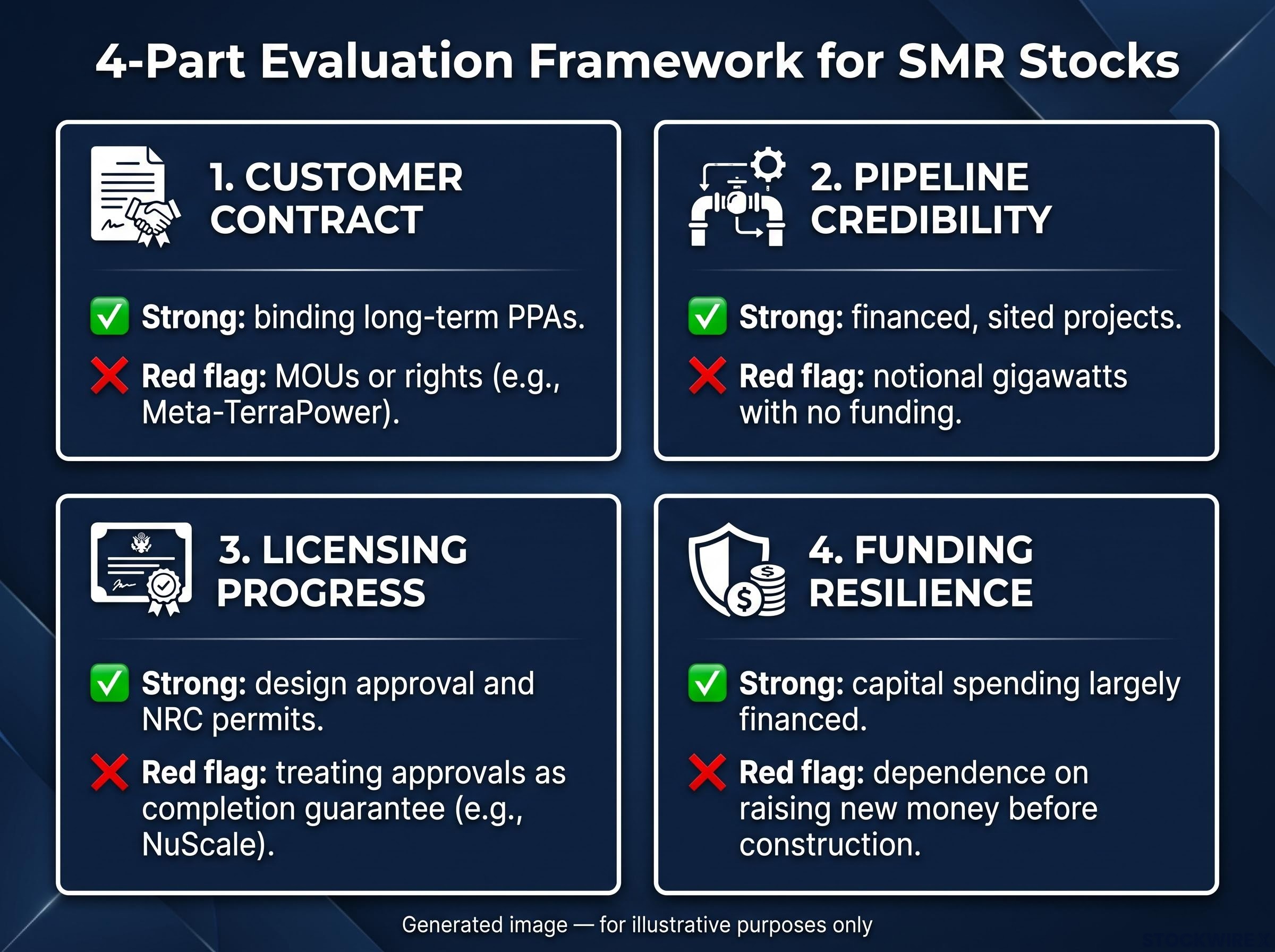
- Customer contract firmness. Strong: binding long-term PPAs with creditworthy buyers. Red flag: memorandums of understanding (MOUs) or rights, such as Meta-TerraPower and Amazon-X-energy, presented as revenue.
- Pipeline credibility. Strong: financed, sited projects. Red flag: notional gigawatts with no funding attached.
- Licensing progress. Strong: design approval and site or construction permits moving through the NRC. Red flag: treating approvals as a completion guarantee, as NuScale shows. Reviews for Natrium, Xe-100, Kairos and GE Vernova’s BWRX-300 remain ongoing or pending.
- Funding and balance-sheet resilience. Strong: capital spending largely financed. Red flag: dependence on raising new money before construction.
Remember that GE Vernova is diversified, not a pure play. Some SMR stocks also traded like meme stocks in late 2024 and early 2025, which Hune says is no investment case.
| Factor | Incumbent operators | SMR developers |
|---|---|---|
| Timing | Late 2020s | 2030s and beyond |
| Risk type | Execution of uprates and extensions | Design, licensing, fuel and cost risk |
| Liquidity | Easier, more liquid | Early-stage, higher volatility |
| Dependence on hyperscaler deals | Contracts anchor existing revenue | Frameworks underpin future valuation |
A hyperscaler’s name on a press release is not a revenue contract. Judge each SMR stock on what is financed and permitted. The practical approach is a diversified basket of established and speculative names, with small SMR holdings sized as high-risk positions.
For readers wanting a third route beyond operators and SMR developers, our deep-dive into nuclear supply chain investing explains how heavy component makers profit from multi-year reactor forging lead times.
The risks that can break the nuclear thesis
Power Magazine’s 2026 industry review put it bluntly: “the real test is now scale.” Some risks hit every name, while others concentrate in the places you are least likely to look.
- First-of-a-kind cost overruns: incumbents face modest uprate risk; SMR names face potential project-ending overruns.
- HALEU fuel supply: TerraPower and X-energy designs need high-assay low-enriched uranium, which requires new enrichment capacity. Incumbents are largely unaffected.
- Licensing delays: relicensing timelines are shorter; new-build delays can push SMR revenue years out.
- Concentration risk: deals cluster among four buyers. Incumbents would lose upside; SMR valuations could lose their core support.
- Market-structure questions: at Clinton, Meta takes the clean attributes while Constellation sells power into the regional market. Ratepayer impacts were not quantified in the research.
- Sentiment amplification: short covering and meme-stock trading can exaggerate moves in both directions.
Fuel supply is the quieter constraint for advanced designs, and projects such as laser enrichment in Kentucky aim to produce the HALEU that TerraPower and X-energy reactors will eventually require.
A hyperscaler pulling back or a licensing slip would hit SMR names far harder than incumbents. Size positions with that asymmetry in mind.
Past performance does not guarantee future results. Forward-looking statements are speculative and subject to change based on market developments and company performance.
Matching your nuclear exposure to your time horizon
The deal map points one way. Incumbents carry the near-term hyperscaler cash flows, while SMRs are a long-dated option on a handful of eventual winners.
Your decision starts with horizon. If your focus is the late 2020s, incumbent operators are where contracted megawatts actually arrive. If you are positioning for the 2030s, SMR names fit, but size them on the assumption you could lose the stake, and screen each against the four criteria.
Three markers are worth tracking:
- NRC permit decisions for Natrium, Xe-100, Kairos and BWRX-300
- Frameworks converting into financed, binding projects
- Uprate progress, starting with Google-Constellation’s 2028 first delivery
This analysis does not provide valuation or price data, so verify current multiples, yields and share prices independently.
This article is for informational purposes only and should not be considered financial advice. Investors should conduct their own research and consult with financial professionals before making investment decisions.