Aristocrat Leisure’s share price has fallen roughly 17% in 2026 while the ASX 200 has barely moved, yet its largest broker is calling for 33% upside from here. Something in that equation has to give. ALL closed at $51.53 on 15 May 2026, sitting only 16.6% above its 52-week low, a level that places one of Australia’s most profitable gaming companies uncomfortably close to its cheapest valuation in years. The dislocation between a resilient underlying business and a depressed Aristocrat Leisure share price is drawing renewed attention from analysts and income-seeking ASX investors alike.
What follows unpacks the forces behind the sell-off, how Aristocrat’s three-segment business model generates recurring earnings, what its price-to-sales discount signals about relative value, and which risks could prevent a re-rating. The aim is to provide a clear, evidence-based framework for deciding whether ALL belongs in a portfolio right now, rather than a received verdict.
A 17% slide in a flat market: what the ALL share price is telling investors
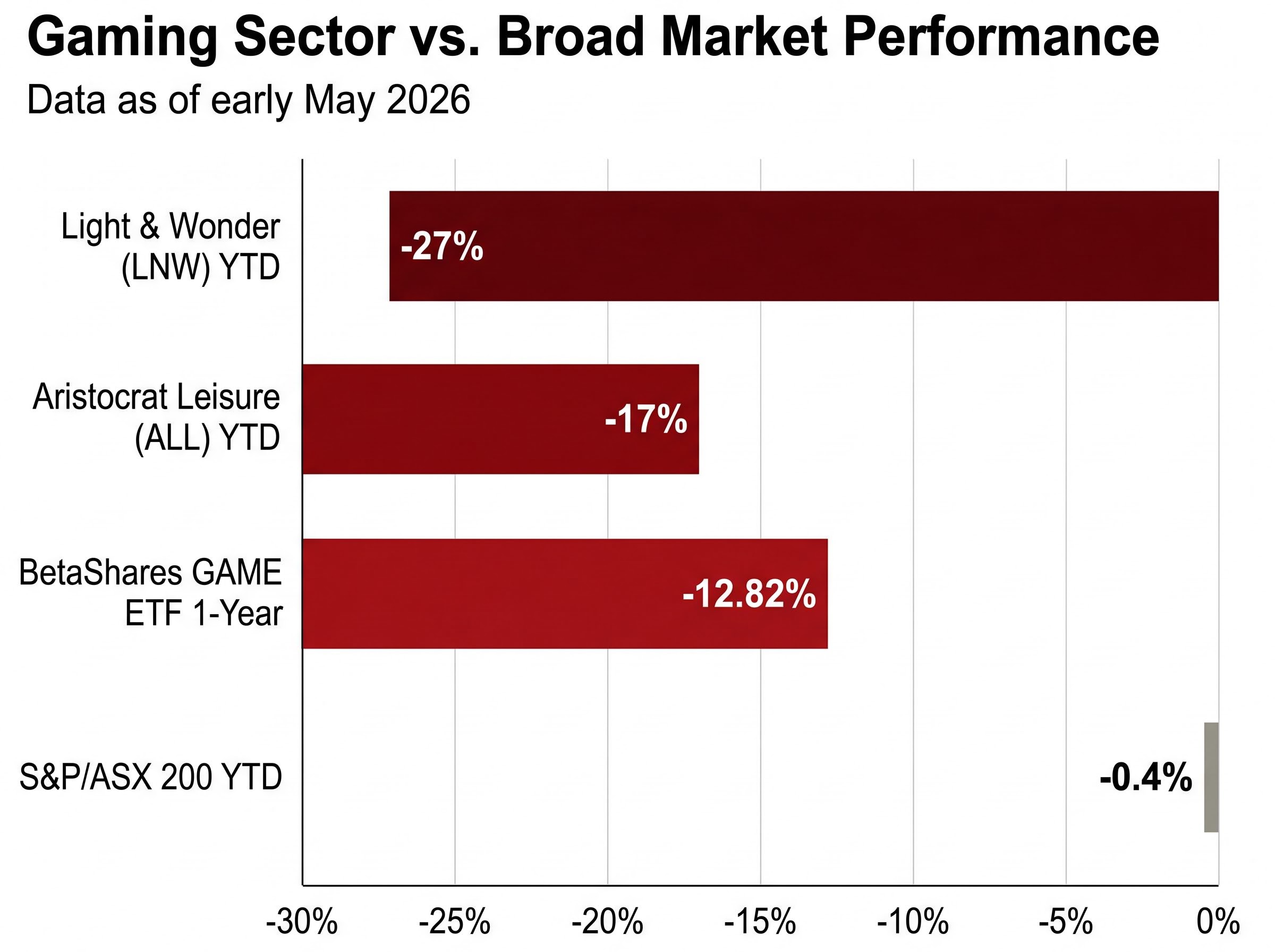
The scale of the underperformance is hard to dismiss. As of 6 May 2026, ALL had shed approximately 17% for the year while the ASX 200 had dipped just 0.4% over the same window. That kind of gap, more than 16 percentage points of relative drawdown, typically accompanies a profit warning or a structural business problem.
Neither has materialised. Instead, the weakness is sector-wide.
Light & Wonder (ASX: LNW) fell approximately 27% year-to-date over the same period, while the BetaShares GAME video-games and esports ETF returned -12.82% in the 12 months to 30 April 2026. The entire gaming and digital-entertainment equity complex has moved out of favour with investors.
| Asset | Return | Benchmark / Index | Period |
|---|---|---|---|
| Aristocrat Leisure (ALL) | -17% (approx.) | ASX 200 | YTD as of 6 May 2026 |
| Light & Wonder (LNW) | -27% (approx.) | ASX 200 | YTD as of 6 May 2026 |
| BetaShares GAME ETF | -12.82% | Global gaming equities | 1-year to 30 April 2026 |
| S&P/ASX 200 | -0.4% (approx.) | Broad market | YTD as of 6 May 2026 |
That context reframes the question. This is less about what is wrong with Aristocrat and more about what is wrong with gaming equities broadly.
According to Motley Fool Australia, Aristocrat is “starting to look more interesting than its share price chart alone would suggest,” with fundamentals holding up far better than the share price implies.
When big ASX news breaks, our subscribers know first
How Aristocrat actually makes money: the three revenue levers investors should understand
Aristocrat Leisure was founded in 1953 by Len Ainsworth and has grown into Australia’s largest gaming machine manufacturer and one of the world’s largest slot machine producers. The business, however, generates revenue through three distinct channels that many retail investors overlook.
- Outright hardware sales: Aristocrat designs, manufactures, and sells gaming machines directly to casinos and gaming venues. This is a traditional capital-goods revenue stream, lumpy by nature and tied to venue refurbishment and expansion cycles.
- Revenue-sharing arrangements: Rather than selling machines outright, Aristocrat places machines in venues and receives a portion of the takings on an ongoing basis. This recurring model provides steadier, more predictable cash flows than hardware sales alone and aligns Aristocrat’s incentives with machine performance.
- Pixel United (digital and mobile gaming): Aristocrat’s mobile and digital gaming division has grown to represent close to 50% of total group revenue, providing exposure to the fast-growing online gaming market and helping smooth earnings across land-based hardware cycles.
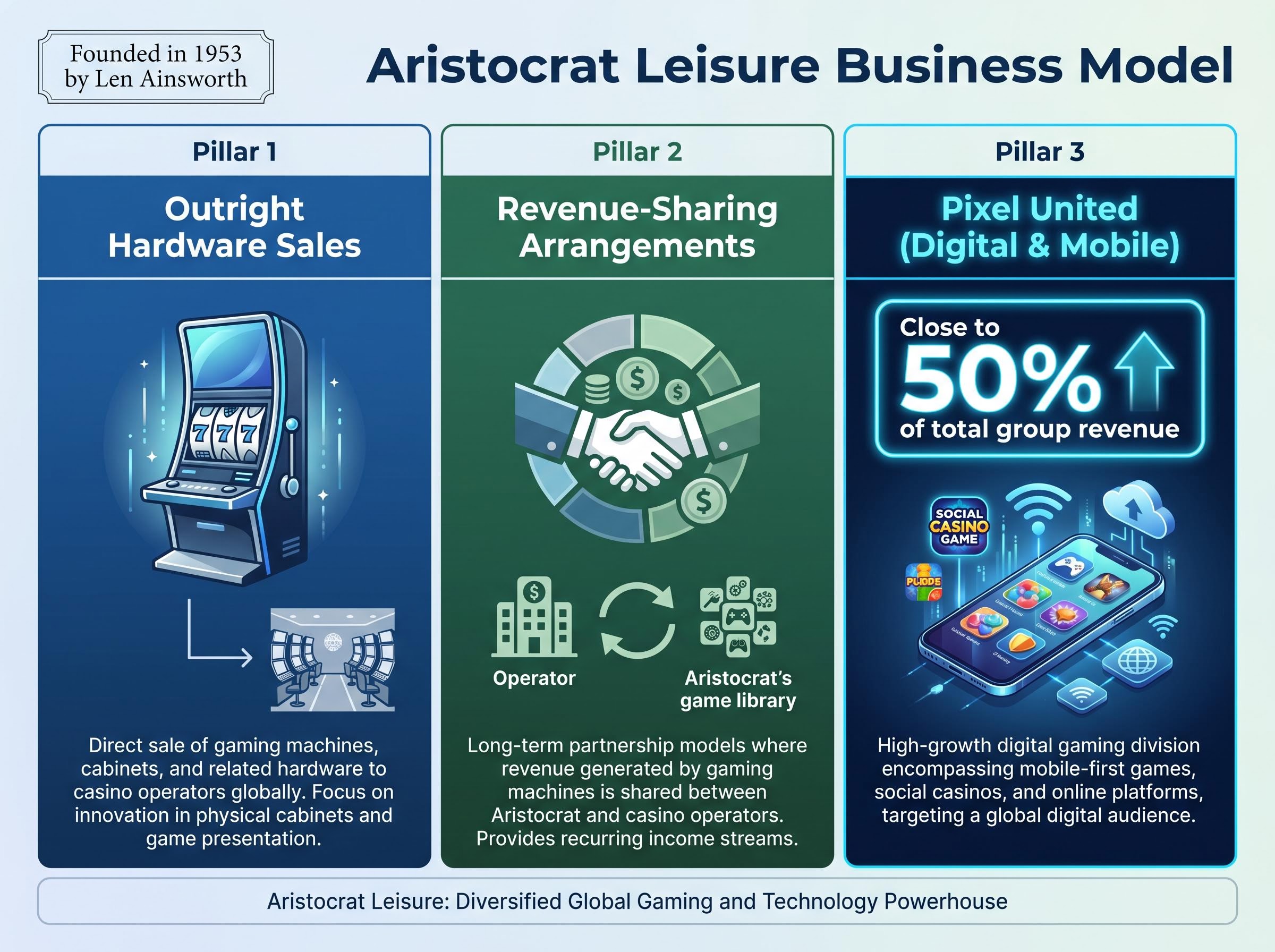
The combination of a recurring revenue-sharing model and a scaled digital segment reveals a higher-quality earnings stream than the headline description of “slot machine manufacturer” suggests. North American gaming-machine demand remains steady, according to broker commentary as of early May 2026, which anchors the land-based business and provides earnings-floor visibility.
Pixel United and the digital growth story
Pixel United is where Aristocrat’s growth narrative is concentrated. The division offers exposure to mobile and online gaming, a market with structural tailwinds even as listed digital-gaming equities have struggled. The BetaShares GAME ETF’s five-year annualised return of just 1.83% per annum illustrates that investor appetite for the sector has been subdued, even as underlying consumer spending on mobile gaming has expanded.
The tension is straightforward. Long-term structural growth in digital gaming has not yet translated into equity returns for listed players. Pixel United’s ability to convert its revenue scale into margin expansion and bookings growth will be a determining factor in whether Aristocrat’s current valuation discount closes or persists.
What the price-to-sales ratio reveals about ALL’s current valuation
The price-to-sales (P/S) ratio measures how much investors are paying for each dollar of a company’s revenue. A lower P/S suggests the market is placing a cheaper valuation on the revenue base; a higher one suggests confidence in that revenue converting into future profits.
For Aristocrat, the current P/S sits at 4.71x. Its five-year historical average is 5.64x.
| Metric | Value | Discount to Average |
|---|---|---|
| Current P/S ratio | 4.71x | ~16.5% |
| 5-year average P/S ratio | 5.64x |
Aristocrat’s current price-to-sales ratio of 4.71x represents an approximate 16.5% discount to its own five-year average, the widest sustained gap in recent history for a company whose underlying earnings performance brokers describe as resilient.
The gap is the clearest single data point suggesting the market may be underpricing what Aristocrat’s revenue base is worth. However, a P/S discount to historical norms does not automatically signal a buying opportunity. It can reflect genuine business deterioration, temporary risk-off sentiment across a sector, or a structural change in business mix that warrants a lower multiple.
Investors should treat the P/S ratio as an initial screening tool rather than a standalone buy signal. Discounted cash flow (DCF) and dividend discount models complement this analysis and provide a fuller picture of intrinsic value.
Combining share valuation methods matters here precisely because a P/S screen showing a 16.5% discount to historical averages can coexist with a business that is genuinely deteriorating; EV/EBITDA benchmarking and DCF analysis each stress-test different assumptions about margin sustainability and growth duration, filling the blind spots that a P/S ratio alone cannot address.
Broker targets and the re-rating case for ALL
UBS carries a Buy rating on Aristocrat with a price target of $68.90. From the 15 May 2026 close of $51.53, that target implies approximately 33-34% upside. As recently as early May 2026, when ALL was trading near an implied level of $46-$47, the same target implied close to 50% upside, a gap that has narrowed as the share price recovered.
The broader broker consensus remains constructive on Aristocrat. The rationale rests on three pillars:
The HY26 results confirmed recurring revenue had exceeded 70% of group revenue for the period, with group EBITA margin expanding from 28.6% in FY22 to 36.9% by the half, a trajectory that directly contradicts any reading of the share price weakness as a sign of operational deterioration.
- Resilient earnings performance that has held up better than the share price suggests
- Steady North American gaming-machine demand, which supports the land-based business
- Ongoing expansion of the digital segment, which could justify a re-rating toward a higher multiple
UBS’s price target of $68.90 implies approximately 33-34% upside from the 15 May 2026 close of $51.53, one of the larger implied returns among institutional Buy ratings on blue-chip ASX stocks.
The sharp recovery from early-May lows raises a legitimate question: has part of the re-rating already occurred? Investors entering at $51.53 are buying a narrower discount than those who acted two weeks earlier. Broker price targets are not guarantees, and the implied upside deserves to be weighed against the risks that could prevent the gap from closing entirely.
The buyback expansion announced alongside the HY26 result lifted the cumulative repurchase programme to $2.5 billion, extended through May 2027, and was deployed simultaneously with a 13.6% increase in the interim dividend rather than as a substitute for it, signalling management confidence in the forward cash generation outlook.
What could keep the discount intact: risks worth pricing in
A valuation discount is only a genuine opportunity if it proves temporary. Three categories of risk could justify the market’s reluctance to re-rate Aristocrat toward its historical multiple.
- Digital segment headwinds: The broader digital gaming equity environment has been under sustained pressure, with the GAME ETF returning -12.82% over 12 months and just 1.83% per annum over five years. Pixel United faces structural headwinds including user acquisition cost inflation, platform policy risk from Apple and Google app store changes, and evolving regulatory attitudes toward loot-box monetisation models. If these pressures compress Pixel United’s margins or slow bookings growth, the digital re-rating catalyst weakens.
- Regulatory environment: While no specific 2025-2026 regulatory changes directly targeting Aristocrat have been confirmed, its key markets (Australia, North America, Europe) each carry evolving responsible-gambling controls, licensing frameworks, and online-gaming regulations. Any tightening could compress margins or restrict growth in specific jurisdictions.
Victoria’s landmark gambling reforms, announced in late 2024 and taking effect from December 2025, include mandatory carded play, reduced load-up limits from $1,000 to $100, and minimum three-second spin intervals, changes that directly affect gaming machine economics and could compress venue demand for new equipment in Australia’s largest state.
- Data transparency limitations: Precise FY24 divisional results and Pixel United forward estimates are not publicly surfaced in analyst summaries. Investors relying on news commentary rather than primary filings may be working with incomplete information when forming a conviction view.
ALL’s proximity to its 52-week low, just 16.6% above, indicates limited buffer if negative developments emerge.
The investor information gap
Aristocrat’s FY24 Results Release PDF, available via ASX announcements or ir.aristocrat.com, remains the authoritative source for divisional revenue, NPAT, and EBITDA breakdowns. Broker price targets and media commentary provide useful context but do not substitute for primary financial documents when building a conviction position. Investors considering a meaningful allocation should verify the digital-to-land-based revenue split and margin trajectory directly before acting.
Discount, recovery, or value trap? Framing the ALL decision for ASX investors
The central tension is now clear. A business with resilient fundamentals, a below-historical-average multiple of 4.71x versus 5.64x, and strong institutional support (UBS target $68.90, implying 33-34% upside) is trading near 52-week lows at $51.53 in a sector under broad selling pressure.
Whether that represents opportunity or warning depends on conditions that have not yet been resolved.
The value trap question is not new to Aristocrat’s 2026 episode; an earlier analysis at the $46-47 price point, when the drawdown from the August 2025 peak of $73.29 had reached approximately 36%, worked through the same framework using FY2025 revenue of $6.3 billion and a 20% return on equity, providing a useful baseline for how the risk-reward calculus has shifted as the price recovered toward $51.53.
The re-rating case strengthens if:
- Pixel United delivers confirmed bookings growth and margin stability in FY25 results
- North American gaming-machine demand remains steady through H2 2026
- Sector-wide sentiment toward gaming equities rotates from risk-off to neutral or positive
The discount may persist or widen if:
- Digital segment headwinds intensify (platform policy changes, user acquisition cost inflation)
- Regulatory tightening in a major jurisdiction compresses margins
- FY25 results reveal divisional weakness obscured by aggregated reporting
The P/S ratio is an initial screening tool. Investors should complement it with DCF and dividend discount analysis, and verify divisional financials via primary ASX filings rather than relying on news summaries alone.
This article is for informational purposes only and should not be considered financial advice. Investors should conduct their own research and consult with financial professionals before making investment decisions. Past performance does not guarantee future results. Financial projections are subject to market conditions and various risk factors.