

Paradigm contract signed: TrialKey to independently evaluate Phase 3 osteoarthritis study
Pathkey.AI Ltd (ASX: PKY) has announced that its subsidiary TrialKey Pty Ltd has signed a services agreement with Paradigm Biopharmaceuticals Ltd (Administrators Appointed) for an independent evaluation of its PARAOA012 Phase 3 osteoarthritis study. The agreement has a total value of $25,000 plus GST.
The contract is small in dollar terms. It converts TrialKey’s broader offering into contracted project work, and the company describes it as a contracted project engagement under its biotech services model, not a recurring licence arrangement.
The earlier Imunexus services agreement, worth up to A$100,000, tied most of its value to future capital raisings and applied TrialKey to trial design, probability-of-success assessment and investor communications.
Key points from the announcement:
- TrialKey will independently assess whether changes to study design, conduct or analysis could have affected the interim result of Paradigm’s Phase 3 trial.
- TrialKey has 14 live services that help identify study risks, compare alternative designs and assess model benefits and costs.
- Internal retrospective testing recorded improved predictions across all nine clinical trial outcomes assessed.
What TrialKey will evaluate
PARAOA012 tested injectable pentosan polysulfate sodium (iPPS) for knee osteoarthritis. On 23 September 2026, Paradigm announced that the independent Data Safety Monitoring Board had confirmed the interim efficacy result did not reach the pre-specified threshold required for continuation of the study.
In later updates, including on 15 October 2026, Paradigm reported differences between United States and rest of world results. It also identified missing assessments and dosing interruptions as matters requiring further analysis, while the overall interim futility outcome remained unchanged.
TrialKey will examine the protocol, statistical analysis plan (SAP) and de-identified study data. The work will cover:
- Potential reasons for the interim outcome, and areas where a different approach to design, conduct or analysis might have affected the findings.
- Regional differences, treatment exposure and missing data, including scientifically justified alternative approaches to handling missing assessments.
Deliverables are an integrated technical report and recommendations on study design, endpoints, sample size, missing-data management and trial conduct, generated using TrialKey’s platform. The findings will inform TrialKey’s recommendations for Paradigm’s consideration.
Boundaries the company set
The announcement sets out several limits on what the engagement represents:
- The current work does not establish treatment efficacy or guarantee future trial success, regulatory acceptance or funding.
- Paradigm is in voluntary administration. Christopher Pattinson and Hayden White of FTI Consulting were appointed as joint and several voluntary administrators on 29 September 2026.
- Neither Paradigm nor its administrators has reviewed or endorses TrialKey’s platform, model results or the other statements in the announcement.
- Paradigm’s de-identified data will be used solely to perform the engagement. It has not been, and will not be, used to train, develop or validate TrialKey’s models, and the internal model results reported do not use Paradigm data.
When big ASX news breaks, our subscribers know first
How TrialKey’s platform works and why it matters to biotech sponsors
TrialKey uses machine-learning models trained on historical clinical trial data to generate predictive insights, risk assessments and recommendations. These are combined with information from study documents to assess risks and compare potential changes to trial design, with expert review of its outputs.
Trial design risk matters because design changes carry both benefits and costs. The platform’s cost modelling is aimed at budget planning, funding decisions and judging whether a design improvement justifies its cost.
Customers can upload a confidential draft protocol or start with an indication and treatment-type idea. Neither requires a public registry entry or trial identifier.
| Core capability | Current functionality | Commercial significance |
|---|---|---|
| ML-guided AI optimisation agent | Proposes study improvements, then scores alternative designs within agreed budget and study constraints | Supports higher-value study-design engagements, with quantified benefits and trade-offs for expert review |
| Confidential protocol assessment | Analyses draft protocols before public registration, identifying design weaknesses and potential delivery risks | Enables earlier engagement with sponsors while study designs can still be changed |
| SAP assessment and integrated modelling | Reviews statistical analysis plans, with testing and client validation continuing | Extends the offering into statistical planning and review, alongside protocol assessment |
| Clinical trial cost modelling | Estimates trial budgets, potential cost overruns and expenditure over time | Supports budget planning, funding decisions and evaluation of whether design improvements justify their cost |
| Competitor and trial similarity analysis | Identifies comparable trials and benchmarks designs, treatments, endpoints and timelines | Supports competitive positioning and differentiation of a sponsor’s development programme |
The company flagged limits on some capabilities. Cost modelling is intended to support relative comparisons rather than reliable absolute trial budgets, and budget forecasting currently covers drug and biological trials, not devices.
Statistical review benchmarks plans against observed practice and is not a validated prediction model. SAP testing and client validation continue.
Internal testing shows improved predictions across nine outcomes
TrialKey’s models now incorporate information extracted from trial documents alongside public registry data. Internal retrospective testing recorded improvements across all nine outcomes assessed, with the largest gain in predicting whether a trial met its primary endpoint.
The measure used is AUC (area under the receiver operating characteristic curve), which gauges a model’s ability to distinguish between trials with and without a specified outcome. A value of 0.5 indicates chance-level discrimination and 1.0 indicates perfect discrimination.
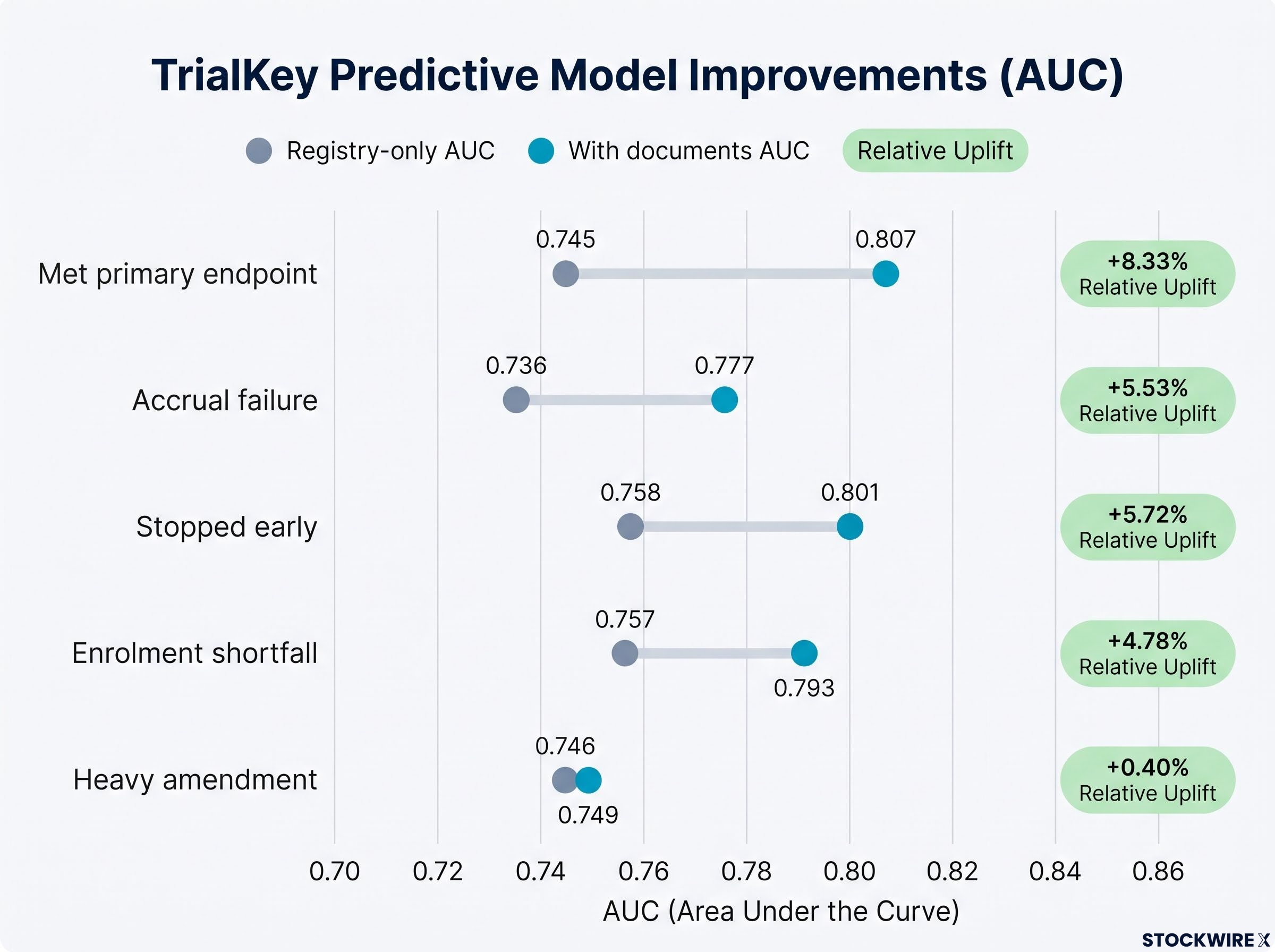
| Outcome | Registry-only AUC | With documents AUC | Relative uplift |
|---|---|---|---|
| Met primary endpoint | 0.745 | 0.807 | 8.33% |
| Accrual failure | 0.736 | 0.777 | 5.53% |
| Stopped early | 0.758 | 0.801 | 5.72% |
| Enrolment shortfall | 0.757 | 0.793 | 4.78% |
| Heavy amendment | 0.746 | 0.749 | 0.40% |
The registry-only baseline was recalculated on the same dataset as the updated models, so the uplift measures the additional document information rather than an expanded trial population. Heavy amendments means four or more substantive amendments within three years.
The primary-endpoint result is an 8.3% relative improvement in AUC, not an 8.3% increase in actual trial success rates. An AUC of 0.807 does not mean 80.7% prediction accuracy.
Caveats the company stated:
- The results are retrospective, internal historical findings and have not been independently validated.
- Further validation is required to establish performance across customer documents and trial populations.
- Independent validation and prospective assessment, with predictions recorded before outcomes are known, are planned priorities.
What happens next for TrialKey
The announcement lists the following priorities:
- Deliver the Paradigm engagement, with TrialKey responsible for the work.
- Establish product credibility through further validation, including planned independent validation and prospective assessment.
- Pursue additional biotech engagements, including scoped assessment, design-support and document-review work.
- Pursue CRO pilot licensing, a separate commercial priority with potential repeat assessments across multiple sponsor studies.
The company said delivery of the Paradigm work, additional paid engagements and repeat use will be practical measures of commercial progress. Longer-term directions include enhanced document analysis and more comprehensive protocol and SAP generation supported by expert oversight, with regulatory and reimbursement assessment also remaining longer-term directions.
Delivery depends on technical results, validation, customer requirements and resources. The announcement provides no platform release dates or revenue forecasts.
For investors, the facts are a $25,000 plus GST contracted project, a biotech services engagement the announcement describes, and a set of validation priorities still ahead.
Get Tech and AI News Before the Market Moves
Get FREE breaking ASX news delivered to your inbox within minutes of release, complete with in-depth analysis. Join 20,000+ investors already receiving real-time alerts from Big News Blast. Click the “Free Alerts” button today and stay ahead the moment market-moving tech announcements land.