
A weaker US dollar is meant to lift every emerging-market currency at once. In Central and Eastern Europe (CEE), that assumption may not survive tomorrow, because two neighbouring central banks are expected to respond to the same global tailwind in opposite ways.
The Czech National Bank (CNB) is widely expected to raise rates on 5 November 2026. The National Bank of Poland (NBP) is expected to hold on the same day. Identical outside conditions could therefore deliver very different results for the koruna and the zloty, which makes the CEE currencies outlook far more about local choices than the headlines suggest.
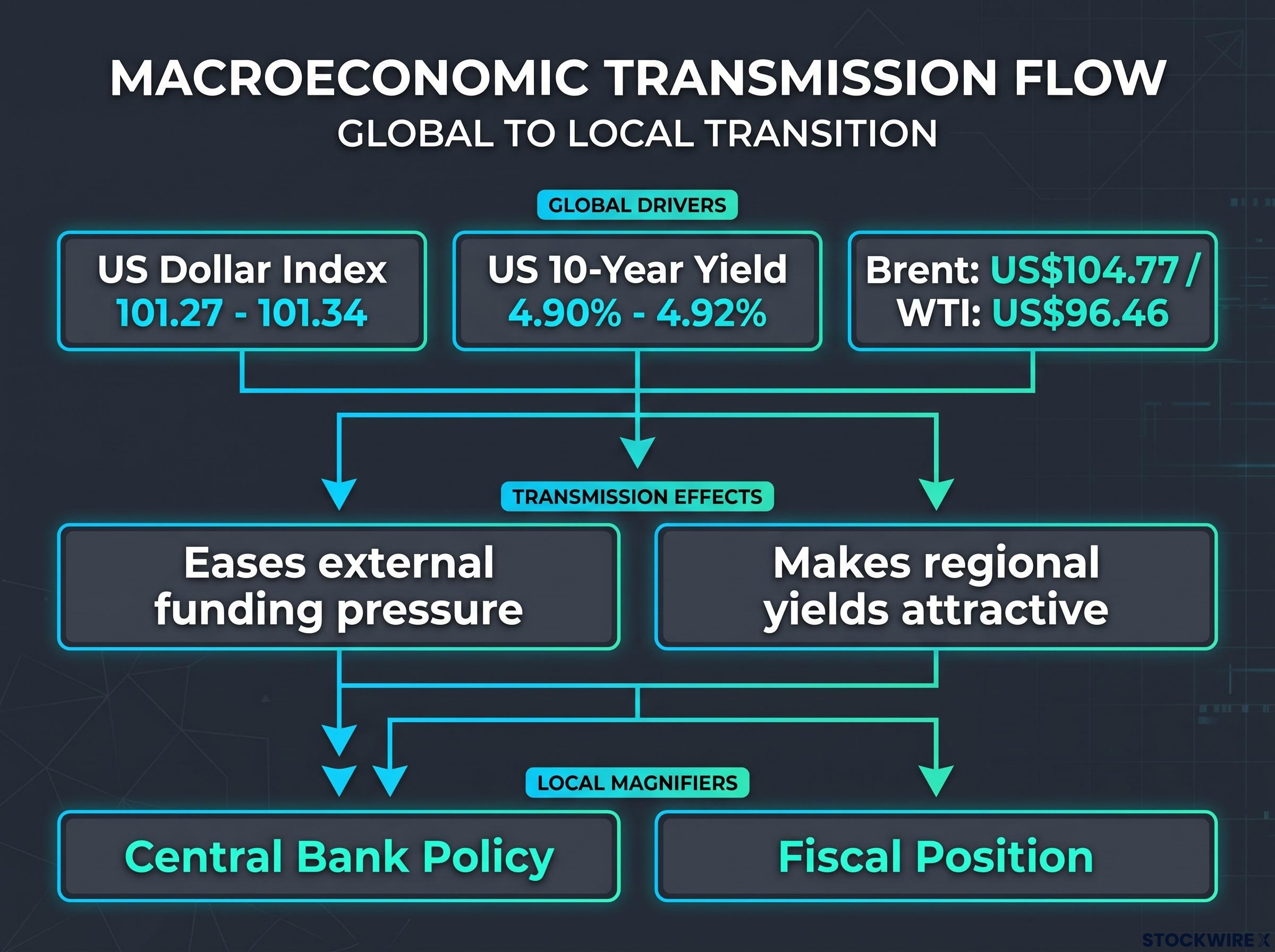
Those outside conditions shifted overnight. Early US midterm results showed significant Democratic gains, the Dollar Index slipped to about 101.3, a one-month low, and the US 10-year Treasury yield fell roughly 5-6 basis points to about 4.90%-4.92%, according to Reuters. A basis point is one hundredth of a percentage point. All of this sits on top of oil relief tied to US-Iran talks, and neither central bank decision has been made yet.
Here is a way to separate the global tide from local policy, so you can read any CEE currency move on its own terms.
Why did the midterms and a weaker dollar spark relief across CEE markets?
What moved on election day
The screen on Wednesday morning looked like a straightforward political trade. Democrats picked up Senate seats, raising the prospect of a Congress that could constrain President Donald Trump’s fiscal and foreign-policy agenda.
Markets read that as gridlock. Fewer deficit-financed measures meant less pressure on US borrowing, so investors moved into Treasuries and out of the dollar. The Dollar Index fell to between 101.27 and 101.34, and the 10-year yield dropped to about 4.90%-4.92% (Reuters, 4 November 2026).
Yet the biggest early moves were not in CEE at all. Reuters gave no uniform basket return for emerging markets, and the strongest quoted gains came in the euro, yen and Swiss franc.
What is really driving the relief
Peel back the election story and a larger one sits underneath. ING’s František Táborský argues the midterm outcome had mostly been absorbed before the votes were counted.
ING’s read on the midterms The result is viewed as largely priced in, with limited near-term implications for EM and CEE markets. The recent relief has come mainly from US-Iran negotiations and cheaper energy, according to ING.
The energy numbers back him up. On 2 November, Brent crude fell 7.63% to about US$104.77 a barrel and WTI fell 7.36% to about US$96.46, Reuters reported, after Iranian and Qatari officials held talks with a draft proposal circulating. No final agreement has been reached.
The election still matters through a clear transmission chain:
- A weaker dollar eases pressure on currencies priced against it.
- Lower US yields make higher-yielding regional assets relatively more attractive.
- Reduced external funding pressure gives CEE borrowers and currencies breathing room.
- Easier regional rates follow, as ING expects relief to filter into local markets.
What this tells you is that the relief is conditional. A CEE position built on this week’s rally is really a bet on oil and the US-Iran talks holding, as much as on Washington politics.
When big ASX news breaks, our subscribers know first
How do global drivers actually transmit into CEE FX?
That conditionality points to a broader rule. Global forces set the direction for CEE currencies, but local factors decide how far each one actually travels.
The external drivers are the dollar, US yields and energy prices. When the dollar weakens and Treasuries rally, risk appetite tends to improve and capital flows towards higher-yielding markets, the pattern that played out after the election. Energy works through a different door.
Czechia and Poland both import energy. When oil and gas prices climb, they pay more for imports, which worsens their trade balances and pushes up inflation. The 2022 energy shock showed how this channel can weaken CEE currencies and force central banks to choose between aggressive tightening and protecting growth; today’s easing in Middle Eastern supply disruption runs that impulse in reverse.
Local drivers then set the magnitude. Central bank policy, the make-up of inflation, how officials communicate and the government’s fiscal position all determine whether a currency amplifies or resists the global tide.
Fiscal risk deserves special attention. A currency can weaken even when interest rates are relatively high, because investors want extra compensation for debt, deficit and policy risk. ING flags Polish fiscal concerns as exactly this kind of drag on the zloty.
Poland’s court standoff adds a political layer to that fiscal drag, with a Constitutional Tribunal clash landing on thin buffers and prompting Commerzbank to turn the most bearish on the zloty among the CE3.
| Driver | Type | Direction of effect | Why it matters |
|---|---|---|---|
| US dollar | Global | Weaker dollar supports CEE FX | Eases external funding pressure |
| US 10-year yield | Global | Lower yields support CEE FX | Makes regional yields relatively more attractive |
| Oil and gas prices | Global | Lower energy supports CEE FX | Both economies import energy |
| Central bank policy and guidance | Local | Hawkish supports, dovish weighs | Sets the rate gap and expectations |
| Fiscal position | Local | Higher risk weighs on FX | Investors demand compensation for deficits |
For you, this boils down to two questions to ask of any CEE move. What is the global tide doing, and what is this country’s central bank doing against it?
Why is the CNB expected to hike while the NBP holds?
Both banks sit at the same 3.75% rate. The gap between them comes from what is driving inflation, not the headline number.
Czechia: the case for tightening
Czech inflation was only 2.5% year on year in September 2026, below Poland’s. The CNB still looks set to move, because the pressure is domestic.
Board member Jakub Seidler said on 27 October he was inclined to back a standard 25 basis point hike, citing resilient domestic demand, elevated energy prices and wage growth above 6%. He warned inflation could temporarily average around 3.5% in early 2027, and framed any move as a meeting-by-meeting decision rather than the start of a full tightening cycle.
Economists polled by the Czech News Agency (ČTK) were unanimous on a hike to 4.00%. Komerční banka, Capital Economics and Societe Generale all expect the same, with Capital Economics pointing to strong credit growth and high labour costs. The CNB has form here: its June 2026 hike made it the only central European bank reported as tightening in response to the Middle East inflation shock.
Poland: room to wait
Poland’s picture runs the other way. Preliminary October inflation fell to 3.5%, from 4.1% in September (some sources cite 4.0%), and ING judges core inflation, which strips out volatile items such as food and energy, probably below 3%.
Government fuel measures help further. Bank Millennium estimates they could cut inflation by about 0.6-0.7 percentage points, keeping it around 3.6%-3.7% to year-end. That lets the Monetary Policy Council treat the energy spike as temporary, as it did by holding through October.
A seventh straight hold at 3.75% is expected, according to ING and BBH. The real event, ING says, is the new projection and Governor Adam Glapiński’s press conference, where guidance could matter more than the decision itself.
| Factor | CNB (Czechia) | NBP (Poland) |
|---|---|---|
| Current rate | 3.75% | 3.75% |
| Expected decision (5 Nov) | Hike to 4.00% | Hold, seventh in a row |
| Inflation backdrop | 2.5% (Sept), wages above 6%, strong demand | 3.5% (Oct prelim), core likely below 3% |
| Key signal | New CNB forecast | Glapiński’s press conference and projection |
The read for you: a rate decision matters less than whether it was already priced in and what the guidance says next.
The gap between what markets expected and what was delivered, not the rate level itself, usually drives the sharpest repricing, which is why how central banks set rates matters for reading any CEE decision day.
What does the CEE currencies outlook look like for the koruna and the zloty?
Those policy paths feed straight into each currency’s base case, and the two look very different.
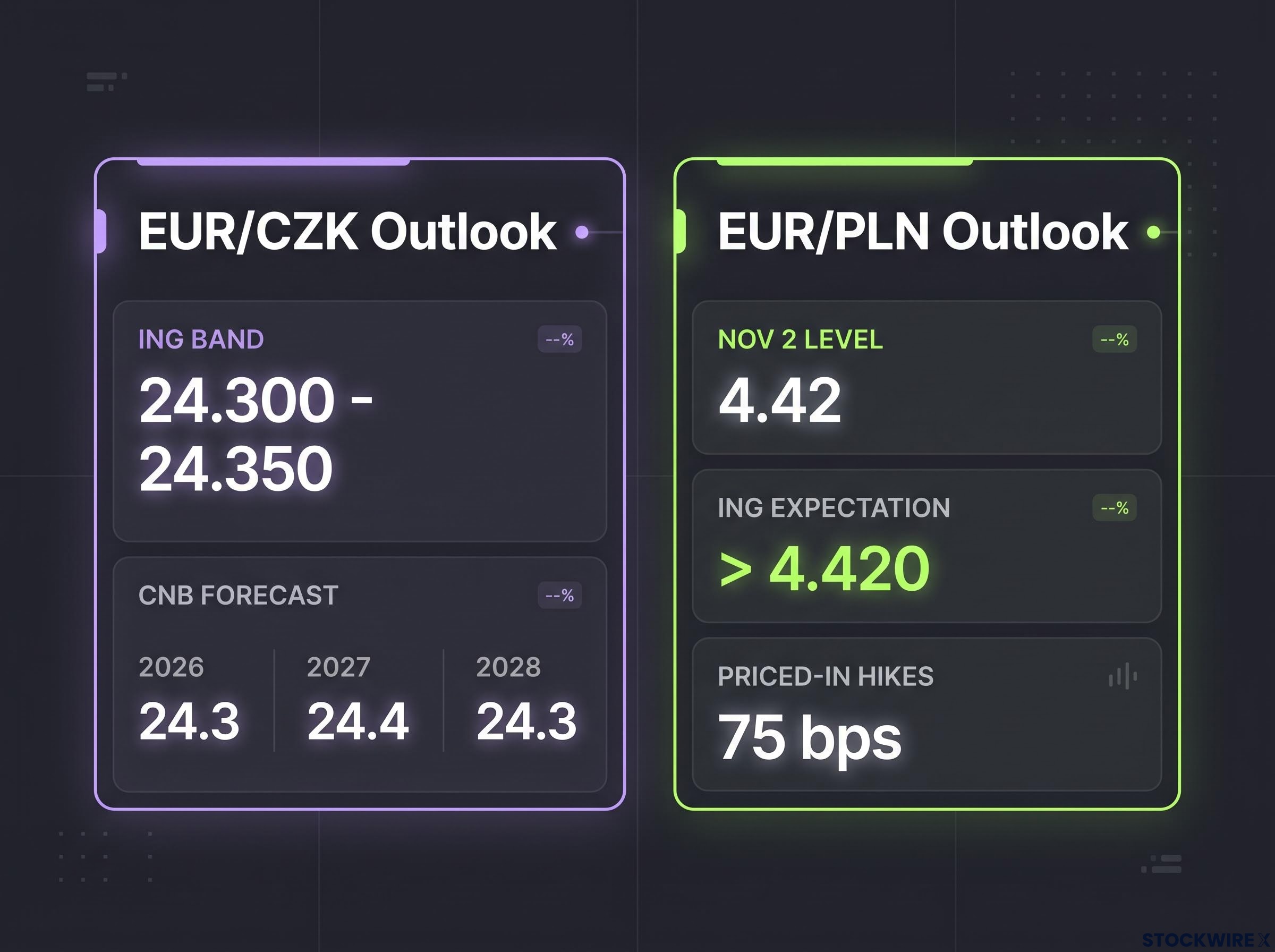
For the koruna, ING expects EUR/CZK to stay in a narrow 24.300-24.350 band after the expected hike. Komerční banka projects about 24.40 at year-end and about 24.00 in one year, while the CNB’s own forecast assumes 24.3 for 2026, 24.4 for 2027 and 24.3 for 2028. The latest EUR/CZK spot level was not available in the research.
The zloty carries a heavier load.
ING on the zloty ING calls the zloty the weakest CEE currency and remains bearish, citing the NBP’s dovish stance, Polish fiscal concerns, dollar strength and high energy prices. It expects Polish rate hikes to be deferred to 2027.
EUR/PLN sat around 4.42 on 2 November. ING’s views on direction differ: its original note pointed to consolidation at 4.410-4.420, while later ING commentary on 3 November expected the pair to settle above 4.420. Pricing signals also differ in date and scope, with ING’s Táborský noting roughly 75 basis points of hikes already priced in, while Reuters on 2 October described pricing for the following four meetings as almost evenly split. No current positions were found from Erste, ČSOB, PKO BP, Goldman Sachs or Morgan Stanley.
| Scenario | Trigger | Likely FX effect |
|---|---|---|
| Hawkish NBP surprise | A hike or a projection showing persistent inflation | Rapid zloty rebound |
| Hawkish NBP tone, no hike | Glapiński stresses wages, fiscal or energy risks | Limits zloty losses |
| CNB holds | Weaker GDP and wage data outweigh inflation | Koruna loses policy edge, EUR/CZK higher |
| CNB hikes more than 25 bp | Concern about inflation persistence | Initial koruna support, later growth worries |
| US-Iran talks break down | Oil decline reverses | Pressure on both currencies |
| Dollar rebound | Post-election dollar move reverses | Weighs on CEE FX, especially the zloty |
| Polish fiscal risk | Fiscal slippage or political uncertainty | Keeps EUR/PLN elevated |
Past performance does not guarantee future results. Financial projections are subject to market conditions and various risk factors.
What this tells you is that the zloty carries the more lopsided event risk. With the consensus already leaning bearish, a hawkish surprise from Warsaw could spark a sharp rebound that catches crowded positions off guard.
Hungary offers a useful contrast, where a real-rate buffer of roughly 4.2 percentage points supports the forint even as heavy energy import dependency leaves it exposed to a gas price spike.
What to watch once the CNB and NBP have spoken
The framework holds whatever tomorrow brings: global drivers set the tide, while local policy and communication set the shape. The base case remains a CNB hike to 4.00% against an NBP hold at 3.75%, but both are expectations, not outcomes.
Four signals will tell you whether that base case is holding:
- Glapiński’s press conference and projection: a hawkish tone could change the zloty story without any rate move.
- The new CNB forecast: it will show whether the hike is a one-off or part of a longer path.
- US-Iran talks and oil: a breakdown would revive the energy pressure both economies face.
- The dollar and US yields: a rebound would tighten conditions across the region.
Once the decisions land, check them against the scenario table above before deciding what the moves mean for you.
This article is for informational purposes only and should not be considered financial advice. Investors should conduct their own research and consult with financial professionals before making investment decisions.