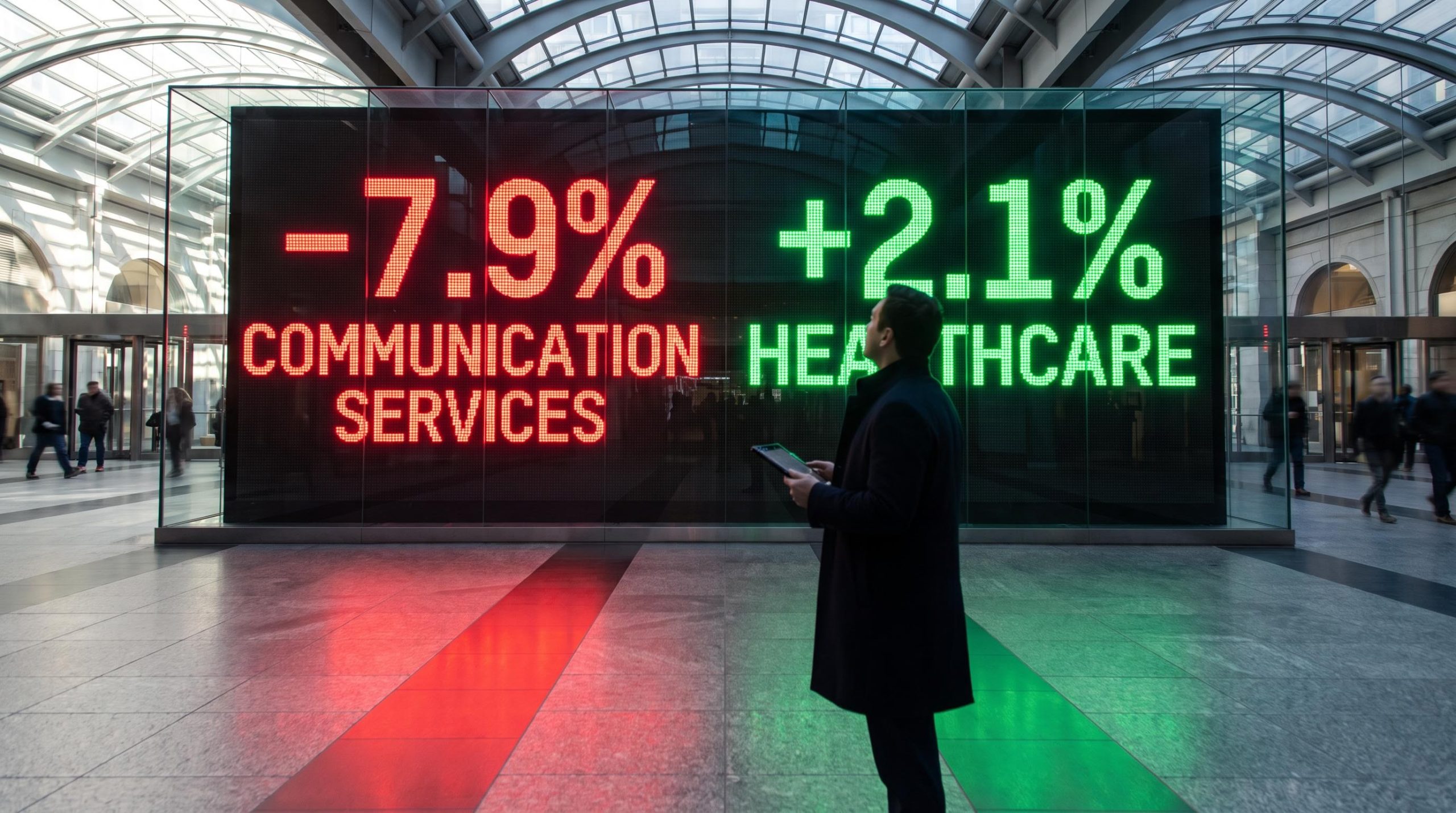
A 12.6% one-day drop in Alphabet looks like the kind of move that sends investors running from stocks. The rest of the tape on 29 October 2026 says otherwise: the S&P 500 slipped just 0.3%, healthcare climbed 2.1% and communication services sank 7.9%. That is sector rotation into healthcare, not a stampede for the exits.
Money is moving between sectors and staying inside the equity market. The one-month figures show the move is not a one-day blip: healthcare is up 9.4% and communication services is down 12.8%, according to Moomoo data.
The timing adds pressure. The figures are current as of 29-30 October, and the 3 November midterm elections are only days away.
Here is what drove the shift, whether it looks cyclical or structural, and how to think about healthcare exposure without walking away from growth.
What the sector moves actually show: rotation inside equities, not an exit
Start with the overnight session. The Nasdaq Composite fell 1.4%, a sharper drop than the broader index. Yet several sectors finished the day higher.
| Sector | Overnight (29 Oct) | Past month | Driver |
|---|---|---|---|
| Healthcare | +2.1% | +9.4% | Pharma beats and guidance raises |
| Communication services | -7.9% | -12.8% | Alphabet’s 12.6% fall |
| Technology | About -1% | -4.2% | AI spending worries |
| Consumer defensives | +1.3% | Not available | Defensive demand |
| Financial services | +1.2% | Not available | Strong growth backdrop |
Tapper Strickland, chief market strategist at Moomoo, drew the one-month figures from the firm’s sector heat map. No other consistent named-source return table was available, so the comparison rests on this single data set.
The damage was concentrated. Alphabet alone dragged communication services, while Caterpillar, a stock tied to the tech buildout, fell 9.3%. Strip those out and the index barely flinched.
That gap is the evidence. The money did not leave stocks; it changed address.
For you, this means your portfolio’s risk now depends more on your sector weights than on whether “the market” is up or down.
When big ASX news breaks, our subscribers know first
Why Alphabet, Amazon and Intel spooked investors despite fast-growing AI units
The surprise is that the fastest-growing parts of each business performed well. The market punished them anyway.
Alphabet: cloud strength, search doubt
Alphabet posted revenue of $127.6 billion, and Google Cloud more than doubled to $30.7 billion. Search, though, grew 12%, slower than the prior quarter, and the company said over a third of cloud growth came from a joint venture it owns. Quarterly capital expenditure (spending on long-term assets like data centres) hit $51.4 billion, with a 2026 outlook of about $195-$205 billion and higher spending signalled for 2027.
The search question Dave Wagner of Aptus Capital Advisors told Reuters that investors worried AI could cannibalise Google’s search franchise, and that the market needed search to accelerate, not decelerate.
That is the one concern here that could prove structural.
Amazon: AWS up, retail slowing
Amazon reported revenue of $201.9 billion against roughly $202.3 billion expected, and adjusted EPS of $1.89 against about $1.96-$1.97. AWS grew 39% to $46.0 billion, but online sales rose only 2%, the slowest since early 2023. With about $220 billion of 2026 capex planned, trailing 12-month free cash flow stood at -$42.4 billion.
Intel: AI growth, weak guidance
Intel’s Data Center and AI unit jumped 78% to $7.3 billion on total revenue of $16.5 billion. Client computing fell 5% to $8.1 billion, and fourth-quarter revenue guidance of $15-$16 billion sat below expectations near $17.1 billion.
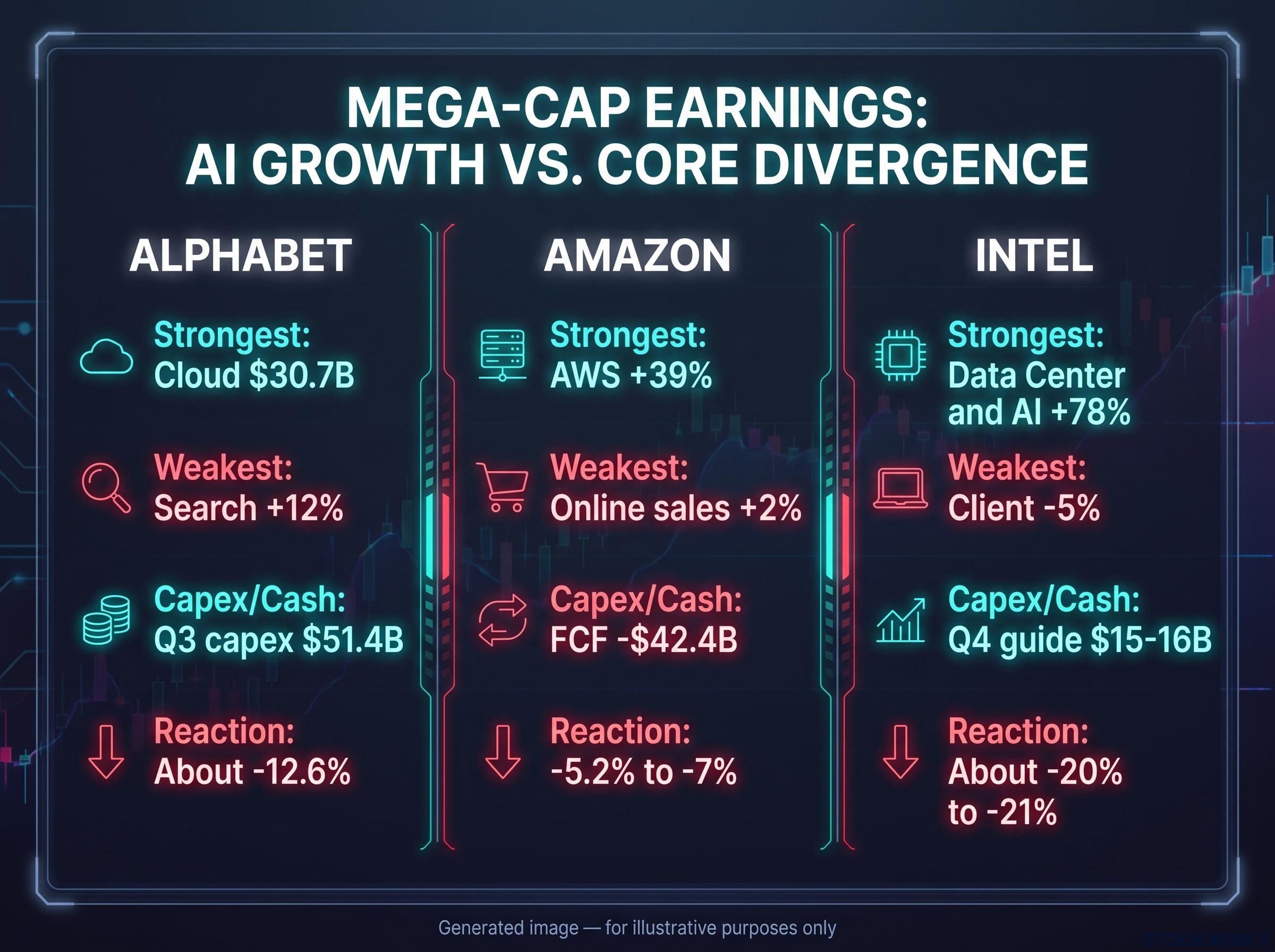
| Company | Strongest segment | Weakest segment | Capex or cash signal | Share reaction |
|---|---|---|---|---|
| Alphabet | Cloud $30.7B | Search +12% | Q3 capex $51.4B | About -12.6% |
| Amazon | AWS +39% | Online sales +2% | FCF -$42.4B | -5.2% to -7% after hours |
| Intel | Data Center and AI +78% | Client -5% | Q4 guide $15-16B | About -20% to -21% after hours |
The shared thread is capital intensity. If you own mega-cap tech, the market is now asking what all that AI spending returns, so stocks priced on growth alone face a higher bar at every earnings print.
The scale of hyperscaler AI capex, with combined 2026 guidance near $725 billion and heavy debt issuance, explains why investors now demand evidence that the spending earns a return.
Record pharma results gave the rotation somewhere to land
Money leaving tech needed a home with its own momentum. Drugmakers supplied one, posting record revenue and raising forecasts.
| Company | Q3 result | Guidance change | Share reaction |
|---|---|---|---|
| Eli Lilly | Revenue about $24.4B, +39%; adjusted EPS $7.48 | 2026 revenue to $91-92B from $85-87B | Record high; +6.6% reported (others 4-8%) |
| Merck | Revenue about $18.1B; Keytruda Qlex $830M | Adjusted EPS $2.77-2.82 | About +4-5% |
| Bristol Myers Squibb | About 12% non-GAAP growth | Revenue to $49.75-50.25B | Not verified |
| Gilead | Revenue about $8.3B; non-GAAP EPS $2.55; base business +16% | Base business to $30.7-31.0B | About +4% |
Four large drugmakers beating and raising in the same week is not the profile of a defensive hideout. Lilly’s obesity drugs Mounjaro and Zepbound led the way, and Gilead’s base business delivered its strongest growth in over a decade.
Gilead’s third-quarter results show the base business growing 16% and full-year guidance rising, which supports the view that healthcare’s rally rests on earnings revisions rather than defensive positioning alone.
The Medicare obesity-drug twist
The story is not one-way. Lilly and Novo Nordisk struck a deal that opens Medicare to their weight-loss drugs in exchange for pricing concessions:
- Access: Wegovy and Zepbound become available through Medicare for the first time.
- Economics: Medicare’s cost is capped at about $245 a month, with patients paying about $50.
- Direct-to-consumer pricing: TrumpRx cash prices of about $350 for Wegovy and Ozempic and about $346 for Zepbound and oral orforglipron.
- Future pricing: Both agreed to most-favoured-nation pricing (matching the lowest price paid in comparable countries) for future US medicines.
The concessions do not touch private insurance, where most revenue is earned. Lilly expects about 500,000 Medicare patients to use its obesity drugs, and its finance chief said volume growth should outweigh price pressure.
For you, the point is that healthcare is attracting capital on rising earnings estimates, which is a sturdier reason to own it than simply “it is not tech.”
The macro backdrop and the November 3 midterms: why timing matters
A supportive but sticky macro backdrop
The economy gave this rotation a tailwind:
- Q3 GDP: 3.4% annualised, against 3.2% expected; nominal growth 5.9%
- Core PCE inflation: 3.1% year on year
- 10-year Treasury yield: 4.94%
Strong growth with stubborn inflation keeps yields high, and high yields reward companies that already make money over those promising profits later. Profitable, defensive growth fits that brief. Commodities eased alongside tech, with gold down about 0.5% near $4,000, copper off about 1.1% and oil near $115.
Geopolitical noise lingers too, including unnamed reports of US military options on Iran after the midterms and Russia extending its diesel export ban.
Three midterm scenarios
Then comes the dated catalyst. Strickland expects a Democratic House (widely anticipated) and argues a Senate win could limit or reverse Medicaid and Affordable Care Act (ACA) cuts.
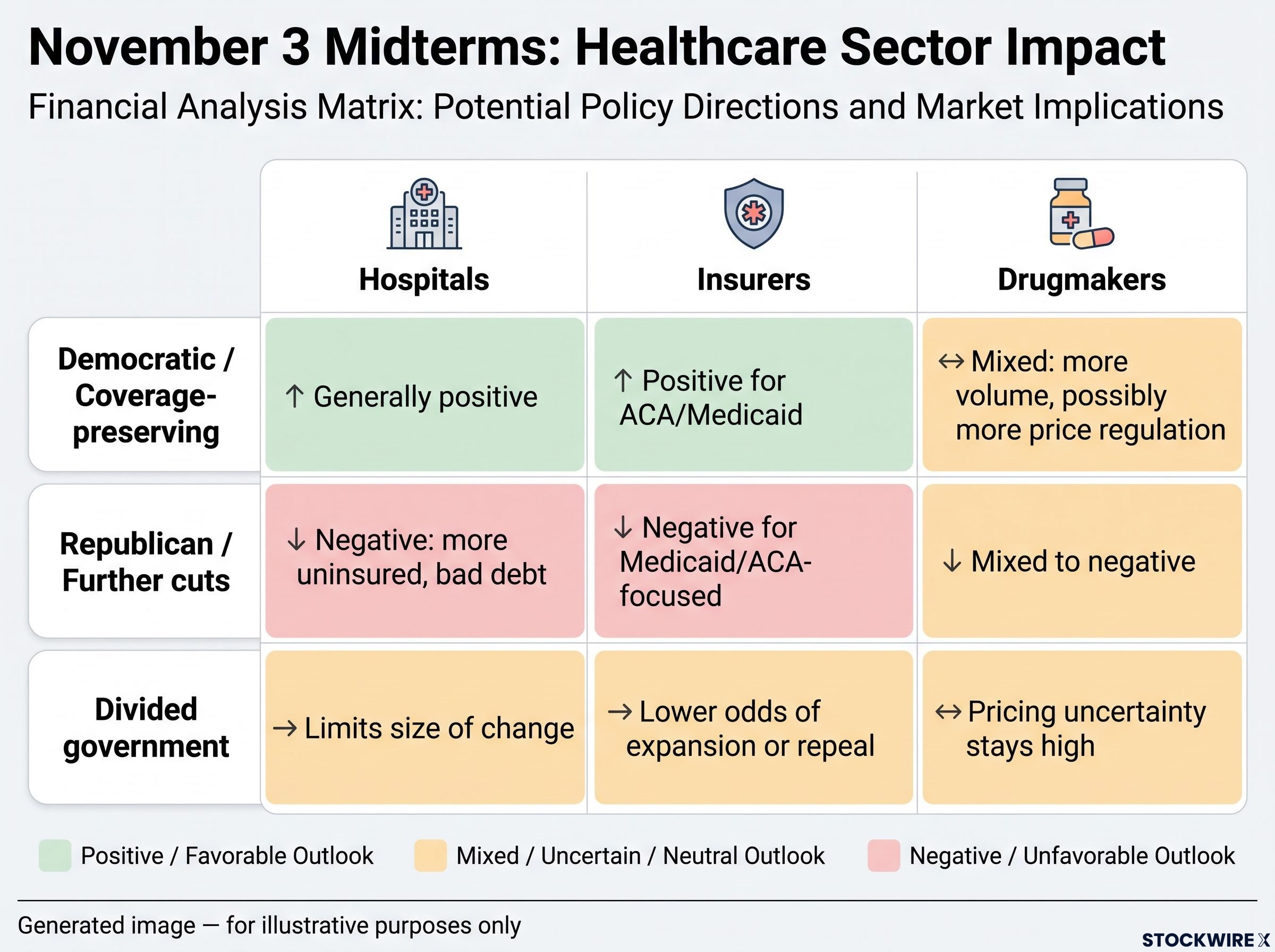
| Outcome | Hospitals | Insurers | Drugmakers |
|---|---|---|---|
| Democratic or coverage-preserving | Generally positive | Positive for ACA/Medicaid insurers | Mixed: more volume, possibly more price regulation |
| Republican or further cuts | Negative: more uninsured, bad debt | Negative for Medicaid/ACA-focused insurers | Mixed to negative |
| Divided government | Limits size of change | Lower odds of expansion or repeal | Pricing uncertainty stays high |
Korea Investment Securities analysts see preserved subsidies lifting hospital and insurer earnings, while ING warns cuts would raise uncompensated care. Drugmakers land on “mixed” in every row.
Read the vote as a near-term volatility event for healthcare’s sub-sectors. Which slice you own matters more than owning “healthcare” generically.
Cyclical or structural? The case for tech, the risks to healthcare, and how to get exposure
What a sector rotation is (and is not)
A sector rotation happens when investors sell one part of the stock market and buy another, without pulling money out of stocks overall. This week fits: tech sold off, healthcare rallied, the index held. Historically, rotations like this have followed rising rates, disappointing tech earnings and overextended investment booms, though no single source quantifies a complete historical comparison.
The case tech stays dominant
Wagner frames the selloff as an AI valuation problem, while King Lip of BakerAvenue sees earnings as the test of whether the pullback is a buying opportunity.
Tech still carries the earnings load LSEG’s Tajinder Dhillon estimated that roughly two-thirds of the expected 31% year-on-year S&P 500 Q3 earnings growth would come from technology and AI-heavy companies.
Cloud and AWS growth points to a valuation reset, not a collapse in AI demand. Healthcare’s lead looks partly structural, though, resting on obesity, HIV prevention and oncology.
Where healthcare could stumble
- Drug pricing and most-favoured-nation commitments
- GLP-1 competition, including oral drugs
- Tariffs on manufacturing and supplies
- Medicaid and ACA changes
- Political reversal if elections disappoint
- Crowded valuations in popular defensive names
Ways to gain exposure
| Vehicle | Approach | Benefit | Trade-off |
|---|---|---|---|
| XLV | Large-cap S&P 500 healthcare | Liquid, diversified | Less small-innovator exposure |
| VHT | Large, mid and small caps | Fuller industry coverage | More volatility |
| BetaShares global healthcare ETF (ASX) | US and European names | Access for Australian investors | US about 80%; Lilly about 8.6% |
| Individual stocks | Lilly, Merck, BMS, Gilead | Targets strongest revisions | Concentrated patent and pricing risk |
Current expense ratios for XLV and VHT were not available. Strickland also flagged Caterpillar, about 38% below its peak on a forward P/E (price relative to expected earnings) near 21, and ResMed, down about 1.9% this year.
Rotating part of your portfolio into healthcare is a rebalancing decision with its own concentration and policy risks, not a signal to abandon technology.
What this rotation changes for your portfolio, and what it does not
Tech fell on capital intensity, not collapsing demand. Pharma rose on genuine beats and raises. A macro backdrop of strong growth and high yields rewards profitable companies, and a dated political catalyst now sits days away.
What has not changed is that the money stayed in equities, and tech still drives most expected earnings growth. Whether its slide is cyclical or structural remains open.
Three variables will sharpen the picture:
- 3 November midterm results and their read for hospitals and insurers
- Next-quarter AI capex commentary from the mega-caps
- Drug-pricing and Medicare developments
This article is for informational purposes only and should not be considered financial advice. Investors should conduct their own research and consult with financial professionals before making investment decisions. Past performance does not guarantee future results, and forward-looking statements are speculative and subject to change.