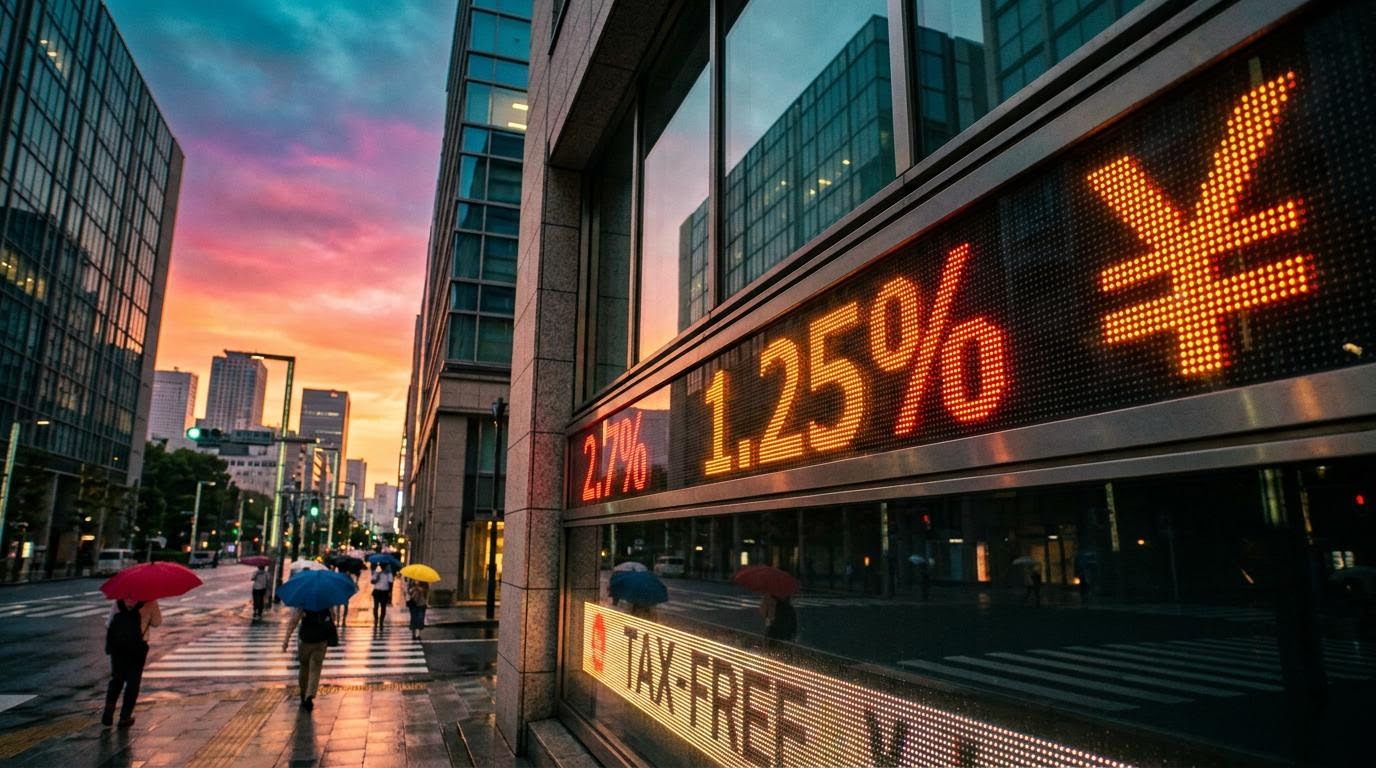
Tokyo core inflation jumped to 2.7% in September from 1.8% a month earlier, yet the Bank of Japan policy rate sits at just 1.25%. That gap between prices and policy is the signal behind the case for another Bank of Japan rate hike, and it is easy to underweight.
National September consumer price index (CPI) figures and the October flash purchasing managers’ index (PMI) land overnight on 22-23 October. Economists and money markets already lean toward a December move following September’s 7-2 decision to hike. The release figures cited below are forecasts, not actuals.
You will come away with a way to read the overnight data, a calibrated view of how likely December is, and a clearer sense of why a hike may do less for the yen than you might expect.
Why is Japanese inflation building, and is it durable?
The Tokyo print beat forecasts, and it reset expectations for the national figures. According to Newsquawk, core CPI in the capital (which strips out fresh food) rose 2.7% year on year. That move came partly from fading government energy relief and higher energy and import costs.
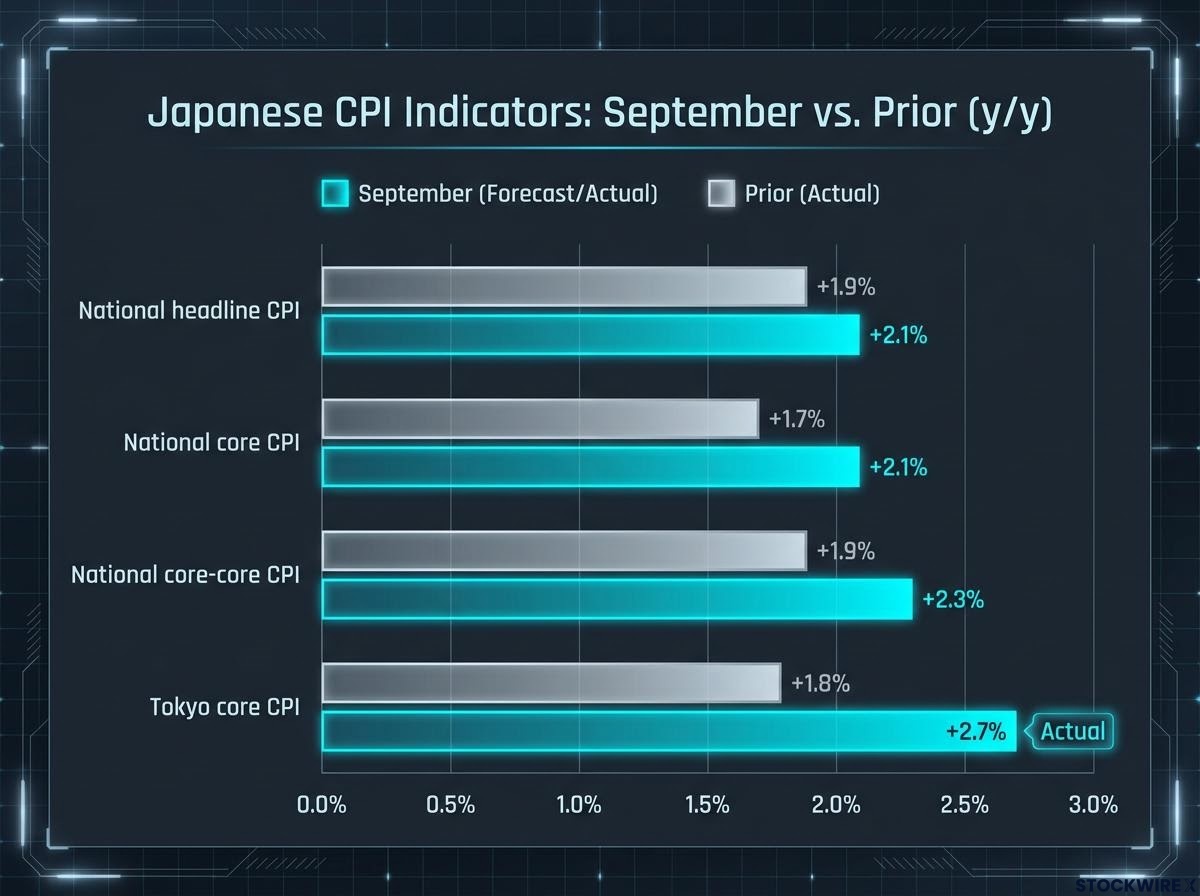
The national previews point the same way.
| Indicator | Forecast | Prior | Source |
|---|---|---|---|
| National headline CPI, Sept (forecast) | +2.1% y/y | +1.9% | Mace News preview |
| National core CPI, Sept (forecast) | +2.1% y/y | +1.7% | Reuters poll of 15 economists |
| National core-core CPI, Sept (forecast) | +2.3% y/y | +1.9% | Mace News preview |
| Tokyo core CPI, Sept (actual) | +2.7% y/y | +1.8% | Newsquawk |
Core-core CPI excludes both fresh food and energy, so it gives a cleaner read on domestic price pressure. Governor Kazuo Ueda has described underlying inflation as “quite close” to 2%, and Deputy Governor Ryozo Himino sees it as almost at target.
Cyclical versus structural pressures
Not every driver carries the same staying power. Sorting them shows how much of the jump may fade:
- Temporary: higher energy costs, including Middle East-related disruption, and the withdrawal of energy subsidies and price caps
- Persistent: wage gains, labour scarcity, services pricing, and repeated weak-yen pass-through into imported fuel, food and machinery
- Demand support: strong global AI demand, which Danske says is lifting Japanese activity and corporate pricing power
Fading subsidies lift measured inflation mechanically, so the headline overstates how much is demand-led. The second-order effects cut both ways: squeezed household consumption, stronger pricing power for some exporters, and rising Japanese government bond (JGB) yields. Wage evidence is also incomplete, since no 2027 shunto (annual spring wage negotiation) outcome has been published.
Slow money supply growth suggests this is cost-push inflation driven by import prices rather than monetary excess, which is why the temporary energy drivers matter so much to how durable the jump proves.
If national core matches or beats 2.1% and core-core holds near 2.3%, that tells you inflation is broadening beyond energy, and the hike case strengthens.
When big ASX news breaks, our subscribers know first
Explainer: how the Bank of Japan decides, and where September left it
Composition matters because the BoJ is trying to judge whether inflation will last. Its policy rate is the short-term interest rate it sets to steer borrowing costs across the economy.
At 1.25%, that rate is the highest since 1995. After decades near zero, the Bank is raising it in small steps, because sudden moves could jolt an economy and a bond market built around cheap money.
The September decision in brief:
- Hike from 1.00% to 1.25% on 18 September 2026
- Vote of 7-2, with board members Toichiro Asada and Ayano Sato dissenting
- Effective from 24 September
- Rationale: more persistent inflation pressure from energy and yen-related import costs, alongside firm activity and labour conditions
The dissent was about speed, not direction. Reports link both dissenters to Prime Minister Sanae Takaichi’s preference for looser fiscal settings, which frames the split as a growth-versus-inflation tension rather than a rejection of normalisation.
Governor Kazuo Ueda on inflation Ueda has said underlying inflation is “quite close” to 2%, while warning that an inappropriate pace of normalisation could push long-term yields higher.
That warning explains the “hawkish hold”. A central bank can pause while signalling that the next hike is coming, which is how an October pause and a December move can coexist.
A divided board means you should expect steady quarterly steps rather than sharp moves. That should temper how aggressively you price both the yen and JGBs.
How likely is a December bank of japan rate hike, and where does it end?
The surveys converge on December. Bloomberg found 83% of economists expect a hike at the meeting ending 18 December, with none forecasting a move on 30 October.
Reuters, polling between 13 and 19 October, found 69% (54 of 78) expect the rate at 1.50% in Q4. Money markets put December odds at roughly 75-80%, and Danske also sees a hike to 1.50%.
The October pause is near-unanimous for a reason. Officials reportedly want to assess September’s effect first and avoid back-to-back increases that raise overtightening risk.
Agreement fades on the destination.
The terminal rate debate is unresolved partly because the BoJ’s own research places nominal neutral between 1.1% and 2.5%, and a planned food tax cut in April 2027 could distort headline CPI just as the path firms.
| Source | December hike probability | Terminal rate view |
|---|---|---|
| Bloomberg survey | 83% | Median 1.75% |
| Reuters poll | 69% for Q4 | 51% expect at least 2.00%, up from 40% |
| Money markets | About 75-80% | No single implied level reported |
The share of Bloomberg respondents expecting quarterly hikes climbed to 67% from 46%. Reuters economists increasingly describe a June, September, December rhythm, with many seeing 1.75% by mid-2027.
Three things could shift the December call:
- National CPI: a core print well below 2.1% would weaken the urgency
- Wage evidence: signs that pay gains are feeding spending and services prices
- Yen and JGB conditions: disorderly yen weakness, or unstable long-dated yields
With December largely priced in, you should treat a hike as the base case. The surprise risk for markets lies in a pause, not a move.
What a BoJ hike really means for the yen, intervention and other markets
Here is the puzzle. Japan hiked in September, yet USD/JPY sits near a one-week low of 157.50, with other coverage near ¥158.
Why the yen has not rallied
Even 1.50% leaves Japanese rates well below US rates, so the yield gap still rewards holding dollars. Hikes that arrive on schedule are already in the price, and the 7-2 vote signalled slow future steps, muting the currency’s response.
The Federal Reserve matters as much as Tokyo. Fed officials signalled no urgency to hike at the 27-28 October meeting, and the differential only narrows meaningfully from both sides if US easing joins BoJ tightening.
Intervention: a brake, not a reversal
Finance Minister Satsuki Katayama warned on 15 October that Japan stands ready to act against disorderly weakness. Markets watch the ¥160 area, which preceded the last intervention.
| Episode | Amount or level |
|---|---|
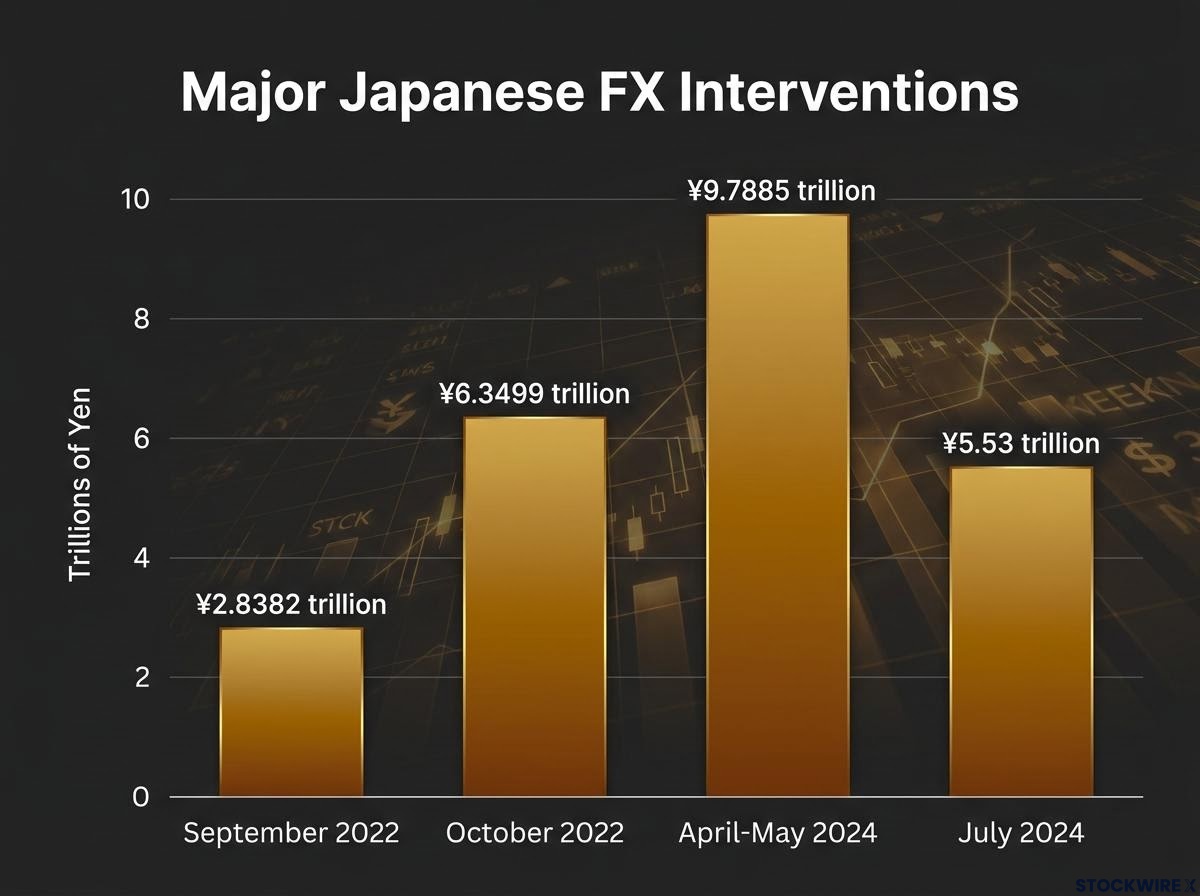
| September 2022 | ¥2.8382 trillion |
| October 2022 | ¥6.3499 trillion |
| April-May 2024 | ¥9.7885 trillion combined |
| July 2024 | ¥5.53 trillion; USD/JPY from about ¥161.76 to ¥157.30 |
| 2026 | Coordinated US-Japan operation; limited lasting support |
Each episode produced a sharp rally that faded against persistent rate differentials. Intervention slows disorderly moves; it does not overturn the dollar’s yield advantage.
Spillovers and risks to the base case
Gradual hikes ripple outward:
- JGBs: short-dated yields rise first; longer yields could jump if investors underestimate inflation and debt-service risks
- Equities: banks and insurers may gain from steeper curves, while leveraged firms, property names and exporters (if the yen firms) face pressure
- Carry trades: borrowing in yen to buy higher-yielding assets becomes less attractive, and a sudden repricing could force unwinds
The wider backdrop shows a softer dollar and lower yields: gold below US$4,100, the Dow near 52,800, and AUD/USD around 0.7000.
The main risks are a policy error into weak consumption, a pause surprise that lifts USD/JPY sharply, JGB instability that exposes bondholder losses, and inflation that fades along with subsidies. A sustained yen recovery needs lower US yields or Fed easing alongside BoJ hikes, so you should not read a December move alone as a signal to bet on yen strength.
Rising JGB yields also change the hedging arithmetic for Japanese institutions, and net selling of US Treasuries has already run at a pace comparable to 2022, a spillover that grows if the BoJ path steepens.
What the overnight data changes, and what it does not
The base case holds unless the data breaks sharply: an October hold at 1.25%, then a 25 basis point hike to 1.50% in December. Bloomberg puts that at 83%, and Reuters at about 69% for Q4.
After the releases, three variables deserve your attention:
- National core CPI against the 2.1% forecast, and whether core-core confirms broadening
- Wage and services inflation evidence that pressure is lasting
- US yields and Fed signals around the late-October FOMC, which decide whether hikes translate into yen strength
This analysis rests on forecasts pending the actual figures. The timing looks settled; the destination and the currency response do not.
This article is for informational purposes only and should not be considered financial advice. Investors should conduct their own research and consult with financial professionals before making investment decisions. Past performance does not guarantee future results. Financial projections are subject to market conditions and various risk factors.