Hungary has just published a plan to cut its budget deficit to 2.8% of GDP by 2030. The central bank kept interest rates steady at 5.50%. Yet EUR/HUF slid back into a 362-364 range instead of extending the forint’s rally, and good domestic news failed to deliver a clean move.
That gap matters for anyone building a EUR/HUF forecast. As of 21 October 2026, the forint sits between an improving story at home and a hostile backdrop abroad: rising energy prices, US-Iran tension and higher yields in core bond markets.
If you read the pullback as the market rejecting the budget, you risk drawing the wrong conclusion. The evidence points to a positioning event, not a verdict.
Here is what the data tells you about which forces are likely to move the pair next, and which ones are noise.
Does Hungary’s deficit roadmap actually clear the bar for euro adoption?
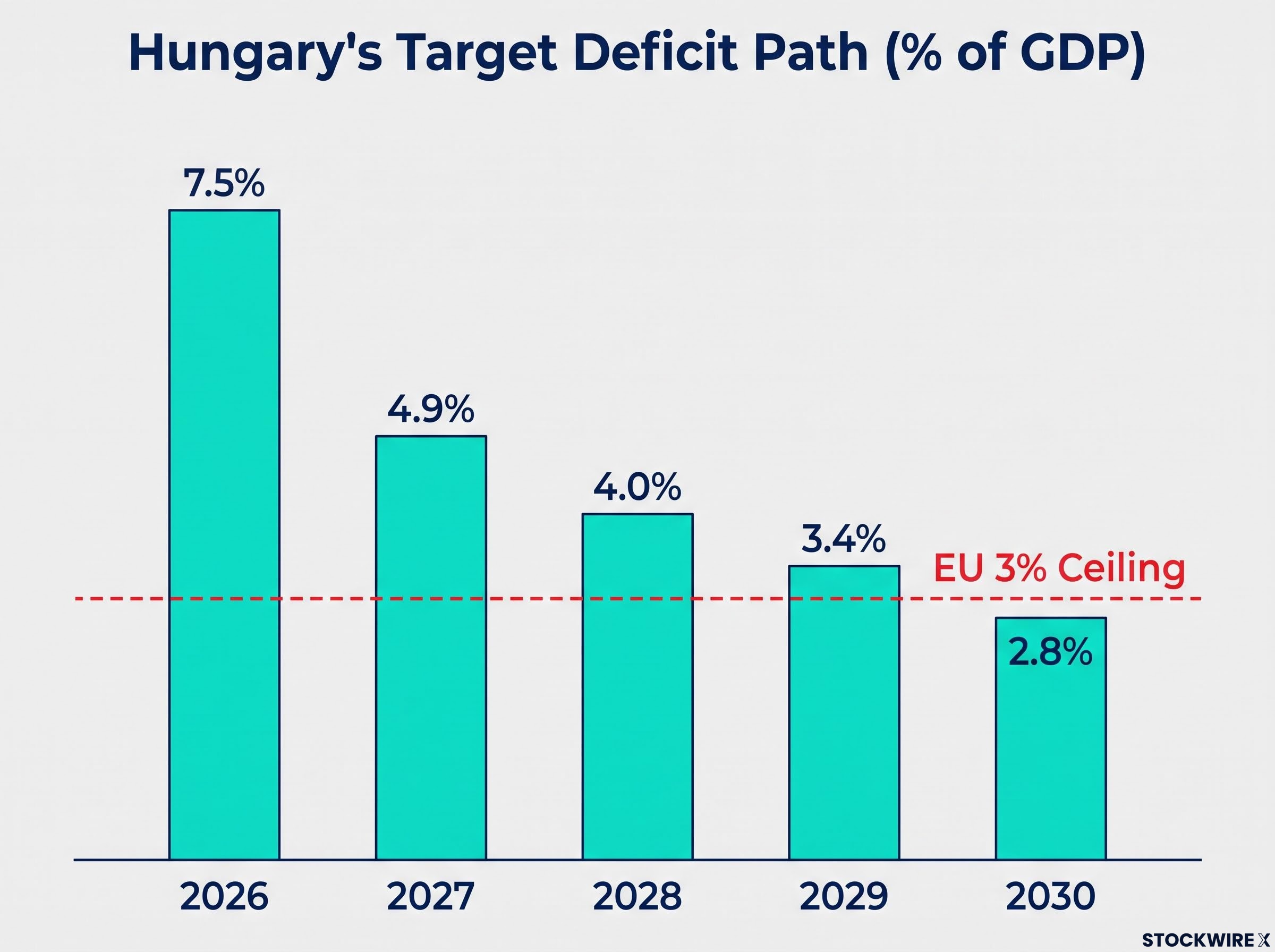
On paper, the numbers look credible. Finance Minister András Kármán set out a path that takes the deficit from an expected 7.5% of GDP this year to 4.9% in 2027, then steadily lower to below the EU’s 3% ceiling.
| Fiscal year | Target deficit (% of GDP) | Debt detail |
|---|---|---|
| 2026 | 7.5% (expected) | Debt expected at 77.5% of GDP |
| 2027 | 4.9% | Debt targeted at 77.2% of GDP |
| 2028 | 4.0% | No separate figure published |
| 2029 | 3.4% | No separate figure published |
| 2030 | 2.8% | Intended to decline; no detailed schedule |
The first step is where the plan gets tested. The 2027 cut relies on levers that do not yet exist:
- About HUF 1.5 trillion of savings from waste reduction, procurement reform and contract reviews
- A new wealth tax expected to raise roughly HUF 200 billion a year
- Higher taxes on large corporations and energy companies
- Restraint of pre-election spending and lower interest costs
Meanwhile, the framework keeps roughly HUF 2.1 trillion of added spending and tax relief, including a cut in the minimum-wage income tax rate from 15% to 9% from 2027. Hungary’s earlier deficit targets were revised upward, which is why a promise to save money while spending more draws scrutiny.
This is also a deficit roadmap, not a euro timetable. It sets no entry date for the Exchange Rate Mechanism II (ERM II), no central parity and no binding adoption date, and debt near 77% remains well above the 60% Maastricht reference value.
The IMF’s warning on euro plans adds a sceptical counterweight, framing adoption as a medium-term anchor for reform and not a shortcut that closes a deficit running above double the Maastricht ceiling.
Where the institutions disagree
The split is about timing and delivery, not whether lower deficits are desirable:
- Government: aims to meet euro conditions around 2030; Kármán sees adoption in 2032
- IMF: a credible package could cut the deficit to about 5% in 2027 and 3% by 2029, conditional on implementation
- Standard Chartered: a plausible route below 3% by 2029-30
- Fitch: negative outlook on its BBB rating, doubting how much saving materialises
- S&P Global: calls the path challenging from a weak starting point
- Equilor: earliest adoption around 2033
For you, the roadmap lowers the forint’s long-run risk premium (the extra return investors demand for holding Hungarian assets) only if the 2027 outturn lands near 4.9%. Track the first year’s execution, not the 2030 headline.
When big ASX news breaks, our subscribers know first
Why did the MNB hold at 5.50% when inflation is only 1.6%?
Inflation came in at 1.6% year-on-year in September, below the former 3% target and beneath the 2-4% tolerance band. A central bank in that position would normally be cutting.
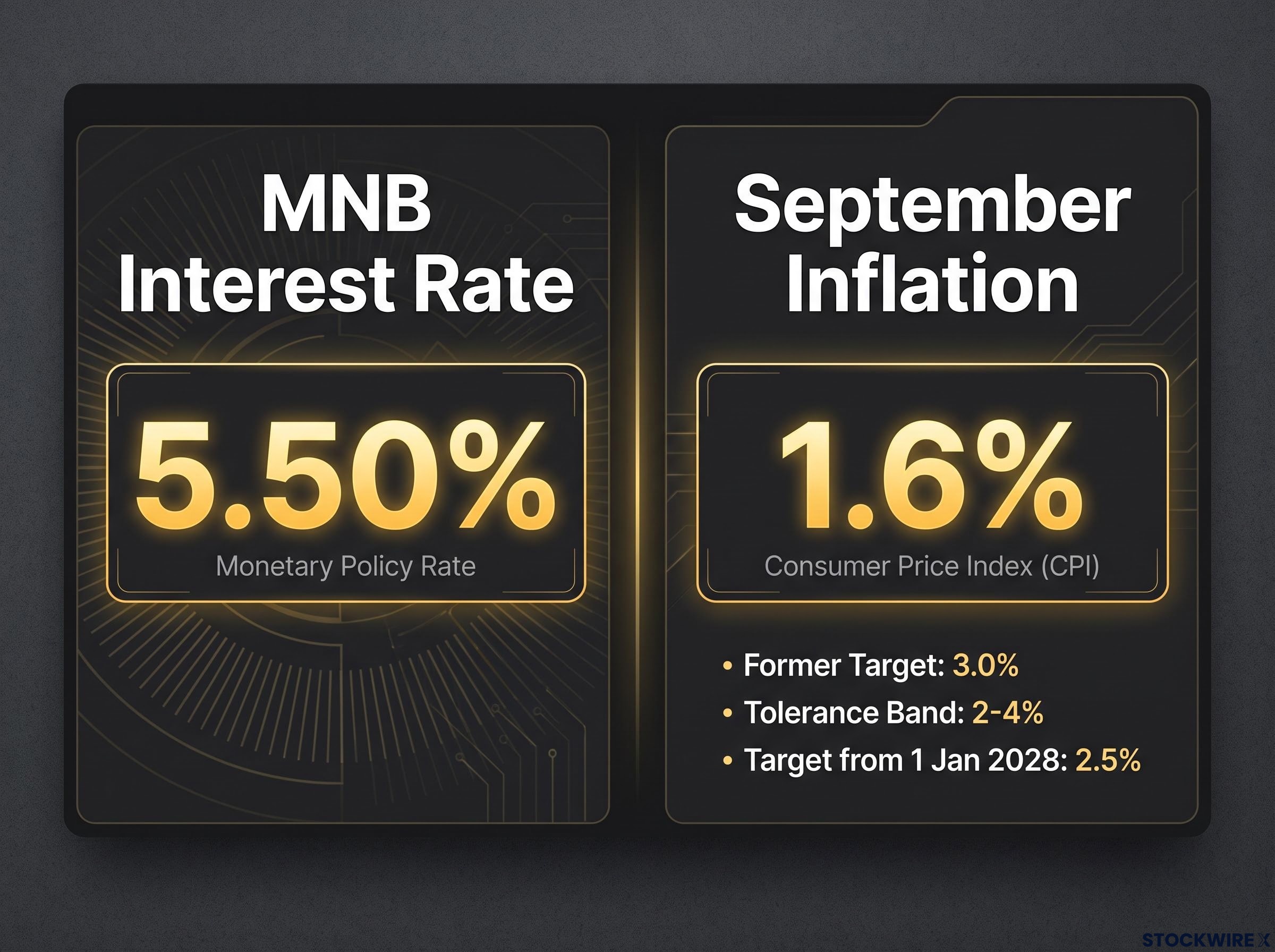
The National Bank of Hungary (MNB) held instead on 20 October, its second consecutive pause after three cuts during the summer. Governor Mihály Varga described a cautious, data-dependent approach aimed at a lasting return to price stability.
The logic sits in three places. Favourable base effects (low readings flattered by comparison with high prices a year ago) do not remove the risk of sticky services inflation. Higher core yields add uncertainty. And the fiscal story now feeds directly into policy.
Governor Varga’s warning Varga said the fiscal path and the market’s assessment of the euro strategy would shape Hungary’s risk premium and the bank’s future decisions. He added that euro adoption is not automatic once the deficit falls below 3%.
The bar is also rising. The MNB’s inflation target falls from 3.0% to 2.5% from 1 January 2028, closer to the European Central Bank’s 2%.
That leaves two competing views on the next move:
- ING: expects one more 25 basis point cut in December, taking the rate to 5.25%, provided energy prices stabilise
- Commerzbank’s Tatha Ghose: argues renewed underlying inflation momentum and the large deficit weigh against near-term easing
What this tells you is that the rate path has become partly a question of fiscal credibility. A held rate supports forint carry (the income earned from holding a higher-yielding currency), but a delayed cutting cycle also caps the tailwind that easing might otherwise provide to Hungarian assets.
A held rate preserves a real-rate buffer of roughly 4 percentage points over inflation, which explains why forint carry stays attractive even as the cutting cycle stalls and energy and dollar risks build.
What is a euro-adoption plan, and why does ERM II decide the timeline?
If Hungary gets its deficit under 3% in 2030, why would it not adopt the euro that year? Because the deficit is only one test among several.
To join, a country must meet the Maastricht criteria. These are five conditions covering the budget deficit, government debt, inflation, exchange-rate stability and long-term interest rates. A country must also spend at least two years in ERM II, a system where its currency is held within a set band against the euro.
The sequence runs like this:
- Consolidate the deficit below 3% of GDP
- Bring debt down towards 60% or show it falling convincingly
- Enter ERM II with an agreed central parity
- Hold the currency stable for at least two years
- Pass a final convergence assessment and adopt the euro
That explains why a 2030 deficit target and a 2032-33 adoption date are separate claims. Debt near 77% also means clearing the deficit test alone is not enough. Kurali, cited by Reuters, warned that turbulence inside ERM II could push accession beyond 2033.
Neighbouring cases show how this plays out:
| Case | Lesson |
|---|---|
| Croatia (adopted 1 January 2023) | Completing formal convergence delivered lower currency risk and access to the ECB |
| Poland | Meeting some criteria does not oblige quick adoption; no near-term timetable |
| Czechia | Credible institutions can support a floating currency without adoption |
| Romania | Repeated euro ambitions delayed by persistent deficits and inflation |
For you, the forint’s convergence trade is a multi-year story with several hurdles along the way. Pricing it as though euro entry were close risks paying up for a narrative that may take until the 2030s to resolve.
What is driving the EUR/HUF forecast after the rally’s correction?
EUR/HUF stood at about 364.17 on 21 October, after two weeks between 362 and 364. Earlier, the pair failed at the 370 area, which held as a firm ceiling.
ING’s František Táborský sees several overlapping pressures behind the pullback:
- Crowded positioning: large long-forint bets left few new buyers and raised the risk of profit-taking
- Buy the rumour, sell the fact: consolidation and a cautious MNB were priced in before the details arrived
- Implementation doubts: Fitch questioned how much of the saving will materialise
- Energy prices: higher costs worsen the external balance and lift inflation risk
- US-Iran tension: can strengthen the dollar and reduce demand for riskier emerging-market currencies
- Core yields and rate-cut repricing: both make forint carry less attractive
None of these amounts to a rejection of the plan. The pattern fits traders locking in gains while global risk worsened.
The profit-taking pattern fits ING’s warning about crowded forint positioning, where long-end Hungarian bonds and long 5y5y swaps against the euro leave good fiscal news vulnerable to being sold rather than bought.
| Source | Date | View |
|---|---|---|
| ING | 15 October 2026 | 360 one-month, 355 three-month; December cut expected |
| Commerzbank | October 2026 | Cautious; inflation and deficit argue against easing |
| ING (pre-dates October) | 26 August 2026 | 355-365 range on three further cuts, since superseded by the hold |
Scenarios to watch
- Towards the lower range: easing US-Iran tension, stable energy prices and a December cut delivered as ING expects
- Towards the higher range: an energy spike, weaker risk appetite, growing doubts over fiscal slippage, or markets repricing MNB cuts
The read you should take is that the next move depends mainly on global risk and positioning. Watching energy prices and MNB signals will tell you more than rereading the budget.
These scenarios are speculative and subject to change with market developments. Past performance does not guarantee future results.
What the plan settles, and what the forint still has to prove
The roadmap is forint-positive in principle, and the recent pullback looks like a positioning event rather than a judgement on Hungary’s finances. The decisive test is whether announced savings and new taxes turn into a real deficit cut in 2027.
Three variables deserve your attention:
- 2027 budget execution: whether the deficit lands near 4.9%
- Services inflation and energy prices: these will decide whether the MNB cuts in December
- EU funds flow: restored funding could ease financing pressure and lower the risk premium
Until those resolve, range-bound trading with global swings looks more likely than a decisive breakout.
This article is for informational purposes only and should not be considered financial advice. Investors should conduct their own research and consult with financial professionals before making investment decisions.