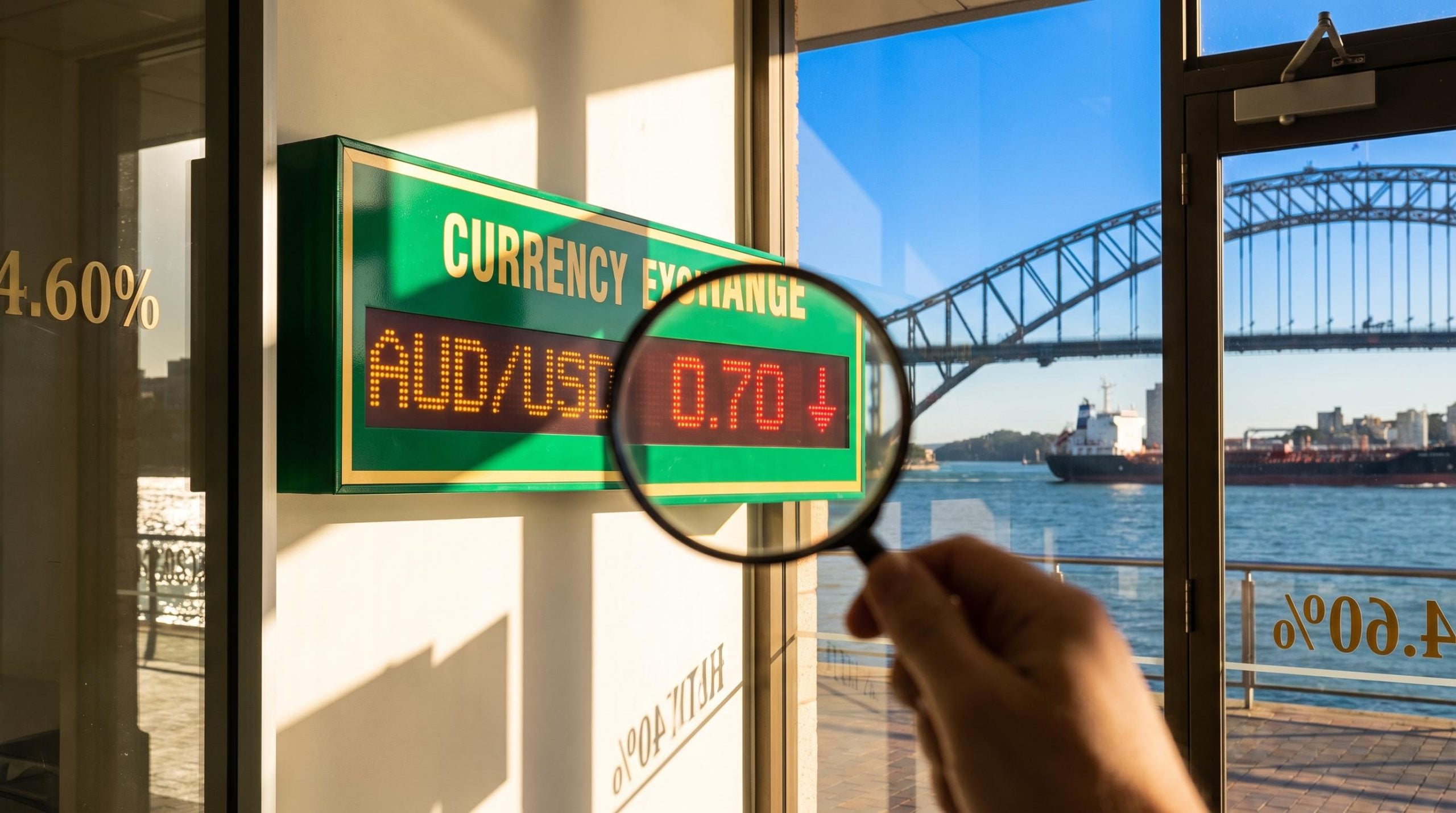
The Reserve Bank of Australia spent its latest minutes sounding as tough on inflation as it has all year. Yet the Australian dollar, the currency a hawkish central bank would normally support, slipped below US$0.70 anyway. That gap is the puzzle at the centre of the next RBA rate hike debate.
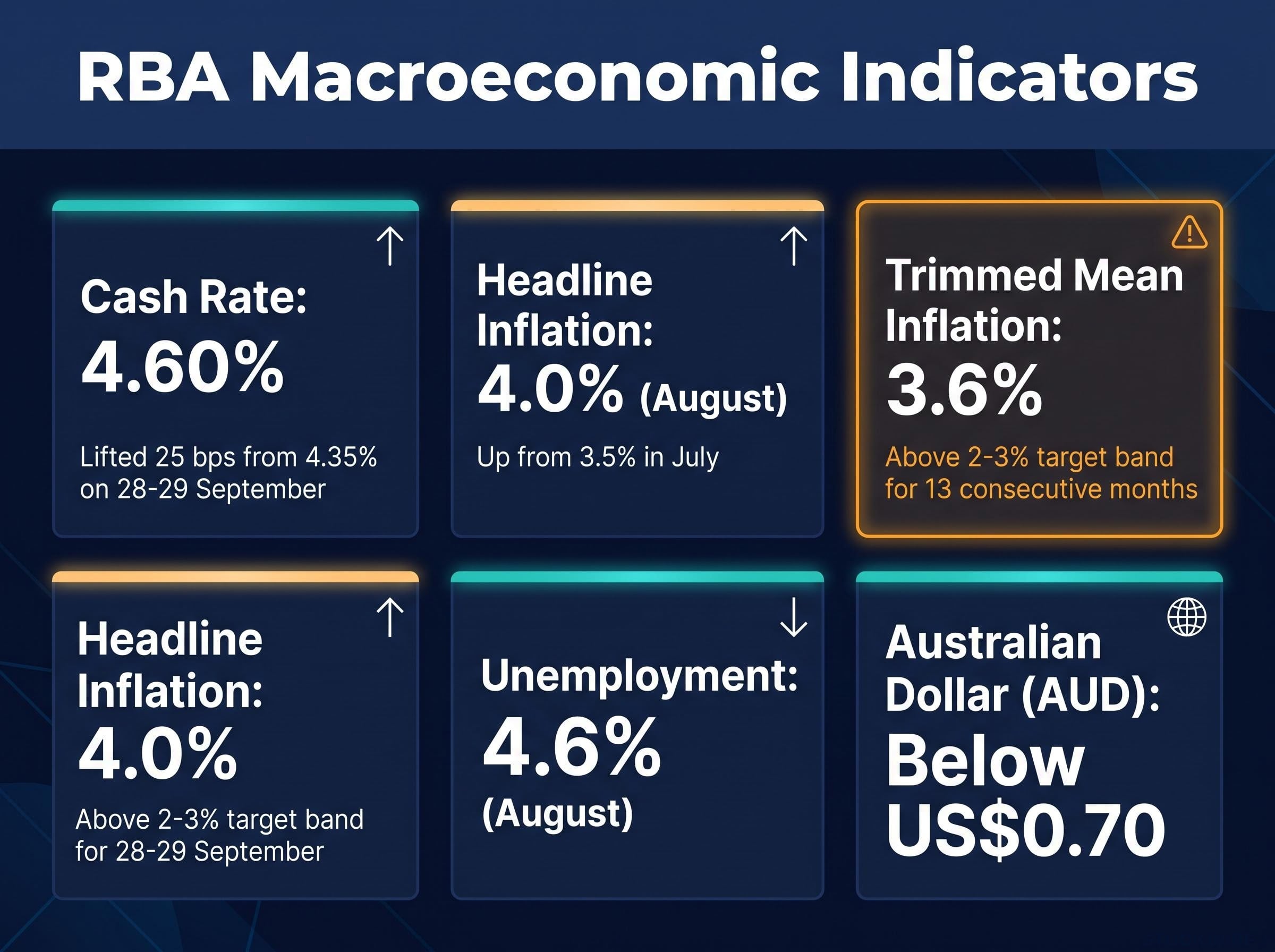
The Board lifted the cash rate to 4.60% on 29 September. The minutes of that meeting landed today, 13 October 2026, two weeks after headline inflation jumped to 4.0% in August.
What the minutes say about the exchange rate may matter as much as what they say about household spending. If you carry a mortgage, run a business that buys imported inputs or hold assets priced in Australian dollars, the currency is now part of the rate story.
Here is how to read the minutes, the three drivers that will decide the next move, and what a November hold or a December hike would each require.
Why a weaker Australian dollar turns into an inflation problem
Start at the checkout. When the Australian dollar (AUD) falls, every product priced in US dollars costs more to bring into the country. Fuel, machinery, electronics and many everyday tradable goods all get dearer before they reach a shelf or a factory floor.
The pass-through tends to run in four steps:
- A weaker AUD lifts the local cost of imports.
- Retailers, manufacturers and transport operators face higher input costs.
- Some of those costs are passed on, pushing up domestic prices.
- If people start expecting higher prices to last, wages and price-setting can follow.
The minutes flagged exactly this risk of imported inflation. The AUD has come under pressure from Middle East conflict, weaker risk appetite and a firmer US dollar.
There is a second, less obvious layer. The neutral rate is the interest rate that neither speeds up nor slows down the economy. If neutral rates overseas rise and Australia’s does not, Australian assets offer relatively less, and the AUD comes under pressure. The minutes suggest the RBA believes Australia’s neutral rate has also moved higher.
Commerzbank’s read Volkmar Baur of Commerzbank, writing via FXStreet, argued the RBA is worried about global developments it cannot control but must still respond to, including imported inflation from a softer currency.
The hawkish and dovish readings of a weak currency
- Hawkish: Higher rates support the AUD, limit imported inflation and anchor expectations. A higher global neutral rate also means today’s cash rate is less restrictive than it looks.
- Dovish: The AUD may be weak because of global risk aversion and a strong US dollar, not low Australian rates. Hiking cannot repair refineries or clear shipping lanes, and matching global rates on a supply shock could deepen a domestic slowdown.
For you, the takeaway is that the exchange rate is no side issue. A persistently weak AUD raises the odds the RBA treats inflation as more entrenched than domestic data alone would suggest.
Relative rates matter more than RBA tone here, with the US 10-year Treasury yield near 5.33% offsetting much of the hawkish signalling and keeping the Australian dollar under pressure.
When big ASX news breaks, our subscribers know first
What the minutes actually said, and how hawkish the shift really is
That currency worry sat inside a longer list of risks. At its 28-29 September meeting, the Board voted unanimously for a 25 basis point increase, taking the cash rate from 4.35% to 4.60%, and said it would consider further increases if required.
The trigger was clear in the data. Headline CPI rose to 4.0% in August from 3.5% in July, while trimmed mean inflation (a measure that strips out the most extreme price moves) held at 3.6% for a third month. According to Australian reporting, trimmed mean has now sat above the 2-3% target band for 13 consecutive months.
The RBA anchors its decisions on trimmed mean rather than the headline print, which is why a 3.6% reading above the target band carries more policy weight than a volatile fuel-driven CPI swing.
| Factor | What the minutes said | Direction of pressure on rates |
|---|---|---|
| Capacity pressures | Stronger than previously assessed | Higher |
| Global energy costs | Had risen | Higher |
| AI-related investment | Adding to demand | Higher |
| Productivity | Remained weak | Higher |
| Labour market | Still relatively tight | Higher |
The heart of the pivot was one judgement: waiting could let inflation become embedded. That is the language of a central bank willing to accept slower growth to avoid acting too late.
The Board was not blind to the other side of the ledger:
- Consumption has slowed below trend.
- Housing prices have fallen in most capital cities.
- Unemployment reportedly rose to 4.6% in August.
- Earlier hikes may not yet have fully reached household budgets.
Even so, June-quarter business investment was strong, which helps explain why the Board still sees excess demand in parts of the economy. What this tells you is that inflation surprises will now carry more weight in the next decision than softer growth signals.
Three drivers that will decide the next RBA rate hike
If inflation is the RBA’s main concern, which signals actually move the odds? Commerzbank’s Baur identifies three, and they work best as dials you can watch, running from the outside in.
Other central banks. If the US Federal Reserve or European Central Bank (ECB) tighten aggressively, the AUD could fall further and the RBA may feel pressed to follow. Commerzbank does not expect either bank to hike at its end-October meeting.
Energy. Energy prices have risen materially above the assumptions in the RBA’s August forecasts, driven by Middle East supply disruption, shipping problems, refinery damage and low inventories. InvestingLive reported renewed upward pressure on 12-13 October. Westpac’s Luci Ellis has said a lasting resolution of the conflict, or a material fall in energy-cost expectations, could prevent a November hike.
Domestic inflation and expectations. This is the dial the RBA cares about most, ahead of growth.
| Driver | Why it matters | What would raise hike odds | What would lower them |
|---|---|---|---|
| Other central banks | Rate gaps move the AUD | Earlier or larger Fed and ECB hikes | Holds through year end |
| Energy prices | Feeds headline inflation and expectations | Further supply disruption | Lasting conflict resolution |
| Domestic inflation | The RBA’s primary target | No improvement in coming CPI data | Trimmed mean easing toward the band |
The read for you is simple: the next move depends less on Australian growth figures than on these three signals, so those are what to track.
November hold or December move: how the scenarios stack up
The uncertainty shows in the forecasts. The big four banks are split two-to-two.
| Institution | Base case | Key reasoning |
|---|---|---|
| ANZ | Hike to 4.85% in November | Persistent inflation, hawkish RBA tone |
| Westpac | Hike to 4.85% in November | Energy costs above RBA assumptions |
| CBA | Hold at 4.60%, hike possible | Lagged effects, softer consumption and housing |
| NAB | Hold at 4.60%, upside risk | Housing correction, inflation in range by end-2027 |
| Commerzbank | No early-November hike | December possible if energy and inflation stay hot |
Before the minutes, market pricing implied about a one-in-three chance of a November hike. That figure is dated and unverified, and no post-minutes pricing for November or December was available.
What would change the call:
- November hold: Energy prices ease, and the Fed and ECB stand pat in late October.
- December hike: Energy markets stay unsettled and October inflation data shows no early improvement.
- November hike: Energy costs keep climbing, the AUD weakens further and inflation expectations firm.
The bottom line The minutes were hawkish in diagnosis but did not make a November hike inevitable. The RBA has moved from wait and see toward an asymmetric response, where the risk of doing too little outweighs the risk of doing too much.
For you, a November hold would not mark the end of tightening. It would simply shift the decision to October inflation, energy and the AUD heading into December. These scenarios are speculative and subject to change as market conditions develop.
Investors weighing the dovish case should read our deep-dive into why the rate hike cycle may end sooner, which examines how past oil supply shocks resolved.
What the minutes settle, and what stays open until December
The minutes settle the RBA’s bias. Imported inflation, energy costs and domestic capacity pressure have pushed the Board firmly toward tightening if needed.
They do not settle the timing. That rests on three dials: what the Fed and ECB do, where energy prices head, and whether domestic inflation and expectations start to cool.
The upcoming October inflation figures and the November and December meetings are where those dials get read. Watching them gives you a better chance of anticipating the decision than reacting after it.
This article is for informational purposes only and should not be considered financial advice. Investors should conduct their own research and consult with financial professionals before making investment decisions. Past performance does not guarantee future results, and forecasts are subject to market conditions and various risk factors.