
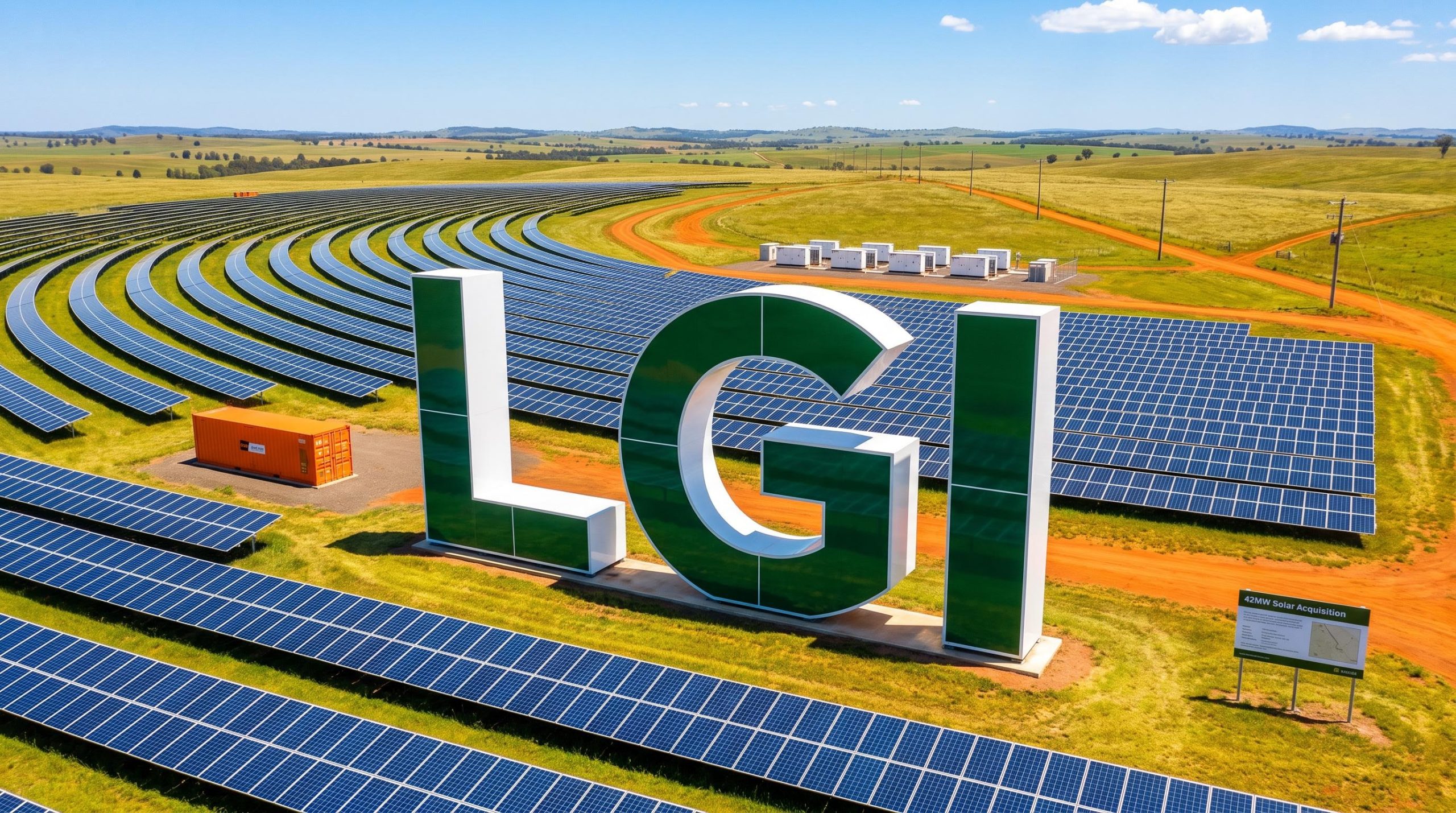
42MW solar acquisition lifts LGI’s pipeline beyond 120MW
In its October 2026 investor presentation, LGI Limited (ASX:LGI) outlined a $22.0 million solar acquisition of 42MW of generation assets. Management said the deal upgrades the medium-term strategic pipeline to over 120MW (80MW high conviction pipeline plus 42MW solar).
The presentation, dated 6 October 2026, framed the purchase as a step in building a renewable energy platform. The assets are acquired from IIG Solar Assets Pty Ltd ATF The IIG Solar Asset Trust.
Management detailed the key terms: the purchase carries no associated debt, completion is set for 9 October 2026, no shareholder approval is required, and there are no remaining outstanding material conditions. Funding comes from cash at bank and undrawn funds from the existing debt facility, which the presentation names as the CBA facility.
The assets are expected to contribute estimated annual EBITDA of $2.1 – $4.0m. That estimate is based on current electricity prices and depends on the timing of revenue synergy realisations and Dynamic Asset Control System (DACS) implementation.
| Element | Detail |
|---|---|
| Transaction | 100% of Maryrorough Solar Pty Ltd (Brigalow) and 100% of Chinchilla Solar Pty Ltd (Chinchilla) |
| Purchase price | **$22.0 million**, with no associated debt |
| Capacity | **42MW** (Brigalow **27.3MW**, Chinchilla **14.7MW**), on leased land |
| Completion | **9 October 2026** |
| Funding | Cash at bank and undrawn funds from existing debt facility |
The presentation set out the strategic objective behind the deal:
Strategic objective
“Develop and operate a diverse renewable energy platform at scale”
The two solar farms
The presentation profiled both farms, which are located on leased land in Queensland.
| Farm | Location | Installed / Export | Commenced | Lease remaining |
|---|---|---|---|---|
| Chinchilla | Baking Board, QLD | **19.9MW** / **14.7MW** | **2019** | **31 years** |
| Brigalow | Yarranlea, QLD | **34.5MW** / **27.3MW** | **2021** | **33 years** |
Key operating points from the presentation:
- Both farms operate on a 100% spot exposed basis.
- Chinchilla recorded 2025 annual generation of 20,981 MWh.
- Brigalow recorded 2025 annual generation of 33,229 MWh.
The presentation also carried a footnote to the estimated EBITDA range: FY27 EBITDA of approximately $1.6 million, assuming 9 months of contribution. This is a footnote to the range rather than a separate guidance figure.
When big ASX news breaks, our subscribers know first
Why solar, and why these assets
According to the presentation, LGI developed solar projects before listing on the ASX and has since run a disciplined search for strategically-aligned renewable assets. Efforts to assess solar opportunities increased over the past year, with due diligence undertaken on multiple assets as solar valuations softened in line with energy prices, which the company described as creating this buying opportunity.
Management outlined the case for Chinchilla and Brigalow:
- The assets were priced below greenfield development cost for like assets.
- Both leases have over 30 years remaining.
- The quality of the build and engineering was described as a stand out.
- The farms are located near LGI’s existing assets in Toowoomba and Warwick, so bringing operations and maintenance in-house will not require incremental resources.
- Applying DACS across both assets will optimise energy dispatch and price outcomes.
On the investor angle, the presentation stated that greater scale opens up new end markets for energy trading with a broader set of offtake partners.
Built-in optionality for batteries
Installed capacity at the farms is 54 MWp, against 42 MWac export capable. This reduces the risk of operating below maximum export levels if any solar panels are offline.
The presentation said the additional headroom could potentially enable efficient charging of a battery energy storage system (BESS) at either or both sites. It also noted a strong case to explore BESS hybridisation, particularly if intra-day volatility in the electricity market builds as anticipated.
Educational: how LGI’s integrated model works
LGI describes itself as a renewable energy and carbon abatement company operating a portfolio of distributed assets. Distributed assets are smaller generation sites spread across locations rather than one large plant.
The presentation outlined three revenue streams:
- Diversified renewable electricity: biogas power systems, utility scale solar and utility scale batteries, dispatched by DACS. Revenue comes from electricity, LGCs, FCAS and ACCUs.
- Greenhouse gas abatement: flaring systems installed on landfills to create ACCUs, under long-term agreements of 12+ years.
- Site infrastructure and management: installation, operation and maintenance of biogas extraction infrastructure and flaring systems for landfill owners, under service agreement only, earning fee-based revenue.
Three terms appear throughout the presentation:
- ACCUs (Australian Carbon Credit Units): credits created from reducing greenhouse gas emissions.
- LGCs (Large-scale Generation Certificates): certificates tied to renewable electricity generation.
- FCAS (Frequency Control Ancillary Services): services that help keep the grid stable.
DACS is the system LGI uses to dispatch its assets to optimise returns across energy and carbon markets. Adding solar to the existing biogas and battery assets means the company’s revenue base draws on a wider mix of generation types.
Pipeline, market backdrop and capital discipline
The presentation showed the medium-term energy platform pipeline totalling 125MW.
| Component | MW |
|---|---|
| Biogas Generation | **26** |
| Solar | **42** |
| Battery | **57** |
| Total | **125** |
A separate waterfall chart in the presentation built the same 125MW total from the following components:
- Capacity Beginning FY27: 21
- Canberra Batteries: 12
- Solar Assets: 42
- Belrose Batteries: 12
- Toowoomba: 1
- Nowra: 11
- QLD Battery Project: 4
- High conviction: 22
- Total: 125
The presentation describes the 80MW high conviction project pipeline as “full-funded”.
Market tailwinds
The presentation set out five themes on electricity market dynamics, drawing on Open Electricity, AEMO 2026 ISP and CSIRO GenCost sources:
- Coal continues to make up more than half of all generation.
- Coal plants are near the end of their useful life and are scheduled to close.
- At current electricity prices, new generation is struggling to reach a final investment decision, with a 6-8 year lead time noted.
- Electricity consumption is increasing.
- Time of day demand is becoming more volatile.
Capital management
Management said the company will maintain discipline with capital management, targeting net debt to EBITDA below 2x through the build out to over 120MW.
The presentation closed by positioning LGI around a flexible and growing asset base, with proprietary DACS used to optimise prices. It said distribution connected projects avoid transmission bottlenecks, and cited demonstrable BESS success.
Get Renewable Energy News Before the Market Moves
Join 20,000+ investors receiving FREE breaking ASX news within minutes of release, complete with in-depth analysis and the full announcement. Click the “Free Alerts” button at Big News Blast to stay ahead on market-moving updates the moment they break.