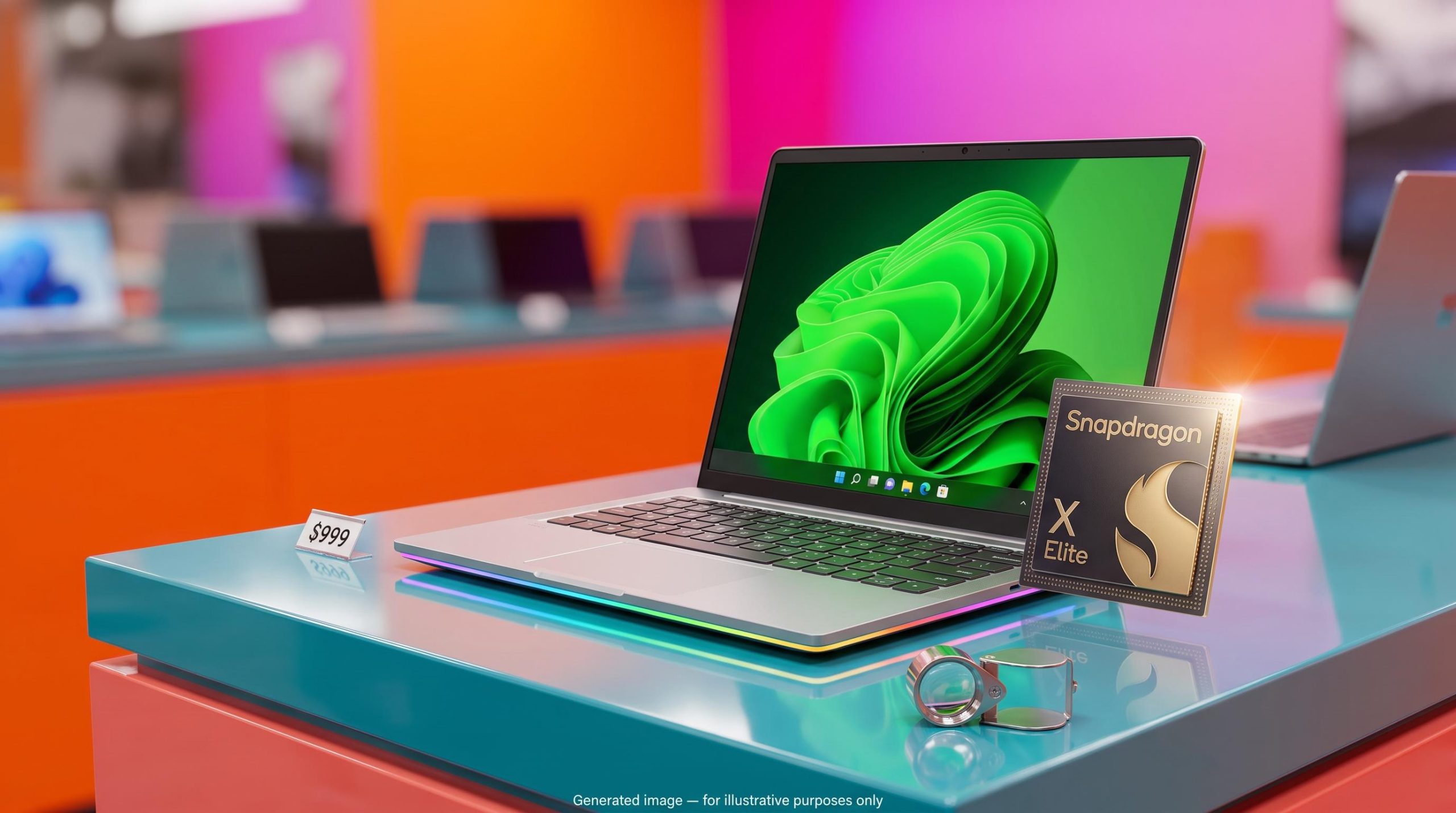
Most readers will file Googlebook under “Chromebook refresh” and move on. The more useful question is not the spec sheet but what Qualcomm gains. Googlebooks began shipping on 4 October in the US and 5 October in Canada, the UK, Ireland, France, Germany and Australia, with Snapdragon X Elite models priced from $999 (Dell) and $1,299 (HP).
Qualcomm announced the collaboration on 21 September 2026, and Android, not ChromeOS, sits underneath the devices. Misreading that foundation means misreading a category that could change where Snapdragon chips sell.
Here is what the evidence confirms, what it leaves out, and which signals deserve your attention next.
What actually shipped: the Googlebook Snapdragon X Elite line-up
Two Snapdragon X Elite models are confirmed: the Dell XPS Googlebook, a 13-inch laptop, and the HP Googlebook 14. Android Central’s hands-on found both in 16GB RAM and 512GB storage configurations.
A third device, a Samsung prototype, has appeared only in GSMArena reporting, spotted in Geekbench with a Snapdragon X Elite and Android 17. Treat it as unconfirmed.
| Model | Chip | Starting price | RAM / storage | Display or memory option |
|---|---|---|---|---|
| Dell XPS Googlebook | Snapdragon X Elite | $999 | 16GB / 512GB | Up to 32GB LPDDR5X |
| HP Googlebook 14 | Snapdragon X Elite | $1,299 | 16GB / 512GB | Up to 3K OLED 120Hz touch; up to 32GB RAM |
Google’s shop lists Googlebooks from $899, but that entry price appears tied to Intel-based models. Acer, Lenovo and Asus also appear among the partners, alongside Intel Core Ultra Series 3 options.
The gap between $899 and $999-$1,299 tells you Qualcomm is entering as a premium option, not a price disruptor.
Google is also setting a floor for the whole platform:
- 16GB RAM minimum
- An NPU (the chip block that handles on-device AI tasks) rated at 45+ TOPS
- Up to 10 years of updates
- A “Glowbar” light bar and a fingerprint sensor
- 12 months of Google AI Pro with 5TB storage
Software features include Cast My Apps, Magic Pointer and Rambler. Qualcomm cites battery life of up to 19 hours, while real-world tests point to roughly 14-18 hours. That gap is small, but it is the first place where the marketing and the evidence part ways.
Pricing and availability by region
Shipping is staggered: the US on 4 October, then Canada, the UK, Ireland, France, Germany and Australia a day later. Intel-based models share the platform and set the entry price.
When big ASX news breaks, our subscribers know first
Is a Googlebook just a better Chromebook? Understanding the Android-based laptop category
It is a fair assumption. Google built Chromebooks, and Googlebooks look like laptops from the same family.
The difference is the foundation. ChromeOS is built around web apps and the Chrome browser. Googlebooks run on Android, so they use native Android apps and games, Gemini Intelligence (Google’s AI assistant layer) and links to Android phones and tablets.
Qualcomm calls it “Google’s new Android-based laptop category.” GSMArena put it more bluntly:
“This isn’t a Chromebook.”
Android Central says the Android base makes the devices “more capable than Chromebooks in a few areas,” particularly in AI.
That matters because Chromebooks won in education but made limited headway in high-end productivity, according to IDC and tech press coverage. A premium Snapdragon laptop needs to escape that ceiling.
| Platform | OS foundation | App model | AI focus | Evidence available |
|---|---|---|---|---|
| Googlebook | Android | Native Android apps and games | Gemini Intelligence | Hands-on only; benchmarks not yet tested |
| Chromebook | ChromeOS | Web-centric | Less central | Established in education |
| Windows on Arm laptop | Windows | Windows apps | Copilot+ PCs from 2024 | Not yet tested against Googlebook |
| MacBook | macOS | Mac apps | Not yet tested against Googlebook | Not yet tested against Googlebook |
Two gaps are worth stating plainly. No official roadmap merging Android and ChromeOS has been found, and neither Qualcomm nor Google compares Googlebooks directly with Windows on Arm PCs or MacBooks.
So when you read Googlebook-versus-Windows verdicts, you are reading positioning claims, not tested performance. Treat any head-to-head conclusion as provisional.
Why both companies need this: Qualcomm’s PC push and Google’s Gemini hub
Two separate motives meet in this product. Neither has yet produced a number you can check.
Qualcomm’s angle
For Qualcomm, Googlebook positions the Snapdragon X series as a PC-class platform rather than a phone chip stretched into laptops. Kedar Kondap, Qualcomm’s SVP and GM of Compute and Gaming, and Google’s John Solomon, VP and GM of Laptops, Tablets, and Android Enterprise, both pitch the devices as the “first laptops designed for Gemini Intelligence.”
“First laptops designed for Gemini Intelligence.”
The messaging stresses seamless links between phones, tablets and laptops, all of which can run on Snapdragon.
Google’s angle
Google gets a laptop that treats Gemini as a first-class resident. Features such as Cast My Apps, Magic Pointer and Rambler draw on email, calendar and on-screen context, which suggests a hub that could deepen lock-in for Android users.
What is missing is any public discussion of whether Googlebooks cannibalise ChromeOS or Windows sales.
Here is how the evidence splits:
- Confirmed: Shipping hardware, Snapdragon X Elite pricing from $999, executive positioning on Gemini
- Not found: Qualcomm PC market share, shipment volumes, compute revenue figures, and any IDC, Counterpoint, Canalys or Gartner commentary on this launch
For you as an investor, a design win with Google adds credibility but is not yet revenue evidence. The launch should shift your questions, not your valuation.
What history says could go wrong, and what to watch next
Three precedents show what usually decides whether a new laptop platform sticks. They are general risks, not Googlebook-specific findings, and no investor-focused commentary on Microsoft relationship or margin risk was found.
| Platform | What worked | What held it back | Lesson for Googlebook |
|---|---|---|---|
| Windows on Arm (2019-2023) | Strong battery life, always-connected features | App compatibility, performance gaps, slow enterprise adoption | Battery alone does not carry a platform |
| Chromebooks | Low cost, simple management in education | Limited premium and enterprise reach | OS limits can cap a platform’s range |
| Apple Silicon (M1 onward) | Performance per watt, Rosetta 2 translation, developer optimisation | Little of note in the research | Developer support decides outcomes |
Copilot+ PCs on Arm, from 2024, were Microsoft’s attempt to reboot its Arm effort with stronger AI features. Because battery life and AI alone did not rescue earlier Arm laptops, you should judge Googlebook on app compatibility and developer uptake rather than launch-week enthusiasm.
Five signals will tell you more than any press release:
- App and game compatibility on real Googlebooks
- Independent battery and performance tests against the 19-hour claim
- OEM breadth beyond Dell and HP
- Developer support for the Android laptop format
- Qualcomm’s next disclosures on its compute segment
Google’s promise of up to 10 years of updates is also a commitment worth tracking.
Judging Googlebook on proof, not launch momentum
The hardware is real and shipping. Premium Snapdragon pricing is confirmed. Market share, shipment and analyst evidence are still absent.
A sensible frame is to treat Googlebook as a credible option for Qualcomm’s PC expansion, then let independent reviews, app compatibility and later Qualcomm disclosures decide whether it becomes a growth driver. The first post-launch reviews and early sales signals are the next evidence points.
This article is for informational purposes only and should not be considered financial advice. Investors should conduct their own research and consult with financial professionals before making investment decisions. These statements are speculative and subject to change based on market developments and company performance.