Walk into any outlet mall and you can find them: Air Jordans in the discount bin, Dunks marked down past the point where scarcity means anything. The same sneaker that once commanded queues and resale premiums now sits on a clearance rack, and that shift from aspirational object to discounted commodity is the story of Nike‘s current predicament.
The financial deterioration is visible in the numbers. Revenue has fallen across consecutive quarters, Jordan Brand dropped by a mid-teens percentage in the most recent period, and Converse contracted by roughly 28%. But these declines are not the problem. They are the downstream consequence of upstream brand decisions made across several years.
Nike brand erosion is best understood not as a marketing failure but as a financial one, where brand equity functions as a pricing-power mechanism rather than abstract goodwill. What follows is a framework for treating brand equity destruction as a quantifiable financial risk, using Nike as the case study. By the time you finish, you will be able to separate what Nike’s Pace restructuring can actually deliver from what it cannot, and why that distinction decides whether recovery is real or cosmetic.
How a sneaker becomes a commodity: the supply mechanics behind Nike’s pricing power collapse
Pricing power in aspirational footwear rests on a single idea: controlled scarcity. Franchises like Jordan and Dunk sustained premium prices because limited drops and tight distribution made owning a pair feel like access to something exclusive. Remove the scarcity and the premium has nothing to stand on.
The sequence that follows is predictable. When volume expands into mass retail and off-price channels, consumers stop expecting to pay full price and start expecting a discount. That resets the reference price, the figure a buyer mentally treats as fair, downward. The damaging part is the persistence: once the reset happens, it survives even if supply is later restricted, because the memory of cheap, abundant pairs does not disappear.
Five mechanisms drive this equity erosion:
- Scarcity erosion: Flagship silhouettes stop signalling exclusivity once they are everywhere.
- Channel dilution: Outlet and off-price exposure trains buyers to wait for markdowns.
- Halo effect breakdown: Commoditised icons stop lifting the perceived value of the wider catalogue.
- Cultural positioning drift: Ubiquity in generalist retail weakens the link to elite sport and street credibility.
- Performance-lifestyle blurring: Icons once tied to athletic performance become everyday casual wear, diluting the premium justification.
The evidence sits in the segment data. Sportswear fell by a low double-digit percentage while performance categories posted high single-digit growth, a clean split between commoditised icons and healthy performance lines. Converse, meanwhile, contracted 28%, declining across every single territory it operates in: a parallel case of a franchise pushed fully into commodity territory.
The halo effect as a financial variable
Icon products are not just revenue lines. Jordan, Air Max, and Dunk act as pricing anchors for the entire catalogue, setting a perceived ceiling that justifies premium pricing on inline performance shoes and apparel.
When those anchors are commoditised, their anchoring function degrades. The perceived fair value of everything connected to them drifts downward, dragging pricing power across categories that never had an oversupply problem of their own.
Nike’s management is now reducing the Dunk franchise’s distribution reach by roughly half. That tells you the company has acknowledged the supply error. What it does not tell you is that the error can be reversed, because deciding to restrict supply and rewriting the consumer’s reference-price memory are two entirely different tasks.
When big ASX news breaks, our subscribers know first
What the historical record says about brands that oversaturated their icons
Nike is not the first culturally dominant brand to flood its own icons into the mass market, and the brands that went before it function less as warnings than as a dataset. Look at four of them together and a pattern surfaces.
| Brand | Core overexposure problem | Recovery lever used | Recovery outcome |
|---|---|---|---|
| Gucci | Logo proliferation and broadened distribution eroded luxury status | Logo reduction, tighter distribution, new design vision under Tom Ford and Domenico De Sole | Full recovery |
| Gap | Logo basics and chronic promotional discounting commoditised the brand | Assortment tightening and cost-cutting | Partial at best |
| Levi’s | 501 franchise became a mass commodity | Fashion repositioning and financial discipline | Partial |
| Abercrombie & Fitch | Hyper-exclusive, youth-only identity became a liability | Wholesale identity repositioning toward inclusivity and fashion-forwardness | Partial turnaround over multiple years |
Gucci is the case that worked. Recovery required logo reduction and tighter distribution, but those cuts were paired with a coherent new design vision. Volume discipline alone would not have done it.
Gap and Levi’s show the ceiling. Both stabilised financially, but neither recaptured peak cultural cachet. Once consumers file a brand under ubiquity and discount, tightening the assortment and cutting costs rarely rebuilds the aspiration that was there before.
Abercrombie shows the cost of genuine turnaround. It did not recover by doing less of the same. It recovered by repositioning its entire identity over a multi-year product and channel reset.
The distinction that matters is between financial stabilisation and restored cultural desirability. Gucci cleared both bars. Gap and Levi’s cleared only the first. Cost discipline is the floor of recovery, not the ceiling.
That pattern should calibrate your expectations for Nike. The Pace program can deliver the floor. Whether it reaches the ceiling depends on levers that cost-cutting does not touch.
Brand equity destruction as a financial risk category: a framework for investors
Here is the useful part of the Nike story for anyone holding consumer discretionary stocks. Brand equity destruction is not a marketing concept you can safely ignore on a balance sheet. It is a financial risk factor, and it shows up in the numbers before it shows up in the revenue line.
The early warning appears as eroding gross margin, rising promotional spend intensity, and average selling price (ASP) compression, the ASP being the typical price a product actually sells for after discounts. By the time revenue itself is falling, the damage has usually been underway for years.
Three leading indicators tell you a brand is destroying its own equity through oversupply:
- Accelerating off-price channel penetration: More product flowing through outlet and discount channels signals the brand is managing inventory rather than demand.
- ASP declining faster than unit volumes: When price falls quicker than volume, the brand is buying sales with discounts rather than selling on desirability.
- Direct-to-consumer conversion falling while traffic holds: Interest is intact, but willingness to pay full price is not.
These are not theoretical. Nike’s own numbers fit the pattern.
Reading Nike’s numbers through the framework
NIKE Direct revenues fell 8% to $4.142 billion in fiscal Q1 2027, a sharper drop than the 4% decline in total brand revenue. When your own stores and apps, the channels you control most tightly, underperform the broader business, it points to weakening full-price conversion rather than a simple demand shortfall.
Gross margin tells a more encouraging story on the surface, expanding 60 basis points to 42.8% in the quarter. The caveat is the base: that margin improvement sits on a revenue figure that is shrinking, not growing, so it reflects cost and mix discipline more than renewed pricing strength.
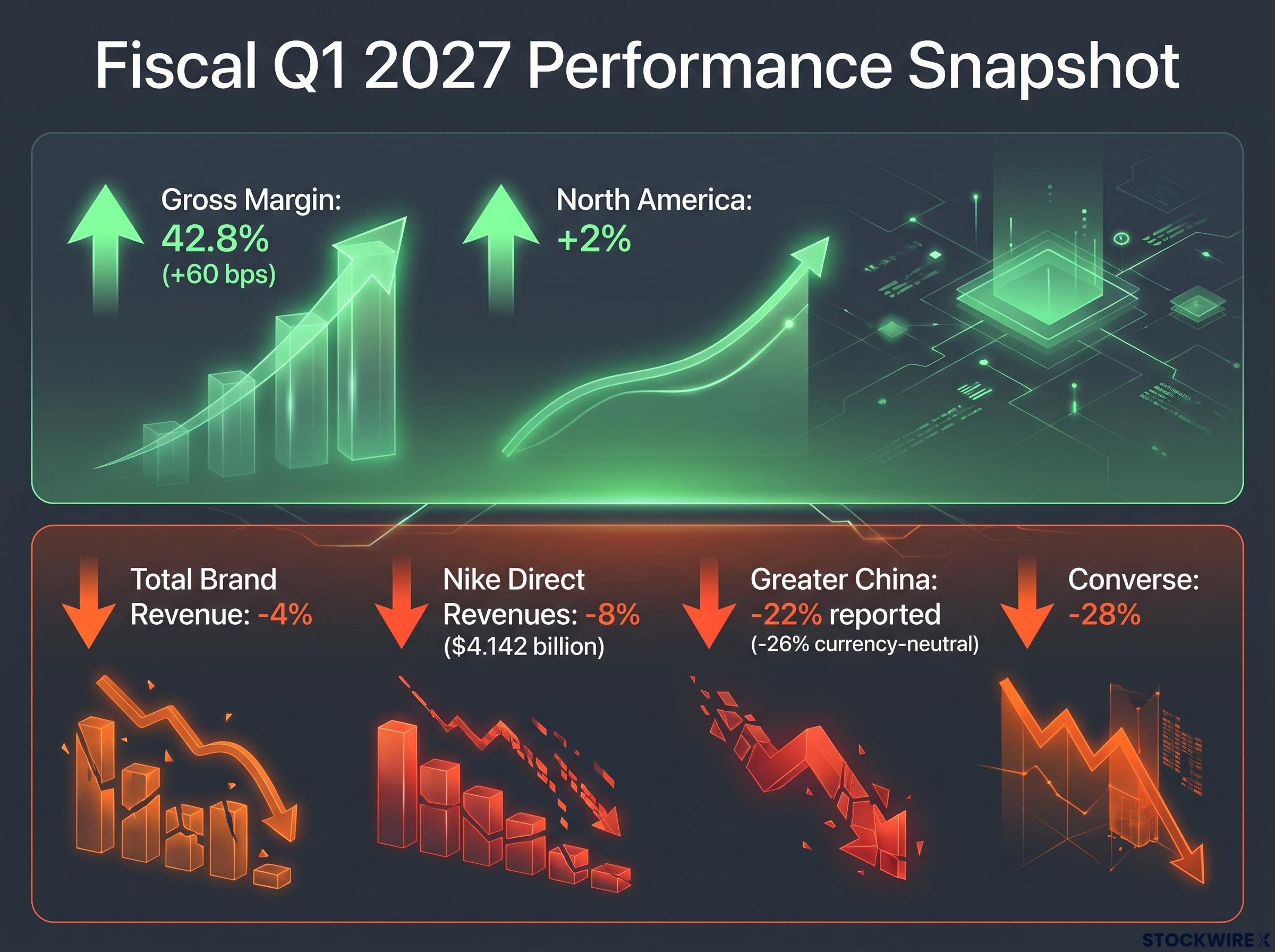
Nike has guided for high-single-digit revenue declines across fiscal 2027, which tells you the top-line impact is not yet stabilised even as the cost measures progress. Meanwhile the portfolio is running at two speeds, performance categories growing at high single digits while Jordan and Dunk decline. That two-speed signature is the empirical fingerprint of a brand in segmented recovery rather than broad repair.
Read together, the 8% DTC decline alongside margin expansion tells you Nike is earning more per unit but selling full-price to fewer buyers. That is structurally healthier than the reverse, but it is not the same thing as restored desirability.
What Pace can deliver, and what only a brand rebuild can
Financial commentary tends to collapse two separate questions into one: can Nike fix its margins, and can Nike fix its brand? They are not the same question, and the Pace program answers only the first.
Pace targets approximately $2.5 billion in cumulative cost savings through fiscal 2031, with the bulk expected in fiscal 2029 and 2030, alongside roughly $1 billion in pretax restructuring charges, of which about $300 million is anticipated in fiscal 2027 alone. The workforce has already fallen from approximately 77,800 to around 73,000 between May 2025 and May 2026, with further reductions signalled for 2027. This is a genuine, sizeable efficiency programme.
| What Pace can deliver | What only a brand rebuild can deliver |
|---|---|
| Margin improvement and operating efficiency | Restored scarcity for Jordan and Dunk |
| Supply chain modernisation | Recovered average selling prices |
| Overhead and headcount reduction | Recaptured share from On, Hoka and New Balance in performance niches |
| A manageable cost structure through the revenue trough | Cultural credibility in lifestyle segments |
The limits are visible in the regional data. Greater China revenue fell 22% reported (26% currency-neutral) in fiscal Q1 2027, a geography no cost-savings programme can restructure away, and one where domestic brands add competitive pressure. North America, by contrast, rose 2%, evidence that at least one large region is beginning to stabilise around performance categories.
Competitor entrenchment compounds the challenge. A Reuters analysis published in February 2025 found that On Running, Hoka, New Balance and Adidas all gained athletic footwear market share between 2022 and 2024 as Nike’s share slipped. That credibility in running and retro-lifestyle will not dissolve because Nike halves Dunk supply.
The segmented recovery thesis is the most empirically grounded reading of current data: performance categories growing at high single digits while lifestyle icons stay under pressure. It is the scenario the numbers actually support today.
Analysts broadly split into three views on recovery depth: deep but reversible, structurally impaired, or segmented. The $2.5 billion programme tells you the balance sheet will stabilise. What it does not tell you is that a leaner Nike with still-commoditised icons is the same company as a Nike with restored pricing power. The gap between those two outcomes is where the real investment question lives.
Three variables that will determine whether Nike’s recovery is real or financial engineering
Rather than reaching for a verdict, the more useful exercise is identifying the specific signals that will reveal, over the next two to three years, which scenario is unfolding. Three variables carry most of the weight.
- ASP recovery across Jordan and Dunk: Not revenue, not gross margin, but the average selling price. It is the most direct evidence that scarcity is being restored and reference prices are climbing back.
- Greater China’s trajectory: A geography that cannot be restructured away, where the 22% reported decline (26% currency-neutral) reflects multi-year softness compounded by domestic competition from Anta and Li-Ning, not just a one-off World Cup comparison.
- Whether performance innovation can carry the load: If running, football and golf grow fast enough to offset continued lifestyle softness, the segmented recovery thesis holds. If they cannot, the structurally impaired view gains credibility.
Watch ASP above all else. Gross margin can expand through cost discipline even while brand desirability stays impaired. Rising average selling prices on the icon franchises cannot be faked by cost-cutting, which is exactly why they are the truest signal of genuine recovery.
There is early encouragement on the performance front. Nike reported that maximum cushioning running shoe market share nearly tripled over the prior year period, with management citing running, golf and football as categories showing positive momentum. That tells you Nike’s performance credentials are far from gone.
Weigh it carefully, though. The scale of Jordan and Dunk within the total portfolio means a tripling of share in one running subcategory does not prove the broader brand has turned. Fiscal 2027 full-year guidance of high-single-digit revenue declines sets the timeline over which these early signals will either confirm or contradict the recovery.
Nike is not too big to lose, but the margin for error is shrinking
The central argument resolves cleanly. Financial restructuring is necessary but not sufficient for brand recovery, and the historical precedents establish partial recovery as the likely floor rather than a full restoration of prior cultural dominance.
The segmented recovery thesis, strong in performance and persistently weaker in lifestyle icons, is the scenario the current data supports most convincingly. For that thesis to be upgraded to full recovery, you would need to see average selling prices climbing on Jordan and Dunk, Greater China stabilising on its own merits, and performance innovation scaling fast enough to carry the revenue burden the icons once carried.
None of those conditions is confirmed yet, and none is impossible. The honest position is neither that Nike is doomed nor that Pace is enough. You now hold the vocabulary to judge which outcome is unfolding as the numbers arrive. Watch the three variables.
This article is for informational purposes only and should not be considered financial advice. Investors should conduct their own research and consult with financial professionals before making investment decisions. Past performance does not guarantee future results. Financial projections are subject to market conditions and various risk factors.