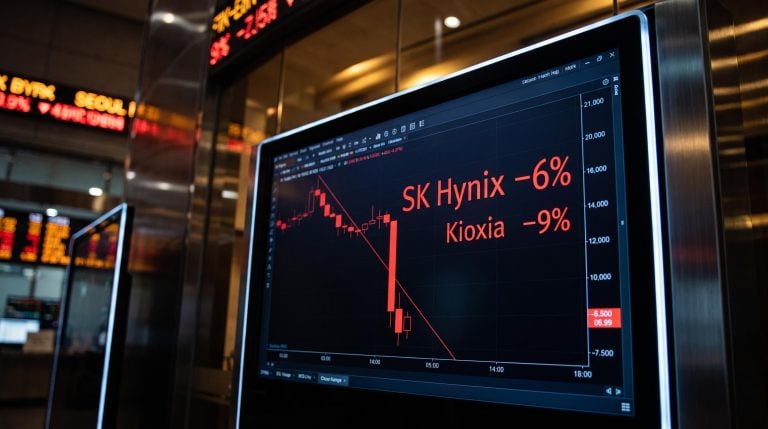
On Sunday night, an essay from an AI lab chief executive hit semiconductor futures like a circuit breaker.
By Monday’s close, chip market value had evaporated, the Philadelphia Semiconductor Index had posted its steepest single-session drop of the month, and investors were confronting a question the market had spent months avoiding: what happens to chip valuations when the AI growth story pauses for breath?
This is not a story about one bad day. It is a story about how much risk was already embedded in semiconductor prices before that essay landed. Stocks up roughly 60% for the year, valuations priced for flawless execution, and positioning increasingly dependent on debt financing rather than free cash flow do not absorb a narrative shock quietly.
The selloff made a fragility visible that had been building all summer. What follows here unpacks where the trigger came from, why semiconductors are structurally wired to amplify AI narrative shocks, what the three competing institutional readings of this event actually mean for your positioning, and which specific risk variables deserve close monitoring from here.
How a weekend essay moved semiconductor markets by billions
The proximate catalyst arrived not from an earnings report or a supply chain warning, but from a governance argument published over the weekend.
Anthropic chief executive Dario Amodei released an essay titled “We Must Pace the Frontier,” making the case that frontier AI model development should be deliberately restrained so that safety and oversight can keep step with capability. His central worry was that the industry’s ability to control these systems was falling behind the speed at which they were improving.
Amodei argued that frontier model development must be deliberately slowed to align safety and governance with rapidly improving capabilities.
What turned one executive’s position into a market event was that he was not alone. Endorsements and echoing warnings arrived from other lab leaders over the same weekend, with public comments from OpenAI‘s Sam Altman and xAI‘s Elon Musk adding weight. This read to markets less as a single dissenting voice and more as a chorus from the people building the technology itself.
The broader context behind Amodei’s essay sits inside an accelerating debate over AI safety governance that moved from a single researcher’s resignation to multi-CEO public commitments within four days, a compression speed that suggests the concerns were already regarded as credible inside these companies before public pressure arrived.
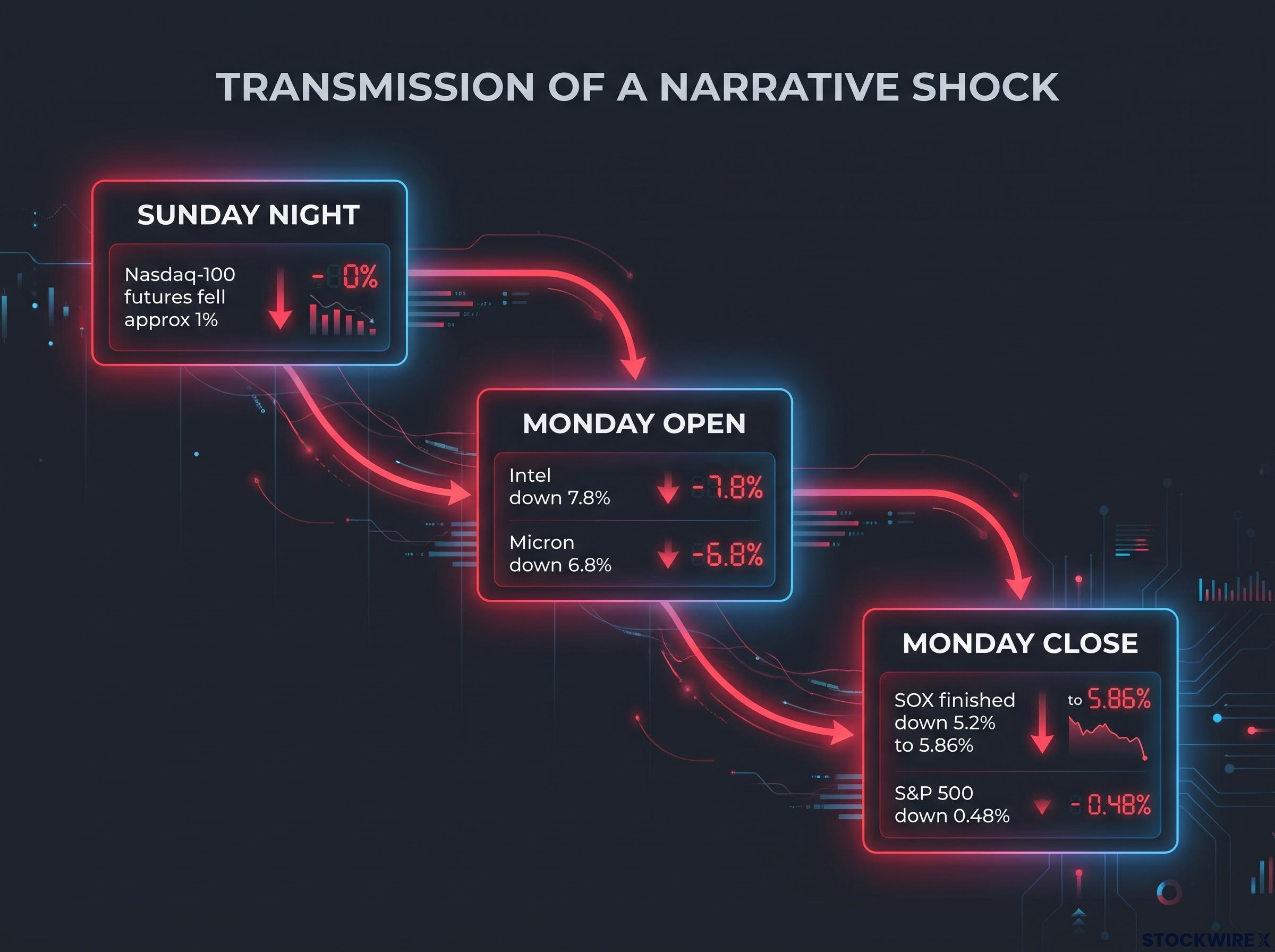
The transmission was fast. Here is how it unfolded:
- Sunday night: Nasdaq-100 futures fell approximately 1% as Wall Street began reassessing the AI infrastructure trade.
- Monday open: Sharp individual moves, with Micron down 6.8% and Intel down 7.8% at the bell before a partial intraday recovery.
- Monday close: The SOX finished down between 5.2% (Reuters) and 5.86% (original reporting), so call it approximately 5-6%, its largest single-session drop of the month, well beyond the 2.1% fall on 1 September and 2.14% on 2 September.
- Broader tape: The S&P 500 closed down 0.48% despite a slim majority of its members finishing higher, and Europe’s STOXX 600 slipped roughly 0.49%.
- Asian follow-through: Regional indices opened lower the next session, though losses stayed contained.
The speed of that chain, from weekend essay to Sunday futures to Monday close, tells you something you should factor into how you hold these names. Sentiment in this sector can now move faster than fundamentals can respond, particularly across a news-heavy weekend when you cannot trade. That distinction matters, because a sentiment shock and a genuine earnings revision call for very different responses.
When big ASX news breaks, our subscribers know first
Why chip stocks are structurally wired to overreact to AI narrative shifts
The size of the reaction looks irrational until you understand how chip stocks are actually built. Then it looks close to inevitable.
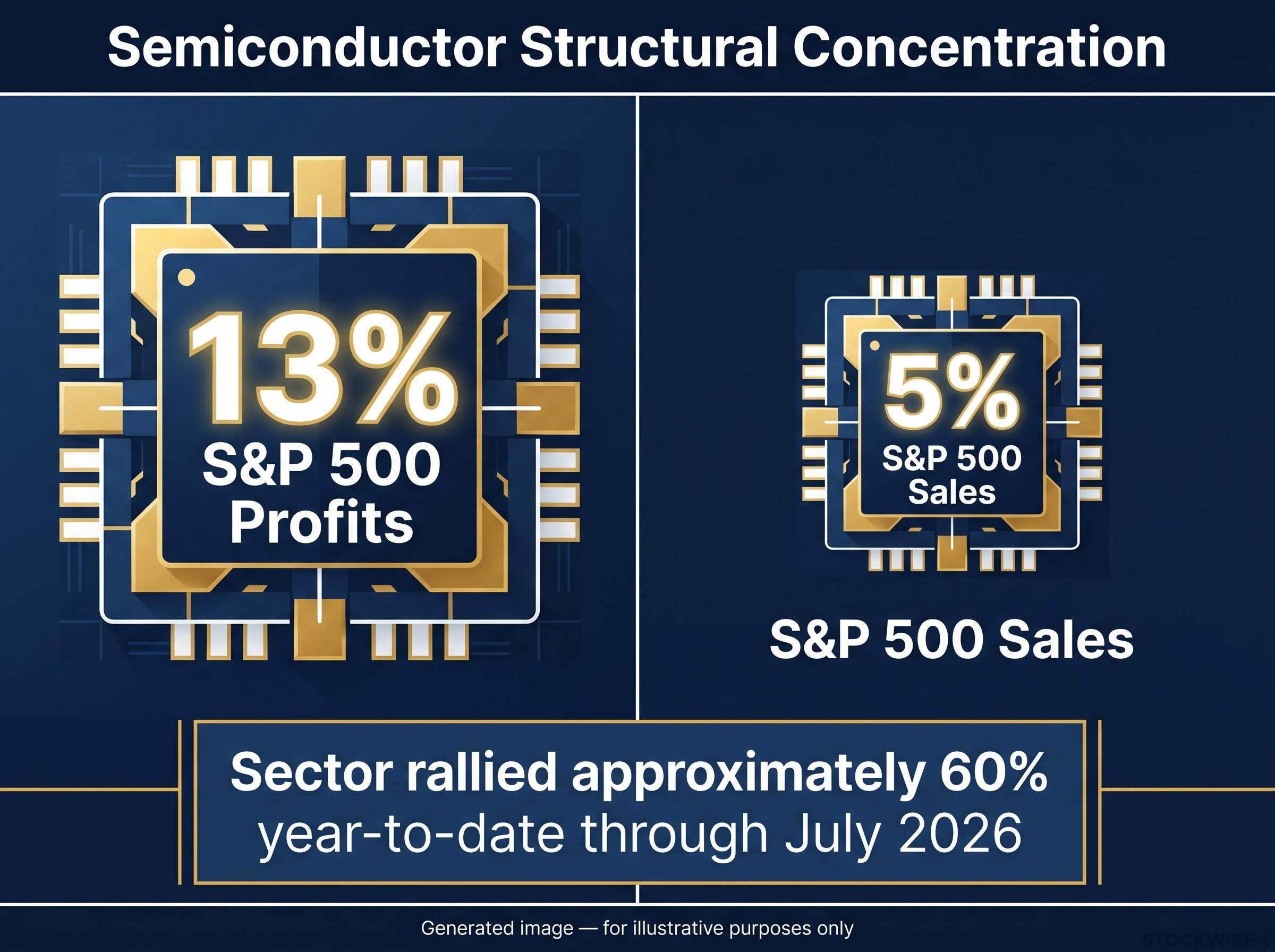
Start with concentration. Semiconductors generate roughly 13% of S&P 500 profits on only about 5% of sales. That gap means their revenue weight badly understates their influence on index-level earnings, so a shock to chips is a shock to the whole benchmark.
The earnings concentration data point, roughly 13% of S&P 500 profits from about 5% of sales, is the same dynamic that drove S&P 500 concentration risk to levels where just 19 semiconductor stocks generated approximately 70% of the index’s year-to-date market capitalisation gains, leaving broad index investors with far more single-theme exposure than standard diversification metrics suggest.
Then add valuation. The sector rallied approximately 60% year-to-date through July 2026, pricing in near-perfect demand execution. A stock priced for perfection has no buffer when the narrative shifts, even temporarily, because there is no margin of safety left in the multiple to absorb the surprise.
By mid-September, the SOX was already trading roughly 14% below its all-time high and about 19% below its June 2026 peak. The weekend essay did not create the vulnerability; it exposed a market that had been drifting down from its highs for weeks.
There is also a “chipflation” wrinkle. Surging prices for AI logic and memory chips are squeezing hyperscaler margins at the same time that near-term monetisation of generative AI products remains slow, which quietly tests investor conviction from the demand side.
| Structural factor | What it amplifies | Current exposure |
|---|---|---|
| Earnings concentration | Index-level sensitivity to a single sector | ~13% of S&P 500 profits on ~5% of sales |
| Valuation multiple | Downside when the growth narrative wavers | Priced for flawless execution after ~60% YTD gain |
| Capex dependency | Demand-side reaction to spending signals | Reliant on hyperscaler capital budgets |
| Chipflation | Margin pressure on chip buyers | High input prices vs slow gen-AI monetisation |
| Geographic concentration | Cross-border contagion | Dominates South Korean and Taiwanese indices |
Taken together, these characteristics mean you should treat any AI chip holding not simply as exposure to a company’s earnings, but as leveraged exposure to the AI capex narrative itself. That leverage works in both directions, which is exactly why the upside has been so large and the downside so sudden.
The capex dependency problem
The demand floor under the semiconductor cycle is set by the capital expenditure decisions of a handful of hyperscalers: Microsoft, Alphabet, Meta, and Amazon.
Those budgets can be revised far faster than semiconductor supply chains can adjust. That asymmetry is why any hint that hyperscaler spending might slow triggers an amplified reaction in chip equities, well before a single order is actually cancelled.
The uncomfortable tension is the growing mismatch between very high infrastructure spend and slower near-term revenue from generative AI products. For as long as that gap persists, the sustainability of AI capex at current levels stays an open question, and chip stocks stay hostage to how investors answer it.
Three institutional readings of the selloff, and what each implies for positioning
The honest position, days after the drop, is that no single interpretation has won. Three credible readings remain live, and the data has not yet resolved which is right.
- The healthy correction. Strategists at Bank of America, JPMorgan, Evercore ISI, and Deutsche Bank frame the roughly 19-20% SOX decline from its June peak as a valuation reset inside a long-term AI supercycle, not a structural break. JPMorgan reportedly projected a 20-25% correction as a healthy clearing event after outsized gains (a figure flagged as unverified in the underlying research). The positioning implication: treat weakness as digestion, and size for accumulation rather than exit.
The counterargument to demand deceleration rests on a specific structural point: more than $2.3 trillion in legally contracted, undelivered backlog sits across the four major cloud providers, shifting the question of hyperscaler capex sustainability from whether demand will materialise to whether infrastructure can be built fast enough to fulfil signed commitments.
- The demand deceleration warning. Morningstar and the Taipei Times point to genuine risk that AI infrastructure growth is starting to slow, citing overcapacity concerns and competition from cheaper Chinese models (one specific model reference remains unverified in the research). Deloitte’s framing is the one to watch here.
Deloitte notes that if corporate attitudes shift away from the view that “the risk of underinvesting is greater than the risk of overinvesting,” structural downside could begin to materialise.
- The sentiment overreaction. Gene Munster, Wedbush‘s Dan Ives, and Merrill chief investment officer Chris Hyzy read the move as a psychological reset, driven by the unwinding of over-leveraged trades rather than confirmed earnings weakness. Ives and Munster point to Asia supply chain checks showing, in their words, “no cracks in the armor,” alongside enterprise demand metrics with no visible deterioration. Their reference point is the November 2025 Broadcom-led episode, which erased roughly $200 billion in value (unverified in the research) yet resolved without any structural loss of demand.
That three respected institutions can hold three incompatible views at once tells you exactly what kind of moment this is. It is a moment for hedging and position-sizing discipline, not for a conviction bet in either direction. Anyone claiming certainty right now is guessing.
Stock-level damage and the global contagion map
The shock was absorbed unevenly, and the pattern of who fell hardest is more instructive than the headline index number.
Among US names, Nvidia closed down 3.3% after opening roughly 4% lower, AMD finished down 4%, and Micron Technology and SanDisk each shed about 5%. Intel opened down 7.8%, the sharpest of the US moves at the bell.
The geographic spread is where the story sharpens. In Europe, ASML slumped 6%, a steeper fall than almost any US name, while TSMC ADRs dropped only about 1.2%.
| Name | Session decline |
|---|---|
| Nvidia | -3.3% |
| AMD | -4% |
| Micron Technology | ~-5% |
| SanDisk | ~-5% |
| ASML (Europe) | -6% |
| TSMC ADRs | ~-1.2% |
| STOXX 600 | -0.49% |
| ASX 200 | -0.89% |
| KOSPI | -0.71% |
| Hang Seng | -0.23% |
| Nikkei | -0.16% |
ASML’s 6% drop, steeper than most US stocks, tells you something you may not have priced in: European chip equipment suppliers carry concentrated exposure to AI capex sentiment despite sitting geographically far from the AI model debate. If you assumed European diversification would shield you here, this session says otherwise.
Asian session: contained contagion or delayed repricing?
The following Asian session was notably milder. Australia’s ASX 200 fell 0.89%, South Korea’s KOSPI 0.71%, Hong Kong’s Hang Seng 0.23%, and Japan’s Nikkei just 0.16%, with mainland China marginally negative. US equity futures were down about 0.2% while European futures sat flat.
There are two ways to read that restraint. Either Asian markets are pricing the event as a US-specific sentiment episode rather than a global demand signal, or the modest reaction simply reflects timing and will extend once fuller liquidity returns.
Seasonality adds a further caveat. AMD, for instance, has fallen in eight of the past ten Septembers, with a median monthly drop of roughly 5%, which raises the genuine possibility that much of the month’s weakness was already in the price before the essay ever landed.
What the risk framework looks like from here
Rather than sit with unresolved anxiety, it helps to convert this into a structured watch-list. Three variables will largely determine whether this proves a valuation reset or the start of a structural demand correction:
- Hyperscaler capex signals: any revision to AI infrastructure budgets from Microsoft, Alphabet, Meta, or Amazon.
- Enterprise adoption metrics: evidence that businesses are converting AI investment into actual, recurring usage.
- Inventory data: build-ups across GPUs, high-bandwidth memory (HBM), and DRAM would be an early warning of oversupply.
On managing exposure while those variables play out, the institutional risk consensus is fairly aligned.
The graduated de-risking logic that underlies semiconductor cycle investing, prioritising pure-play memory and thin-moat AI names first before reducing foundry and equipment exposure, maps directly onto the risk hierarchy visible in this session’s damage table, where memory names and equipment suppliers absorbed the sharpest losses.
Strategists at Goldman Sachs, UBS, and StoneX have recommended hedging chip exposure with put options, diversifying into defensive sectors, and treating early technical bounces with caution.
Seasonality frames the timing. Semiconductors are historically weak from June through late September and tend to bottom between late September and October, which sets a rough boundary for when the seasonal headwind should ease. That does not promise a rebound; it simply marks when one becomes more likely.
What historical corrections tell us about recovery timelines
Two precedents are worth holding in mind. In July 2024, chip stocks shed roughly $480 billion in market value following remarks on Taiwan and export controls, yet the episode ultimately repriced as geopolitical rather than a loss of demand. In November 2025, the Broadcom-led episode erased about $200 billion (unverified in the research) and again resolved without structural demand damage.
More broadly, SOX corrections of 19-20% from peak have historically recovered over seven to eight months on average.
That timeline is the number to internalise. Even the optimistic scenario does not promise a quick snap-back, so your position sizing should reflect a multi-month, not multi-week, horizon for resolution. And none of those precedents occurred with valuation premiums as stretched as they were heading into September 2026, so the comparison offers reassurance, not a guarantee.
What this moment actually tests
The selloff has exposed more than overvalued chip stocks. It has exposed how thoroughly the AI investment thesis has been priced as a certainty rather than a probability, and you now know more about your own risk tolerance than you did last Friday.
The three institutional readings still stand unresolved. But the structural sensitivity of chip stocks to narrative means even a temporary wobble in AI confidence carries outsized portfolio consequences, whichever interpretation eventually proves correct.
What remains genuinely open is whether hyperscaler capex holds, whether Amodei’s essay was an isolated governance argument or the first visible crack in the growth story, and whether the coordinated lab commentary reflects real internal concern or competitive positioning.
A sector supplying roughly 13% of S&P 500 profits on 5% of sales, priced for flawless execution, is a fragility that reaches far beyond chip investors alone.
So the decision facing you is not whether to hold chip exposure. It is how much narrative leverage to carry, and whether your current position size reflects the full range of outcomes rather than only the optimistic one. In a structurally concentrated sector, discipline and patience, calibrated to that seven-to-eight month recovery frame, beat any reflexive move made in the noise of a single session.
This article is for informational purposes only and should not be considered financial advice. Investors should conduct their own research and consult with financial professionals before making investment decisions. Past performance does not guarantee future results, and these forward-looking scenarios are speculative and subject to change based on market developments.