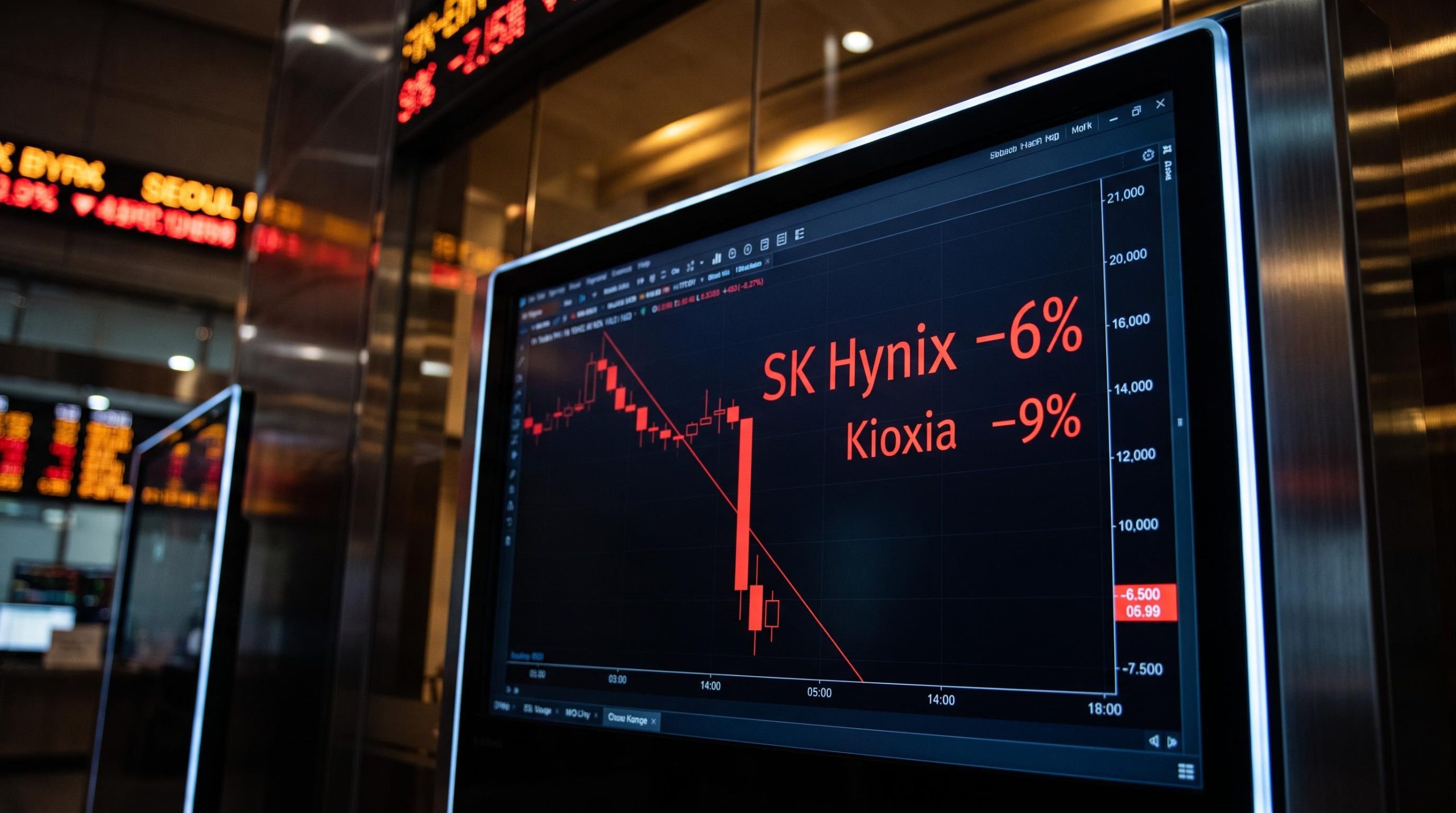
A call for caution should not crater a market. Yet in early September 2026, when AI industry leaders publicly urged a slower pace of frontier model development, the response from Asian semiconductor markets was immediate and severe. SK Hynix tumbled more than 6%, Samsung fell about 4%, and Kioxia slid roughly 9% at its lows.
The reason a plea for restraint could inflict that scale of damage sits in the financial architecture built around AI. The capex supercycle, with hyperscalers projected to deploy between $660 billion and $690 billion in 2026 alone and UBS forecasting $4.1 trillion across 2026 to 2028, was priced directly into the valuations of chipmakers and AI-adjacent Asian equities. Any credible signal of deceleration, whether from regulation or voluntary restraint, destabilises that pricing.
This is a structural framework for evaluating AI regulatory risk that goes beyond reading the headlines. Here is how to recognise the prisoner’s dilemma dynamic that makes collective restraint almost impossible, how the fragmented global rulebook is being assembled, and what portfolio positioning looks like once you understand both.
What the September sell-off reveals about AI’s valuation assumptions
Start with what actually moved. In the first week of September 2026, following those public warnings from within the AI industry, the Asian chip complex took a coordinated hit. SK Hynix dropped more than 6%, Samsung lost around 4%, Kioxia fell roughly 9% at its lows, and SoftBank recorded its largest single-day decline in nearly three months.
The scale of that reaction is the tell. These are not companies reporting collapsing earnings. They are companies whose share prices carried a premium built on an assumption: that capital deployment into AI infrastructure would keep accelerating at the pace already baked into their multiples.
The AI regulation market impact extended well beyond Asian chip names: ASML shed approximately 33.6 billion euros in market value on 14 September 2026, SoftBank fell 11%, and Nvidia dropped 3.5%, with platform-layer incumbents such as Google and Microsoft holding materially higher, drawing a visible regulatory risk boundary across the value chain in real time.
| Company | Market | Move (early Sep 2026) | Event context |
|---|---|---|---|
| SK Hynix | South Korea | Down more than 6% | Reaction to industry calls for slower AI development |
| Samsung | South Korea | Down around 4% | Sustainability of AI data-centre demand questioned |
| Kioxia | Japan | Down around 9% at lows | Memory supplier exposed to AI capex assumptions |
| SoftBank | Japan | Largest drop in nearly three months | Concentrated AI-linked exposure |
The distinction matters because a stock priced on a growth trajectory behaves differently from one priced on current earnings. When the market questions the forward assumption, the multiple contracts before the fundamentals move at all. That is precisely what the September moves show: a revision in the probability that the AI capex cycle sustains at its priced-in pace, not a response to financial deterioration.
Samsung’s own recent history makes the point unmissable.
The Samsung paradox In July 2026, Samsung pre-announced a 19-fold jump in second-quarter operating profit. On the same event date, the stock fell as much as 10.1% intraday and closed down 6.9%, dragging the KOSPI benchmark down 4.9%. By mid-July, its share price sat roughly 30% below its peak.
Record profit, and a 30% drawdown from the top. That gap tells you the market had been repricing the sustainability of the AI boom for months, well before September’s warnings crystallised the concern. For anyone holding AI-exposed equities, this is the first diagnostic tool: the premium you are paying is a bet on the trajectory, and the trajectory can be questioned even as the earnings roll in.
When big ASX news breaks, our subscribers know first
The prisoner’s dilemma at the heart of AI development
So why can the industry not simply slow down when its own leaders say it should? The answer is a coordination problem, and it explains why the September warnings unsettled the market rather than reassuring it.
Consider the incentives facing any single AI developer. Collectively, the industry may prefer a slower, safer pace that reduces the risk of a catastrophic failure event. Individually, no firm can afford to be the one that eases off.
The RAND Corporation modelled this in 2025, framing the race toward artificial general intelligence (AGI), a hypothetical AI system able to match or exceed human capability across most tasks, explicitly as a prisoner’s dilemma. In that structure, defection, meaning reckless acceleration, becomes the individually rational choice even though it raises the shared hazard for everyone.
The logic is unforgiving. A firm that decelerates unilaterally risks surrendering market share, capital access, and engineering talent to rivals who keep racing. So each player keeps pace, and the collectively preferred outcome, restraint, never arrives.
Academic work published on arXiv across 2025 and 2026, alongside foundational game-theory framing from the Yale Review of International Studies in 2018, reinforces the same conclusion: heterogeneous actors facing a dominant incentive to defect will defect, unless something external forces cooperation. For that voluntary restraint to hold, four conditions would need to be met simultaneously:
- Binding enforcement that penalises defectors, not just voluntary pledges
- Verifiable shared outcomes so participants can confirm rivals are actually slowing
- Deterrence protocols that make racing ahead costlier than cooperating
- Mutual transparency across borders and competitors
None of these currently exist in any binding international form. That absence is the enforcement gap, and it is why the September sell-off was more than a reaction to words. The market grasped that a coordination problem of this magnitude has no obvious resolution, which means the risk is not a passing headline but a permanent feature of the sector.
AI safety governance commitments compete against four structural forces simultaneously: competitive prisoner’s dilemma incentives, winner-take-most capital market dynamics, internal belief systems that rationalise acceleration, and regulatory lag, forming a self-reinforcing loop that voluntary pledges must overcome before any coordinated slowdown becomes credible.
Why market pricing has not fully resolved this risk
Even where regulatory outcomes are partly priced in, the prisoner’s dilemma creates a contingent risk layer that is genuinely hard to model. The danger is not simply that regulation arrives. It is that the race to the frontier accelerates in anticipation of regulation, compressing the timeline in which a failure event could occur.
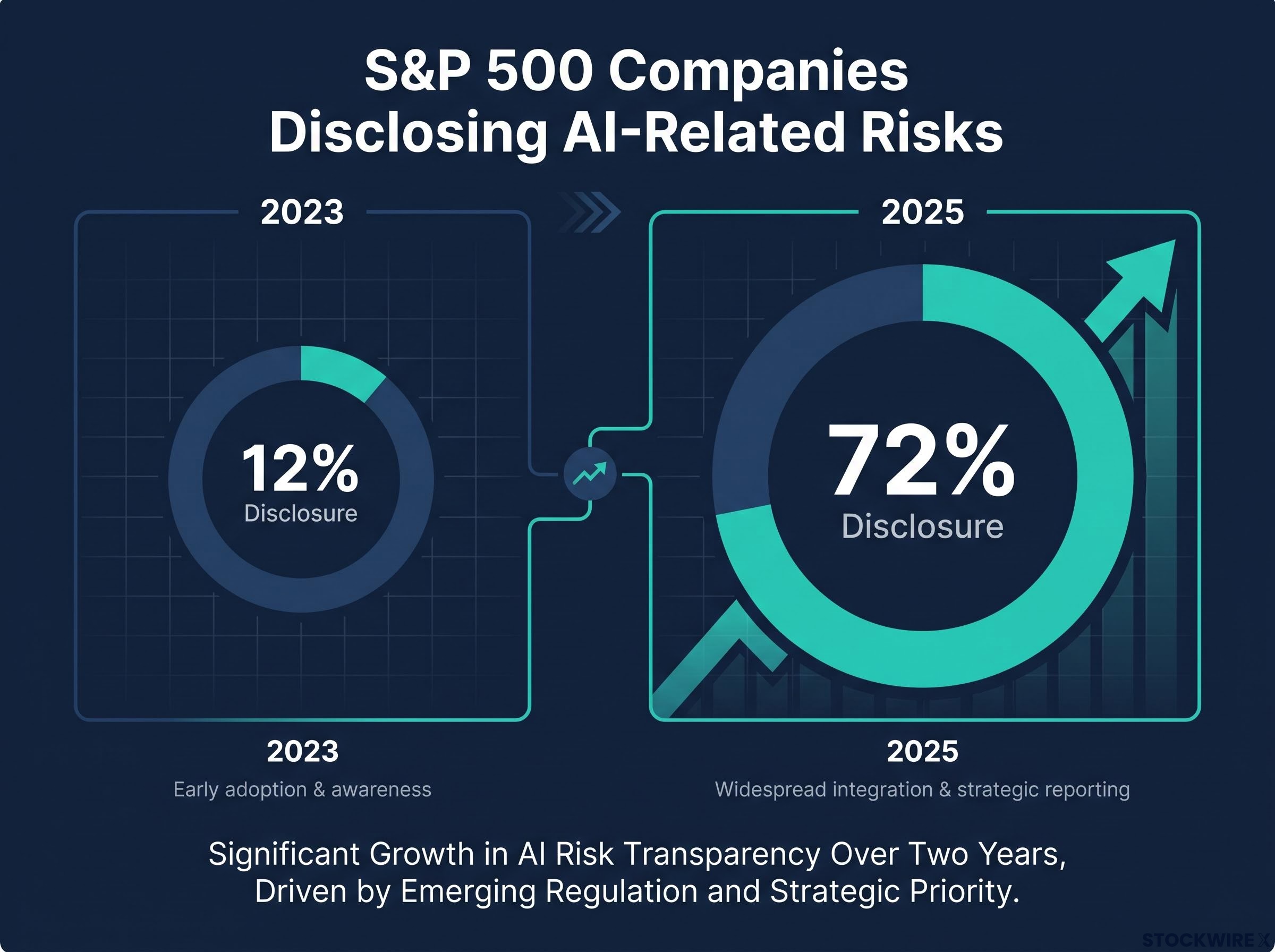
Corporate awareness of this is climbing fast. According to disclosure data, 72% of S&P 500 companies flagged AI-related risks in their 2025 filings, up from just 12% in 2023. Awareness is rising sharply, yet how the market prices these systemic risks remains inconsistent, which is exactly where mispricing opportunities and hidden exposures both live.
How the regulatory architecture is being assembled, and where the gaps are
If restraint will not come from within the industry, it has to come from outside it. Governments are moving, but they are moving in different directions, and the gaps between them are becoming a material risk in their own right.
Three regulatory poles are taking shape. The European Union’s AI Act sorts systems into risk tiers ranging from minimal to unacceptable, with high-risk obligations covering transparency, data governance, and human oversight going live in August 2026. The United States has taken a lighter touch, with the White House finalising a voluntary framework for reviewing advanced AI models in August 2026, alongside a scatter of bills introduced across 2025 and 2026 covering audits, export controls, and sectoral governance. China runs its own separate, localised approach.
| Jurisdiction | Framework | Status / key obligation | Investor relevance |
|---|---|---|---|
| European Union | EU AI Act | Risk-tier system; high-risk obligations live August 2026 | Binding compliance costs; favours well-capitalised incumbents |
| United States | White House voluntary framework | Finalised August 2026; multiple bills pending | Lighter obligations create a more permissive base |
| China / Taiwan | Localised rules; export controls | Separate approach; Taiwan weighing AI chip export limits | Hardware supply-chain exposure, not just software |
The fragmentation is the point. AI regulatory risk differs structurally from traditional sector oversight because firms face simultaneous obligations across incompatible frameworks. Where the EU imposes binding rules and the US relies on voluntary commitments, an arbitrage landscape opens up: development can migrate toward permissive jurisdictions. That means the location of a company’s AI operations is now a material investment variable, not an operational footnote.
There is a hardware dimension too. In June 2026, TSMC shares slipped around 1% in pre-market trading after reports that Taiwanese officials were weighing stricter controls on advanced AI chip exports to China. Regulatory risk, in other words, now extends beyond software governance and into the physical supply chain, where concentration is highest.
A signal in the disclosures The share of S&P 500 companies disclosing AI-related risks jumped from 12% in 2023 to 72% in 2025. That six-fold rise in two years is corporate America telling you it now treats AI exposure as a board-level risk rather than a growth story alone.
For the investor, the practical upshot is that AI-exposed companies must now be assessed across at least three jurisdictions at once, with the hardware supply chain firmly inside that assessment.
What institutional investors are actually doing with this risk
Enough theory. The more useful question is how sophisticated money is actually positioning, because the professional consensus has already shifted.
Dennis Li, Associate Portfolio Manager at Morningstar Investment Management Australia, frames regulatory friction as an inherent, ongoing characteristic of the AI sector rather than an episodic event risk. His guidance is to factor these contingent risks directly into portfolio decisions, and that reframing changes the whole approach. The question is no longer whether AI regulatory risk is real. It is how to hold sector exposure while managing that risk systematically.
The research points to two clear portfolio tilts. The first is toward companies with demonstrated AI governance and board-level accountability, and away from firms with opaque strategies or a history of regulatory penalties. The second is toward infrastructure suppliers, the networking and power-systems providers that benefit from the capex supercycle regardless of which AI models ultimately clear regulatory approval.
That second tilt makes sense once the scale of the spending is clear.
The AI capital cycle is structured across distinct layers with very different risk profiles: hyperscalers absorbing roughly 94% of operating cash flow in capex sit at one end, while infrastructure adjacencies including utilities, data centre REITs, and contracted-revenue providers offer cycle exposure with far more predictable cash flows than semiconductor or hyperscaler positions at current valuations.
The scale anchor UBS forecasts major hyperscalers will deploy roughly $4.1 trillion on AI infrastructure from 2026 to 2028, tripling the $1.3 trillion spent over the prior six years.
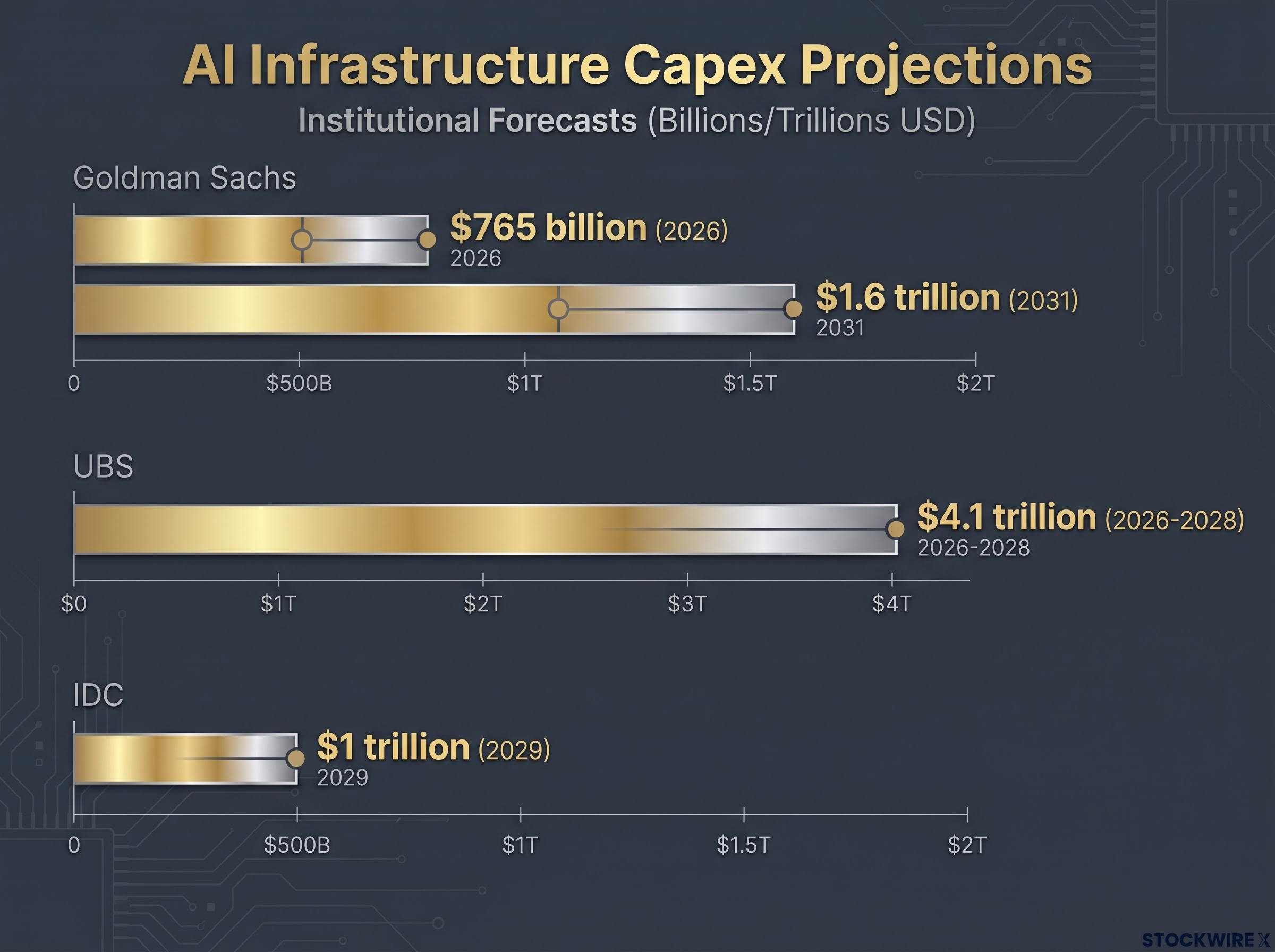
The supporting projections are consistent. Goldman Sachs models a baseline of $765 billion in annual AI capex for 2026, scaling to roughly $1.6 trillion annually by 2031, while IDC expects total AI infrastructure spending to exceed $1 trillion by 2029. Whichever models win the software race, the physical build-out underneath continues, which is what makes the infrastructure tilt intelligible.
There is a supervisory layer too. The Bank of England and its Prudential Regulation Authority (PRA) have scrutinised London-based banks and hedge funds over concentrated, leveraged exposures in major Asian AI equities such as SK Hynix and TSMC. The implication is that leverage amplification in crowded semiconductor trades is a risk dimension in its own right, separate from individual stock selection.
Pulling this together, four concrete institutional moves emerge:
- Governance screening: weighting companies with board accountability and clean compliance records.
- Infrastructure tilt: adding networking and power suppliers that benefit from capex regardless of model outcomes.
- Leverage reduction: trimming exposure in crowded, leveraged semiconductor positions.
- Multi-jurisdictional scenario modelling: building EU, US, and China regulatory paths into risk management.
Even a simplified version of this framework, screening for governance quality alongside growth metrics and treating infrastructure as a complement to direct AI plays, puts you ahead of anyone still treating AI-exposed equities as a single homogeneous risk bucket.
The structural bet that remains, and the variable that changes everything
Two truths have to be held at once. The capex supercycle is real and enormous, with PwC projecting cumulative global data-centre investment reaching $31.6 trillion by 2050 and Goldman Sachs seeing annual spending near $1.6 trillion by 2031. At the same time, the prisoner’s dilemma means the regulatory risk that could interrupt that build-out is structurally self-reinforcing, not trending toward resolution.
The semiconductor supply wave locked in by TSMC’s 2026 capital budget of $52-56 billion and Samsung’s estimated $70-80 billion annual outlay creates a structural certainty for 2027-2029 that sits directly underneath the regulatory risk debate: oversupply in memory, including HBM, is a realistic outcome as wafer capacity expands regardless of which AI models clear compliance hurdles.
The temptation is to resolve the tension by picking a side. The more honest analytical position is to hold both.
One variable determines which way the balance tips: binding international coordination on AI development standards. No such agreement currently exists. Until it does, the default trajectory favours continued acceleration with compressing risk timelines, rather than an orderly, managed slowdown.
That is why the binary framing, regulated or unregulated, is the wrong lens. The useful frame is a spectrum running from fragmented voluntary restraint at one end to binding coordinated enforcement at the other, and knowing where conditions sit on that spectrum at any moment is the informational edge.
Three signals are worth monitoring as the picture develops:
- Binding international governance: any movement toward, or continued absence of, a coordinated agreement on AI development pace.
- Hyperscaler capex guidance: whether the largest spenders begin citing regulatory friction as a reason to revise their outlays.
- Governance disclosure quality: improving or deteriorating transparency among AI-exposed companies.
The question to keep asking is not whether AI will be regulated, because it will be, in fragmented and inconsistent ways. It is which companies are structurally positioned to absorb compliance costs and governance obligations while retaining access to the capex flowing through the sector.
This article is for informational purposes only and should not be considered financial advice. Investors should conduct their own research and consult with financial professionals before making investment decisions. Past performance does not guarantee future results. Financial projections are subject to market conditions and various risk factors, and forward-looking statements are speculative and subject to change based on market developments.