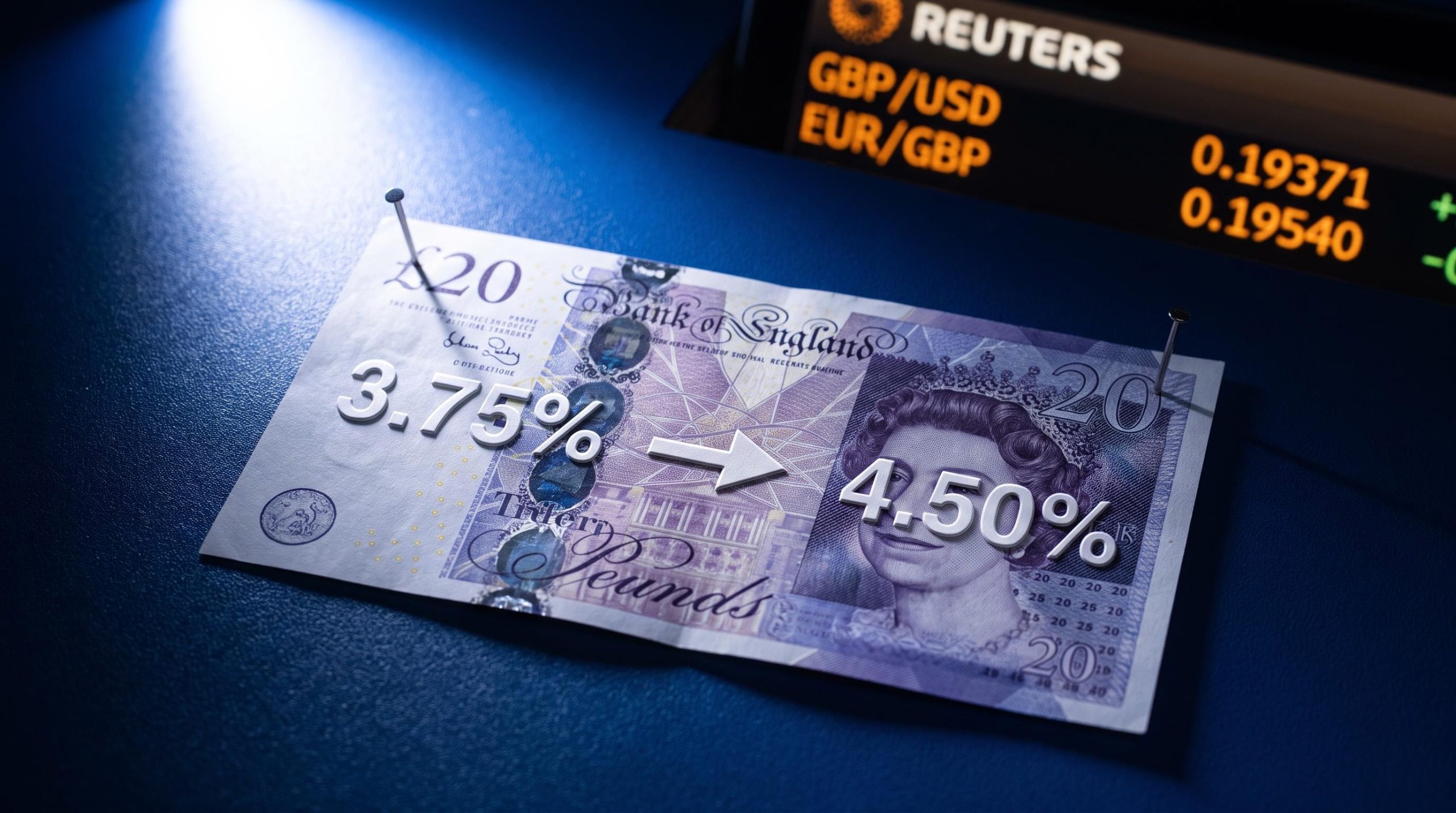
The UK swaps curve is pricing as much as 75 basis points of further Bank of England tightening, implying a terminal Bank Rate of 4.50%. There is one problem: the economy does not obviously support getting there, and analysts at Brown Brothers Harriman (BBH) argue sterling is already carrying the risk of that gap closing.
With Bank Rate at 3.75%, near the upper boundary of the BoE’s own estimated neutral range of 2-4%, the question for GBP is not simply whether the Bank will hike again. It is whether the path embedded in swaps pricing is credible given a negative output gap, modest growth, and a Labour government running fiscal consolidation.
The Bank is also about to reassess the pace of its balance sheet reduction, with BBH projecting a cut in the annual gilt rundown target from £70bn to £50bn for the year starting October 2026. Both developments carry direct implications for gilts and sterling.
This piece maps the specific gap between what markets are pricing and what UK fundamentals suggest the BoE will deliver, explains what a slowing balance-sheet-reduction programme means for gilt yields, and sets out where GBP is most exposed if analysts are right about the mispricing.
How far markets have moved on the BoE, and why the gap matters
Start with the number that structures everything else. The swaps market, where institutions bet on the future path of interest rates, is currently discounting a terminal Bank Rate of 4.25-4.50%. From today’s 3.75%, that is 50-75 basis points of additional tightening priced in over the coming year.
Now set that against what the Monetary Policy Committee (MPC) actually did. At its meeting on 29-30 July 2026, six of the nine members voted to hold, and only three preferred a 25bp increase to 4.0%. That is a committee tilted toward caution, not one embarking on the multi-hike cycle the curve implies.
The distance between those two pictures is the whole story. A 6-3 hold does not obviously lead to 4.50%.
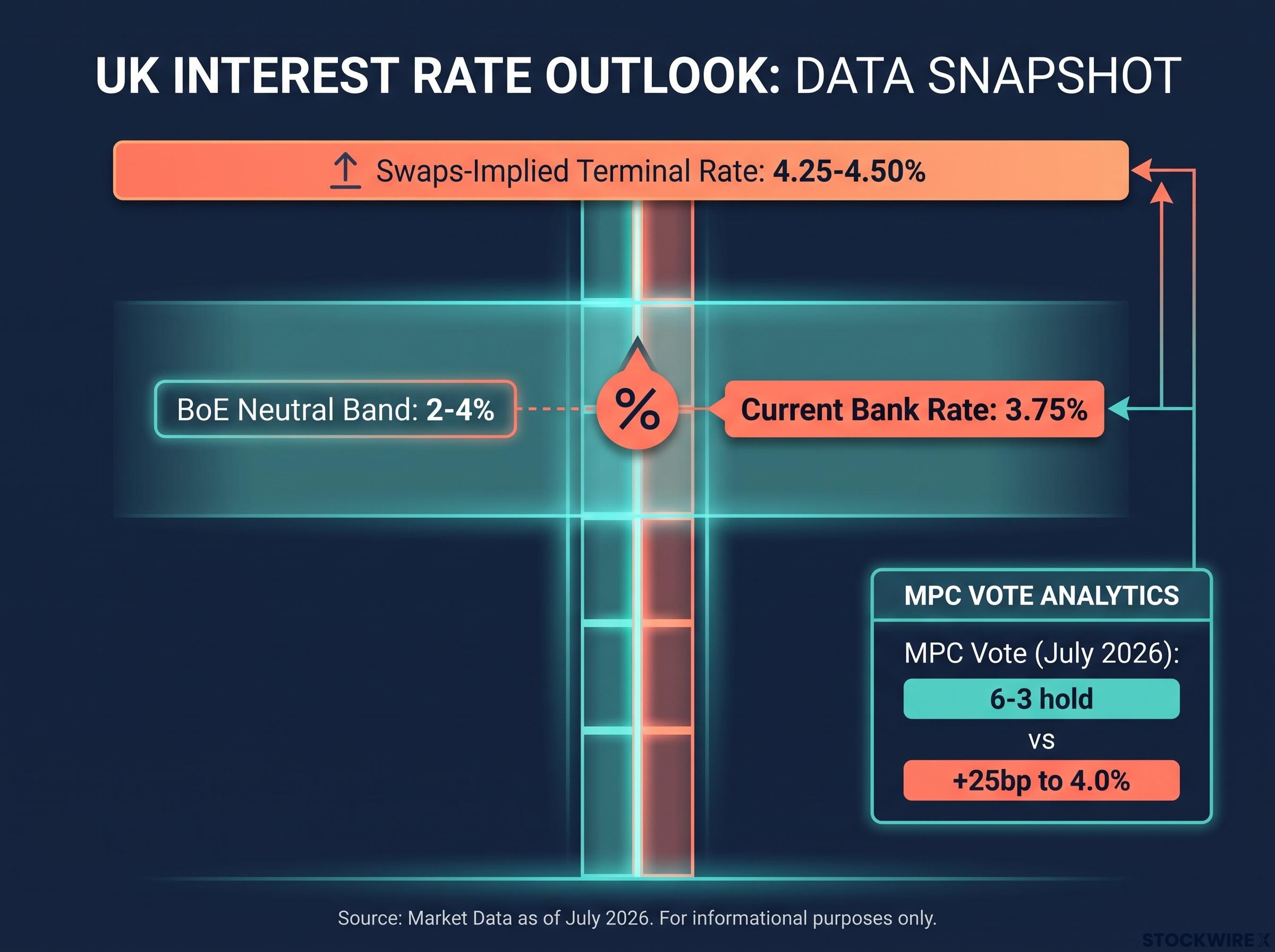
“The swaps curve implies 75 bps of tightening to 4.50%,” said Elias Haddad of BBH via FXStreet on 7 September 2026, characterising that pricing as “too aggressive” given the negative output gap and a policy rate already near the upper end of the neutral band.
Here is the mechanism that makes this a sterling problem rather than a rates footnote. When markets price aggressive hikes, GBP earns a carry and rate-differential premium: holding sterling pays more relative to other currencies. If data or BoE communication force those expectations lower, short-dated yields fall, cross-currency spreads narrow, and the long-GBP positions built on that carry story get unwound.
The rate-to-FX transmission runs through three BoE policy tools: the base rate, quantitative easing, and quantitative tightening, and each operates on sterling through a distinct channel that interacts differently with carry positioning and gilt supply.
What this tells you is that the gap between 3.75% and a priced 4.50% is not merely a forecast disagreement. It is a risk premium sitting inside sterling’s current level, and one that can drain quickly if the Bank disappoints the hawks.
| Indicator | Value | Source |
|---|---|---|
| Bank Rate | 3.75% | BoE MPC, 29-30 July 2026 |
| Swaps-implied terminal rate | 4.25-4.50% | BBH/Haddad, Sept 2026 |
| Estimated neutral band | 2-4% | BoE internal estimates |
| MPC vote split | 6-3 (hold vs +25bp) | BoE Minutes, July 2026 |
Whether that carry premium is durable is the first question any GBP holder needs to answer, and the answer depends on what the UK economy actually looks like.
When big ASX news breaks, our subscribers know first
What the UK economy actually looks like right now
Look at each variable in turn, because the case against aggressive hikes is built from the accumulation, not from any single alarming figure.
Growth first. The Office for National Statistics (ONS) reported real GDP up 0.4% quarter-on-quarter in Q2 2026, and July 2026 delivered another 0.4% monthly expansion. Zoom out and the annual trajectory reads 1.0% in 2024 rising to 1.3% in 2025. That is positive and steady, not an economy running hot.
Inflation next. Both headline and core CPI sat at 2.6% in July 2026, according to the ONS, having eased from a CPIH reading of 3.4% in March 2026. The BoE’s own July 2026 Monetary Policy Report projects a renewed uptick toward a peak of roughly 3.2% in Q4 2026, driven largely by energy prices.
The BoE July 2026 Monetary Policy Report sets out the MPC’s central projection for inflation peaking near 3.2% in Q4 2026 and frames the energy-price dynamics the committee identified as the primary driver of that anticipated uptick.
Here is the snapshot in one place:
- GDP: +0.4% q/q (Q2 2026); +0.4% m/m (July 2026); 1.3% annual in 2025
- CPI: 2.6% headline and core (July 2026), projected to peak near 3.2% in Q4 2026
- Output gap: -0.7% of potential (OBR); -1.5% to -1.7% (BBH/BoE estimates)
Governor Andrew Bailey himself signalled discomfort with the hawkish end of market pricing. Speaking to City AM on 8 April 2026, he said traders were “getting ahead of themselves” in pricing several rate hikes.
The hawkish MPC bloc has grown from a single dissenter in April 2026 to three members by July, with Pill, Greene, and Mann all voting for an immediate move to 4%, and five-year swap rates have already crossed 4.52% in response, lifting mortgage costs before any official decision arrives.
The output gap and its implications for the hiking cycle
The third variable deserves its own treatment, because it is conceptually distinct and often misunderstood. The output gap is the difference between what the economy is actually producing and what it could produce at full capacity. When it is negative, the economy has spare capacity: unused labour and idle plant.
That matters for monetary policy because a negative output gap implies disinflationary pressure building from below. Spare capacity tends to pull prices down over time, which limits how far a central bank needs to raise rates to return inflation to target.
The estimates vary. The Office for Budget Responsibility (OBR) put the gap at -0.7% of potential output for 2026-27 in its April 2026 forecast, while BBH cites wider BoE-referenced estimates of -1.5% to -1.7%. The exact figure is contested, but the direction is not, and it links straight back to Haddad’s point: with Bank Rate already near the top of the 2-4% neutral band, spare capacity is a reason for restraint, not acceleration.
Put the growth, inflation and output gap data together and you arrive somewhere specific. An economy expanding at 0.4% a quarter, with headline inflation tracking the Bank’s own forecast and a negative output gap, is not one that standard analysis says demands another 75bp of tightening. That disconnect is precisely why analysts describe GBP as overexposed, and it sets the ceiling on how far the Bank is likely to go regardless of the swaps curve.
The QT slowdown: mechanical adjustment or meaningful policy signal?
The Bank’s balance sheet reduction is the second thread, and it needs to be read on two levels. The surface question is whether the annual target falls. The deeper question is whether that fall changes anything for gilt markets.
Start with the surface. Quantitative tightening (QT) is the process of reversing years of bond-buying by shrinking the Bank’s gilt holdings, partly by letting bonds mature and partly through active sales. The current target is £70bn for October 2025 to September 2026, itself already reduced from £100bn the prior year. BBH projects a further cut to £50bn for October 2026 to September 2027, which would make it the second consecutive year of slowing.
Now the substance, and this is where the intuition breaks. BBH’s own reasoning is that scheduled gilt maturities over that period total roughly £30.5bn. Subtract those from a £50bn target and only around £20bn of active gilt sales remain. That active-sales figure is roughly unchanged from the current programme.
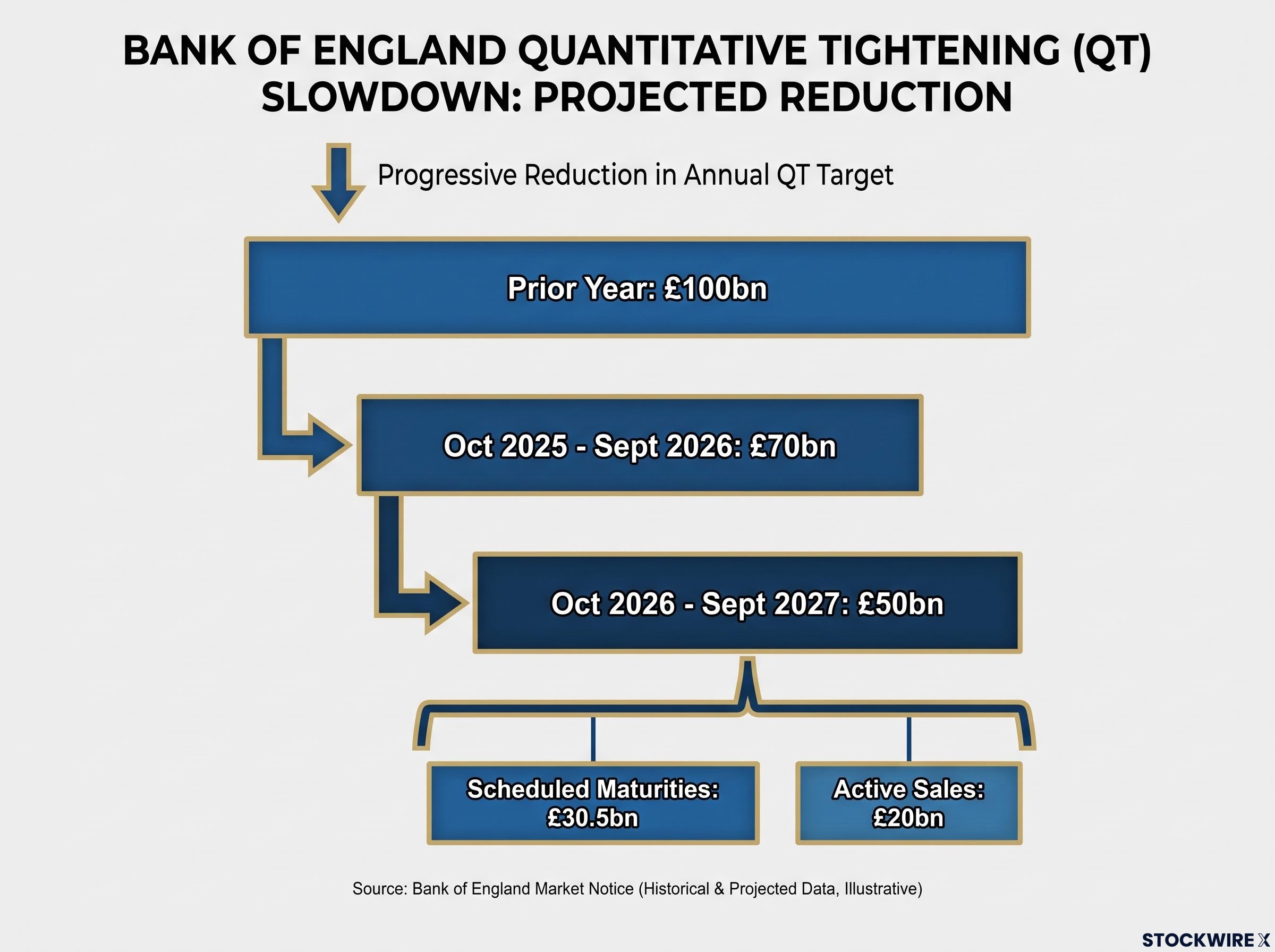
In other words, the headline pace is falling largely because fewer bonds happen to be maturing, not because the Bank has decided to pull back. BBH frames the adjustment as “largely mechanical” rather than a change in policy stance.
That distinction matters for what a lower number does to yields, and the estimates diverge sharply:
| Institution | Maturity focus | Estimated impact |
|---|---|---|
| BoE / Ramsden | 10-year | ~25bp |
| NIESR | Beyond 1-year | 44-70bp |
| Morgan Stanley | 30-year | ~70bp |
| Goldman Sachs AM | Announcement effect | 10-20bp |
Deputy Governor Dave Ramsden’s most recent evidence, cited in September 2026 coverage, places QT’s cumulative upward pressure on 10-year gilt yields at approximately 25bp, the official anchor against which the higher external estimates should be read.
Goldman Sachs Asset Management goes further, arguing the peak headwind from QT on gilt yields is already behind the market. What this tells you is that the reduction to £50bn, if confirmed, says less about the Bank’s intent than the headline figure suggests. Because active sales barely move, gilt investors should not read a lower pace number as a meaningful dovish pivot on balance-sheet policy, even if the difference between a 25bp and a 70bp yield effect is far from trivial at the long end.
Where GBP is most exposed if the repricing comes
Bring the two threads together. If the Bank delivers fewer hikes than the curve embeds, or delays them, sterling loses the carry premium that hawkish pricing built in. The rates story and the FX story are the same story.
This is not hypothetical. The channel already operated once this year. ING noted in March 2026 that two-year GBP swap rates jumped 50bp after the Iran conflict as investors priced out easing, a move ING itself described as an overreaction. Rates repriced, sterling moved, and the mechanism ran in real time.
It can run in reverse just as fast. Francesco Pesole of ING, in an EUR/GBP strategy note on 25 August 2026, said he expects no hikes at all, and that a dovish repricing of the GBP front end “should push EUR/GBP up toward 0.87.” A higher EUR/GBP means a weaker pound.
Sterling’s technical positioning added a further layer to the fundamental picture: after July CPI locked in roughly 25 basis points of December tightening, GBP/USD reached its strongest level since February near 1.3639 with the daily RSI crossing into overbought territory at 70.49, a configuration that historically precedes consolidation rather than continuation.
Haddad has been blunter still, describing GBP as “overexposed” to a tightening path UK fundamentals are unlikely to deliver, and warning in May 2026 that a downward adjustment to the swaps curve “can further undermine GBP.”
The lesson from March is that the rate-to-FX channel is live and moves quickly. GBP holders do not get a long window to reposition once incoming data prompt the Bank to push back on aggressive pricing.
Three triggers that could crystallise the GBP risk
For anyone assessing sterling exposure, whether through direct currency positions, UK gilts or equities with currency sensitivity, these are the concrete calendar events to watch:
- The next BoE policy meeting. Any communication from the MPC pushing back on the scale of hikes priced into the swaps curve would be the first, and fastest, catalyst for a repricing lower.
- The Q4 2026 CPI print. Measured against the Bank’s central forecast peak of roughly 3.2%, an outcome at or below that level removes the most visible inflationary justification for the aggressive end of the priced path.
- The October 2026 QT announcement. Confirmation of the £50bn target clarifies whether the pace change really is mechanical, with limited market impact, or arrives with a shift in policy language that markets read more broadly.
The mispricing case in full, and what it leaves unresolved
The hawkish case is not baseless, and honest analysis has to say so. Energy prices are expected to push CPI toward 3.2% in Q4 2026, with the BoE attributing roughly 0.4 percentage points of H2 2026 inflation to energy. Wage growth remains just below 4%, according to the British Chambers of Commerce, which flags the wage-energy interaction as a genuine persistence risk. KPMG’s July 2026 outlook similarly sees inflation staying above the 2% target across the coming year.
So the debate is not closed. If energy shocks or wage dynamics prove stickier than the Bank’s central case assumes, the hawkish end of the curve gains credibility.
But weigh the two cases against each other and the asymmetry becomes clear.
The bullish GBP case requires the Bank to deliver the full 50-75bp of hikes embedded in the curve, a significant departure from current fundamentals. The bearish case requires only that the Bank delivers roughly what its own 6-3 vote split and macro commentary already imply.
That asymmetry is what makes the risk meaningful. Sterling does not need a BoE capitulation or a recession to reprice lower. It needs only a modest disappointment relative to elevated expectations, with a negative output gap (OBR at -0.7%, BBH/BoE at -1.5% to -1.7%) reinforcing the disinflationary pull beneath it.
For anyone positioning around GBP, the exercise is about probability against a priced path, not predicting an extreme outcome. On the weight of current analysis, the priced path looks like the tail scenario, not the base case.
For investors wanting to situate the BoE mispricing risk within the broader fiscal picture, our full explainer on fiscal credibility and sterling examines how gilt yield spreads against Germany, rather than absolute yield levels, separate domestic credibility risk from the global yield moves that have driven UK and US 10-year yields on an almost identical arc through H1 2026.
This article is for informational purposes only and should not be considered financial advice. Investors should conduct their own research and consult with financial professionals before making investment decisions. Past performance does not guarantee future results. Financial projections are subject to market conditions and various risk factors, and forward-looking statements are speculative and subject to change based on market developments.