
Here is a fact most people never question: when a central bank says inflation expectations are “well anchored,” a meaningful part of that judgement rests on surveys asking ordinary consumers what they think prices will do next, and some of those consumers may be answering based on a video they scrolled past this week.
That assumption is now being challenged directly. UBS Chief Economist Paul Donovan has published research arguing that the survey data central banks lean on has been degraded by social media noise, collapsing response rates, and increasingly tribal politics, to the point where much of it may be signal-free.
This is not a purely academic quarrel. How a central bank weights different inflation signals feeds straight into rate decisions, and rate decisions shape your borrowing costs, the value of your assets, and the returns on your portfolio.
By the time you finish this, you will know what market-based inflation expectations actually are, why UBS believes they should displace consumer surveys in the way central banks set policy, and where the serious counterarguments sit, so you can weigh the debate yourself instead of taking either side’s word for it.
What are market-based inflation expectations and how are they built?
If you pull up a chart on the Federal Reserve Bank of St. Louis data service (FRED), you will find a series called T5YIFR sitting at 2.32% as of 11 September 2026. That single number is a market-based inflation expectation, and understanding what stands behind it changes how you read almost every inflation headline.
Before diving into complex forward rates, cementing your grasp of how inflation erodes purchasing power will clarify why central banks go to such lengths to track and manage these expectations.
Market-based inflation expectations are the inflation rate implied by prices in financial markets, rather than by asking anyone a question. There are two main ways this number gets built.
The first is the breakeven rate, drawn from the price gap between a conventional government bond and an inflation-linked bond of the same maturity. In the United States, these are TIPS (Treasury Inflation-Protected Securities), and the difference in yield between a normal Treasury and a TIPS gives you the inflation rate investors are effectively pricing in.
The second is the inflation-linked swap, a contract where one party pays a fixed rate and receives actual inflation in return. The fixed rate in that contract is the market’s inflation expectation, and it is the primary gauge in the euro area.
Here is what separates these from a consumer poll: every one of these figures comes from a trade where real money is on the line. Proponents such as Donovan argue that a number extracted from people betting capital is more behaviourally grounded than a number extracted from people expressing an opinion with nothing at stake.
Below are the two instrument families side by side.
- TIPS breakevens (United States): derived from the yield gap between conventional Treasuries and inflation-linked Treasuries; the Fed watches the T5YIFR forward series; currently 2.32% (daily) and 2.31% for August 2026 (T5YIFRM).
- Inflation-linked swap rates (euro area): derived from the fixed rate in inflation swap contracts; the ECB’s primary long-run gauge is the five-year forward rate five years ahead, at approximately 2.2% as of March 2025.
The live benchmark The FRED T5YIFR series read 2.32% on 11 September 2026. This is the market-based anchor the Federal Reserve monitors, not a poll of shoppers.
What that 2.32% tells you is specific: sophisticated investors committing real capital currently expect inflation to run slightly above the Fed’s 2% target over the medium term. That is the figure sitting at the centre of the Fed’s market-based read on where inflation is heading.
The 5-year, 5-year forward convention explained
You may wonder why central banks fixate on a “five-year forward” rate beginning five years from now rather than a simpler ten-year figure. The reason is filtering. The forward structure strips out near-term noise, such as this year’s energy prices or a temporary supply shock, and isolates the horizon by which a central bank should have restored price stability.
So the 2.32% reading is not a forecast for inflation this year. It is a market verdict on where inflation will settle in the mid-2030s, which is precisely the horizon a policymaker cares about most.
When big ASX news breaks, our subscribers know first
Why UBS says consumer surveys have lost their signal
Donovan’s argument starts from one deceptively simple test: an inflation expectation only matters if the person holding it has the power to act on it. Run every survey population through that filter, and the picture shifts.
Consider what it takes for a consumer’s expectation to actually move inflation. The household must hold enough wage bargaining leverage to demand higher pay, or must change spending in anticipation of rising prices. Absent that power, the expectation stays a feeling and never becomes economic behaviour.
Now layer on how those feelings are formed. In a UBS CIO paper titled “Are inflation expectations irrelevant?” (updated 2026), Donovan describes a survey environment “sensationalized by social media and polarized by deeply tribal politics.” Feeds full of price complaints amplify the sense that inflation is worse than the data show.
You must also account for the growing partisan bias in economic surveys, where respondents increasingly align their financial outlook with political identity rather than objective household conditions.
Then add a second, quieter problem: response rates are collapsing. Fewer people answer surveys, and the ones who do may be less representative of the wider population, which thins out the informational content of the aggregate. Donovan has pointed to divergences in the University of Michigan consumer inflation expectations, cited in his notes “Precious opinions” (29 July 2026) and “Marshmallows and monetary policy” (28 August 2026), as evidence that surveys are drifting away from actual pricing and behaviour.
Corporations sit in a parallel bind. A firm’s inflation expectation only matters if the business has the pricing power to raise prices or the leverage to change cost strategy. Donovan’s assessment is that at the current juncture, companies lack sufficient pricing power for their expectations to carry real economic consequence.
The behavioural test UBS summarises Donovan’s position bluntly: “inflation expectations are meaningless noise unless people have the power to act upon them.”
Here is how the three tiers of expectation-holders rank under that test.
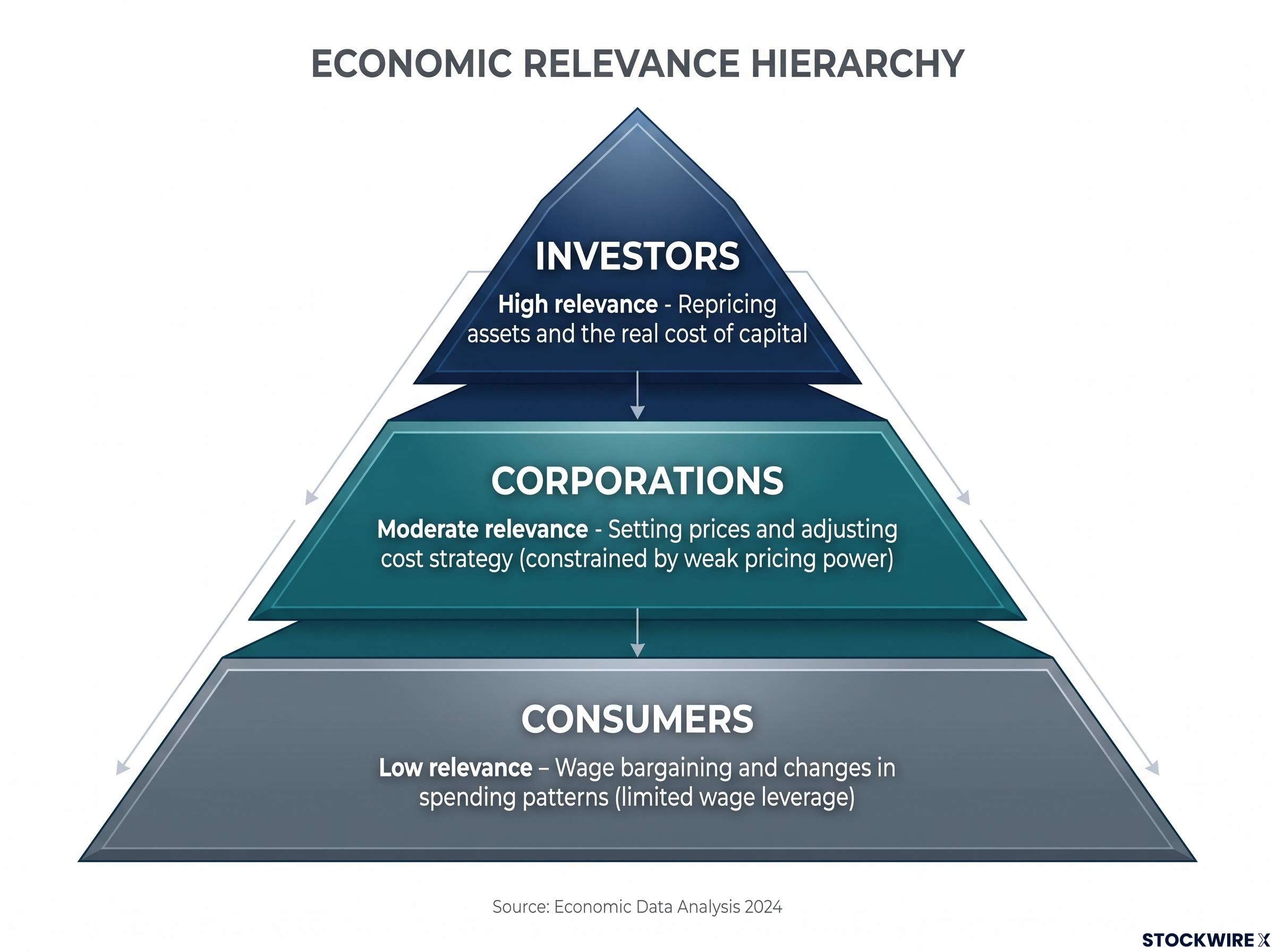
- Consumers: act through wage demands and spending shifts; ranked lowest right now because they lack the bargaining leverage to convert anxiety into action.
- Corporations: act through pricing and cost strategy; ranked in the middle, constrained by weak pricing power at present.
- Investors: act through repricing assets and the cost of capital; ranked highest because they can move fastest and widest.
| Group | Mechanism for acting on expectations | UBS assessment of current relevance |
|---|---|---|
| Consumers | Wage bargaining and changes in spending patterns | Low; limited wage leverage at present |
| Corporations | Setting prices and adjusting cost strategy | Moderate; constrained by weak pricing power |
| Investors | Repricing assets and the real cost of capital | High; fastest and broadest capacity to act |
The practical upshot for you is a filter. When a hot University of Michigan reading lands, do not treat it as an automatic hawkish signal. Ask first whether the people answering can actually turn their anxiety into wage demands or spending shifts. If they cannot, the number may be noise dressed as a warning.
What inflation markets get wrong: the case against treating prices as pure signals
Before you conclude that market-based measures win by default, it is worth walking through why the numbers on your screen are not clean expectations either. The distortions build on each other.
Start with the most intuitive problem. A raw TIPS breakeven or swap rate is not a pure expectation; it embeds an inflation risk premium, which is the extra compensation investors demand for the uncertainty of future inflation. Buyers want to be paid for the risk of being wrong, and that payment sits inside the quoted rate.
TIPS carry a second distortion on top: a liquidity premium, because inflation-linked bonds trade less freely than conventional Treasuries. Fed and IMF research shows that failing to strip out these premia leads to a sizeable understatement of the true inflation outlook, especially during periods of financial stress.
The scale is not trivial. A U.S. Bureau of Labor Statistics analysis of the Treasury Breakeven Inflation curve found unadjusted breakevens can deviate from actual inflation by up to 80 basis points at shorter horizons and up to 55 basis points at longer horizons, driven partly by these premia effects.
You must also consider how active Treasury yield suppression strategies manipulate these curves, often breaking the traditional link between commodity prices and breakeven inflation rates.
Then there is index mismatch. A Bank of England Staff Working Paper (No. 551) argues that UK breakeven rates cannot be read as forecasts of CPI inflation, because they reference RPI, a different and generally higher inflation index, introducing a systematic bias relative to what the central bank actually targets.
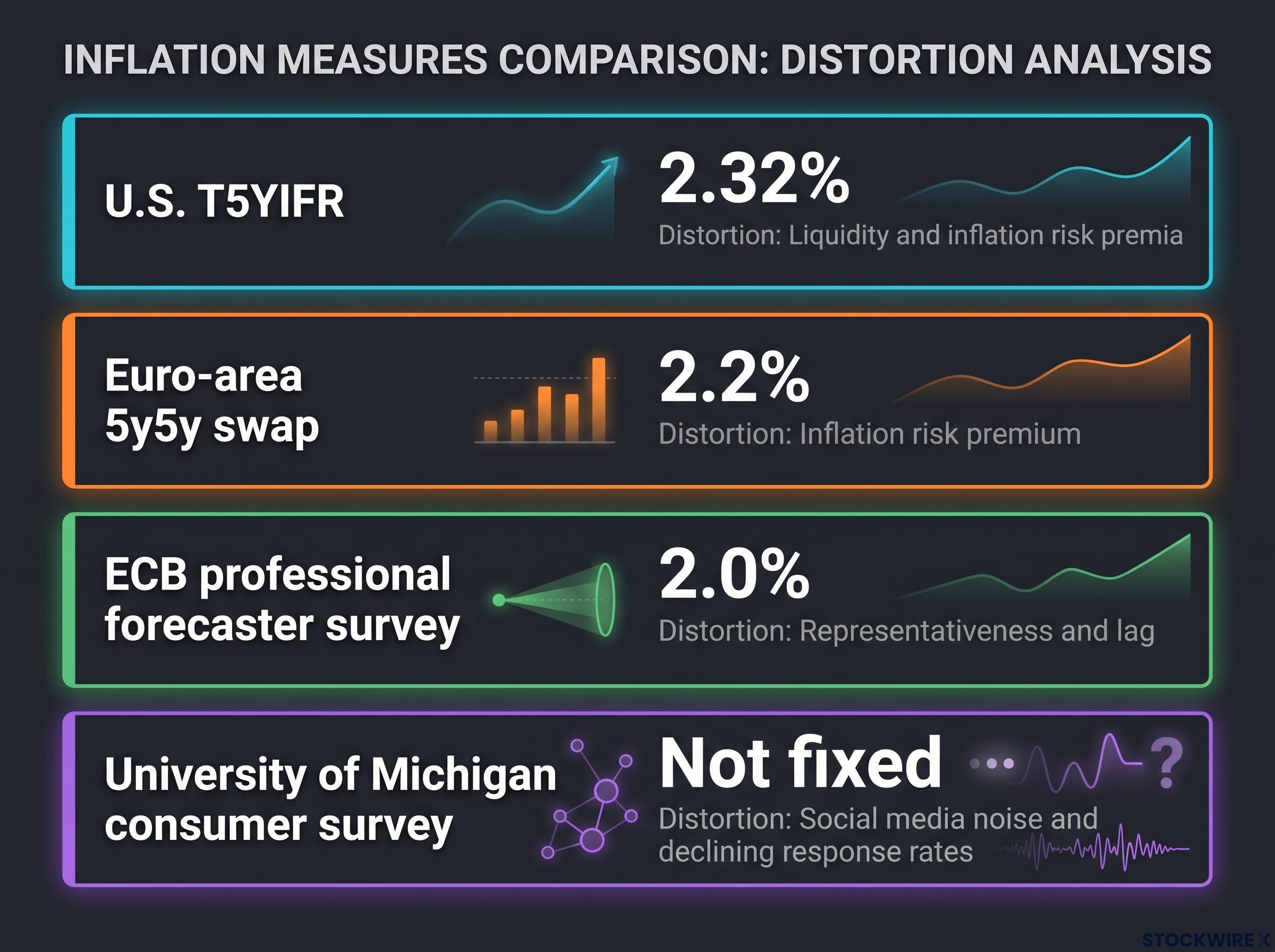
The table below shows the four measures side by side, with what each one hides.
| Measure | Current value | Key distortion to adjust for |
|---|---|---|
| U.S. T5YIFR | 2.32% | Liquidity and inflation risk premia |
| Euro-area 5y5y swap | 2.2% | Inflation risk premium |
| ECB professional forecaster survey | 2.0% | Representativeness and lag |
| University of Michigan consumer survey | Not fixed | Social media noise and declining response rates |
To turn a raw breakeven into a genuine expectation, a researcher performs three steps in sequence.
- Remove the liquidity premium embedded in the inflation-linked instrument.
- Remove the inflation risk premium that compensates investors for uncertainty.
- Align the result to the inflation index the central bank actually targets.
This reframes a number you might otherwise misread. The 20 basis point gap between the euro-area 5y5y swap rate (2.2%) and the ECB’s professional forecaster survey (2.0%) is not evidence that markets expect more inflation than economists. It is largely compensation for the risk of being wrong, which means the two measures are far closer in substance than the headline gap suggests.
If adjusted market prices just mirror professional forecasters, what are they adding?
This is where the counterargument reaches its sharpest point. Jesper Nielsen, in an ECB forum paper titled “Limitations to the role of inflation expectations in monetary policymaking: A markets’ perspective,” concludes that once market prices are properly adjusted for liquidity and risk premia, they become “little more than a weighted average of the forecasts by private-sector professional forecasters.”
Sit with that implication for a moment. The elaborate machinery of the TIPS and swap markets may, after adjustment, simply re-encode what a smaller group of economists could have told you directly.
This does not invalidate market-based measures. It repositions them: as a real-time, high-frequency cross-check on professional forecasts, rather than as an independent source of information. For you as an investor, that means a widening gap between market rates and survey expectations is not automatically a sign inflation is being repriced. Ask first whether risk appetite has shifted, because that is a different question with very different implications.
How the Fed and ECB actually use these measures today, and what UBS wants changed
Set the current practice of central banks next to the UBS recommendation and a clear gap opens up. Neither the Fed nor the ECB gives either measure type formal primacy. Donovan wants exactly that hierarchy imposed.
The Fed treats the two as partners. Governor Adriana Kugler, in her 2 April 2025 speech “Inflation Expectations and Monetary Policymaking,” said she “closely monitors” survey measures precisely because they complement market-based indicators that are affected by “dynamics intrinsic to financial markets such as changes in risk premia.”
Governor Kugler’s April 2025 speech on inflation expectations sets out the Fed’s reasoning directly: survey measures are monitored precisely because they capture dynamics that financial markets can obscure, including shifts in household sentiment that do not yet appear in pricing data.
The authoritative statement of the current position Chair Jerome Powell, on 22 August 2025, said that “measures of longer-term inflation expectations, as reflected in market- and survey-based measures, appear to remain well anchored and consistent with our longer-run inflation objective of 2 percent.”
The ECB tilts slightly differently. Its Economic Bulletin Issue 8 (January 2025) noted that “most measures of longer-term inflation expectations stand at around 2%,” treating professional forecaster surveys as the anchor and applying risk-premia adjustments to swap rates before reading them as informative cross-checks.
UBS wants to replace this balance with a behavioural filter. Under Donovan’s framework, the central bank should identify which expectation-holder group currently has the capacity to act, and give that group’s expectations the primary weight. At the moment, that points to investors, who can reprice both asset valuations and the real cost of capital across the entire economy faster than consumers can change wages or firms can change prices.
The three positions sit as follows.
| Institution / analyst | Primary anchor for long-run expectations | Role given to market-based measures |
|---|---|---|
| Federal Reserve | Both survey and market measures, no formal primacy | Complementary evidence, weighed jointly |
| European Central Bank | Professional forecaster surveys at 2% | Model-adjusted cross-check after removing risk premia |
| UBS / Donovan | Whichever group can currently act; investors now | Primary, because investors reprice capital fastest |
Economists flag three specific risks if central banks lean too hard toward market-based measures.
- Overreaction to liquidity-driven volatility: market prices swing on risk sentiment and technical flows, not just inflation fundamentals.
- Systematic underestimation during stress: when liquidity premia spike, breakevens can understate true expectations, tempting policymakers to run tighter than warranted.
- Pro-cyclical feedback loops: markets price central bank actions, central banks react to those prices, and asset prices become more sentiment-driven.
The Fed and ECB insistence on treating both measure types as complementary is a deliberate hedge against the individual weaknesses of each. But if Donovan is right that consumer surveys have become systematically noisy, that hedge may now be amplifying bad signals rather than cancelling them.
For you, the practical stake is which data releases move markets most. A regime that leaned harder on investor-derived gauges would make TIPS auction results and swap-rate moves more market-moving, and Michigan consumer sentiment relatively less so.
Whether this debate gets resolved depends on what central banks decide to measure
The tension here is genuine, and it does not resolve cleanly in either direction. Market-based expectations are more behaviourally grounded and update in real time, but they need substantial adjustment before anyone can interpret them. Consumer surveys are simpler and longer-running, but may now be structurally noisier than they were before social media reshaped how people form views on prices.
The question neither side has fully answered is a threshold question: at what point does the degradation of survey quality become severe enough to justify a formal change in how central banks weight the two measure types, and who gets to decide that line has been crossed?
Nielsen’s finding is worth holding onto here, because it complicates the simple market-versus-survey framing. Once adjusted, market prices and professional forecasts substantially overlap, which suggests the two camps are arguing over a narrower gap than the headlines imply.
Donovan himself adds a caution that cuts both ways: a divergence between investors’ macroeconomic inflation outlook and borrowers’ firm-level inflation experience could constrain investment activity. That is the risk of getting the weighting wrong in either direction.
For a retail investor, the honest signal of where central banks move next is not any single indicator. It is the direction of travel across all of them at once. When surveys, swaps, and professional forecasts diverge, that divergence is itself the information.
Because these policy shifts dictate overnight borrowing costs across the economy, any change in how central banks interpret data will immediately alter how interest rate decisions reprice the assets in your portfolio.
Three things are worth monitoring as leading indicators of any shift in how central banks weight these measures.
- The language the Fed and ECB use around survey measures in post-meeting statements and speeches.
- Divergences between the T5YIFR and consumer survey readings.
- TIPS auction demand, as a proxy for how much conviction investors hold in the market-based measure.
If the Fed begins publicly discounting Michigan survey readings, or the ECB formally narrows its framework toward professional forecaster anchors, those shifts will show up in language before they appear in rate decisions. Watching for them puts you a step ahead of the headline.
This article is for informational purposes only and should not be considered financial advice. Investors should conduct their own research and consult with financial professionals before making investment decisions.
Past performance does not guarantee future results, and any references to future policy direction are speculative and subject to change based on economic developments and central bank decisions.