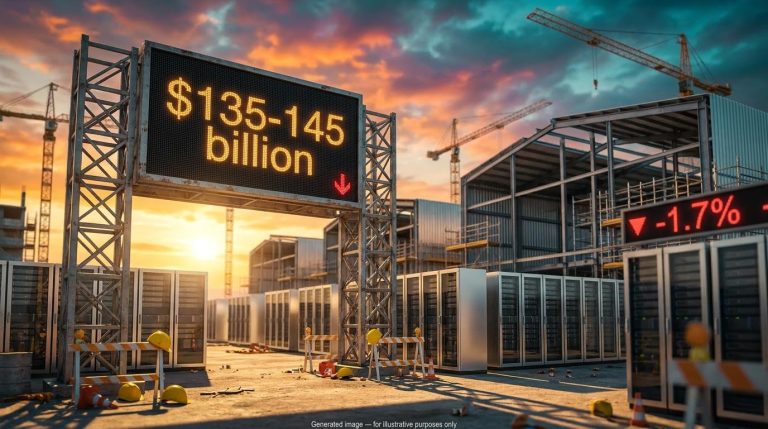
Australia’s data center market has attracted more capital in the past three years than in the prior two decades combined. That is not a disputed claim; the construction figures confirm it. Yet the most important question for investors is not whether demand is real. It is whether the capital flooding in will prove to be too much of a good thing.
Artificial intelligence and cloud adoption have repositioned Australia from a secondary regional market to a globally strategic infrastructure node. Sovereign wealth funds, hyperscalers, and listed operators are running simultaneous build programmes across Sydney, Melbourne, Brisbane, and Perth. NextDC, the dominant domestic neutral operator, is the primary lens through which ASX-listed investors access this theme, and its expansion pipeline alone tells you the scale of conviction behind the thesis.
Here is a structured way to assess both sides of the argument before committing capital. The demand case is genuinely strong, but so is the risk stack. What follows is designed to surface the specific assumptions the bull case depends on, and name the variables that would most damage returns if they disappoint.
What is actually driving demand, and how durable is it?
Three structural drivers underpin the capacity build-out, and they are distinct from one another in ways that matter for forecasting durability:
- AI workloads: Training and inference for large language models and enterprise AI applications require sustained, high-density compute capacity that did not exist at scale five years ago.
- Cloud migration and multi-cloud interconnection: As businesses shift workloads to cloud-based services, they require simultaneous access to several providers at once. A co-located facility delivers that connectivity with greater speed, security, and efficiency than alternatives.
- Data sovereignty: Australian regulatory requirements increasingly mandate that certain categories of data remain onshore, creating demand that cannot be served from Singapore or Tokyo.
The capacity trajectory confirms this is a generational shift, not a cyclical uplift. Live power capacity has grown from roughly 37MW in 2005 to approximately 1.3GW in 2025, with two-thirds of that growth concentrated since 2020. Revenue estimates across multiple research houses place the market broadly in the USD 7-8 billion range in the mid-2020s, with forecasts to 2030-2031 suggesting mid-single to low-double-digit annual growth depending on methodology.
To put this domestic growth into perspective, international investment banks have recently doubled their baseline projections for global data centre capacity as hyperscalers commit trillions of dollars to securing long-term power.
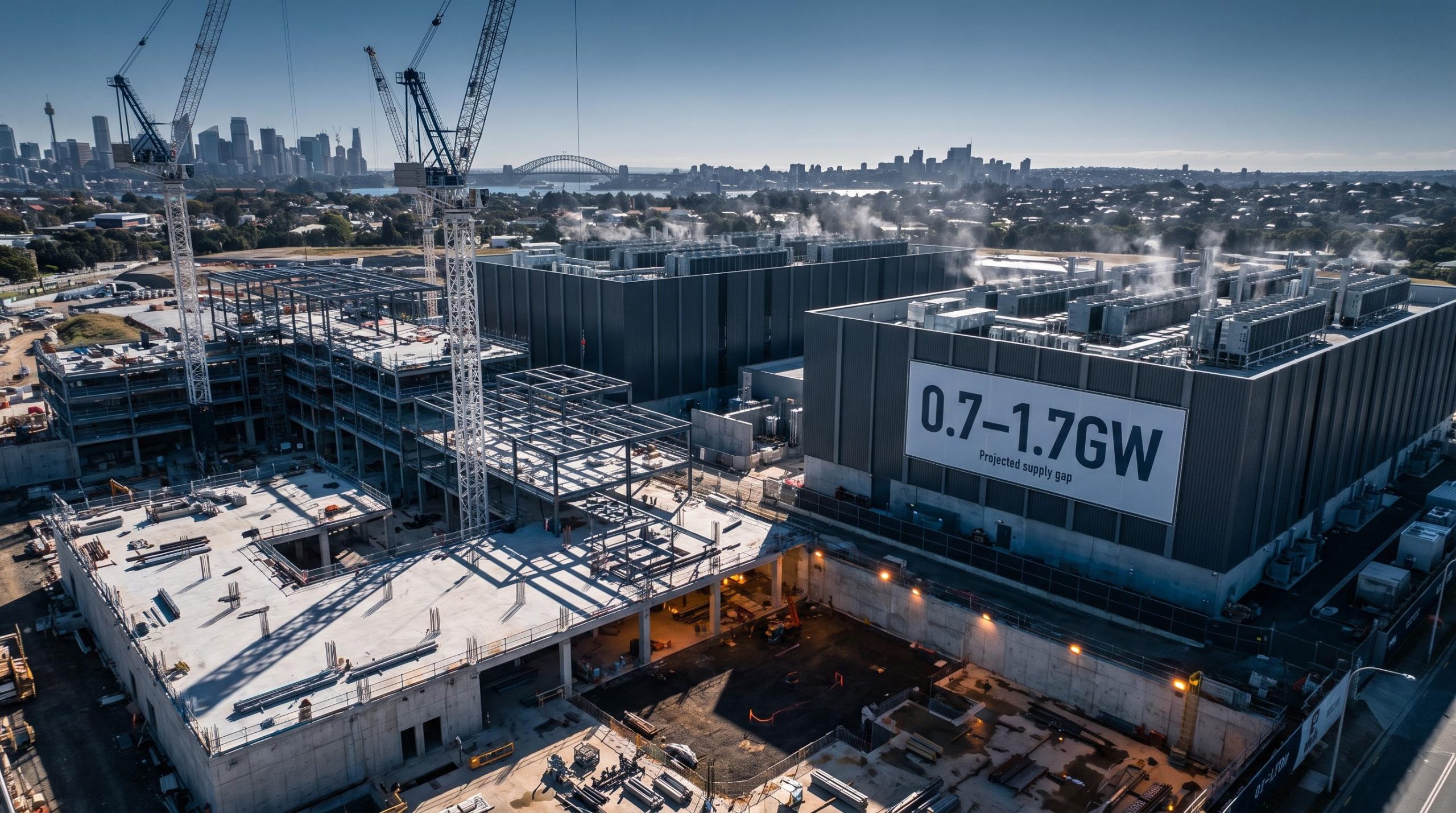
CBRE projects live capacity rising from roughly 1.3-1.4GW in 2025 to approximately 1.8GW within three years, yet still leaving a projected supply gap of 0.7-1.7GW by 2028.
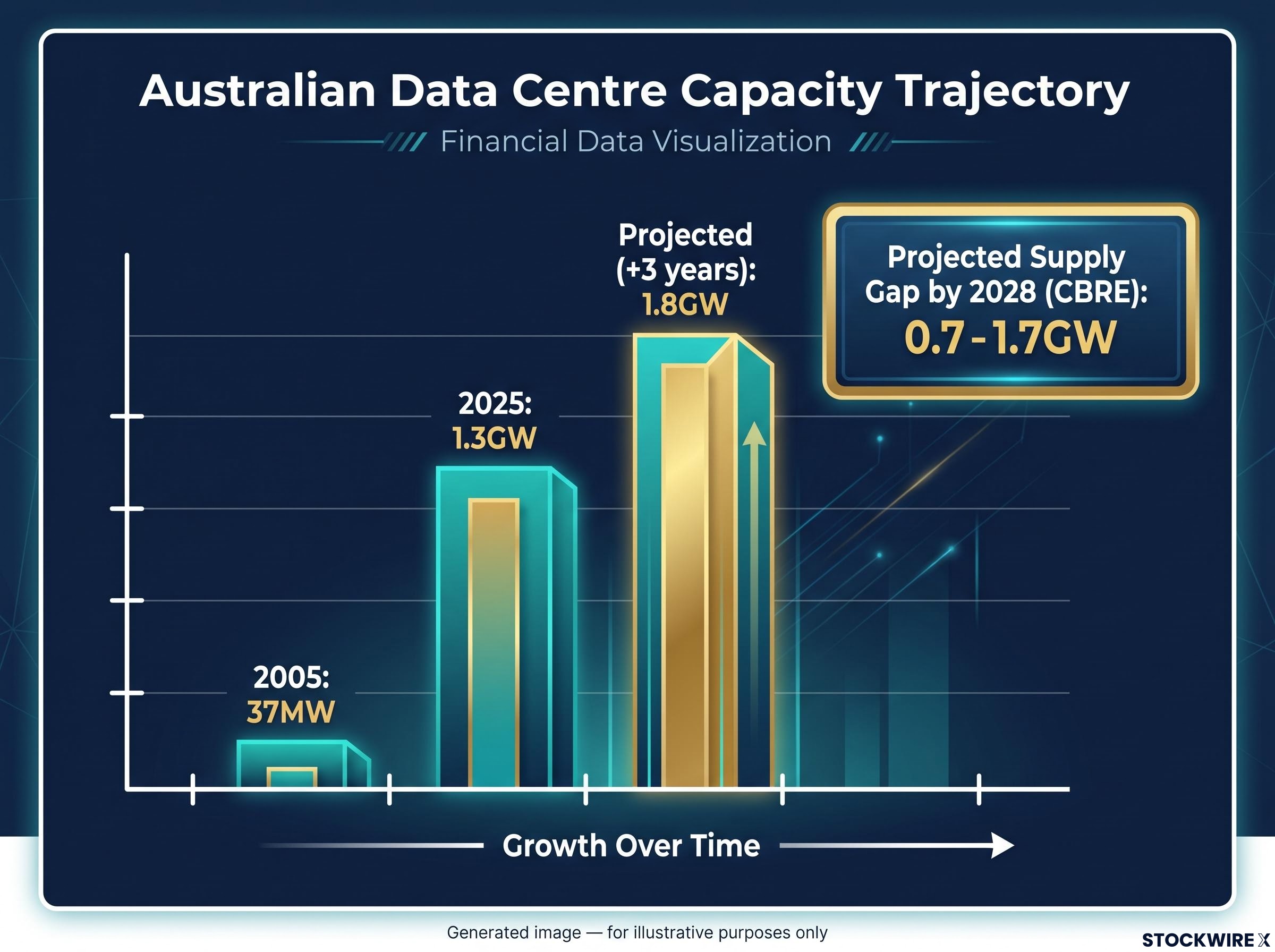
That supply gap is why hyperscalers and sovereign wealth funds are treating Australia as a strategic build-out market rather than a satellite to regional hubs.
The efficiency risk that most demand forecasts understate
Every prior compute era has produced step-change improvements in performance per watt and storage per square metre. Mainframes gave way to servers. Servers virtualised. Cloud architecture compressed physical footprints further. There is no historical basis for assuming AI is exempt from this pattern.
Advances in AI chip design, model compression, and alternative compute architectures could reduce the power and space required per unit of AI revenue over time. The question for investors is not whether AI efficiency improves, because it will, but how quickly, and whether current capacity valuations account for it. When every demand indicator points the same direction, that alignment itself is the signal to stress-test the thesis. Markets where every indicator agrees rarely stay that way indefinitely.
When big ASX news breaks, our subscribers know first
NextDC’s structural position: network effects, capital intensity, and what the pipeline actually signals
NextDC operates a neutral co-location and interconnection model that is structurally distinct from hyperscaler-owned capacity. Enterprises running multi-cloud strategies, connecting to Amazon Web Services, Microsoft Azure, and Google Cloud simultaneously, have historically needed neutral on-ramps. A hyperscaler-owned facility creates an inherent gravitational pull toward that provider’s ecosystem. A neutral facility does not.
The competitive logic mirrors what Equinix and Digital Realty have demonstrated globally: dense interconnection hubs become more valuable as more participants join. Network effects make established hubs increasingly difficult to displace. Interconnection revenue, the fees charged for cross-connects and private links between tenants, carries higher margins than raw colocation. As of 2025, interconnection revenue represented approximately 8.6% of NextDC’s net recurring revenue. Whether that figure rises toward 15-20% over the next three to five years is one of the most consequential variables in the investment case.
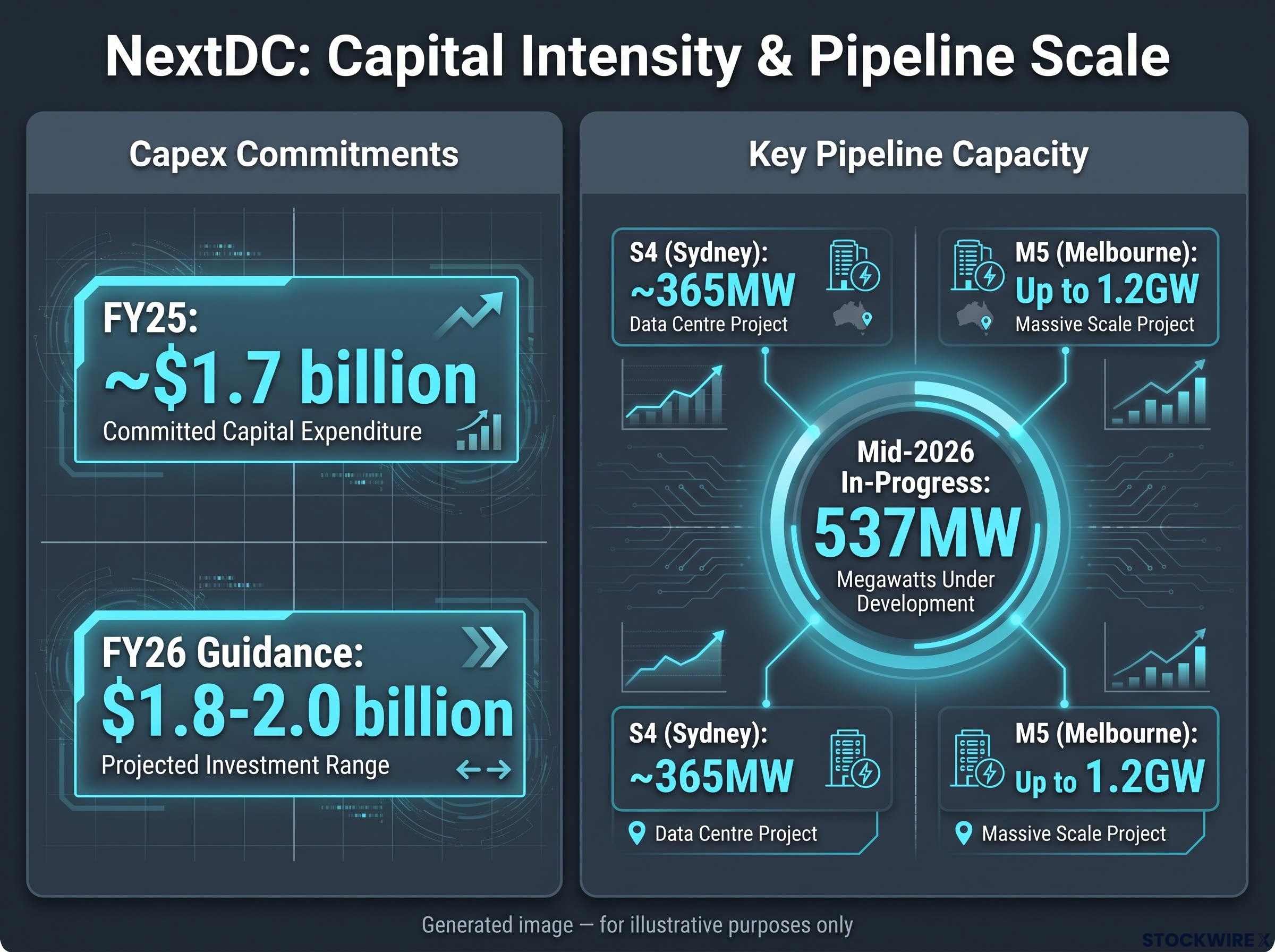
The pipeline scale validates the demand thesis and sharpens the risk simultaneously. NextDC had 537MW under construction or in progress by mid-2026, with further capacity in planning.
Recent milestone announcements confirming a record 250MW capacity surge at the S4 Western Sydney facility illustrate just how rapidly this forward order book is translating into tangible revenue commitments.
| Site | Location | Status | Planned Capacity |
|---|---|---|---|
| S3 | Sydney | Active expansion | Not disclosed |
| S4 | Sydney | Early works underway | ~365MW |
| M2/M3 | Melbourne | Active expansion | Not disclosed |
| M5 | Melbourne | New site, planning | Up to 1.2GW |
| KL1 | Kuala Lumpur | Active expansion | Not disclosed |
FY25 capex reached approximately $1.7 billion, with FY26 guidance initially set at $1.8-2.0 billion before subsequent updates reflected an accelerated programme. That level of capital deployment tells you hyperscaler demand for NextDC’s capacity is contracted and real. It also tells you the company is making multi-decade bets on specific geographies and customer relationships, and equity holders absorb that concentration risk directly.
Joint ventures and the financing logic behind the build programme
Joint venture structures serve a specific strategic purpose in this capital intensity environment:
- Shared construction risk: A single hyperscale-aligned facility can cost hundreds of millions of dollars; JV partners absorb a portion of that outlay.
- Retained operational control: NextDC contributes specialist expertise while partners contribute capital.
- Higher return on equity potential: Sensibly structured JVs can translate into better returns on equity compared with fully balance-sheet-funded builds, provided project-level leverage and partner alignment are well managed.
JVs are a partial offset to balance-sheet concentration, not an elimination of execution risk. What investors should monitor is whether JV terms remain favourable as competition for hyperscaler partnerships intensifies.
For readers wanting to understand how the company is funding this pipeline without diluting existing equity holders, our deep-dive into NextDC’s $1.7 billion hybrid securities raise explains the specific capital structure mechanics.
The risk stack: five variables that could break the bull case
The bear case for Australian data centre operators does not need a macro shock to be credible. It requires only that a subset of five specific risks move in the wrong direction by a moderate amount.
- Technology efficiency: Advances in AI chip design, model compression, and alternative architectures could reduce physical capacity required per unit of compute revenue. This is not a speculative risk; it is the pattern of every prior compute era.
- Hyperscaler concentration: The threat is not that cloud providers abandon co-location entirely but that they increasingly push enterprises into proprietary facilities and virtual on-ramp solutions, narrowing the addressable market for neutral operators to more specialised segments.
- Virtual interconnection substitution: Software-defined networking, cloud-native interconnection platforms, and advanced encryption are making virtual connectivity more capable. If enterprises decide virtual paths are sufficient relative to dedicated physical links, interconnection revenue growth and pricing power could prove materially lower than current expectations.
- Supply-demand forecasting: CBRE projects a supply gap of 0.7-1.7GW by 2028, yet the simultaneous capital inflows from hyperscalers, international platforms, and domestic players raise the risk that sub-markets temporarily tip into oversupply. Oversupply transmits as weaker pricing, slower lease-up on new builds, and lower utilisation on existing assets, which is particularly damaging in a capex-heavy business where assets have 20-30 year lives.
- Power and execution: Securing grid capacity is increasingly the binding constraint in major data centre markets globally. Entitled land and utility relationships represent a competitive barrier, but delays in grid upgrades, changing planning rules, or tighter environmental standards could stretch project timelines and compress returns even in a strong demand scenario.
None of these five risks require AI or cloud demand to collapse. They only require that one or two move in the wrong direction by a moderate amount, and the valuation arithmetic on a capex-heavy operator changes materially.
That is the risk calculus worth carrying into any capital allocation decision in this sector.
Building the investment case from the assumptions up
The investor’s job is not to decide whether the Australian data centre market is large and growing. It is. The job is to decide whether the current entry point prices in the right set of assumptions.
| Bull Case Assumption | What Would Break It |
|---|---|
| Australian demand absorbs capacity domestically rather than being served from offshore hubs | Data sovereignty requirements weaken, or latency-tolerant AI workloads shift to lower-cost regional facilities |
| Hyperscalers continue to value neutral on-ramps for enterprise go-to-market | Major cloud providers build out captive enterprise infrastructure and redirect customers away from neutral facilities |
| Physical interconnection retains a premium over virtual alternatives | Software-defined networking and cloud-native interconnection close the performance and security gap |
| NextDC executes its pipeline on time and within budget | Power delays, planning setbacks, or construction cost escalation stretch timelines and compress returns |
The bear case does not require a collapse in AI or cloud demand. It requires only that technology efficiency, hyperscaler vertical integration, virtual connectivity improvements, or overbuilding combine to moderate pricing power and utilisation below what current valuations imply. CommBank analysis suggests total nominal data centre construction could approach $150 billion by 2030, and CBRE estimates the investible universe of Australian data centres will grow approximately 50% to roughly $46 billion by 2029. That is both a validation of the opportunity and a measure of how much capital is competing for it.
While these numbers capture the broader ecosystem, parsing out the true Australian data centre headline figure reveals that much of this projected capital expenditure includes speculative projects and supporting energy infrastructure.
Three valuation variables deserve explicit modelling before committing capital:
- Utilisation rates: The speed at which new builds lease up determines whether capex translates into returns or sits idle. This is the single most important near-term variable.
- Interconnection revenue share: At approximately 8.6% of net recurring revenue today, this figure is the baseline against which future growth or erosion should be measured. If it rises, the network effect thesis is working. If it stagnates, colocation commodity risk is dominant.
- Pricing trajectory: In a market where multiple operators are building simultaneously, the ability to maintain or grow per-megawatt pricing is not guaranteed. Oversupply in sub-markets like Sydney could compress pricing before demand catches up.
The reader’s practical task is to assess whether the current entry point assumes these three variables move favourably, and what the return profile looks like if one or two of them disappoint.
Positioning in a market where the thesis is real but the price of being wrong is high
The Australian data centre investment thesis rests on a genuine structural shift. AI workloads, cloud migration, and data sovereignty requirements are not cyclical phenomena, and the capacity build-out reflects contracted demand, not speculative construction. That much of the bull case is solid.
The complication is that the capital flooding into the market has narrowed the margin for error on pricing and utilisation. CBRE projects a supply gap of 0.7-1.7GW by 2028, but CommBank’s $150 billion construction figure signals the risk of that gap closing faster than current forecasts assume.
Three forward monitoring indicators will tell you whether the bull case is holding as the build programme unfolds:
- Utilisation per new-build site: Watch NextDC’s half-year and full-year results for site-level utilisation data, particularly on S4 and M5. Slower-than-expected lease-up is the earliest signal of demand softening.
- Interconnection revenue share trajectory: If interconnection revenue grows as a percentage of total recurring revenue, it validates the network effect thesis. If it plateaus near 8.6%, the moat argument weakens.
- Hyperscaler co-location commentary: Quarterly earnings calls from Amazon, Microsoft, and Google will reveal whether these providers are deepening their commitment to neutral co-location or shifting toward proprietary capacity in Australia.
The thesis is real, but in a capital-flooded market, being right about demand and wrong about price and timing is still a losing position.
Position sizing and entry timing matter more in a capital-intensive sector with long asset lives than in sectors where the cost of being early is low. The analytical edge is not in knowing that AI demand is real. It is in tracking whether utilisation, interconnection share, and pricing are moving in the direction the current entry price implies they will.
This article is for informational purposes only and should not be considered financial advice. Investors should conduct their own research and consult with financial professionals before making investment decisions. Forward-looking statements regarding market size, capacity projections, and revenue forecasts are subject to change based on market developments and company performance.