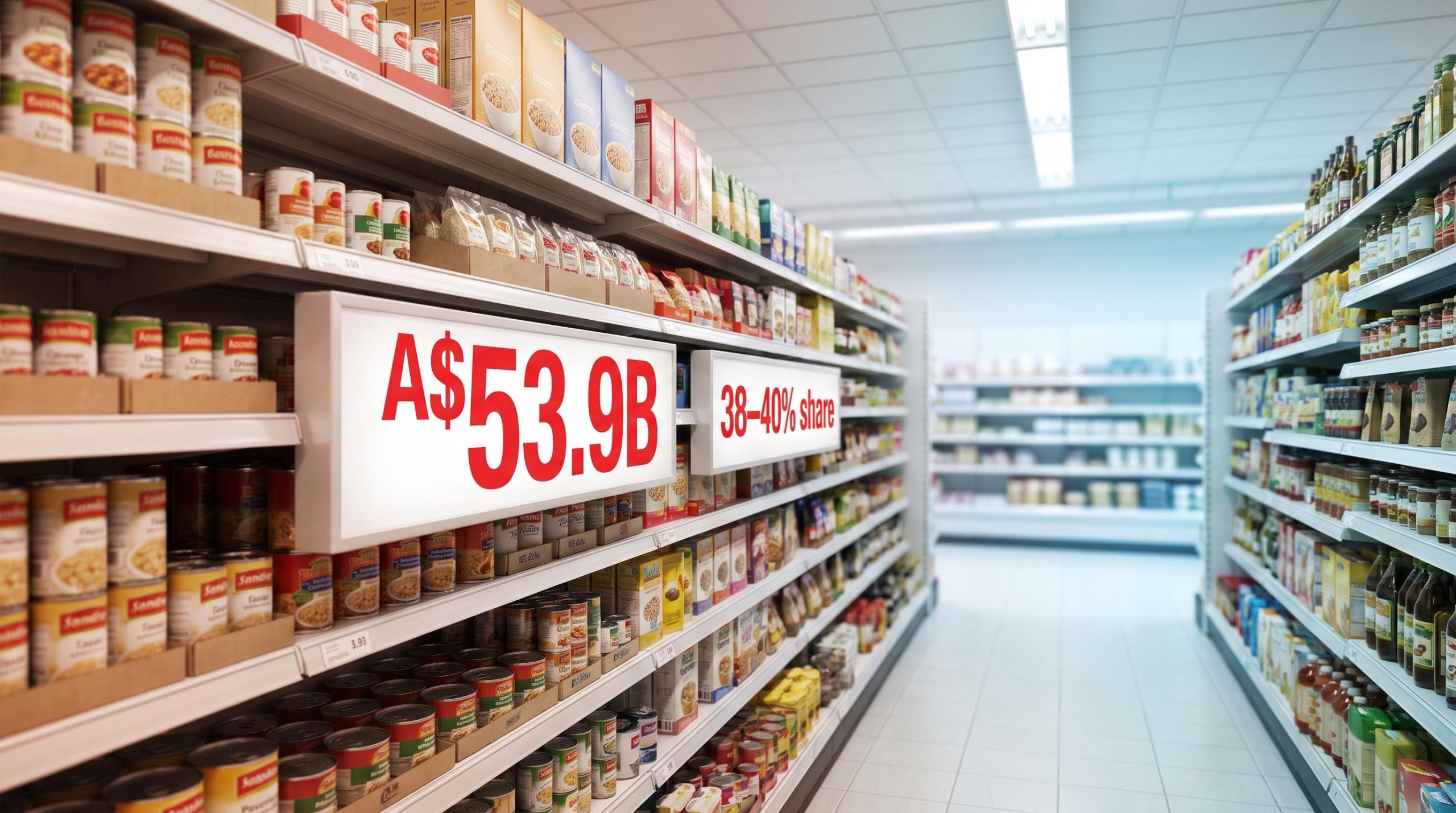
Woolworths just reported A$53.9 billion in Australian food sales and holds somewhere between 38% and 40% of national supermarket share. By almost any measure, it is the dominant grocery business in the country. Yet analyst consensus finds more upside in Coles, the smaller, cheaper rival. That inversion sits at the centre of the investment case.
This is not an article about whether Woolworths is a good business. It is. The question is whether the competitive environment structurally prevents the earnings growth needed to justify paying a premium for the stock. The answer depends on how you read four forces: duopoly rivalry, discount-tier pricing pressure, a regulatory and channel-mix margin ceiling, and the tail risk most models are underweighting.
Here is how those competitive forces map to the margin ceiling, and what that means for the premium you are being asked to pay.
The duopoly that doesn’t behave like one
Woolworths and Coles together account for roughly two-thirds of national grocery sales, according to ACCC data. On paper, that concentration looks like a comfortable position. In practice, it generates more competitive intensity than it insulates against.
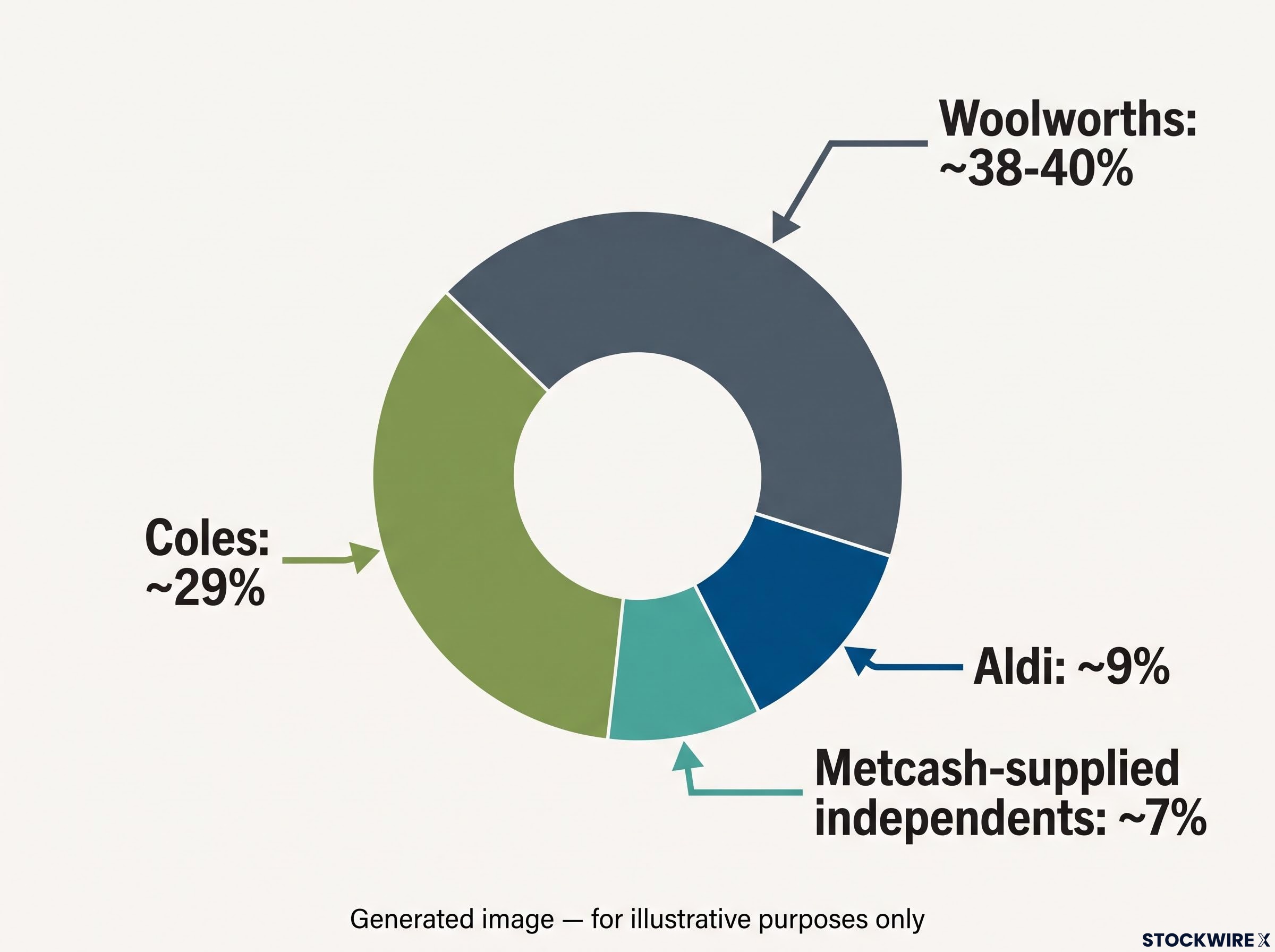
Woolworths holds approximately 38-40% national supermarket share (ACCC and UBS estimates). Coles holds approximately 29%. Woolworths’ FY26 Australian Food sales of A$53.85-53.9 billion dwarf Coles’ FY26 supermarket sales revenue of A$41.5 billion. The scale advantage is real.
So is the current momentum. According to Morningstar analyst Johannes Faul (writing on 28 August 2026), Woolworths holds a sales growth lead of around 2 percentage points over Coles as of July-August 2026, a gap that holds even when the boost from Woolworths’ collectibles promotional campaign across those months is stripped out.
That lead tells you Woolworths is executing well right now. It does not tell you the lead will compound.
Morningstar anticipates Coles will respond by intensifying its own discounting activity, with both retailers expected to hold their respective market shares steady over the long term.
The rivalry between the two has been active and ongoing since the change in Coles’ ownership in 2007, and the pattern is consistent: short-term outperformance by one triggers counterpunching from the other rather than cementing a new equilibrium. For investors, the 2-percentage-point sales lead is a trading catalyst. It is not a structural re-rating event.
The Coles vs Woolworths valuation divergence became most visible in September 2025, when Coles traded at a record high while Woolworths sat near a six-year low, a gap driven by genuine earnings differences rather than sentiment; the subsequent half-year results confirmed which market verdict the numbers supported.
| Metric | Woolworths | Coles |
|---|---|---|
| National supermarket share | ~38-40% | ~29% |
| FY26 sales revenue | A$53.85-53.9 billion | A$41.5 billion |
| FY26 underlying net profit | A$1.60 billion | Refer to Coles FY26 disclosure |
| Sales growth trajectory (Jul-Aug 2026) | ~2 ppts ahead (adj. for collectibles) | Expected to respond with intensified discounting |
When big ASX news breaks, our subscribers know first
Why Aldi and the independents matter more than their market share suggests
Aldi holds approximately 9% of national supermarket share. Metcash-supplied independents hold approximately 7%. Combined, that is 16%, a fraction of the duopoly’s dominance. The influence those competitors exert on Woolworths’ margins is disproportionate to those figures.
Aldi’s structural role is not as a volume competitor. It is as a low-price reference point. Consumer price comparisons consistently find Aldi’s basket to be materially cheaper than comparable shops at Coles or Woolworths (estimates suggest around 25% cheaper, though this figure is directional and not independently confirmed). That gap forces a defensive response from the majors that goes well beyond the stores where Aldi is physically present.
ACCC inquiry evidence on price responses to Aldi entry shows that the absence of Aldi stores in regional areas correlates with materially higher consumer prices, confirming that Aldi functions as a systemic price anchor rather than a localised competitive factor in Australian grocery markets.
Evidence from competition inquiries, including the ACCC Supermarkets Inquiry (final report March 2025), confirms the mechanism. Specifically:
- Woolworths and Coles reduce prices in catchments where a new Aldi store opens nearby, not just in the stores directly adjacent.
- The price reduction is defensive rather than margin-accretive; it protects volume without improving profitability.
- The growth of Aldi’s store footprint has reshaped and increasingly fragmented the Australian grocery market, intensifying competitive pressure on commodity product lines.
- The pricing floor Aldi sets in affected areas limits Woolworths’ ability to recover margin on the categories where the overlap is greatest.
For a Woolworths investor, the implication is that price investment in response to Aldi is a structural cost of defending volume. It is not a temporary promotional choice. The margin drag from the discount tier is embedded, not cyclical.
Independents and the local relevance problem
The Metcash-supplied independents, including IGA banners, compete on entirely different terms. Their strength is not price at scale. It is local relevance, fresh category depth, and community positioning.
That makes them difficult to dislodge through the kind of scale advantages Woolworths deploys against a direct rival. Their approximately 7% share is concentrated in categories and geographies where Woolworths is structurally less competitive: regional towns, suburban pockets with strong local loyalty, and fresh food segments where provenance and relationship matter more than shelf price.
This creates a second front. Woolworths cannot simply out-price the independents the way it might out-discount a competitor operating at comparable scale. The result is a two-directional constraint: Aldi anchors a floor from below on commodity pricing, while independents carve out profitable niches that Woolworths cannot easily replicate from above.
How the ACCC inquiry and online growth create a margin ceiling from two directions
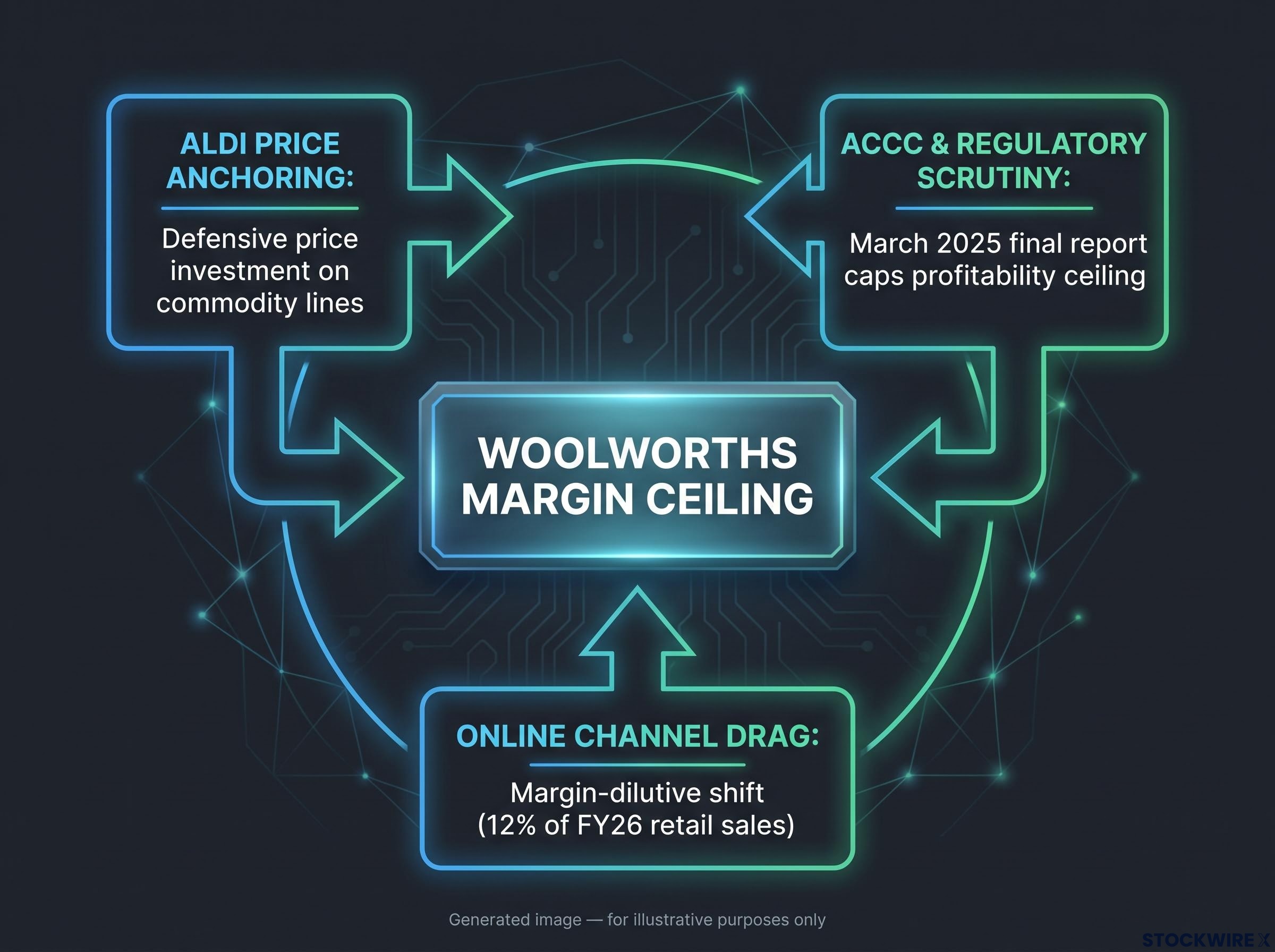
The margin ceiling on Woolworths’ earnings is not a single force. It is a convergence of regulatory and operational pressures arriving from opposite ends of the business model, and that convergence makes it structurally stickier than either constraint alone would be.
The ACCC Supermarkets Inquiry (final report March 2025, covering the five financial years through 2024-25) documented that major supermarkets, including Woolworths and Coles, expanded profit margins during the cost-of-living surge, indicating that at least part of prior price rises translated into higher profits.
That finding is now the regulatory trigger for sustained political and public scrutiny of supermarket pricing. An investor reading the headline FY26 profit of A$1.60 billion should understand that the regulatory environment shaped by that prior margin behaviour sets a practical ceiling on how far Woolworths can push profitability without triggering further intervention or sustained public pressure.
ACCC pricing conduct rulings against the major supermarkets have produced mixed outcomes, with the Federal Court finding Coles’ Down Down price increases were commercially justifiable while simultaneously confirming misleading promotional timing, a distinction that illustrates how regulatory intervention targets specific practices rather than delivering the blunt margin compression some models assume.
From the other direction, strong growth in online sales improves customer relevance and supports top-line revenue, but the channel is widely recognised as margin-dilutive in grocery until fulfilment automation and online order density reach materially higher levels. In FY26, Australian food sales accounted for roughly 12% of total Australian retail sales; as more of that volume shifts online, the channel mix acts as a drag on group margins even when execution is strong.
Together, the constraints narrow the range within which Woolworths can expand margins:
- Aldi price anchoring forces defensive price investment on commodity lines, compressing pricing headroom from the discount tier.
- ACCC and regulatory scrutiny caps the ceiling from the profitability side, making politically visible margin expansion risky for the business.
- Online channel mix drag pulls the floor lower from the cost side, requiring higher volumes through a structurally lower-margin format before the economics improve.
Even with strong execution, the combination means sustained margin expansion of the kind needed to justify a significant premium over Coles is unlikely without a material change in at least two of these three constraints.
Amazon and the scenario risk most investors are discounting
Amazon Australia’s potential grocery entry is not a base-case near-term threat. Estimates place its market share potential at only low single digits even several years after launch (a directional figure, not independently confirmed). Most investor models do not build in a material Amazon grocery presence.
The mechanism of entry, however, is well-established internationally. Amazon would likely start with shelf-stable and dry grocery categories (a Pantry-style offering) before building into fresh (a Fresh-style offering), following the pattern of its market entries elsewhere. The characteristics that make this structurally disruptive, even at modest share, are specific:
- Logistics infrastructure that reduces last-mile delivery costs below what incumbent supermarkets can match
- Customer data at a depth and granularity that enables personalised pricing and promotion
- Price transparency that makes consumers more price-sensitive in categories where Woolworths earns the most
- Subscription integration through Prime, which locks in repeat purchase behaviour
- Category-specific margin pressure concentrated in shelf-stable goods, where Woolworths’ margins are highest and differentiation is lowest
Even if Amazon never captures more than 2-3% of Australian grocery sales, its presence as a price-visible alternative in shelf-stable categories would be enough to depress Woolworths’ pricing power in those lines and reinforce the margin ceiling already set by Aldi. The risk is disproportionate to the market share figure.
What the Amazon scenario changes for premium valuation holders
If the base case already offers modest upside and the tail risk includes a new entrant with Amazon’s capital base and logistics capability, the risk-reward asymmetry at a premium price becomes harder to defend. The mere credibility of Amazon as a future entrant acts as an optionality discount: it places a ceiling on the multiple the market will pay for Woolworths’ earnings stream, even in scenarios where Amazon’s actual share remains small. For investors holding at a premium, that is the variable most likely to be underweighted in current positioning.
What makes Woolworths worth holding, and what it would take to close the valuation gap
None of the above negates the quality of the franchise. Woolworths is a wide-moat business with management capability that Morningstar cites as a basis for sustaining sector leadership. Store refurbishment programmes, improved format productivity, and operating leverage recovery as cost inflation moderates all provide genuine upside offsets.
The consumer staples capital return record on the ASX complicates the defensive positioning argument: the S&P/ASX 200 Consumer Staples Index returned -1.57% per year over the five years to May 2026 against 3.91% annually for the broader ASX 200, a gap that makes the distinction between earnings stability and share price protection practically important for investors sizing a Woolworths position.
The conditions under which the premium over Coles becomes justified over a 3-5 year horizon are specific and identifiable:
- Sustained margin recovery above the regulatory and competitive constraints documented in the ACCC inquiry
- Online channel maturation that drives cost efficiencies at scale, reducing the margin dilution from channel mix shift
- Absence of a material new entrant (specifically, Amazon remaining non-committal on Australian fresh grocery)
- Store productivity uplift from the refurbishment programme translating into measurable sales-per-square-metre gains
“Is there enough margin and earnings growth left to justify paying up at current prices?” That is the central question the competitive structure answers.
The answer, on the available evidence, is that Woolworths is defensively attractive and franchise-durable. It offers modest rather than outsized upside from current prices, particularly compared with a cheaper entry point at Coles, where analyst consensus typically finds greater upside potential (a directional characterisation, not independently confirmed at a specific figure).
What you are buying at the current Woolworths price is a high-quality defensive position with limited margin expansion runway. That is a sound portfolio holding for the right purpose. It is not a growth story, and the distinction should drive how you position around it.
ASX consumer staples mean reversion risk compounds the stock-specific margin ceiling analysis: with the consumer staples index pushing the 99th percentile of its spread versus the broader ASX 200, the 1-3 month window following extreme outperformance has historically been the most consistent period of sector weakness, making entry timing a separate variable from the structural earnings case.
This article is for informational purposes only and should not be considered financial advice. Investors should conduct their own research and consult with financial professionals before making investment decisions. Past performance does not guarantee future results. Financial projections are subject to market conditions and various risk factors.