
Equity Trustees delivers 33% profit growth from continuing operations as it exits superannuation trusteeship
In its FY26 results presentation delivered on 27 August 2026, EQT Holdings outlined a year of accelerating core performance set against a major strategic repositioning. Managing Director Mick O’Brien and Chief Financial Officer Johanna Platt detailed continuing operations net profit after tax (NPAT) of $33.9m, up 32.7%, on revenue of $167m, up 9.4% for the year ended 30 June 2026.
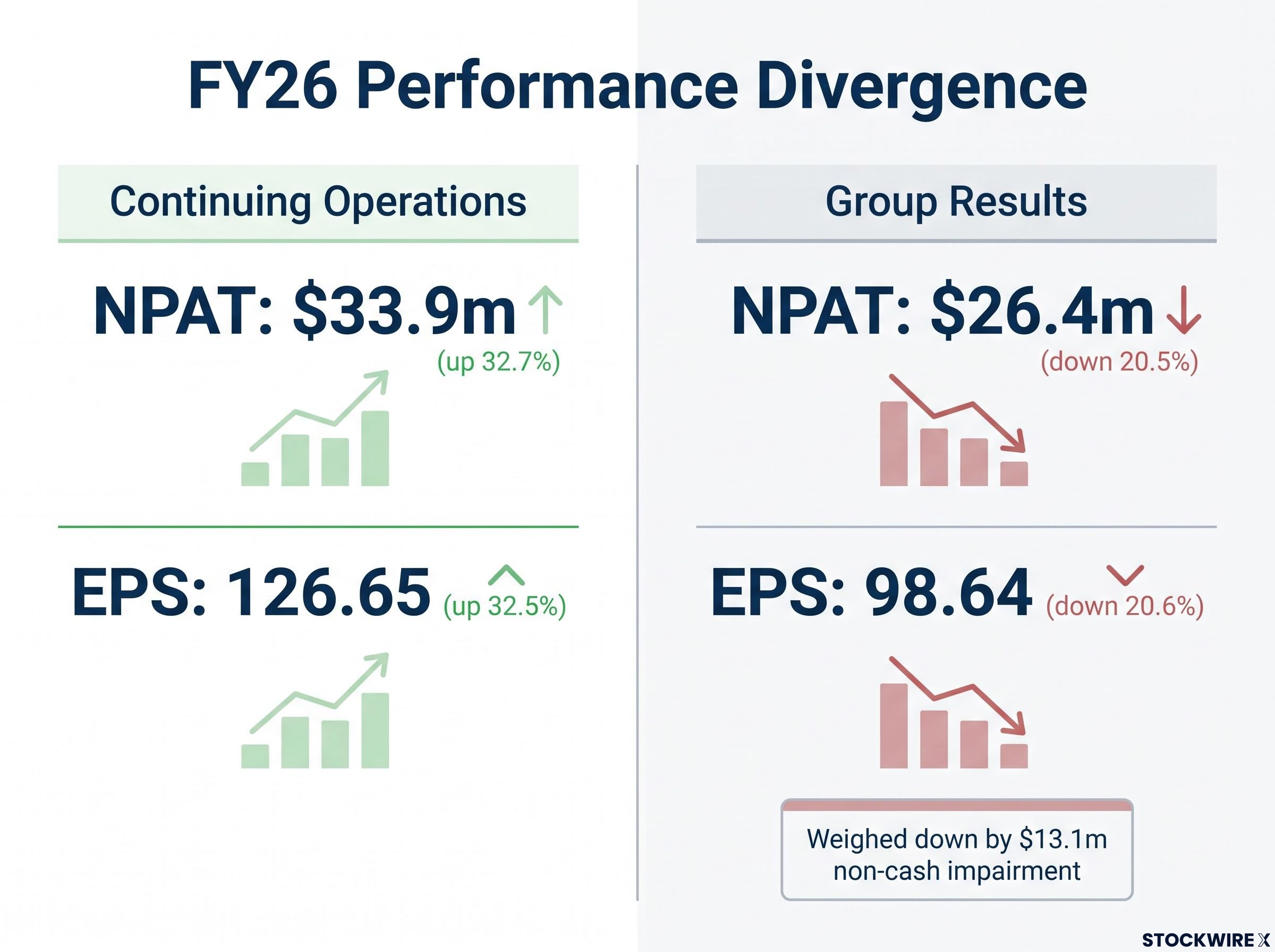
The centrepiece was the decision to exit Superannuation Trustee Services (STS), splitting the company into continuing operations (Trustee and Wealth Services plus Corporate Trustee Services) and discontinued operations. This drove a divergence in the headline picture: while the core business expanded net profit before tax (NPBT) margin by 580bps to 29.9% and grew continuing Funds Under Management and Supervision (FUMAS) to $191.9b (up 15.1%), Group NPAT fell 20.5%, weighed down by a $13.1m non-cash impairment and a reduced dividend.
When big ASX news breaks, our subscribers know first
FY26 headline results at a glance
The dual picture is central to interpreting the year. Group figures declined because of the STS exit and the associated impairment, not because of weakness in the ongoing business. Continuing operations, by contrast, showed acceleration across profit, margin and scale metrics.
| Metric | Continuing Operations | Group |
|---|---|---|
| NPAT | $33.9m (up 32.7%) | $26.4m (down 20.5%) |
| Revenue | $167m (up 9.4%) | — |
| NPBT margin | 29.9% (+580bps) | — |
| FUMAS | $191.9b (up 15.1%) | $293.5b |
| EPS | 126.65 (up 32.5%) | 98.64 (down 20.6%) |
| Full-year dividend | — | 76cps (down 35cps, 77.1% payout) |
Group EPS reflected a three-year compound annual growth rate (CAGR) of 10.1%.
The strategic pivot — why Equity Trustees is exiting superannuation trusteeship
The presentation detailed that the Board completed a strategic review of the STS business during 2H26, resulting in the decision to exit and refocus on core Corporate Trustee Services (CTS) and Trustee and Wealth Services (TWS). This repositioning was announced in June 2026.
The EQT superannuation trustee exit was announced in June 2026 following a strategic review, with ETSL having managed $95 billion in funds under management but contributing only 5% of Group NPBT in 1H26, making the business a poor fit for EQT’s capital allocation priorities.
Exit progress and mechanics
Management outlined the following steps in the exit process:
-
On 21 April 2026, HUB24 exercised its call option to acquire the HTFSN entity; completion is subject to APRA approval and expected by the end of 2026.
-
Directors of Equity Trustees Superannuation Limited (ETSL) are assessing options for the transition of funds under its trusteeship, including a possible sale of the business in coming months.
-
The exit requires repayment of $35.8m in loans taken out to support the trustee capital required for ETSL.
-
A substantial portion of any sale proceeds is anticipated to fund repayment of these ORFR loans.
The full STS exit is expected to be completed by the end of FY27.
The Shield & First Guardian overhang
Legal proceedings relating to the Shield and First Guardian schemes remain in progress, and ETSL remains committed to defending its position, with defences lodged in the Federal Court for both matters. ASIC is seeking civil penalties, compensation and remediation orders and costs.
According to liquidator reports, the estimated net investment loss for ETSL members is $74m for Shield and $70m for First Guardian. Equity Trustees has notified its Professional Indemnity insurance providers; the Shield claim has been accepted, while First Guardian is under consideration. The company noted that levels of coverage will not be disclosed to the market.
Core business performance — TWS and CTS driving growth
Corporate Trustee Services (CTS) — new business engine
CTS delivered revenue of $53.2m, up 13.8%, NPBT of $22.0m, up 15.3%, and FUMAS of $174.2b, up 17.2%. The segment recorded 104 new client appointments (including 9 listed schemes) in FY26, contributing $4.4m of the $7.4m total new business revenue.
Management attributed demand to greater regulatory complexity and general investment growth driving appetite for independent responsible entity services. The business plans to undertake a strategic pricing review to optimise return on investment on regulatory capital.
Trustee and Wealth Services (TWS) — margin uplift from NavOne
TWS reported revenue of $110.0m, up 7.7%, and NPBT of $36.7m, up 24.8%, with margin expanding 457bps to 33.3%. The margin gains were driven by productivity improvements following implementation of the NavOne trustee platform.
Health and Personal Injury revenue increased $2.3m (12%), while Estate Management revenue rose $2.1m (25.1%). Both included non-recurring benefits, with Estate Management revenue approximately $2.5m above the future run rate. FUMAS slipped 1.2% due to the loss of a community trust late in the year, an impact expected to carry into FY27.
| Segment | Revenue | NPBT | NPBT Margin | FUMAS |
|---|---|---|---|---|
| TWS | $110.0m | $36.7m | 33.3% | $16.7b |
| CTS | $53.2m | $22.0m | 41.4% | $174.2b |
What is an independent trustee business?
A trustee services company acts as an independent party responsible for managing assets on behalf of others. This spans deceased estate administration, corporate trustee and responsible entity roles for investment funds, custody of assets, and, historically for EQT, superannuation trusteeship.
A key scale metric is Funds Under Management and Supervision (FUMAS), which captures the total value of assets the business oversees. Because trustee revenue is largely recurring and long-term, higher FUMAS supports a stable, predictable earnings base.
The independent responsible entity model matters because a regulatory framework backs demand for genuine separation between Responsible Entities and Investment Managers. Equity Trustees noted this separation was a key failure in both the Shield and First Guardian episodes. The company also pointed to structural tailwinds, citing an intergenerational wealth transfer estimated between $3.5 trillion and $5.3 trillion over 20 years, alongside superannuation growth.
Capital management and the dividend decision
The Board determined a FY26 final dividend of 20cps fully franked, taking the full-year distribution to 76cps (down 35cps), a payout ratio of 77.1% and within the Board’s target range of 70% to 90% of Group NPAT. The payout ratio is calculated on statutory Group NPAT and includes the impact of the $13.1m non-cash impairment.
Management framed the reduction as prudent capital preservation through the STS exit and regulatory transition, rather than a reflection of core performance, given continuing NPAT rose 33%. The balance sheet remained stable, with Group cash of $159.9m at 30 June 2026 (up from $146.5m) and operating cash flow of $54.9m (up $14.6m).
Regulatory capital holdings included:
-
AFSL regulatory capital of $92.6m (applicable from 1 July 2026)
-
ETSL capital of $39.7m
-
Available cash of $27.6m
Board’s stated position on the dividend
While continuing operations NPAT increased 33%, the Board has elected to retain a portion of profits to preserve capital flexibility through the STS exit and ongoing regulatory matters during this transitional period. Dividend decision balances shareholder returns with the capital requirements associated with the STS exit and ongoing regulatory matters.
FY27 outlook and strategic priorities
Management outlined a forward roadmap centred on continued momentum from the core TWS and CTS businesses and completion of the STS exit by the end of FY27. Approximately $5m is expected to be invested in FY27 across business transformation, including CTS operational capability, digitised risk monitoring, digital customer experience offerings, and increased risk and governance resources. Continued ETSL litigation costs are also anticipated.
The six FY27 strategic priorities presented were:
-
Leverage market leadership in CTS and TWS to continue business momentum.
-
Deploy further advances in technology to improve service, build efficiency and manage risk.
-
Develop digital capabilities in Estate Planning and Management.
-
Finalise and complete the STS exit plan.
-
Maintain balance sheet flexibility.
-
Continue management of the Shield and First Guardian proceedings.
Management framed the investment case around a post-STS Equity Trustees positioned as a focused, higher-margin business supported by strong recurring revenue and structural tailwinds. The outlook remains subject to normal investment market conditions, no material adverse change in market sentiment, and successfully managing further change in the regulatory environment.
The TPG Global takeover proposal, lodged at A$24.55 cash per share via a scheme of arrangement, cited the STS exit complexity and unresolved ORFR loan obligations as material factors feeding directly into its due diligence process, adding a corporate transactions dimension to an already eventful reporting period.
Stay Ahead on ASX Finance and Fintech News
Breaking ASX announcements from the finance and fintech sector land in your inbox within minutes, complete with in-depth analysis, through the FREE Big News Blast alert service. Join 20,000+ active subscribers already getting market-moving news the moment it breaks. Click the “Free Alerts” button to start receiving alerts before the broader market catches up.