
Entropy secures UCSF trial to pit TRP-8803 against America’s top antidepressant
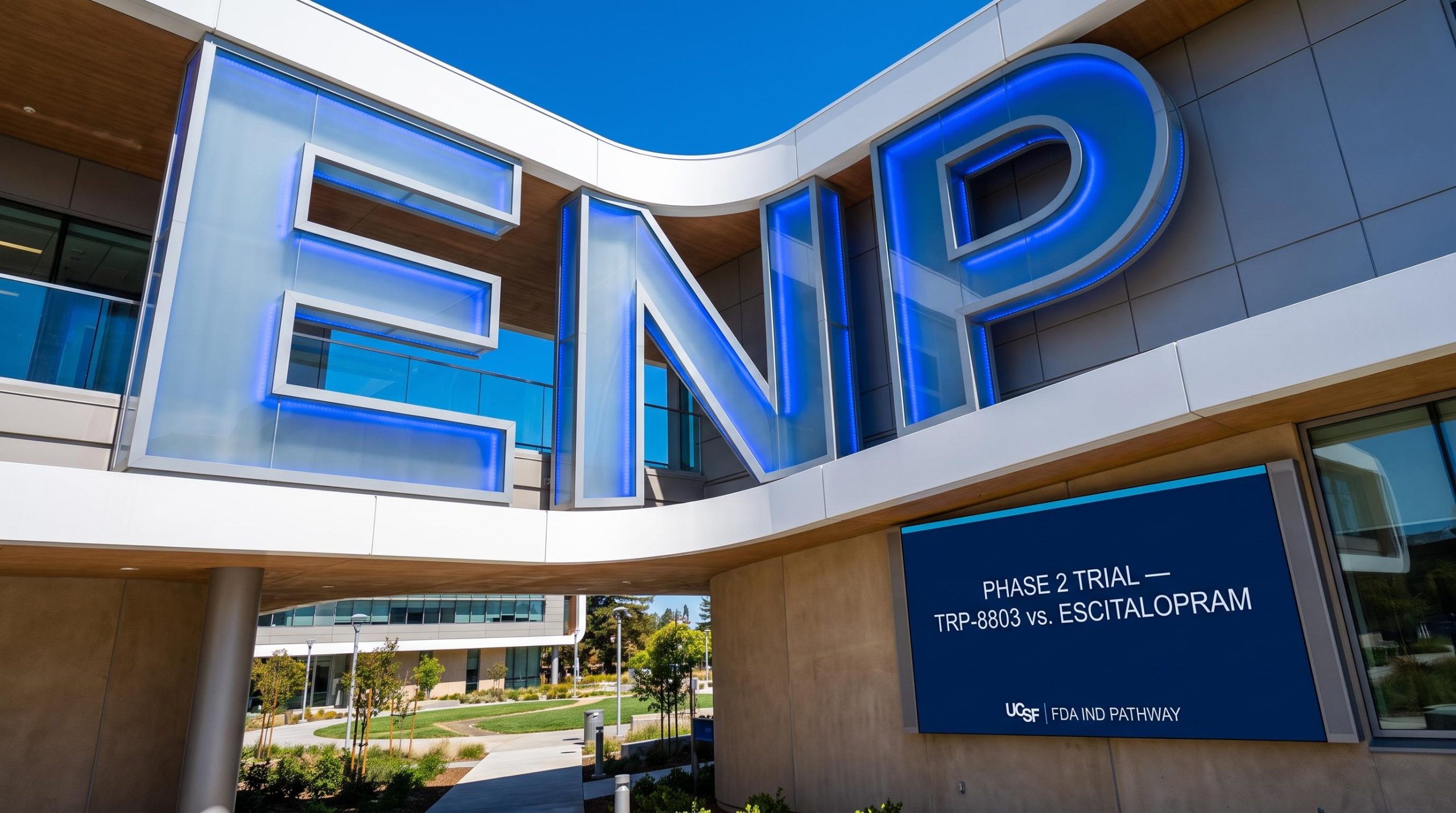
Entropy Neurodynamics (ASX: ENP) has signed a pre-Clinical Trial Agreement (“pre-CTA”) with the University of California, San Francisco (UCSF) to develop a Phase 2 head-to-head trial of its proprietary TRP-8803 (IV-infused psilocin) against escitalopram (Lexapro®).
The proposed study will recruit up to 80 young adults with Major Depressive Disorder (MDD), directly comparing the two treatments across established measures of depression severity. It establishes a clinical and regulatory pathway into the United States for the clinical-stage biotechnology company.
The trial is to be led by Professor Robin Carhart-Harris as Principal Investigator, with depression severity assessed over eight weeks and six months. The trial is expected to commence in H1 CY27, marking a step upstream into a large, established market alongside one of the field’s most cited investigators.
When big ASX news breaks, our subscribers know first
Why targeting the US MDD market matters
Escitalopram is the most widely prescribed antidepressant in the US, providing an established benchmark against which to directly evaluate TRP-8803. A validated comparator drug allows for a clean, credible comparison, while the scale of the underlying patient population underscores the size of the commercial opportunity.
Key market data cited in the announcement includes:
-
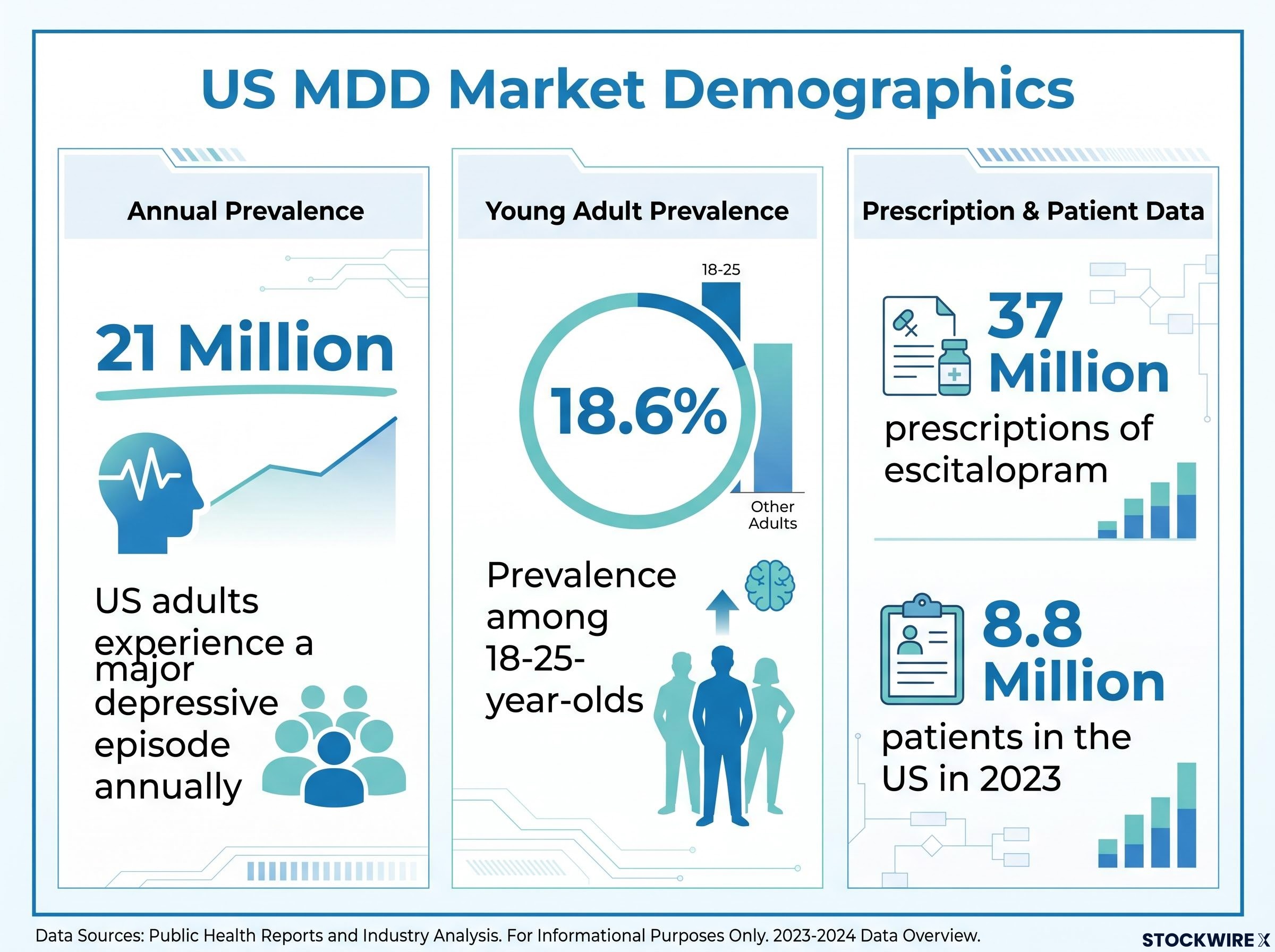
Approximately 37 million prescriptions of escitalopram to 8.8 million patients in the US in 2023
-
An estimated 21 million US adults experience a major depressive episode annually
-
Prevalence is highest among 18–25-year-olds at 18.6%
For investors, a benchmark drug with this level of established usage means any positive comparative signal from TRP-8803 would carry weight against a familiar standard of care, addressing a substantial addressable patient population.
Understanding TRP-8803 and precision-controlled psychedelic therapy
TRP-8803 is a proprietary formulation of IV-infused psilocin, the active metabolite of psilocybin. Rather than the ongoing daily dosing associated with conventional antidepressants, the trial is intended to investigate whether a limited course of precision-controlled treatment can deliver meaningful clinical and functional outcomes.
MDD is standardly treated with selective serotonin reuptake inhibitors (SSRIs) such as escitalopram. According to the announcement, SSRI use can be associated with emotional blunting, sexual dysfunction and other tolerability issues, while response can vary widely between patients, creating a need for alternative approaches.
By delivering psilocin through IV-infusion, Entropy states the platform offers rapid onset and precise control over treatment duration, intensity and predictability, with the potential to improve treatment consistency while offering a more reproducible and scalable model than oral psilocybin.
The IV psilocin platform underpinning TRP-8803 delivers a 15-minute onset and 1-2 hour treatment sessions compared to the 1-3 hour onset and 8-10 hour sessions typical of oral psilocybin, a distinction that carries direct implications for clinical throughput and commercial scalability.
| Feature | Conventional SSRI (Escitalopram) | TRP-8803 Approach |
|---|---|---|
| Dosing regimen | Ongoing daily dosing | Limited, precision-controlled course |
| Treatment duration | Continuous daily medication | Controlled duration and intensity |
| Control/predictability | Response can vary widely between patients | Designed for greater predictability and reproducibility |
For investors, a differentiated treatment model that aims for consistency and scalability speaks directly to a clear unmet need in depression care.
A landmark investigator and a first-in-class trial design
Professor Robin Carhart-Harris is the Ralph Metzner Distinguished Professor of Neurology and Psychiatry at UCSF and one of the world’s foremost researchers in psychedelic therapies. He was lead author of the landmark New England Journal of Medicine (NEJM) trial directly comparing psilocybin therapy with escitalopram in patients with moderate-to-severe MDD.
With 52,000+ citations, he is described as the world’s most influential psychedelic neuroscientist and one of the most cited figures in modern neuropsychopharmacology. The proposed trial builds on his prior NEJM work, which demonstrated encouraging clinical outcomes for psilocybin including higher remission rates.
The trial’s novel angle lies in moving earlier in the depression pathway, evaluating TRP-8803 in young adults at earlier stages of MDD rather than after failure of conventional therapies. The study is also expected to incorporate EEG measures, including complexity, spectral power and network dynamics, to investigate potential mechanistic differences between IV psilocin and SSRI treatment.
Professor Robin Carhart-Harris, Principal Investigator
“TRP-8803 provides an opportunity to build on that work using an IV formulation of psilocin designed to offer greater precision, predictability and control over the treatment experience. These characteristics are particularly interesting from a research perspective because they may enable us to examine the effects of psilocin with a level of control that is difficult to achieve with oral psilocybin.”
The FDA pathway and how it fits Entropy’s broader strategy
Entropy will act as the US Food and Drug Administration (FDA) Investigational New Drug (“IND”) sponsor, progressing the required regulatory activities with UCSF’s support. Subject to FDA clearance, establishing an IND for TRP-8803 may provide a broader US regulatory foundation capable of supporting a wider US clinical development program.
The MDD trial complements Entropy’s existing Australian clinical programs. These building blocks include:
The 72-patient basket study received HREC approval to evaluate TRP-8803 across eight neuropsychiatric indications in parallel, a capital-efficient design estimated at A$3.2 million that is structured to generate cohort-level data across multiple conditions simultaneously rather than sequentially.
-
The ongoing 72-patient, eight-indication Phase 1b/2a Basket-design Study with Swinburne University of Technology (refer ASX announcement: 4 August 2026)
-
The proposed US Phase 2 trial with UCSF
-
The FDA IND pathway for TRP-8803
-
A manufacturing relationship with BioCina, which will produce GMP-grade TRP-8803 and matched placebo vials for the US clinical program (refer ASX announcement: 19 August 2026)
For investors, the strategic value lies in the potential for a single IND to support additional US clinical development, including future Phase 2b/3 studies in selected indications informed by data from the Australian Basket-design Study.
Funding, next steps and timeline
The trial is expected to be funded from existing cash reserves, option conversions and pending R&D Tax Incentives, with the trial expected to commence in H1 CY27.
Entropy and UCSF will now progress the activities required to develop the proposed Phase 2 trial, including:
-
Develop and finalise the clinical trial protocol and informed consent with UCSF
-
Schedule a pre-IND meeting with the FDA to confirm the protocol’s acceptability
-
Submit an IND application to the US FDA for TRP-8803 for the proposed trial
-
Following FDA clearance of the trial protocol, finalise the Clinical Trial Research Agreement (“CTRA”) with UCSF
The roadmap presents defined regulatory milestones against a stated funding base, giving investors clear checkpoints to track development progress.
CEO outlook and investor webinar
Entropy CEO and Executive Director Jason Carroll framed the trial as a “bold and revolutionary step forward for TRP-8803” that significantly expands the clinical and regulatory pathway being built around the program. He noted the deliberate 18-month build of the Australian clinical program, proposed US trial, IND pathway and BioCina manufacturing relationship, which together are intended to open the Company to commercial partnership discussions.
Jason Carroll, CEO and Executive Director
“What is particularly compelling about this trial is that we are moving upstream in the treatment pathway. Until now, the development of novel therapies for depression have focused on patients who have already failed years on conventional treatments. We want to understand whether a limited number of precision-controlled TRP-8803 treatments can provide an effective alternative treatment in young adults experiencing major depression much earlier in the condition progression.”
Carroll will host an investor webinar at 11:00am AEST (9:00am AWST) on Friday, 28 August to provide additional information about the pending MDD trial and the broader TRP-8803 development program. The briefing will be followed by a Q&A session, with questions able to be submitted before or during the event.
With an Australian clinical program underway, a proposed US trial alongside a world-leading investigator, an FDA IND pathway and an established manufacturing partner, Entropy has positioned TRP-8803 across multiple stages of clinical development as it works towards defining where the therapy may hold the greatest potential.
Ready to Learn More About TRP-8803’s Head-to-Head Challenge Against America’s Most Prescribed Antidepressant?
Entropy Neurodynamics (ASX: ENP) is advancing TRP-8803 into a landmark Phase 2 trial at UCSF, directly benchmarking its IV psilocin platform against escitalopram across a patient population of up to 80 young adults with Major Depressive Disorder — a condition affecting an estimated 21 million US adults annually.
With a world-leading principal investigator, a defined FDA regulatory pathway, and an Australian clinical programme already underway, TRP-8803’s development trajectory is building towards commercial partnership discussions. Explore the full TRP-8803 clinical programme and investment case at the Entropy Neurodynamics investor centre to stay across each regulatory milestone as it unfolds.