
RAM Essential Services Property Fund completes its pivot to a specialist healthcare REIT
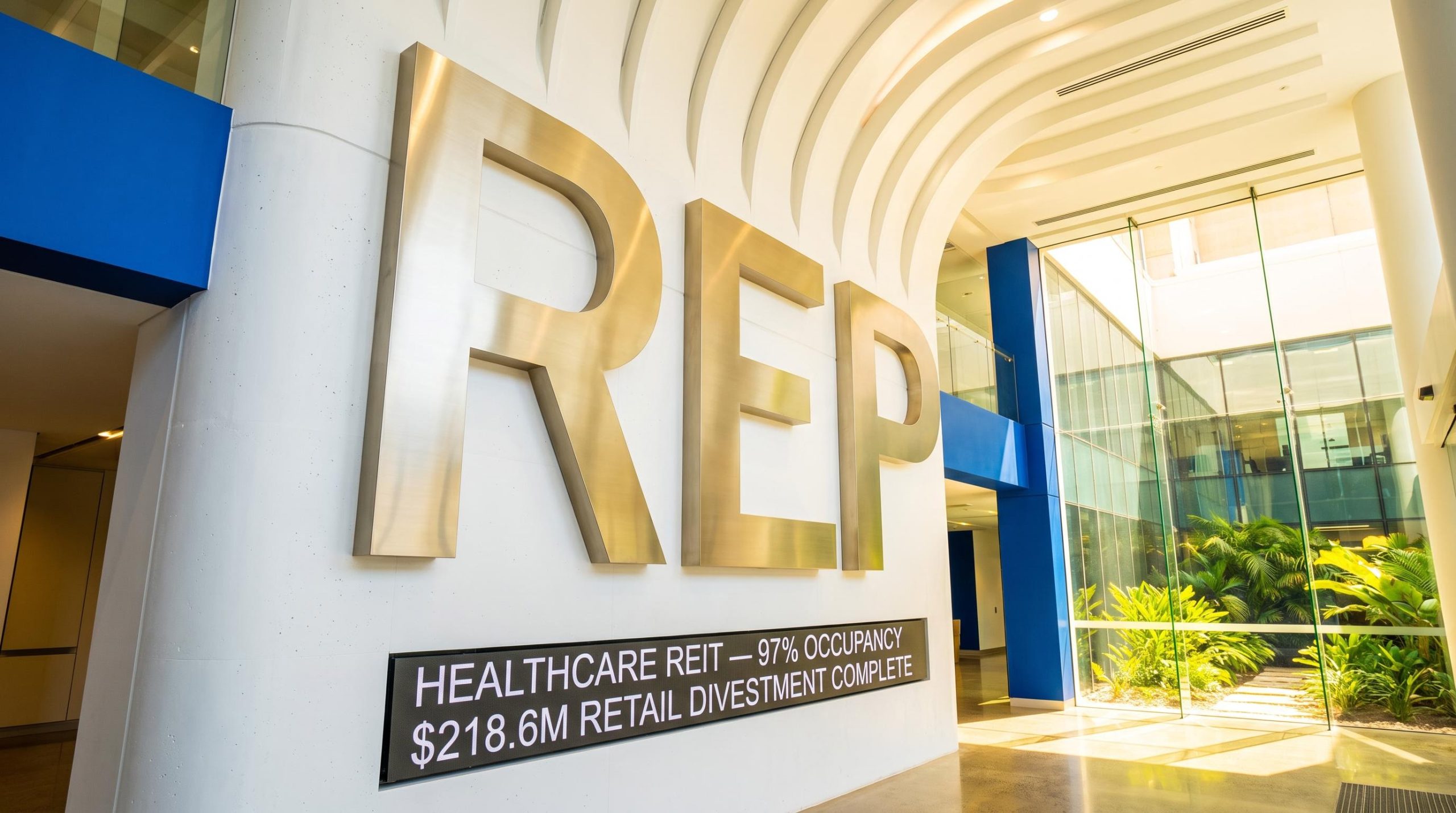
In its FY26 results presentation released on 26 August 2026, RAM Essential Services Property Fund confirmed it had delivered on its stated strategy to transition into a specialist healthcare REIT. Central to the update was the $218.6m divestment of five retail assets, now unconditional, which is set to reduce gearing from 43.5% to 16.8% post-transaction.
The Fund reported an FY26 distribution per security of 4.55cpu and net tangible assets (NTA) of $0.71/unit for the 12 months to 30 June 2026. Yet a clear tension underpins the update: solid portfolio fundamentals sit against a trading position at roughly a 40% discount to NTA.
When big ASX news breaks, our subscribers know first
FY26 full-year highlights
For the 12 months to 30 June 2026, the Fund reported outcomes across portfolio operations, financials, and capital management.
Portfolio operations
- Occupancy held at 97% by income.
- Positive leasing spreads of 4% across 21 deals (15 new and 6 renewals).
- Post-transaction WALE of 8.1 years, reflecting healthcare’s longer lease structures.
- Nil arrears across REP’s private hospitals.
- 84% of leases carry fixed or CPI-linked reviews.
Financials
- FY26 DPS of 4.55cpu and NTA of $0.71/unit.
- Weighted average capitalisation rate (WACR) softened from 6.09% to 6.20%.
- 96% of the portfolio was externally valued within the past three months.
Capital management
- Gearing reduced to 16.8% post-transaction.
- 61% hedged as at 30 June 2026.
The reset positions the Fund with greater balance-sheet flexibility and a longer, higher-quality income profile, weighted toward healthcare tenants on extended, inflation-linked leases.
Inside the $218.6m retail divestment
Management outlined the divestment of five retail assets, Coomera Square, Springfield Fair, Coles Rutherford, Keppel Bay Plaza and Mowbray Marketplace, to the newly established Forest Retail JV fund alongside a major institutional investor. REP retains a 10% interest in the fund.
The net realised value from the retail assets is $218.6m, with proceeds comprising cash and a 10% equity interest in the new fund. No acquisition or divestment fee was paid by REP, and settlement is scheduled for Q2 FY27.
The structure creates a discrete five-asset fund with a 5-year investment term and a minimum 2-year hold, offering REP a targeted distribution of 5.5%–6.0% per annum and continued exposure to retail income.
| Metric | Impact of Transaction |
|---|---|
| WALE | +1.3 years |
| Healthcare income | +21% |
| Tertiary Healthcare income | +17% |
| Tenant expiry post-FY2031 | +7% |
| CPI & Fixed escalators | +8% |
| Net lease structure | +3% |
Figures are based on gross passing income as at 30 June 2026.
What “unconditional contracts exchanged” means for investors
Unconditional contracts have been exchanged, with settlement due in Q2 FY27.
Why healthcare is the destination, a beginner’s guide to the REIT thesis
Management presented three structural tailwinds supporting the pivot toward healthcare property.
-
Ageing population. The 65-and-over cohort is projected to reach approximately 8 million people by 2051, reflecting a roughly 2% 30-year compound annual growth rate (CAGR).
-
Government-backed private hospital spending. Spending in private hospitals reached $23.04bn in 2023-24, with circa 37% government funded and a 3.4% 10-year CAGR.
-
Private health insurance. In 2024, 45.3% of Australians (circa 12.48 million people) held hospital treatment cover.
These dynamics matter because they underpin demand for the healthcare tenants the Fund is prioritising. Long lease structures, a high proportion of CPI-linked rent reviews, and predominantly triple-net leases combine to provide stable, inflation-hedged income.
Portfolio and financial performance for FY26
As at 30 June 2026, the Fund held 26 properties valued at $662.6m, with occupancy of 97% and a pre-transaction WALE of 6.8 years. The portfolio spanned 234 tenants, with 98% of income drawn from essential services and 84% exposed to annual escalations.
On valuations, 96% of the portfolio was externally valued in June 2026. The WACR increased 11 bps since December 2025 to 6.20%, with healthcare valuations reflecting recent comparable transaction evidence.
| Metric | FY26 | FY25 |
|---|---|---|
| Recurring Property NOI | $37.9m | $36.3m |
| Underlying FFO | $17.6m | $16.9m |
| Reported FFO | $14.7m | $24.5m |
| DPS | 4.55c | 5.00c |
| NTA | $0.71 | $0.81 |
Like-for-like property income grew 4.4%, while underlying funds from operations (FFO) rose 4.1% to $17.6m. The decline in Reported FFO to $14.7m primarily reflected the absence of prior-period income from disposed assets and non-recurring items recognised in FY26.
Balance sheet reset
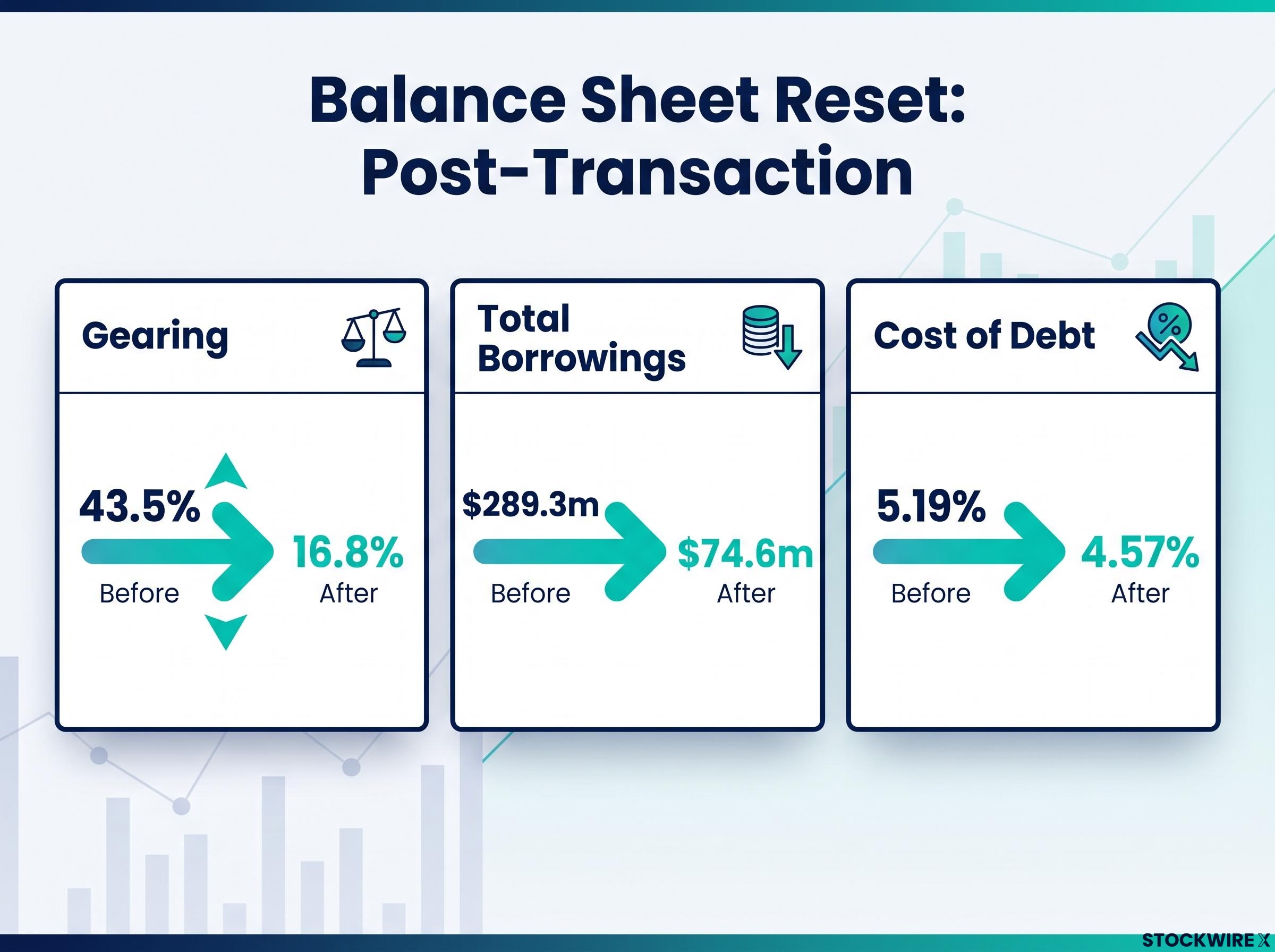
- Gearing falls from 43.5% to 16.8% post-transaction.
- Cost of debt is forecast to improve from 5.19% to 4.57% post-refinance.
- Total borrowings reduce from $289.3m to $74.6m.
- Preliminary lender support has been received to refinance the facility post-settlement.
FY2027 guidance and capital priorities
Management outlined the following guidance for FY27:
- Distribution per security of 3.6 – 3.8c.
- Forecast distribution yield of 8.5 – 9.0%, based on the $0.42 closing price on 21 August 2026.
- Forecast distribution approximately 90% tax deferred.
- Target FFO payout ratio of 90% – 100%.
The FY27 DPS guidance of 3.6 – 3.8c sits below the FY26 figure of 4.55cpu.
The capital allocation question
Management indicated it is weighing the best use of proceeds. Options canvassed include a potential buyback, though liquidity acts as a natural constraint, alongside debt reduction and acquisitions. While market conditions offer “compelling healthcare buying opportunities,” management noted that trading at a discount to NTA means acquisitions are “unlikely to be the best use of capital in the short term.”
The investment case, strengths against the headwinds
The results present a Fund that has executed its strategy, yet operates within a demanding market backdrop for small-cap REITs.
| Positives | Headwinds |
|---|---|
| Retail sale executed in line with strategy | ~40% discount to NTA |
| Gearing of 16.8% | ‘Higher for longer’ macro backdrop |
| High yield | Small-cap REITs under pressure |
| Improved portfolio WALE and quality | Limited access to opportunities |
| Opportunity to acquire well-priced healthcare assets | Low stock liquidity limiting buyback impact |
| Value-add opportunities in portfolio |
RAM Essential Services Property Fund
“RAM is currently considering all pathways for the fund to determine what would be in the best interests of unit holders.”
With the retail divestment now unconditional and gearing set to fall to 16.8%, the Fund’s strategic transition to a specialist healthcare REIT is complete. It now carries low gearing and a longer income profile weighted toward healthcare tenants, though the roughly 40% discount to NTA remains a challenge management has signalled as central to its capital allocation thinking.
Don’t Miss the Next Healthcare REIT Breakout
Get FREE breaking ASX healthcare and property news delivered to your inbox within minutes of release, complete with in-depth analysis. Over 20,000 subscribers already rely on Big News Blast to stay ahead of the market. Click the “Free Alerts” button to start receiving alerts the moment market-moving announcements drop.