
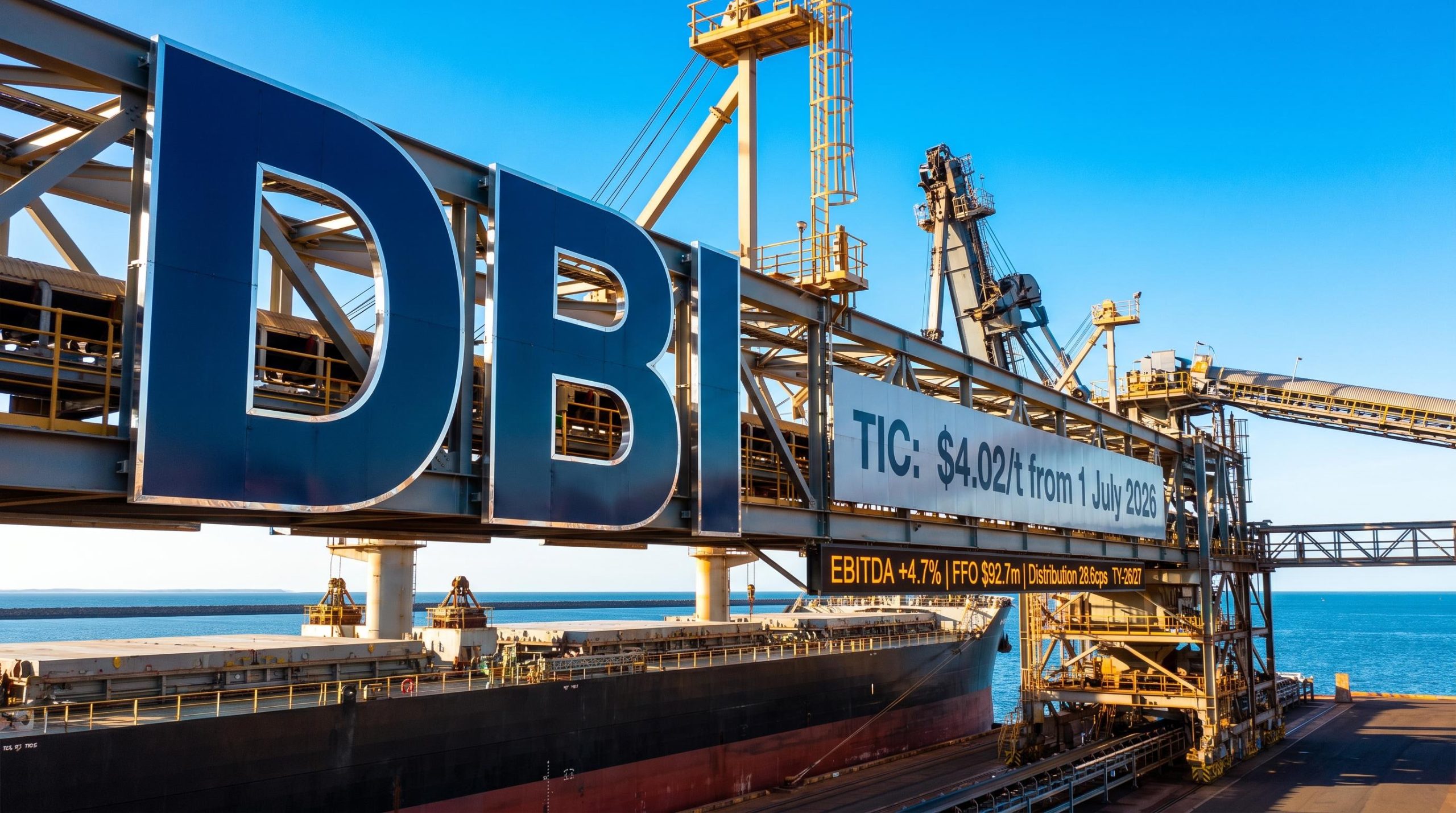
DBI delivers 4.7% EBITDA lift and boosts distribution guidance in H1-26 result
In its half-year investor presentation released 24 August 2026, Dalrymple Bay Infrastructure reported H1-26 EBITDA of $150.5m, up 4.7% on H1-25, alongside funds from operations (FFO) of $92.7m, up 10.2%. Distributions referable to the half were lifted to 13.5cps, an increase of 14.9%.
Management also detailed full-year TY-26/27 distribution guidance of 28.6cps, up 8.5% on the prior year. The presentation reinforced the company’s core investment angle: a low-risk, take-or-pay infrastructure model generating stable, growing cashflows.
Key figures from the H1-26 snapshot included:
- EBITDA: $150.5m (+4.7%)
- FFO: $92.7m (+10.2%)
- Distributions (H1-26): 13.5cps (+14.9%)
- $350m issued in the Australian Medium Term Note market
- Zero incidents causing serious injury or illness (excluding the independent terminal operator)
- $370.6m of capital projects still to be added to the NECAP Asset Base
When big ASX news breaks, our subscribers know first
A take-or-pay model built for stable, predictable revenue
DBI’s foundation asset is the Dalrymple Bay Terminal (DBT), described in the presentation as the world’s largest metallurgical coal export facility by contracted volume. The terminal’s capacity of 84.2Mt is fully contracted on a 100% take or pay basis, meaning DBI receives its charge on every contracted tonne regardless of tonnes actually shipped.
The customer base spans 10 customers across 20 mines, with 84% of revenue derived from predominantly metallurgical coal mines. The Terminal Infrastructure Charge (TIC), levied on every contracted tonne, rose to $4.02/t from 1 July 2026, up approximately 8.1% from the prior $3.72/t. The current pricing arrangement runs to 2031.
| TIC Component ($/t) | TY-23/24 | TY-24/25 | TY-25/26 | TY-26/27 |
|---|---|---|---|---|
| Base TIC | 3.32 | 3.44 | 3.52 | 3.66 |
| NECAP Charge | 0.12 | 0.16 | 0.20 | 0.35 |
| QCA Levy | 0.00 | (0.01) | (0.00) | 0.00 |
| TIC per contracted tonne | 3.44 | 3.59 | 3.72 | 4.02 |
What NECAP means for investors
Non-Expansion Capital Expenditure (NECAP) is the mechanism underpinning DBI’s organic growth. As the company invests in the terminal, that capital is added to the NECAP Asset Base, which then earns a regulated return set at the 10-year Australian Government Bond rate (reset annually) plus a margin, along with a return of capital via a depreciation allowance. This flows through as a higher NECAP charge component of the TIC.
During construction, interest during construction (IDC) accrues at an agreed rate until spend is added to the base, compensating DBI for its cost of debt funding. The mechanism is contractually underpinned and requires customer approval, allowing revenue to grow without expansion risk. Every additional $0.10/t of TIC delivers approximately $8.5m of incremental revenue per annum.
The presentation outlined the NECAP growth trajectory as follows:
- The NECAP Asset Base grew to $232.5m at July 2026, up from $139.5m in July 2025.
- $97.8m was added to the NECAP Asset Base on 1 July 2026, lifting the TIC by $0.15/t.
- $370.6m of projects remain to be added, with approximately $300m (plus IDC) expected on 1 July 2027.
- That addition is expected to lift the NECAP charge by a further approximately $0.53/t by 1 July 2027.
Major projects SL1A and RL4 near the finish line
The presentation detailed two flagship end-of-life asset replacements, both commenced in April 2023 and delivered under a Design-Bid-Build execution model. Both are anticipated to be added to the NECAP Asset Base from TY-27/28, which management expects to drive a step change in TIC.
-
SL1A (Shiploader 1 replacement): expected cost of $165.4m (excluding IDC), 90% complete. Construction and commissioning in Western Australia is complete, with the unit awaiting Heavy Lift Vessel transport (booked for September/October 2026) and handover to the Operator expected before year end.
-
RL4 (Reclaimer replacing Stacker Reclaimer SR2): expected cost of $115.6m (excluding IDC), 87% complete. Fabrication in Mackay is complete, with commissioning and handover expected in December 2026.
A new $38.5m regular NECAP program, Series Z, was unanimously approved by customers on 13 July 2026.
Financial performance and balance sheet strength
The H1-26 result showed growth across headline metrics. Statutory net profit after tax rose to $49.2m from $43.1m, while TIC revenue increased 3.6% to $156.5m. FFO reached $92.7m versus $84.1m, with the EBITDA margin holding steady at 95%.
| Metric | H1-26 | H1-25 |
|---|---|---|
| Total income | $433.3m | $395.4m |
| EBITDA | $150.5m | $143.8m |
| NPAT | $49.2m | $43.1m |
| FFO | $92.7m | $84.1m |
On the balance sheet, DBI retained an investment grade rating of BBB / Stable (S&P), a weighted average all-in interest rate of 7.0%, a debt tenor of 6.3 years, and liquidity of $261.4m. The company reported approximately $415m of debt headroom under the S&P gearing threshold for its BBB rating.
During the half, DBI issued $350m of 5-year fixed rate notes under a new Australian Medium Term Note programme, carrying a 6.234% coupon and maturing 24 March 2031, and repaid and cancelled the $250m Syndicated Term Facility. Net interest costs were held broadly flat despite increased debt funding of NECAP, which the company attributed to the December 2025 refinancing.
Growing, franked distributions underpin the investment case
The distribution policy targets a payout of 60-80% of FFO and distribution per security (DPS) growth of 3-7% per annum for the foreseeable future, subject to business developments and market conditions. Distributions continue to be franked to the maximum extent allowable.
For TY-26/27, guidance was set at 28.6cps, up 8.5% on the prior year, with quarterly guidance of 7.155cps. Management stated that multiple growth levers, including revenue initiatives, NECAP, 8X expansion optionality and external acquisition opportunities, support ongoing distribution growth.
The TY-26/27 distribution guidance of 28.6cps was first announced in May 2026, when DBI attributed the step-up to the 8.1% TIC increase and the entry of $97.8m in commissioned NECAP projects into the regulated asset base.
The company reaffirmed its commitment to growing long-term total returns for all securityholders, underpinned by its low-risk business model.
The distribution growth trajectory across recent TIC years was outlined as:
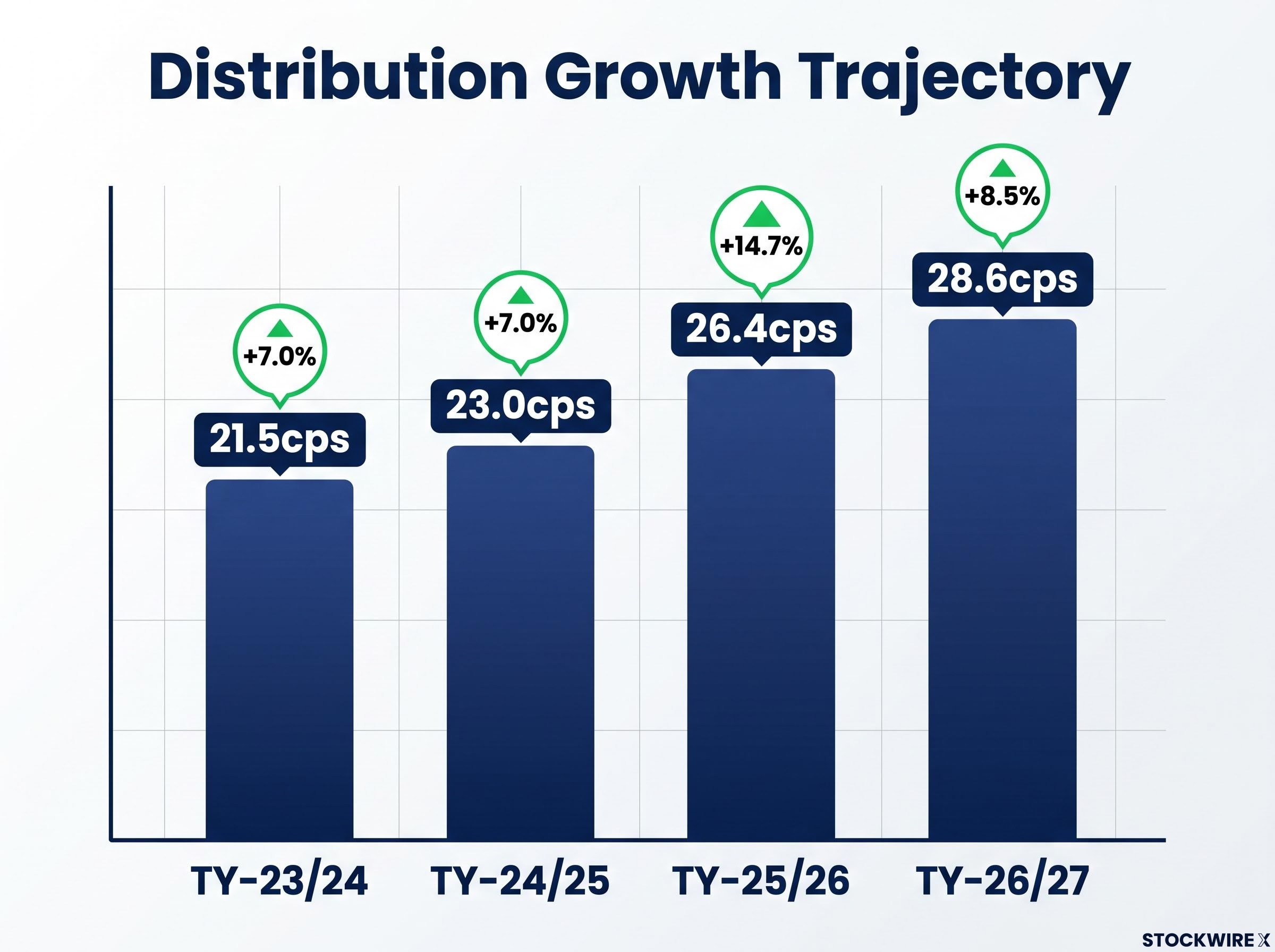
- TY-23/24: 21.5cps (+7.0%)
- TY-24/25: 23.0cps (+7.0%)
- TY-25/26: 26.4cps (+14.7%)
- TY-26/27: 28.6cps (+8.5%)
Strategic priorities and what comes next
Management outlined its strategic roadmap for FY-26, centred on delivering total securityholder returns. Priorities included delivering organic revenue growth through new revenue initiatives and the inclusion of completed NECAP projects in the NECAP Asset Base, and completing SL1A and RL4 on time and on budget.
The presentation also flagged progressing long-term Bowen Basin capacity opportunities, including optimisation of existing capacity and economic assessment of the 8X Project, an expansion option to a maximum of 99.1Mtpa that can be delivered in phases, subject to ongoing commercial negotiations and a final investment decision. Management further noted plans to assess refinancing opportunities to reduce long-term interest costs while maintaining an investment grade rating, and to explore diversification through acquisitions with a similar risk profile.
On governance and ESG, three new independent non-executive directors have been appointed since the Brookfield exit in September 2025 as part of a planned Board refresh, with female Board representation of 57%. DBI released its first AASB S2-compliant Sustainability Report in February 2026 and recorded zero incidents causing serious injury or illness in H1-26, with that metric covering DBI and its NECAP contractors but excluding the independent operator of DBT.
With SL1A and RL4 expected to be completed by mid-2027 and added to the NECAP Asset Base from TY-27/28, the anticipated step-change in TIC positions DBI to support continued distribution growth over the medium term.
Stay Ahead on ASX Infrastructure News
Get FREE breaking ASX announcements delivered to your inbox within minutes of release, complete with in-depth analysis already done. Join 20,000+ subscribers who never miss a market-moving update. Click the “Free Alerts” button at Big News Blast to start receiving alerts the moment news breaks.