

US$10M upfront payment lands in Dimerix’s balance sheet
Clinical-stage biopharmaceutical company Dimerix Limited (ASX: DXB) has received the US$10 million (~A$14.1 million) upfront cash payment from Everest Medicines under the previously announced commercial licensing agreement for its lead kidney disease therapy, DMX-200.
The funds represent cash-in-hand from a deal first announced on 16 June 2026, with the payment now triggered and settled as at 20 August 2026. Critically, this is non-dilutive funding, strengthening the balance sheet without issuing new shares.
Everest marks the fifth regional licensing partner secured for DMX-200, adding to an established network of commercialisation agreements. For investors, the arrival of the cash reinforces Dimerix’s funding position without diluting existing shareholders.
When big ASX news breaks, our subscribers know first
What the Everest agreement delivers
Under the agreement, Everest Medicines holds exclusive rights to develop and commercialise DMX-200 across all indications including Focal Segmental Glomerulosclerosis (FSGS). The licensed territories span Greater China (Mainland China, Hong Kong SAR, Macao SAR and Taiwan region), South Korea and certain Southeast Asian countries (Singapore, Malaysia, Thailand, Indonesia, Vietnam and Philippines).
Between 500,000 and 1,000,000 people are estimated to be living with FSGS across these territories, indicating a substantial addressable patient population.
Beyond the upfront payment, Dimerix is eligible to receive up to a further US$330 million (~A$467 million) in success-based development, regulatory and commercial milestone payments, alongside tiered royalties on net sales.
| Component | Amount (USD) | Amount (AUD) |
|---|---|---|
| Upfront payment (received) | US$10M | ~A$14.1M |
| Development & regulatory milestones | up to US$30M | ~A$42.4M |
| Commercial milestones | up to US$300M | ~A$424.4M |
| Royalties on net sales | 10%–15% tiered | — |
The layered payment structure, spanning upfront cash, staged milestones and ongoing royalties, helps de-risk Dimerix’s path to revenue by tying future income to defined development and commercial achievements.
A five-partner global licensing strategy
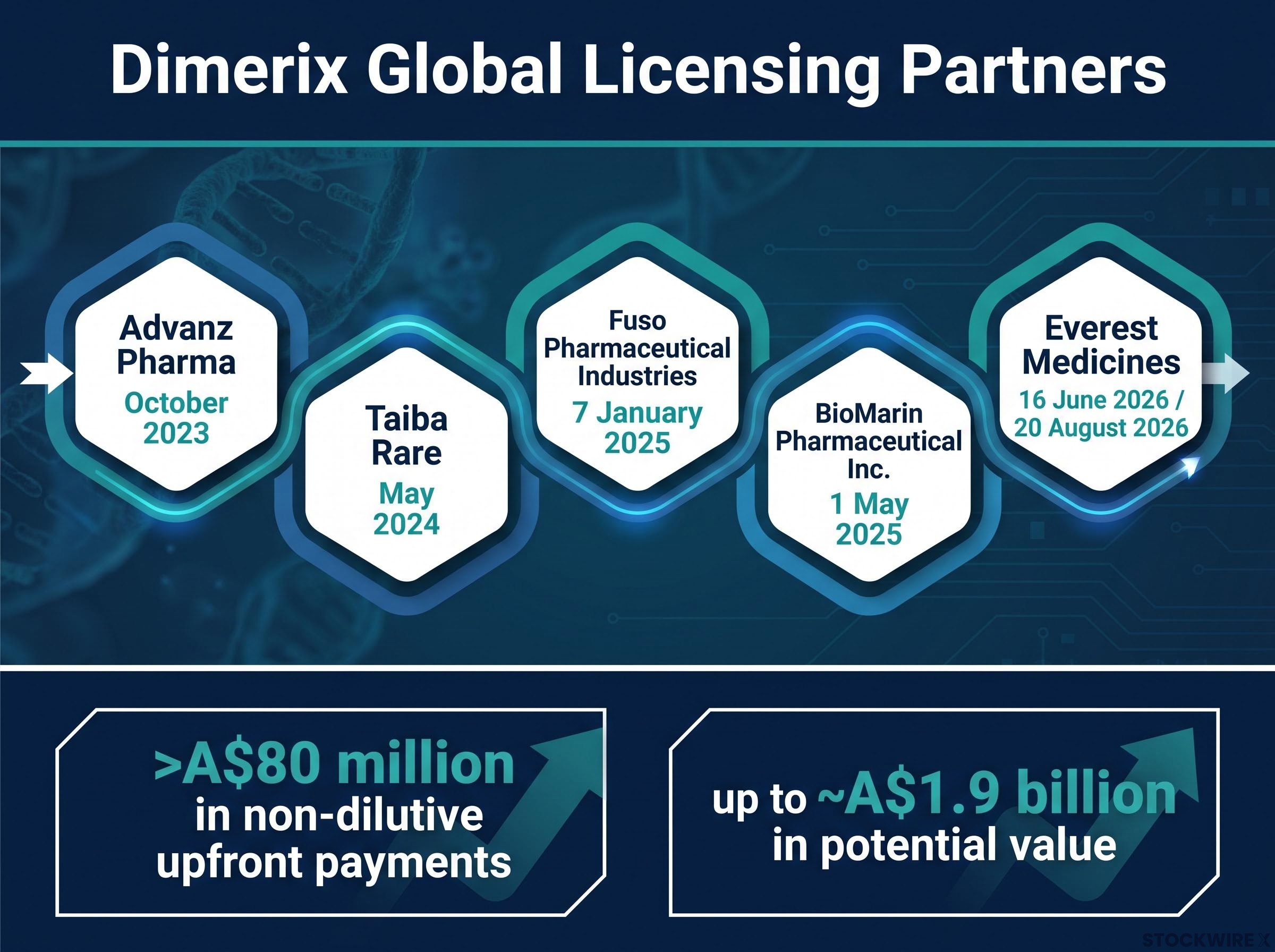
The Everest partnership completes a network of five high-quality regional partners across key pharmaceutical markets. Rather than relying on a single agreement, Dimerix has pursued a geographically diversified commercialisation strategy for DMX-200.
The five regional licensing agreements to date are:
-
Advanz Pharma (announced October 2023)
-
Taiba Rare (announced May 2024)
-
Fuso Pharmaceutical Industries (announced 7 January 2025)
-
BioMarin Pharmaceutical Inc. (announced 1 May 2025)
-
Everest Medicines (announced 16 June 2026; payment received 20 August 2026)
Collectively across these five deals, Dimerix has now received more than A$80 million in non-dilutive upfront licensing payments. The agreements provide the potential to generate up to ~A$1.9 billion in upfront and potential milestone payments, in addition to future royalty income on net sales.
Importantly, Dimerix retains all rights to DMX-200 in territories not currently licensed and continues to progress licensing discussions with potential partners across those unpartnered regions. For investors, this structure delivers diversified, geographically spread revenue potential while preserving upside from regions yet to be partnered.
Understanding FSGS and DMX-200
Focal Segmental Glomerulosclerosis (FSGS) is a rare, serious kidney disorder characterised by progressive scarring in parts of the glomeruli, the kidney’s filtering units. This scarring leads to proteinuria (protein leaking into the urine), progressive loss of kidney function, and often end-stage renal disease.
The unmet need is significant. There are no therapies specifically approved for FSGS in the U.S., and in progressive or treatment-resistant cases, the average time from diagnosis to end-stage kidney disease can be as short as five years. Even among patients who undergo kidney transplantation, disease recurrence occurs in up to 60% of cases.
DMX-200 is a chemokine receptor (CCR2) antagonist, a treatment designed to block a specific inflammatory pathway. It is administered to patients already receiving an angiotensin II type I receptor (AT1R) blocker, the standard of care for hypertension and kidney disease.
The therapy is protected by granted patents until 2032, with applications submitted globally that may extend protection to 2042. It has also been granted Orphan Drug Designation in the United States, Europe, UK and Japan. This combination of large unmet need, patent protection and orphan status underpins the commercial value of the regional licences.
ACTION3 Phase 3 trial progress and funding runway
The Everest payment connects directly to Dimerix’s clinical development milestones, according to management.
Dr Nina Webster, CEO & Managing Director
“Everest is a highly regarded partner with deep expertise in rare kidney diseases, and we look forward to continuing our collaboration as we advance the ACTION3 Phase 3 study.
Pleasingly, receipt of the US$10 million upfront payment also further strengthens Dimerix’s balance sheet. Combined with existing cash reserves and the recently announced A$10 million facility, the Company is funded through major inflections points including completion of the ACTION3 Phase 3 trial for DMX-200 as well as initiation of the Phase 2 clinical trial for DMX-652.”
Key progress points from the ACTION3 Phase 3 study include:
-
The adult cohort is fully recruited, with 333 patients randomised and dosed globally.
-
Recruitment was completed across 219 sites in 21 countries, including the United States, Europe, Japan, China, Australia and New Zealand.
-
The final adult patient commenced treatment in March 2026, transitioning the study from recruitment into treatment and follow-up.
-
The final adult patient is expected to complete dosing in March 2028.
-
Recruitment of paediatric patients aged 12–17 continues as an independent cohort within the ACTION3 programme.
On funding, the US$10 million payment combined with existing cash reserves and the recently announced A$10 million facility is stated to fund the Company through these inflection points. Alongside DMX-200, Dimerix is advancing DMX-652, a Phase 2 programme in acute kidney injury (AKI), broadening its renal pipeline.
The AU$10 million facility, secured from related party SKIPTAN Pty Ltd in July 2026, is drawable at Dimerix’s discretion until 31 December 2026 and structured so that interest accrues only on amounts actually drawn, with repayment linked to milestone receipts rather than a fixed schedule.
What comes next for Dimerix
Dimerix continues to pursue additional licensing opportunities in territories that remain unpartnered as it advances DMX-200 toward potential global registration and commercialisation.
The Company now carries a two-programme pipeline: DMX-200 in Phase 3 development for FSGS, and DMX-652 in Phase 2 for acute kidney injury. With the Everest payment received and multiple regional partners secured, Dimerix moves toward its key clinical readouts with a strengthened, non-dilutive funding base.
The DMX-652 acquisition, completed on 17 July 2026, brought a Phase 2-ready acute kidney injury candidate with an open US IND and FDA-approved trial protocol into the Dimerix pipeline, targeting a US$3.5 billion market with no currently approved therapies and no known clinical-stage competitors.
Don’t Miss the Next ASX Healthcare Breakthrough
Big News Blast delivers FREE breaking ASX healthcare news and in-depth analysis directly to your inbox within minutes of release. Join 20,000+ investors already staying ahead of market-moving announcements. Click the “Free Alerts” button at StockWire X to start receiving alerts the moment news breaks.